
Beware of false GOP rebranding efforts
When Bobby Jindal says Republicans must change their ways, he doesn't mean change their policies or anything
By Alex PareeneTopics: Republican Party, Bobby Jindal, 2012 Elections, Politics News
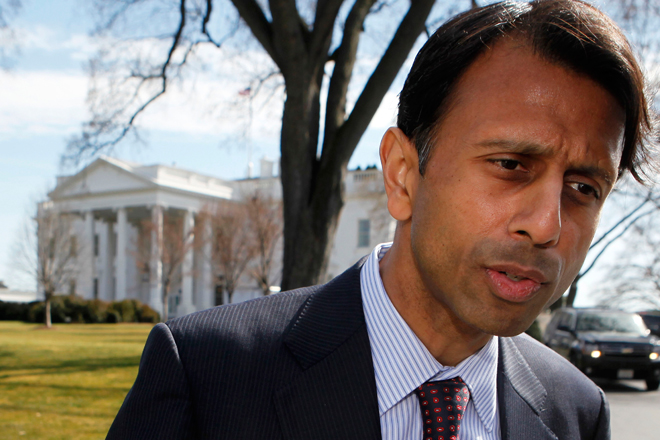
Conservatives with an eye on the future are rolling out their post-election loss “we must remake the party to save it” pitches. In Politico, Louisiana governor and perennial fantasy presidential candidate Bobby Jindal weighs in, getting some positive press for saying, “We’ve got to make sure that we are not the party of big business, big banks, big Wall Street bailouts, big corporate loopholes, big anything.” One would think some major policy changes would be required to make the Republican Party cease being the party of big business. One would be wrong.
There are two separate conservative narratives emerging since Obama’s shocking-to-them reelection. Everyone in one camp is basically saying, don’t overreact to this loss, because a couple thousand extra white votes in Ohio would’ve won it. The other camp is basically competing to win Andrew Sullivan “Yglesias Awards.” (Congrats, Erick and Gov. Jindal! And Bill Kristol, too!) They are sounding, suddenly, very reasonable. They are recognizing the flaws of their side and demanding changes. Just not actually any significant changes.
When you hear Republicans and conservatives soberly intone that Big Changes Will Have to Be Made if they want to Remain Competitive, listen closely for any actual suggested Big Changes. Go through the Politico story on its Jindal interview and you’ll see that he is actually not saying anything at all. Jindal is clearly pursuing the same agenda as he was before the election. His point is that this agenda should be branded slightly differently.
This is his prescription: The Republican Party should stop saying stupid things.
“It’s not going to be the last time anyone says something stupid within our party, but it can’t be tolerated within our party. We’ve also had enough of this dumbed-down conservatism. We need to stop being simplistic, we need to trust the intelligence of the American people and we need to stop insulting the intelligence of the voters.”
The “something stupid” he refers to is all those weird comments on rape, which kept being said because all of these candidates were trying to explain their (mainstream Republican) positions on abortion. Bobby Jindal is not saying “let’s moderate our position on abortion,” he is saying “let’s not talk about it so explicitly.” (“On cultural issues, he suggested the party not retreat from its stances opposing abortion rights and gay marriage but rather soften its tone on such matters.” Just talk about opposing gay marriage more politely!)
Jindal is playing a very old game: repeatedly and loudly professing to have “Big Ideas” — Jindal says the GOP must be “the party of ideas, details and intelligent solutions” — and decrying “bumper sticker politics” while pushing the exact same agenda as everyone else in your party. It’s a close relative of Paul Ryan’s “I’m a wonk” game, and both work because the political press is more comfortable with branding than policy.
So, Gov. Jindal, if your goal is to make sure people don’t see the GOP as the party of the rich, shouldn’t the Republican Party maybe back off on its pledge to never raise taxes on rich people? Eh, not so much.
Jindal said he didn’t want to see tax rate increases but called for broad tax reform to rid the code of loopholes and make it fairer for more Americans.
That’s Romney’s (vague) platform.
“Depending on the other reforms that are made, certainly I’d be open to the idea of having more deductions, credits available to lower-income [filers],” he said.
That’s … adding more “loopholes,” just ones targeted at poor instead of middle-class people.
The only actual slightly unconservative policy Jindal endorses is some form of the Volcker Rule. On everything else his message is stay the course while pretending to be headed on a very different, better course.
This isn’t really shocking: The Republican Party is stuck with the leadership it has. The movement conservatives long ago took over, and it would be very odd if they all stopped being movement conservatives. In 1996, after the Republicans failed to unseat a president they hated, they blamed their too-moderate candidate and then slapped the label “compassionate” on their existing beliefs. They will likely do something very similar this time.
It would just be nice if the press pointed out that almost none of their longtime policy proposals are likely to change, because they haven’t really changed any of the big ones in a quarter-century.
Alex Pareene writes about politics for Salon and is the author of "The Rude Guide to Mitt." Email him at apareene@salon.com and follow him on Twitter @pareene More Alex Pareene.
Related Stories
-
We'd all be packing heat if the NRA had its way
-
Dumb tweet of the day: "Obama's gestapo EPA"
-
Louie Gohmert: Assault weapons could also mean hammers
-
Why is Google chief Eric Schmidt visiting North Korea?
-
Former NRA president compares banning guns to racism
-
Lesson of the failed Boehner coup: We're dealing with idiots
-
How conservatives ineptly plotted to oust John Boehner
-
House approves $9.7 billion in Sandy flood aid
-
Ann Coulter's astounding gun control diatribe
-
Idaho senator pleads guilty to DWI charge in Va.
-
Barney Frank says he wants Senate appointment
-
Today's jobs report is a mixed bag
-
Carding for Sudafed can't solve America's meth problem
-
California court: Victim wasn't married, rape conviction reversed
-
Venezuela teetering on the edge over Chavez's health
-
It's time to focus on jobs
-
Illinois gay marriage supporters look to next session
-
FEMA: Flood money will run out without Congressional action
-
The new conservative purity test
-
Taliban shooting victim Malala Yousufzai leaves UK hospital
-
Congress: Worst reality TV show ever
Featured Slide Shows
What To Read Awards: Top 10 Books of 2012 slide show
close X- Share on Twitter
- Share on Facebook
- Thumbnails
- Fullscreen
- 1 of 10
- Previous
- Next
-
10. "The Guardians" by Sarah Manguso: "Though Sarah Manguso’s 'The Guardians' is specifically about losing a dear friend to suicide, she pries open her intelligent heart to describe our strange, sad modern lives. I think about the small resonating moments of Manguso’s narrative every day." -- M. Rebekah Otto, The Rumpus
-
9. "Beautiful Ruins" by Jess Walter: "'Beautiful Ruins' leads my list because it's set on the coast of Italy in 1962 and Richard Burton makes an entirely convincing cameo appearance. What more could you want?" -- Maureen Corrigan, NPR's "Fresh Air"
-
8. "Arcadia" by Lauren Groff: "'Arcadia' captures our painful nostalgia for an idyllic past we never really had." -- Ron Charles, Washington Post
-
7. "Gone Girl" by Gillian Flynn: "When a young wife disappears on the morning of her fifth wedding anniversary, her husband becomes the automatic suspect in this compulsively readable thriller, which is as rich with sardonic humor and social satire as it is unexpected plot twists." -- Marjorie Kehe, Christian Science Monitor
-
6. "How Should a Person Be" by Sheila Heti: "There was a reason this book was so talked about, and it’s because Heti has tapped into something great." -- Jason Diamond, Vol. 1 Brooklyn
-
4. TIE "NW" by Zadie Smith and "Far From the Tree" by Andrew Solomon: "Zadie Smith’s 'NW' is going to enter the canon for the sheer audacity of the book’s project." -- Roxane Gay, New York Times "'Far From the Tree' by Andrew Solomon is, to my mind, a life-changing book, one that's capable of overturning long-standing ideas of identity, family and love." -- Laura Miller, Salon
-
3. "Billy Lynn's Long Halftime Walk" by Ben Fountain: "'Billy Lynn's Long Halftime Walk' says a lot about where we are today," says Marjorie Kehe of the Christian Science Monitor. "Pretty much the whole point of that novel," adds Time's Lev Grossman.
-
2. "Bring Up the Bodies" by Hilary Mantel: "Even more accomplished than the preceding novel in this sequence, 'Wolf Hall,' Mantel's new installment in the fictionalized life of Thomas Cromwell -- master secretary and chief fixer to Henry VIII -- is a high-wire act, a feat of novelistic derring-do." -- Laura Miller, Salon
-
1. "Behind the Beautiful Forevers" by Katherine Boo: "Like the most remarkable literary nonfiction, it reads with the bite of a novel and opens up a corner of the world that most of us know absolutely nothing about. It stuck with me all year." -- Eric Banks, president of the National Book Critics Circle
-
Recent Slide Shows
-
What To Read Awards: Top 10 Books of 2012 slide show
-
Blue Glow TV Awards: Top 10 Shows of the Year
-
The Week in Pictures
-
The Week in Pictures
-
- Share on Twitter
- Share on Facebook
- Thumbnails
- Fullscreen
- 1 of 10
- Previous
- Next
-
The Week in Pictures
-
The Week in Pictures
-
Meet this season's 10 TV scene-stealers and scene-killers
-
The Week in Pictures
-
Great graphic novels from 2012
-
The Week in Pictures
-
Gladwell, Franco, Patti Smith: These books changed me
-
Was I right? Six new TV series reassessed
-
Salon's Sexiest Men of 2012
-
Cinema's 11 most memorable LGBT villains
-
The Week in Pictures
-
The Week in Pictures
-
Sandy, the day after
-
Transit in trauma
-
Sandy's shocking aftermath
-
The best storms in cinematic history
-
Chris Christie reports in casual-wear
-
Lou Reed's been terrible for years!
-
The Week in Pictures
-
Susan Isaacs loves a rogue: Here are her nine favorites
-
The Week in Pictures


Comments
23 Comments