
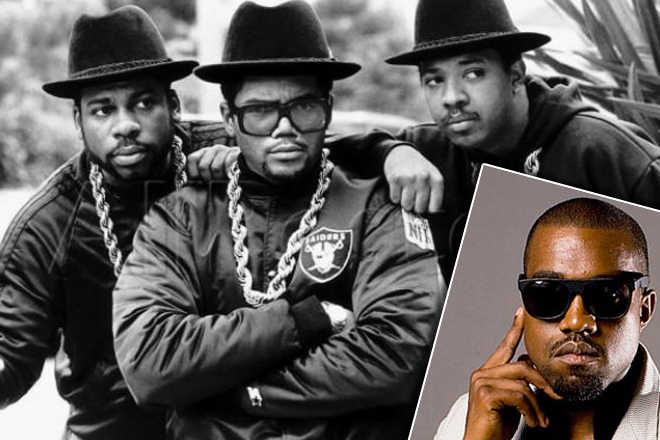

Eminem once rapped “My first year in 9th grade, can’t forget that day at school/ it was cool till your man MC Shan came through/ And said that Puma’s the brand ’cause the Klan makes Troops.” He isn’t the only one who bought a pair of shoes because a rapper said it was cool. Years before, in 1986, Adidas become popular thanks to Run-DMC’s hit “My Adidas,” which was probably the first time rap music become an (accidental) commercial vehicle for a product. Nearly 20 years later, not as many rappers are spittin’ about shoes as they’re talking about more opulent things. Like the Maybach Benz. Even someone who isn’t familiar with rap has probably heard of the car, one of the most ubiquitous status symbols in rap. And because it is also the most expensive, it’s become a commercial failure that will be discontinued in 2013, after a 16-year run on the market.
Rap as a commercial vehicle might seem like a far cry from its origins. The genre began in a more political form, with groups like Public Enemy and N.W.A. attempting social change through art. But the attempts to change a social landscape were aspirational attempts, and as rap grew, it became more personally aspirational. The aspirations to own nicer things, to pull oneself out of the ghetto, became omnipresent. Then something happened: Many of those rappers remained rappers, but they got the money and fame they sought. So, what happens next? Well, among other things, a car company decides to market a car targeted to the hip-hop community.
At first glance, Adidas and the Maybach Benz don’t seem to have much in common. After all, Daimler AG automotive corporation’s luxury car — revived in 1997, 57 years after it ceased production — costs more than most Americans’ homes (the car’s starting price tag is $344,000), while Adidas is a fairly omnipresent brand. Most people have at least seen a pair of Sambas. The Maybach, on the other hand, is mostly viewed in rap videos. At one point, though, both of these brands symbolized the pinnacle of success and status in rap music.
Status symbols work in rap the way they do in any capital venture: The most successful tout having or even wanting something, and the less successful aspire to have it. Hence why in 1986, that symbol became Adidas, which is “downright quaint” in its “earnest declarations of the great things that can be accomplished in the sneakers,” in comparison to today’s luxury brand lust, according to which Stonehill professor of culture Jared Green.
Unlike Adidas, though, the car was created to be a status symbol in rap music. The car was introduced “to manufacture the sort of event that happened when Diddy became the first in the U.S. to purchase the 1999 Bentley Azure,” Green said. “Other hip-hop stars soon followed suit and accounted for 15 percent of the [Bentley Azure’s] sales, making ultra-luxury car manufacturers realize that rappers could drive the high-end market.”
The Maybach Benz was created with the intent of being marketed through rap music, something you got once you made it. And nothing encapsulates the evolution of rap’s aspirational quality quite like the (re)birth and death of the Maybach Benz. That death isn’t only literal. Its time as a status symbol is coming to a close, as rap titans move onto a different type of capital.
Let’s take a look back at last year’s gargantuan collaboration between Kanye West and Jay-Z, “Watch the Throne.” The video for “Otis” from that collaboration opens with a slow zoom into a stunning Maybach Benz sitting in an alleyway. From behind the camera slowly walk Kanye and Jay-Z. Before seeing them, the viewer sees what they hold: a chain saw and a blowtorch. They are going to destroy the car that Kanye, who seems too intent on the job to acknowledge the camera, once so badly desired. Remember, about eight years and five or seven albums (depending on how collaborations count) ago, Kanye’s debut “College Dropout” included “Spaceship,” which found him bragging about how hard he worked: “Lock yourself in a room doin’ five beat a day for three summers … I deserves to do these numbers / The kid that made that / Deserves that Maybach.” That car was the very picture of success to a young Kanye and many other rappers.
For example, in 2007, Lil’ Wayne mentioned his “long body Maybach” on Ja Rule’s “Uh Oh.” Jay-Z has mentioned his in “Change Clothes,” “What More Can I Say,” the Game on “Westside Story” and “Documentary” — all commercially successful rappers making the car an even bigger status symbol. So much so Rick Ross even has four songs named after it: “Maybach Music,” “Maybach Music 2,” “Maybach Music 3” and, you guessed it, “Maybach Music 4” Then he went ahead and just named his Warner Bros.-distributed record label Maybach Music Group after the car.
Yet Kanye and Jay-Z destroyed one, about which Green said, “The footage of the car being gleefully destroyed by the very stars meant to establish the car’s brand envy surely must look like a dismal sort of irony to Daimler at this point.” And he’s right. The Maybach Benz was set to sell about 1,000 a year. It sold, on average, around 200 a year, according to Automotive News.
So, why is the car a commercial failure, if it’s also one of the most blatant status symbols in rap music? Simple: Who, aside from a rap star, can afford it? Rap is an aspiration genre, and while commercial items have always (or at least, in popular culture, since 1986) been something to aspire to, over time that grew from cheaper, everyday items that showed a possible step out of poverty, like Adidas, to items that were even out of reach, or at least too decadent for the 1 percent — i.e, the Maybach. In T.I’s 2008 hit “Life Your Life,” he raps to his peers, “Seems as though you lost sight of what’s important/ When depositing them checks into your bank account/ And you up out of poverty.”
Mark Anthony Neal, Duke black popular culture professor, editor of New Black Man and author of “What the Music Said: Black Popular Music and Black Public Culture” and other books on hip-hop, said status outside the traditional realm of hip-hop came into play with the rise and marketing of the Maybach. It was a move for rappers to become businessmen and not simply entertainers. It was a foray into the “traditional” business world.
Though it failed, the idea behind the Maybach was that rappers would market them — exclusively. The plan’s failings seem obvious: The only people who can afford the damn things are the people rapping about them (who presumably weren’t paying full sticker). But one can see why Daimler thought it was a good idea. Rap is flooded with brand names. Just look at rappers’ pseudonyms nowadays: Gucci Mane, taking his pseudonym straight from the actual product; Rick Ross, named after the incredibly financially successful crack dealer from the mid-1990s, probably the most famous American drug dealer in existence; hot young rapper Curren$y doesn’t really leave much to the imagination as to what he’s all about.
It works because rap’s also aspirational for the listeners. Eminem said it best in his song “Sing for the Moment”: “That’s why we sing for these kids who don’t have a thing/ Except for a dream and a fuckin’ rap magazine/ Who post pin-up pictures on they wall all day long / Idolize they favorite rappers and know all they songs/ Or for anyone who ever feels like shit in they lives/ ‘til they sit and they cry at night wishin’ they’d die/ ‘til they throw on a rap record and they sit and they vibe.”
Sue Weinstein, author of “Feel These Words: Writing in the Lives of Urban Youth,” which focuses on poetry among black youth, agrees rap has always had an aspirational component often embodied by commercial products, which acts as an escape for everyone who didn’t have those things. “One thing people look for in popular entertainment is escape from the realities of their lives. Remember that movies became hugely popular during the Depression partly for that reason.”
“It points to what people want to be,” Weinstein said, so when rappers like Kanye and Jay-Z became “ridiculously rich” superstars, “Their status symbols are only going to become more and more esoteric and exotic.”
There’s a weird dovetail happening, though. As rappers are becoming richer and older, they move toward a different sort of wealth: the kind that comes with being a business, and not just a rapper. The Maybach marketing plan backfired, because it made rappers more than folks aspiring to own things. Rappers became the sales tool. They became businesses. But they had no one to sell such an expensive car to.
“They’re trying to make grown men moves within the context of the business world, and at some point I think they realized they needed to have consumer taste in line with consumer taste of people they’d consider their peers,” Neal said. He continued to point out that Bill Gates wouldn’t be riding around on 22s, but he might own an ultra-luxury car like a Rolls-Royce, a Bentley or rap’s very own luxury car: the Maybach Benz.
Another prime example is how Kanye drops former CIA director George Tenet’s name in his song “Clique,” by G.O.O.D. Music, which came out in September (alongside a Maybach mention, showing this confusing and counterintuitive dovetail): “I’m talkin’ George Tenet, I seen him the other day/ He asked me about my Maybach, think he had the same/ Except mine tinted and his probably rented.”
And why is his rented? Because he’s white, and he aspires to be a businessman. The second half of that line: “You know white people get money, don’t spend it/ or maybe they/ get money, buy a business,” Kanye says. And Jay-Z’s proud of his foray into business. See his famous line from “Diamonds From Sierra Leone (Remix),” “I’m not a businessman. I’m a business, man.”
He is. He’s not aspiring to own things. He’s aspiring to sell them. It takes money to make money, and it’s the obvious next step to show a different kind of wealth. As New York Times writer Jon Caramanica wrote about “Watch the Throne,” “The signifiers aren’t jewelry and cars … but high fashion and high art.” The album is filled with references to, well, yes, Maybachs and such, but also Jean-Michel Basquiat paintings, Andy Warhol prints and Maison Martin Margelia jackets. And they’re not the only ones. Remember Drake’s “Lust for Life,” on which he plans to “show up in a Margiela tux.” And Rick Ross compares himself to Basquiat on “John.”
It’s a move toward art and high fashion: items that appreciate in value over time. Neal said Jay-Z probably realizes the moment one drives a car off the lot, it decreases in value, while art often does the opposite. Art and fashion might appeal to more mature tastes, but they also represent wealth in a different way. On “Not Going Back,” Nas reflects on his young success: “In reality, I’ll earn my salary/ The way I flaunted it then would now embarrass me/ It kinda makes me want to hate bling/ It’s a race thing/ How they sell blacks to bootleg shit, in fact/ Real millionaires spend 60 million on paintings.”
That was in 2006, and Nas was already suggesting that “real” wealth or “white” wealth — the wealth of old Bill Gates, who wouldn’t be caught dead on 22s, remember — is found in art, things that appreciate in value.
Many of the rappers who have sustained their popularity through the years are getting older, further along in the maturation process. Jay-Z is married and has a baby daughter, and Kanye West is … well, older at least. As anyone ages, he or she tends to mature. Jay-Z was involved in the presidential campaign. Kanye has made political statements. At the very least, most see the world in a different light when older, and, especially during a recession-born economy, wealth can seem less fluid than it once did.
And why just collect art when you can make it? The aforementioned “Otis” Maybach, which can be argued to be destroyed or be art, was auctioned off. It may have only pulled back $60,000 in an auction (the money going to Save the Children Foundation), but Neal said think of how it’ll be seen 10 years from now: The “destroyed” car could remain a work of art. Music and art have always gone hand in hand, so it makes sense for the two to become one in the same. Who needs a Lou Reed and an Andy Warhol when you can be Reed and Warhol, in the same person?
Status symbols have been part of rap’s aspirational nature from the beginning, and the titans are still speaking about some of the staples. But the movement toward art and fashion — more timeless status symbols — might have begun, and the Maybach’s discontinuation could do nothing more than catalyze that movement. The movement toward rap being businessmen. The movement to a place where Jay-Z lives alongside Barack Obama, and Kanye West lives alongside George Tenet.
After all, hip-hop’s not dead; the Maybach Benz is.
