
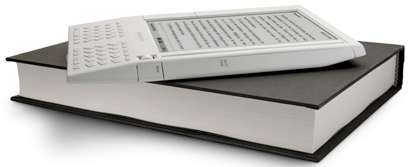

 I bought a Kindle, which means I’m the devil.
I’m the devil because Kindle is part of the vast network of Amazon, whose goal is pretty much to destroy everything I hold dear in my brick-and-mortar culture. And they employ a morally reprehensible scheme to do so. They charge less than what a book actually costs them, taking a small loss on each sale, with the hope of driving every other book retailer out of business. Kind of like gas wars from fifty years ago, when two competing gas stations lowered their prices beyond profitability to beat the guy next door, but in this situation Amazon’s the only company that can afford to lose money. Their job, as they seem to see it, is to keep dumping cash into themselves until they become the go-to place for not just books, but everything. “Don’t waste your time going to your local store. Buy it from Amazon for less and you’ll never have to leave home.” This drives many independent bookstores—which rely on profits to stay afloat—out of business, taking with them the entire culture of book buying I value (selling back used books, seeing my money go into the local economy, dealing with a bookseller, author readings, creaky floors, participating in a community as opposed to mouse-clicking, etc.)
But resistance is futile, right? Has a more imposing windmill than Amazon ever been chased? In less than twenty years, the online monolith has established itself as the unalterable king of the book-buying world. And isn’t every company pretty much out to destroy its competition?
Yes, yes and yes, but I’m notoriously hard-headed about these things. I get it in my transom that some company is too powerful, and I get this sour feeling in my stomach, which makes it all but impossible for me to support them. It started when I was eighteen and decided I’d never eat at McDonald’s again, claiming they were too big, too greedy. This was hard to explain to my friends, who liked cheap food, but they humored me and we ate at Burger King instead. My favorite offending company in the nineties was Starbucks, which transformed my world into one giant corporate coffee shop in what felt like minutes. Amazon seems to be my online equivalent of Starbucks, another bare-knuckles Seattle company going out of its way to crush the little guy at every instance.
I feel this way, and yet I buy a Kindle. Let me explain.
Despite being a loyal book-book reader, I bought an e-reader because I’m a self-published novelist, and I need to be able to check how my e-books look on an actual e-reading device. Also as a self-publisher, I sold more e-books than book-books in 2011, which was a first, and I want to understand why this is happening. Is it just the cheaper price, or are people finding e-readers an equivalent—or more fulfilling—way to read a book? Finally, I sometimes get free pdfs of books, and I need an e-reading device to read them. These factors, combined with a general curiosity of what the publishing world is going through, made me take the plunge.
But there are myriad other e-reader devices. Why buy Amazon’s Kindle? Because the Kindle is the industry standard. In 2011, Amazon accounted for 61 percent of U.S. ebook purchases, according to R.R. Bowker. It wouldn’t make sense to buy some e-book device that most people aren’t using and tailoring my e-books to them. I want my customers to find my product comparable to those released by traditional publishing companies. If I’m checking my work on a Nook, I’ll never know how it looks to most of my buyers.
And truth be told, there’s something about this devil that beguiles me. Despite their predatory retail model, Amazon challenges the publishing industry in ways I find interesting. They’re the only entity big enough to go up against New York publishing and win. They have successfully pushed for change in many industry practices—e-book pricing, for example—and they have enough market share to seriously give traditional publishing fits if they want.
Because yep, you guessed it, I have a grudge against traditional publishing too. Another monster in need of taming, albeit an entirely different kind of taming. Too tame, might be the better way to put it.
Traditional publishing has published ninety percent of the books I’ve valued over the years, books that changed my life and made me want to be a writer. But the last decade or so has seen them get undeniably safe with the books they choose to publish and promote. I would even go so far as to say much of the valuable literary talent in the country today isn’t being published by New York publishing but by independent presses. Why would the entities that brought us Updike and Morrison and Bellow so willingly give up the mantle of publishing the best? Are they counting on past glories to convince us that whatever they release is quality? How long will that dog hunt?
Is Amazon the lessor of these two evils? Hard to say. They’re both pretty evil in that they’re both owned by huge conglomerates, and both wish to make you a mindless crack monkey for their products and no one else’s. The rest of us out here in the Wild West of self-publishing don’t stand a chance against the monoliths on the East Coast, so it’s nice to see someone do some damage to them, even if it is Amazon. Hopefully, it will lead to better books getting published and hyped.
Also, in my decade as a self-publisher, no one wields the term “vanity press” so indiscriminately as those loyal to traditional publishing. Not only is this offensive, it scares writers away from getting the best cut of sales, which is to sell directly to their readers with fewer middlemen. With the advent of e-books and print-on-demand publishing, self-publishing can be a viable economic path for some writers, but many who support traditional publishing don’t want to hear it. In the brick-and-mortar world, this would be equivalent to trumpeting the products of Walmart over those at your locally-owned corner store.
Perhaps those who embrace New York publishing are afraid of self-publishing taking over the industry. No doubt making everyone in the world a publisher is something that should give pause to those who support the Old Way, but more than anything I think they just don’t like the idea of a ton of garbage books cluttering up the market. To the traditional publishing industry acolyte, your name along the spine of a book is earned through hard work and the Publishing Gods deeming it worthy. It’s more like being chosen. Self-publishing stands on no such ceremony. If you’ve got a few thousand words, a few bucks and computer access, you can be the next Amanda Hocking, or (what the hell) Stephen King. There is no ceiling (yet) to this newly revamped branch of publishing, so don’t try to tell the would-be starry-eyed self-publisher it isn’t going amount to anything. “How would you know?” he’d say, and he’d be right.
As evil as Amazon is, they’ve been completely supportive of the idea that anyone can be a publisher (which of course makes sense for their business model) with programs like Kindle Direct and Author Central, and Amazon’s association with indie godsend Kickstarter doesn’t hurt its perception with self-pubbers either. Name one advance New York publishing has come up with over the last decade. And no, circling the wagons doesn’t count.
Still, with my Kindle purchase, I know I’m dancing with the devil. There’s always the chance it could alter my reading habits. I may start buying all of my books with it, which is just what the folks at Amazon hope for. This morning I was on the Internet looking for a title. I noticed it was fifteen dollars at my local independent bookstore and $11.99 on Amazon as an e-book. To get the book-book would require a trip across town. The e-book would be on my Kindle in a matter of seconds. I’m not saying I thought about giving over my soul right then and there, but I certainly understood why many do.
So Amazon’s the devil, but apparently I like some aspects of this devil. I guess I’m taking my chances with this spin around the dance floor.
