
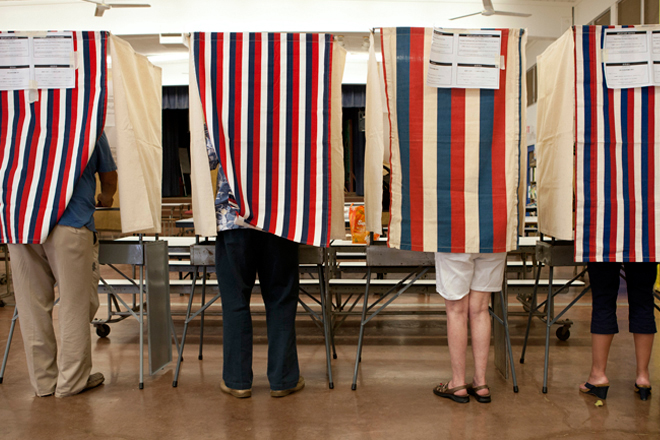

Despite rampant concerns on both the right and left about the integrity of the election, we seem to have dodged a bullet on Nov. 7, at least on the presidential level. There were no serious problems reported — no hanging chads, endless recounts or credible evidence of widespread dirty tricks — and 97 percent of voters said they had no problems voting this year, aside from waiting in lines.
It’s lucky that was the case, because the federal commission tasked with making elections function better has been stymied by partisan infighting that has left it with zero commissioners, with Republicans refusing to appoint new ones and blocking Democrats from doing the same.
Congress created the U.S. Election Assistance Commission with the passage of the Help America Vote Act of 2002, which allocated over $3 billion to help states improve their election administration and enacted a number of reforms aimed at preventing another debacle like the presidential election of 2000. The act passed with rare and overwhelming bipartisan support — the House voted 357-48 in favor and the Senate 92-2 — but the honeymoon didn’t last long and the commission soon fell victim to the partisan bickering that has hamstrung the Federal Election Commission.
With four commissioners, two from each party, the body is tasked with “adopting voluntary voting system guidelines, and serving as a national clearinghouse of information on election administration,” according to the commission. Along with other functions, the EAC is basically supposed to help set standards and find best practices for a county whose elections are governed by a convoluted patchwork of municipal, county and state election agencies and laws.
It’s a noble and useful purpose, but the commission has operated without any of its four commissioners for over a year and experts on both sides of the aisle agree it’s broken.
“It’s a national embarrassment that this agency, whose only mission is to provide information, doesn’t have a single commissioner,” Rick Hasen, an election law expert at the University of California, Irvine, told Roll Call’s Amanda Becker in an excellent story published before the election.
“The agency is paralyzed,’’ Hans von Spakovsky, a senior fellow at the conservative Heritage Foundation and one of Republicans’ most prominent voices on election administration, told Gannett.
But it is von Spakovsky and his comrades whom some observers blame for the commission’s failures. Von Spakovsky, whose work advancing the voter fraud myth was profiled in October’s New Yorker, was working in the Bush Department of Justice in 2006 when he was reportedly the “ringleader” of an effort to make sure one of the EAC’s Republican commissioners would not get reappointed. The commissioner, Paul DeGregorio, was accused by his conservative enemies of not being “Republican enough” — i.e., not exploiting the commission for partisan goals. When DeGregorio left he was replaced by a lawyer from the Republican National Committee. (Von Spakovsky denies having anything to do with this.)
It was an inflection point for the commission. It went on to produce controversial reports about conservative hobby horses like voter ID, and the relationship between commissions of different parties broke down.
By December,2010, the two Democratic commissioners had left for various reasons, leaving the EAC without a three-member quorum. And in February 2011 Mississippi Republican Rep. Gregg Harper introduced legislation to kill the commission entirely. Shortly thereafter, the remaining two Republican commissioners left, leaving the body with four vacancies and zero commissioners.
As Becker reported, “Republican leadership has not recommended any nominees to the White House, a tactical move that ensures the vacancies remain because Democratic and Republican openings must be filled in tandem.”
On Monday, California Democratic Sen. Barbara Boxer shone some light on this neglected issue, sending a letter to the Republican leadership of both the House and Senate asking them to recommend new commissioners.
“While two Democratic EAC nominees are awaiting action in the Senate Rules Committee, my understanding is that your offices have not recommended names for the two Republican positions in nearly a year,” she wrote. “I hope that you will take immediate action to make these recommendations so that we can get the Election Assistance Commission working again, and let the American people know that the government is protecting their fundamental right to vote.”
It’s a welcome step, but unless Republicans abandon their strategy of obstruction in President Obama’s second term, the EAC may be waiting a while longer to function properly again.
