
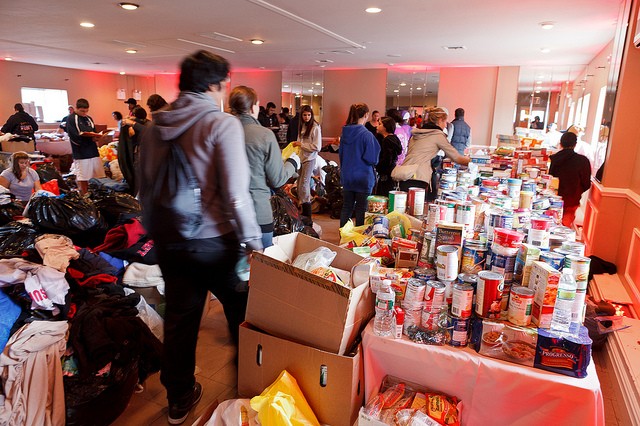

 How did we get here? This is the question occupying “occupiers,” as they call themselves, at their first post-Sandy community-wide meeting. On this cold November night just before Thanksgiving, “here” is the St. Jacobi Lutheran church in Sunset Park, Brooklyn, where at least 300 Occupy Sandy volunteers have crammed into the pews. But “here” is also the uneasy juncture of political protest and disaster relief where this newly formed organization finds itself.
Occupy Sandy’s story began in the hours just after the superstorm hit, when “a few of us occupiers were just texting each other at like 2 a.m. seeing how we could help,” recalls Bre Lembitz. A lanky 22-year-old whose blond curls are shaved close on one side of her head, Lambitz suggested bringing meals to the shore, and “everyone was totally down to do relief work.” So the next morning, she and a few others from Occupy Wall Street created an Occupy Sandy Twitter account and Facebook page, and headed down to Breezy Point with hot food, though they didn’t mention their affiliation to the residents of the relatively conservative community at the time. “It felt like people might not trust us to eat the food,” says Lambitz. “It was about helping the people—not pushing occupy values.”
Four adrenaline- and caffeine-fueled weeks later, while the question of how the occupy movement’s founding values jive with relief work is still a matter of debate, there is no question how much the mammoth, headless, volunteer-run disaster-relief organization has helped people. Since those very first days, Occupy Sandy has cooked and distributed between 10 and 15 thousand meals each day; enlisted more than 7,000 volunteers; created three major distribution hubs from which it dispatches both workers and supplies; and established dozens of recovery sites in New York and New Jersey. Perhaps most stunning, the group has raised more than $600,000 in cash for its efforts and received more than $700,000 in supplies donated through repurposed online wedding registries.
In a strange way, the storm has helped the Occupy movement, too, providing the insistently non-hierarchical, tech-savvy network of protestors with an opportunity to demonstrate the values it sometimes struggled to articulate during its Zuccotti Park chapter. When it was centered around inequality in broad, theoretical terms, OWS failed to connect with many of the “99 percent” it aimed to represent, particularly the kinds of folks who live in Gerritsen Beach, Staten Island and the other working class areas that are now ground zero for Occupy Sandy.
Post-storm, the occupy movement finds itself in a position many in these neighborhoods might find more palatable. “They’re channeling all their energy into something tangible,” says Susan Healey, a 54-year-old social worker from Bay Ridge who volunteers with the group but didn’t consider herself an “occupier” back in the Zuccotti days. Necessities and the ability to quickly dispatch volunteers to where they’re needed most are apparently worth a thousand banners.
The Occupy movement is also easier to understand in motion. During the encampment, OWS was standing against something—albeit something as widely disregarded as corporate greed. Now, the group is standing forsomething—or, rather, running, digging, cooking, cleaning, hoisting, and organizing for something—and much of the effort clearly stems from unassailable generosity and altruism. The good they’re doing seems to have answered any remaining questions about what Occupiers meant by standing up for the “99 percent.” It’s also a rebuke to those who dismissed occupiers as lazy, unemployed kids: Yes, many of the volunteers are young, pierced and tattooed, but, clearly, slackers they are not.
By effectively blowing away the polite outer layer that usually masks the extremity of inequality, the storm handed inequality activists an almost eerily perfect illustration of exactly what they see as wrong with our world. New York and New Jersey’s shoreline communities span the economic spectrum, from the fanciest beach resorts to low-income public housing and year-round bungalows. In Far Rockaway, for instance, where Occupy Sandy is still handing out food and clothes, more than a quarter of residents have an income of less than $15,000 a year. Similarly, Coney Island, where occupy volunteers are working out of a church on Neptune Avenue, is one of the poorest neighborhoods in New York City. Just a mile or two down the beach, houses can cost many millions of dollars. While residents with means have been able to pay for the supplies and help they needed, replace what was ruined, and, most important, get out of the most affected areas when necessary, a huge swath of have-nots was cast into a struggle for survival.
After the first few days, when disaster had just struck (and volunteers found themselves helping a range of people that included a former Wall Street banker who chuckled at the irony of the encounter before offering them the gas from his three flooded cars), Occupy Sandy has found itself focusing mostly on the neediest—the “ten percent,” perhaps, whose basic needs have gone unmet by many larger, official disaster-relief agencies. On many occasions, the volunteer group has had more boots on the ground in disadvantaged neighborhoods than FEMA, the Red Cross, and other more mainstream groups.
A year or so ago, Occupy Wall Streeters might have predicted the fall-out from a major natural disaster would take the route it did, wreaking its worst devastation on the poorest. But it’s one thing to speculate and quite another, many are finding, to witness such suffering firsthand. “There are 14 people living in one apartment,” a clearly distressed volunteer who has been canvassing door-to-door in the Rockaways reported at the community-wide meeting. “I’ve been working at Beach Channel 57th Street and they still don’t have heat. I was in an apartment with a mother whose kid was sleeping in a moldy crib.”
For the most optimistic organizers, the crisis offers an opportunity to expand on their original message. ”Occupy Wall Street has always been a disaster recovery response mobilization,” says Michael Primo, who has been active in both groups. “Then we were responding to things that to many people were more abstract. Now we’re responding to a more acute disaster, but it’s still part of system of inequity.
Others see Sandy as a chance to reach communities that didn’t previously warm to their message—or to politics at all. “This is an opportunity to connect with each other and build collective power,” says Sam Corbin, who serves as Actions Director for a non-profit called The Other 98 Percent and has done trainings for Occupy Sandy. Ideally, the network of newly connected people will be empowered by the experience, says Corbin. “It’s not just about returning people to the level they were at before the storm. It’s an opportunity to prevent them from being taken advantage of in the future.”
Forays in other new directions for Occupy are also underway. A legal-assistance team has formed to provide guidance for dealing with FEMA, preventing foreclosures, and getting food stamps. Various groups of occupiers are exploring the long-term health effects of generators used in the storm’s aftermath; providing storm relief in Haiti; and homing in on corporate responsibility for climate change and the perils of disaster capitalism. Meanwhile, another group of Occupiers is considering how to assist Red Hook residents wage a rent strike against the New York City Housing Authority and another has begun rebuilding—or at least mucking and pumping out flooded homes in anticipation of soon beginning green construction.
Still others fear that that the ever-widening range of efforts will obscure the original Occupy movement’s long-term goals. As the community-wide meeting began winding down the other night, small groups were forming to discuss the myriad questions that have sprung from the activists’ unprecedented and unplanned mass foray into disaster relief. People concerned with improving communication between hubs were meeting in one corner, those who wanted to work on volunteer wellness in another. Zorah Tucker, a 33-year-old former college instructor who has spent the past few weeks as a volunteer coordinator in the Rockaways, suggested a meeting of “anyone who has agita about the fact that we were a political protest group and we’re now talking about building.” The group’s first problem was there was no space left to meet.
