
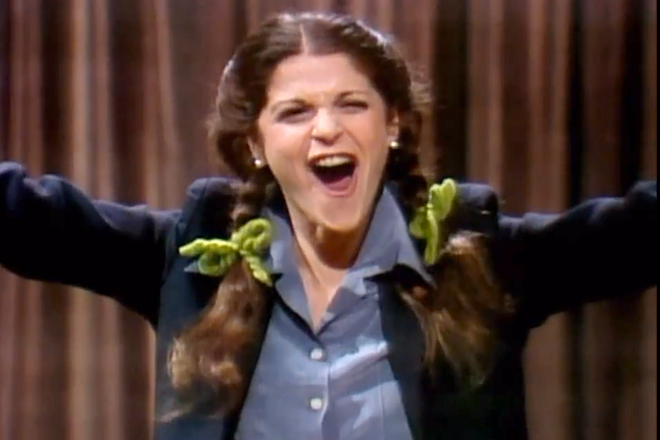

One of the mottos of Gilda’s Club, the support organization for people with cancer and their friends and family, is “Come as you are.” But if you’re a member of the Madison, Wis., chapter, that all-encompassing message of acceptance must come with the codicil, “And who are you again?” It has recently announced that it’s changing its name, because apparently people there don’t know who Gilda Radner was.
Gilda’s Club — created in honor of the “Saturday Night Live” star who died in 1989 of ovarian cancer — doesn’t just take inspiration from the big-mouthed cartoon figure on its logo. It embodies Radner’s open, playful spirit in a clubhouse environment where parties are a regular occurrence and junior members are called Noogies. Yet Lannia Syren Stenz, the Madison club’s executive director, told the Wisconsin State Journal Tuesday that “One of the realizations we had this year is that our college students were born after Gilda Radner passed, as we are seeing younger and younger adults who are dealing with a cancer diagnosis. We want to make sure that what we are is clear to them and that there’s not a lot of confusion that would cause people not to come in our doors.”
Because each chapter is independent, with its own board, it’s free to make its own autonomous choices on these matters. So starting in January, the organization will go by the wildly unambiguous moniker of Cancer Support Community Southwest Wisconsin.
As a passionate, active member of the New York chapter, I am sympathetic to the fact that the name “Gilda’s Club” is a little vague. I likewise get that specificity is an asset in nomenclature. When a friend first recommend Gilda’s to me, I asked her, “Isn’t that just for ovarian cancer?” And whenever I refer other people to the organization, chief among the responses I hear are “Isn’t it just for women?” and “What’s that?” So I tell them. I understand that even if you know who Gilda Radner was, you might not glean the purpose of the charity that bears her name, and that, as Stenz says, “When you hear Gilda’s Club, if you don’t know what that means, you may not come to us.”
But that seems like the sort of thing that could be fixed tidily, simply by calling it Gilda’s Cancer Support Community. After all, I was not aware that knowing about the namesake of an organization was integral to awareness of or membership within it. Seems to me that somehow, even non-celebrity cancer organizations like Alex’s Lemonade Stand Foundation, Susan G. Komen for the Cure and the Jimmy Fund manage to endure. Hell, I’m a patient at Memorial Sloan-Kettering and a New York City runner and I only recently figured out the origin of the decidedly unself-evident Fred’s Team.
And as for the argument that young people don’t know who Radner was, is that even true or valid? This year’s Gilda’s Club New York ambassador is Emma Stone. She was only 6 months old when Radner died but says that “Gilda Radner was my original hero.” When Stone hosted “Saturday Night Live” last year, she channeled Radner, in full Roseanne Roseannadanna regalia, for the promo pictures. A Change.org petition, meanwhile, has been started to appeal the name switch, and the responses on the group’s Facebook page have ranged from “appalling” to “terrible.”
Here’s the important thing — there’s a reason that organizations are named after people. There’s a reason that a name resonates in the heart of someone facing a disease in a way that a bland, Cancer Support Community Southwest Wisconsin, does not. It’s because it makes it personal and intimate. It creates the unique and powerful and so necessary experience of identification and empathy. It sure as hell says to people with cancer, “You’re not forgotten,” which is actually a very big deal for a whole lot of us going through it. My kids certainly didn’t know who Gilda was when we started going to the clubhouse. They do now. And they love her. They love her because she’s real to them. She’s there smiling from a picture on the wall when they walk in. She’s there for all of us in the club, a beacon of laughter and warmth.
When I spoke two weeks ago at the Gilda’s Club annual dinner, I told the audience the most important thing I’ve learned in my whole cancer experience. It’s this: Cancer isn’t just a disease. Cancer is a group experience. It’s all about people. People with lives and families and hopes and dreams and pain and fear and names. And that’s kind of the whole point of a cancer support organization, isn’t it?
