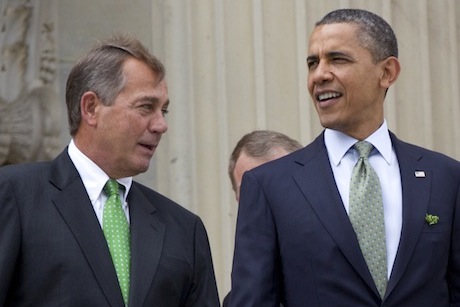

Understanding the “fiscal cliff” in 150 seconds

Democrats, listen up: Follow these eight guiding principles, and you just might save the U.S. economy VIDEO

Topics: Video, RobertReich.org, Fiscal cliff, Taxes, Wall Street, Business, ,

Understanding the (Credit: AP/Carolyn Kaster)
This originally appeared on Robert Reich's blog.

UNDERSTANDING THE FISCAL CLIFF (IN 2 MINUTES 30 SECONDS)

Democrats, here are eight principles to guide you in the coming showdown over the fiscal cliff:

ONE: HOLD YOUR GROUND. The wealthy have to pay their fair share of taxes. That’s what the election was all about, and we won. It’s only fair they pay more. They’re taking home record share of national income and wealth, and have lowest effective tax rate in living memory.

TWO: NO DEAL IS BETTER THAN A BAD DEAL. You’re in a strong bargaining position. If you do nothing, the Bush tax cuts automatically expire in January, and we go back to rates during the Clinton administration. Which isn’t such a bad thing. As I recall we had a pretty good economy during the Clinton years.

THREE: MAKE REPUBLICANS VOTE ON EXTENDING THE TAX CUTS JUST FOR THE MIDDLE CLASS. After all the Bush tax cuts expire, have Republicans vote on extending the Bush tax cut just for the middle class. If they refuse and try to hold those tax cuts hostage to tax cuts for the wealthy, it will show whose side they’re on. They’ll pay the price in 2014.

FOUR: DEMAND HIGHER TAX RATES ON WEALTHY, NOT JUST LIMITS ON DEDUCTIONS. Don’t fall for Republican offers to limit some tax deductions on the wealthy. Demand we go back to higher tax rates on the wealthy and eliminate their unfair tax loopholes, so they truly start paying their fair share.

FIVE: DON’T CUT SAFETY NETS. Don’t sacrifice Medicare or Social Security, or programs for the poor. Americans depend on these safety nets and can’t afford any benefit cuts.

SIX: DON’T CUT INVESTMENTS IN OUR FUTURE PRODUCTIVITY. Education, basic R&D, and infrastructure aren’t spending; they’re investments in our future prosperity. If the return on these investments is greater than the cost, they ought to be made, period.

SEVEN: CUT SPENDING ON MILITARY AND CORPORATE WELFARE. You want to cut, cut spending on the military — which now exceeds the military spending of the next 13 largest military spenders in the world combined. And cut corporate welfare — support to agribusiness, oil and gas, Big Pharma, big insurance and Wall Street.

EIGHT: PUT JOBS BEFORE DEFICIT REDUCTION. Finally, don’t cut the budget deficit as long as unemployment remains high. Otherwise you’ll cause the economy to contract, making the deficit even larger in proportion. That’s the austerity trap Europe has fallen into. We need to create American prosperity, not European austerity.

Remember: Jobs come first.

Robert Reich, one of the nation’s leading experts on work and the economy, is Chancellor’s Professor of Public Policy at the Goldman School of Public Policy at the University of California at Berkeley. He has served in three national administrations, most recently as secretary of labor under President Bill Clinton. Time Magazine has named him one of the ten most effective cabinet secretaries of the last century. He has written 13 books, including his latest best-seller, “Aftershock: The Next Economy and America’s Future;” “The Work of Nations,” which has been translated into 22 languages; and his newest, an e-book, “Beyond Outrage.” His syndicated columns, television appearances, and public radio commentaries reach millions of people each week. He is also a founding editor of the American Prospect magazine, and Chairman of the citizen’s group Common Cause. His widely-read blog can be found at www.robertreich.org.

Next Article

Featured Slide Shows

What To Read Awards: Top 10 Books of 2012 slide show

close X
  • Share on Twitter
  • Share on Facebook
  • Thumbnails
  • Fullscreen
  • 1 of 10
  • 10. "The Guardians" by Sarah Manguso: "Though Sarah Manguso’s 'The Guardians' is specifically about losing a dear friend to suicide, she pries open her intelligent heart to describe our strange, sad modern lives. I think about the small resonating moments of Manguso’s narrative every day." -- M. Rebekah Otto, The Rumpus

  • 9. "Beautiful Ruins" by Jess Walter: "'Beautiful Ruins' leads my list because it's set on the coast of Italy in 1962 and Richard Burton makes an entirely convincing cameo appearance. What more could you want?" -- Maureen Corrigan, NPR's "Fresh Air"

  • 8. "Arcadia" by Lauren Groff: "'Arcadia' captures our painful nostalgia for an idyllic past we never really had." -- Ron Charles, Washington Post

  • 7. "Gone Girl" by Gillian Flynn: "When a young wife disappears on the morning of her fifth wedding anniversary, her husband becomes the automatic suspect in this compulsively readable thriller, which is as rich with sardonic humor and social satire as it is unexpected plot twists." -- Marjorie Kehe, Christian Science Monitor

  • 6. "How Should a Person Be" by Sheila Heti: "There was a reason this book was so talked about, and it’s because Heti has tapped into something great." -- Jason Diamond, Vol. 1 Brooklyn

  • 4. TIE "NW" by Zadie Smith and "Far From the Tree" by Andrew Solomon: "Zadie Smith’s 'NW' is going to enter the canon for the sheer audacity of the book’s project." -- Roxane Gay, New York Times "'Far From the Tree' by Andrew Solomon is, to my mind, a life-changing book, one that's capable of overturning long-standing ideas of identity, family and love." -- Laura Miller, Salon

  • 3. "Billy Lynn's Long Halftime Walk" by Ben Fountain: "'Billy Lynn's Long Halftime Walk' says a lot about where we are today," says Marjorie Kehe of the Christian Science Monitor. "Pretty much the whole point of that novel," adds Time's Lev Grossman.

  • 2. "Bring Up the Bodies" by Hilary Mantel: "Even more accomplished than the preceding novel in this sequence, 'Wolf Hall,' Mantel's new installment in the fictionalized life of Thomas Cromwell -- master secretary and chief fixer to Henry VIII -- is a high-wire act, a feat of novelistic derring-do." -- Laura Miller, Salon

  • 1. "Behind the Beautiful Forevers" by Katherine Boo: "Like the most remarkable literary nonfiction, it reads with the bite of a novel and opens up a corner of the world that most of us know absolutely nothing about. It stuck with me all year." -- Eric Banks, president of the National Book Critics Circle

  • Recent Slide Shows

  • Share on Twitter
  • Share on Facebook
  • Thumbnails
  • Fullscreen
  • 1 of 10

More Related Stories

Comments

21 Comments

Comment Preview

Your name will appear as username ( profile | log out )

You may use these HTML tags and attributes: <a href=""> <b> <em> <strong> <i> <blockquote>