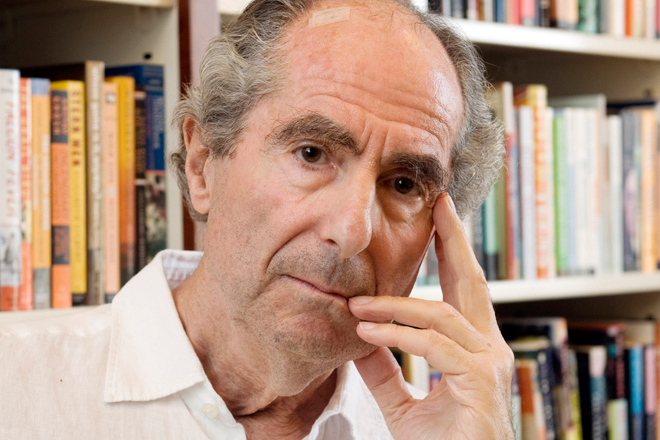

My dinner with Philip Roth

His retirement announcement several weeks ago came as no surprise. He told me himself that he was "kaput"

Topics: The Jewish Daily Forward, Philip Roth, literature, The Plot Against America, Psychoanalysis, Satire,

My dinner with Philip Roth (Credit: AP/Richard Drew)
This piece originally appeared on the Jewish Daily Forward. You can read more of their Philip Roth coverage here.

As word came over the transom last week (an actual transom, since I don’t have a working computer) that Philip Roth was retiring, I dismissed it as old, dull news. I’d read the report in the original French, and translated it myself into Turkish and then into Swiss-German just for fun. Then, along with the rest of the literate world, I’d read about it in the Times, which described Roth as a mentally healthy gentleman, happy with his lot.

I knew he was putting on an act, because I’d already heard the opposite from the horse’s mouth. “The Horse” is what I’d called Roth when he and I shared an office space in the late 60s while he was working on Portnoy’s Complaint and I was working on a similar but superior work, Feldman’s Penis. Roth had earned his nickname because he ate a lot of apples and oats, and also because he loved to saddle up with the shiksas. No one knows a writer as well as his contemporaries. Roth and I are as contemporary as they get.

One morning a few months ago, as I sat in my third-floor study in my chateau near the summit of Mount Winchester, my rotary phone rang downstairs. My beleaguered manservant Roger answered it, and came knocking at my door a minute later.

“Mr. Roth would like to invite you to dinner tonight,” he said.

Of course, I accepted the invitation. I don’t go out as much as I used to, because everyone I once knew in publishing is either gone, or, in the case of Joyce Carol Oates, an android. Like John Adams and Thomas Jefferson, Roth and I are the only two of our kind remaining, and by “kind” I mean “men who have written award-winning trilogies about the history of Newark.”

I went to the neighborhood store, stole a bottle of wine, and climbed into the private gondola that the publishing industry installed for me in 1975 as part of a network that allows prominent writers to travel to one another’s homes without having to be bothered by the cares of ordinary people. The gondola system doesn’t have as many stops as it once did in its heyday, but it stays alive, thanks to a MacArthur Foundation grant, in case the Book once again regains cultural dominance over the electronic idiocy that threatens its sacred existence.

An hour later, I was at Roth’s door. He opened it, looking pale and terrible.

“Thank you for coming,” he said.

“It’s always nice to see another working novelist,” I said.

He barely suppressed a sob, and that’s when I knew something was wrong.


We sat by a roaring fire, which I found strange since it was mid-August, and reminisced tenderly about the time we egged Mary McCarthy’s mailbox.

“But she’s dead now, isn’t she?” Roth said.

“Long dead,” I said.

“Mailer. Gore. Updike. Hunter Thompson,” he replied. “All dead.”

“Totally dead,” I said. “Tom Wolfe is still alive, though.”

“Oh, please,” he said.

Everyone had died, Roth said. He’d outlived so many people: George Carlin, Phyllis Diller, Arlen Specter, even, tragically, Junior Seau. They were ash. Still, on he struggled, with the written word.

Philip Roth stared into the fire for a good long while.

“I read your novel ‘Jewball,’” he said.

“Yes?”

“It was unparalleled.”

“Thank you.”

“How can a man your age write with so much energy, vitality, and wisdom?”

“There’s not just one explanation,” I said.

He sighed.

“I read ‘Nemesis,’” I said.

“Yes?” he said.

“It was definitely a book.”

“That it was,” said Philip Roth. “My last book.”

“What?” I said.

“I’m hanging it up,” he said. “I’ve done what I can with the world has given me. And now I just want to spend the rest of my years reading obscure Eastern European poets and watching ‘The X Factor.’”

“But you can’t quit!” I said. “Then I’ll have no competition.”

“You never did have any competition,” Roth said.

“I don’t know about that,” I said. “You came as close as anyone. That book about the masturbating puppeteer was pretty special.”

“Be that as it may,” he said. “I am kaput.”

Dinner was a simple affair, just the two of us, joined by a log wearing a blond wig, googly plastic eyes, and bright red lipstick. Roth kept referring to it as “The Monkey,” and repeatedly asked me, “doesn’t she look pretty today?” to which I replied, “oh, yes, very pretty.” I find that it’s bad form to deny a retired novelist his fleeting pleasures.

We talked for a while of the old days, remembering the times we rolled Truman Capote down a hill and gave William F. Buckley a wedgie in the bathroom at Sardi’s. America had been so trouble-free then, in the 70s. We both wept a little, he over innocence lost, me because he’s always been such a terrible cook.

“Joyce Carol Oates is an android,” he said.

“I know,” I said.

After dinner, we played a little backgammon and had good sport throwing crumpled pages of Updike’s collection of golf essays into the fire. As you age, your tastes refine and you find yourself turning toward the classics, away from trends. Also, sometimes you poop in your pants a little.

Then it was 9 p.m. Roth picked up his log and said, “The Monkey and I are going to turn in. You’re welcome to stay the night.”

“That’s OK,” I said. “I’ll catch the last gondola home. Besides, I’m receiving an important award tomorrow.”

“Of course you are,” he said.

“Don’t worry, Horse,” I said. “That Nobel is still within your reach.”

“Sure it is,” he said, shaking his head sadly. “And so’s the Stanley Cup.”

With that, I left Philip Roth to his retirement. I realized that I’d seen him for possibly the last time, which made me feel a bit wistful, but also happy, because it meant that I’d won at last. The quest for literary dominance is a life-long one, but only the greatest Jews can reach the final round. Philip Roth had come close, but I’d outlasted him.

As I neared the end of my own glorious career, I truly had no complaints.

Neal Pollack

Neal Pollack is the author of the literary satire "The Neal Pollack Anthology of American Literature," among other works of fiction and nonfiction. His latest book, a historical novel called "Jewball," was published in October.

Featured Slide Shows

7 motorist-friendly camping sites

close X
  • Share on Twitter
  • Share on Facebook
  • Thumbnails
  • Fullscreen
  • 1 of 9

Sponsored Post

  • White River National Forest via Lower Crystal Lake, Colorado
    For those OK with the mainstream, White River Forest welcomes more than 10 million visitors a year, making it the most-visited recreation forest in the nation. But don’t hate it for being beautiful; it’s got substance, too. The forest boasts 8 wilderness areas, 2,500 miles of trail, 1,900 miles of winding service system roads, and 12 ski resorts (should your snow shredders fit the trunk space). If ice isn’t your thing: take the tire-friendly Flat Tops Trail Scenic Byway — 82 miles connecting the towns of Meeker and Yampa, half of which is unpaved for you road rebels.
    fs.usda.gov/whiteriveryou


    Image credit: Getty

  • Chattahoochee-Oconee National Forest via Noontootla Creek, Georgia
    Boasting 10 wildernesses, 430 miles of trail and 1,367 miles of trout-filled stream, this Georgia forest is hailed as a camper’s paradise. Try driving the Ridge and Valley Scenic Byway, which saw Civil War battles fought. If the tall peaks make your engine tremble, opt for the relatively flat Oconee National Forest, which offers smaller hills and an easy trail to the ghost town of Scull Shoals. Scaredy-cats can opt for John’s Mountain Overlook, which leads to twin waterfalls for the sensitive sightseer in you.
    fs.usda.gov/conf


    Image credit: flickr/chattoconeenf

  • Nordhouse Dunes Wilderness Area via Green Road, Michigan
    The only national forest in Lower Michigan, the Huron-Mainstee spans nearly 1 million acres of public land. Outside the requisite lush habitat for fish and wildlife on display, the Nordhouse Dunes Wilderness Area is among the biggest hooks for visitors: offering beach camping with shores pounded by big, cerulean surf. Splash in some rum and you just might think you were in the Caribbean.
    fs.usda.gov/hmnf


    Image credit: umich.edu

  • Canaan Mountain via Backcountry Canaan Loop Road, West Virginia
    A favorite hailed by outdoorsman and author Johnny Molloy as some of the best high-country car camping sites anywhere in the country, you don’t have to go far to get away. Travel 20 miles west of Dolly Sods (among the busiest in the East) to find the Canaan Backcountry (for more quiet and peace). Those willing to leave the car for a bit and foot it would be remiss to neglect day-hiking the White Rim Rocks, Table Rock Overlook, or the rim at Blackwater River Gorge.
    fs.usda.gov/mnf


    Image credit: Getty

  • Mt. Rogers NRA via Hurricane Creek Road, North Carolina
    Most know it as the highest country they’ll see from North Carolina to New Hampshire. What they may not know? Car campers can get the same grand experience for less hassle. Drop the 50-pound backpacks and take the highway to the high country by stopping anywhere on the twisting (hence the name) Hurricane Road for access to a 15-mile loop that boasts the best of the grassy balds. It’s the road less travelled, and the high one, at that.
    fs.usda.gov/gwj


    Image credit: wikipedia.org

  • Long Key State Park via the Overseas Highway, Florida
    Hiking can get old; sometimes you’d rather paddle. For a weekend getaway of the coastal variety and quieter version of the Florida Keys that’s no less luxe, stick your head in the sand (and ocean, if snorkeling’s your thing) at any of Long Key’s 60 sites. Canoes and kayaks are aplenty, as are the hot showers and electric power source amenities. Think of it as the getaway from the typical getaway.
    floridastateparks.org/longkey/default.cfm


    Image credit: floridastateparks.org

  • Grand Canyon National Park via Crazy Jug Point, Arizona
    You didn’t think we’d neglect one of the world’s most famous national parks, did you? Nor would we dare lead you astray with one of the busiest parts of the park. With the Colorado River still within view of this cliff-edge site, Crazy Jug is a carside camper’s refuge from the troops of tourists. Find easy access to the Bill Hall Trail less than a mile from camp, and descend to get a peek at the volcanic Mt. Trumbull. (Fear not: It’s about as active as your typical lazy Sunday in front of the tube, if not more peaceful.)
    fs.usda.gov/kaibab


    Image credit: flickr/Irish Typepad

  • As the go-to (weekend) getaway car for fiscally conscious field trips with friends, the 2013 MINI Convertible is your campground racer of choice, allowing you and up to three of your co-pilots to take in all the beauty of nature high and low. And with a fuel efficiency that won’t leave you in the latter, you won’t have to worry about being left stranded (or awkwardly asking to go halfsies on gas expenses).


    Image credit: miniusa.com

  • Recent Slide Shows

  • Share on Twitter
  • Share on Facebook
  • Thumbnails
  • Fullscreen
  • 1 of 9

Comments

1 Comments

Comment Preview

Your name will appear as username ( settings | log out )

You may use these HTML tags and attributes: <a href=""> <b> <em> <strong> <i> <blockquote>