
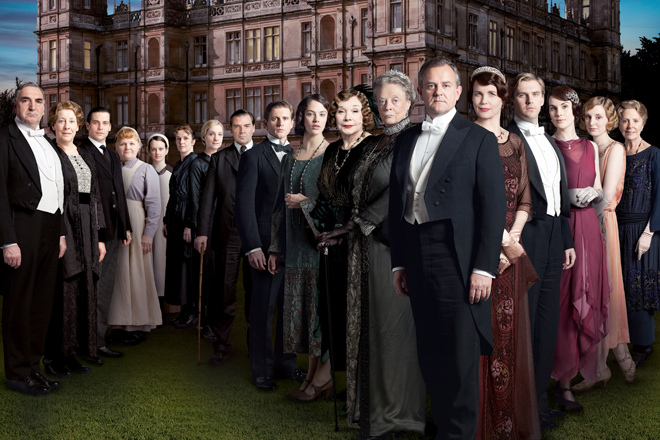

“Downton Abbey’s” serial mistreatment of Edith Crawley, the ultimate middle child, is one of its most telling quirks. The deliciously mean-spirited piling on of indignities is unjust, unfair, unkind, good fun and a pure expression of “Downton’s” ideology. Edith, poor pathetic, googley-eyed Edith, who has neither luck nor luminosity, neither her older sister’s stones nor her younger sister’s sweetness, or either of their beauty, is a true personification of “Downton’s” aristocratic worldview: We are not created equal.
“Downton” believes in the aristocracy, in its grace, glamour — why are all the soaring, sexy love stories upstairs? What’s Daisy got to do to get a boo? — and essential benevolence, and to believe in the aristocracy you must believe in a hierarchy of human character. If you are Lord Grantham, you can’t believe we are all fundamentally the same. We cannot be, because if we were, it would be a grave injustice that Bates and Thomas and Daisy have to clean your shirts and cook your dinner, while you flipper away an inherited fortune and, along with it, your one real duty, to provide employment and stability by staying wealthy beyond measure. No, the aristocrats — who are not just lucky, but predestined, their wealth and especially their property an intrinsic signifier of their own substantiality — think of themselves as being made of better mettle, more high-minded stuff, purer raw materials than their charges. They are educated and cosseted and lucky, yes, but they imagine themselves innately better suited to tackle life’s grander pleasures and problems.
But if every person to the manor born was a bright, astute, well-mannered, strong-minded human and everyone below stairs a weak-willed dependent wouldn’t that suggest the financial realities had something to do with it? If a couple people could flip things around, if some aristocrats were uninspired duds and some members of the lower classes were blessed with a pure and swaggering spirit (but ideally not with enough outrage, like Thomas, to make oneself a nuisance. Better to be fangless like Tom, who sits there and smiles when Robert calls him “our tame revolutionary” like he’s a house cat, or Matthew Crawley, a blood aristocrat all along) wouldn’t that suggest it doesn’t just have to do with who has and who has not? The exception, and only the exception, can prove the rule that some people are born better than others. Here in America we are sure our meritocracy works because sometimes members of disadvantaged groups “make it,” even though they don’t make it in nearly the numbers they would if our society were truly fair. At Downton Abbey, they are sure the aristocracy functions because Edith sucks so much more than her sisters.
Edith is intrinsically middle-class. She is always trying too hard. Nothing comes easily to her. She is constantly keeping score, taking count, innately competitive because she is always losing. She is willing to settle. She makes everything look hard, because, for her, everything is hard. By her very existence, she is a burnishing of her sisters, one who has semi-forsaken the aristocracy and one dedicated to it, but who are both, in their separate ways, undeniably cooler, classier, better, and, up to this point, far more blessed than she.
On another show, a show more ideologically bourgeoisie, more ideologically liberal, all this effort and bad luck would make Edith a hero. On “Downton” she is a punching bag. The shade Mary has thrown at Edith — her relentless and merciless refusal to even consider liking her sister — would be a flaw. But Mary is the heroine of the show — here she was, saving “Downton” this week by force of will — and we — just like Cora last week, giggling at Mary all, “Never mind Edith” — have been encouraged to take Mary’s essential point of view, which is that Edith is a wet rag. It’s not nice, it’s not fair, but that doesn’t mean it’s not true. This is the thing about the aristocracy: It is inflexible, but you know where you stand. It is where you were born.
And so, in last night’s episode, poor Edith got picked on again, getting abandoned at the altar by an old codger with one arm who would have been lucky to have her. (There is something extremely fitting about the fact that Edith’s very special episode aired the same night as the Golden Globes. She even gets overshadowed by airdates.) “I still can’t [believe] something happening in this house is actually about me,” Edith proclaims in the opening scene, at which point she should have reached over and knocked wood on her grandmother’s head. By the time Edith is settling in to enjoy a life finally on equal terms with her sisters — “all of us married, all of us happy” — the veil is about to drop: she is, as ever, still too focused on her standing compared to them to see the precariousness of her position. And then, there she is at the altar, chirping foolishly to the man trying to leave her for her own sake — “We’re so happy aren’t we? We’re going to be so terribly, terribly happy” — but without the sack to stand up to him or her interfering grandmother.
Having been roundly humiliated, Edith sobbing in bed, insists her concerned sisters leave the room: “Look at them, with both of their husbands.” They are a reminder of what Edith doesn’t have, may never have. In this moment, Edith shows the deep, crazy, unpleasant part of herself that is so obsessed with how she stacks up to Mary and Sybil she can’t forget the competition even in intense emotional distress. She has lost and she can’t bear to have them watch, even though they already knew a long time ago that they had won.
In the morning, Edith wakes up, still defeated, but maybe finally, finally ready to play a different game. “I’m a useful spinster,” she cries to Anna, as she drags herself out of bed. “Good at helping out. That is my role. And spinsters get up for breakfast.” Is this self-pity? Oh you bet. Is she still getting out of bed? She sure is. Edith’s sense of herself, of her own grandiosity, is just not up to dragging out this humiliation. She’s a shitty aristocrat, and she always has been. But she is useful. And, here’s the thing, the future’s not looking so good for aristocrats. It’s always looking good for the useful. Edith might have finally, painfully found a way to start being happy.
