
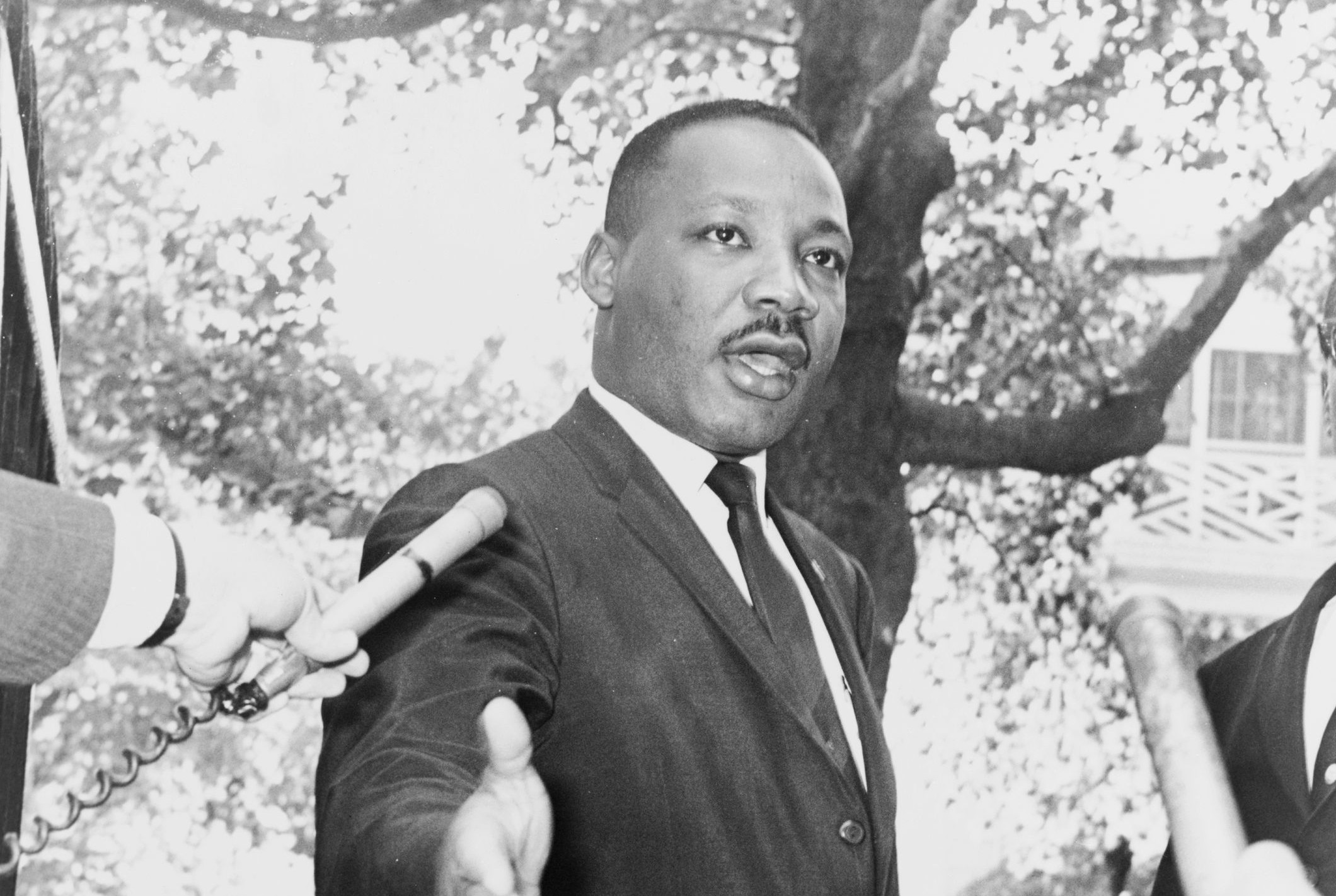

 One could make the case that the Reverend Dr. Martin Luther King Jr. was the most significant American of the 20th century. He is only the third American whose birthday is commemorated as a federal holiday, a distinction not even granted Ben Franklin, Thomas Jefferson, or FDR. 44 years after his death. Although King is one of U.S. history’s most widely chronicled individuals, there are aspects of his life that are less well-known than the pivotal speeches, the campaigns against Jim Crow city halls from Montgomery in 1955 to Memphis in 1968, and the dalliances that for some, tainted his personal life. King was as complex a figure as exists in our social narrative. He was a man conflicted by his commitment to a movement into which he was drafted against his better judgement and by the overwhelming demands to fulfill the role of human rights spokesperson. He was a husband and father who belonged to a people and a revolution, and the nation’s most prominent advocate of nonviolence at a time when violence burned on urban streets, college campuses and in Southeast Asia.
For all his gifts, MLK was quite human. Here are some things about him that may surprise you.
1. King was born Michael, and loved ones called him Mike.
The future “drum major for justice” was born Michael Lewis King, and family members called him Mike. At some point after his father, the Rev. M.L. King Sr., changed his own name to Martin Luther, the oldest son’s name was also changed. Neither man spoke or wrote publicly about the change. The elder MLK insisted that his oldest son’s name was incorrectly recorded as Michael at birth, implying that the boy was named after reformer Martin Luther. Some accounts state that both names were changed in 1934 (when Junior was five) following the father’s visit to Germany, when King Sr. developed an appreciation for the first Protestant. Other biographers state that King Jr. changed his name as a teenager so as to again be named after his preacher father. Whenever the appellation occurred, it was never filed legally. Like religious figures before him, such as the disciple Simon and the apostle Paul, King underwent a spiritual name change. Though his wife called him Martin, to his big sister Christine, and the rest of his immediate family he was forever Mike.
2. King wanted to marry a white cafeteria worker.
At Crozer Theological Seminary, in Chester, Pennsylvania during the late 1940s, King fell in love with a German cafeteria employee named Betty. Fellow seminarians, both white and black, talked him out of it, partially on the grounds that King’s father would frown upon the interracial romance of a son he was grooming for a successor role in the pulpit. Not only would the relationship have been taboo in King’s native Atlanta, but even had King chosen to pastor in the North (and further disappoint his father), MLK Sr. would have still viewed the cafeteria worker as below his son’s station. Daddy King was dead set against his oldest son “marrying down.” David Garrow, in his seminal civil rights book Bearing The Cross, wrote that King never recovered from the heartbreak caused by the socially unacceptable affair. The senior King was not all that enamored with his son’s matrimonial choice of conservatory student Coretta Scott either, as his arranged choice of a bride for Martin Jr. was opera singer Mattiwilda Dobbs, whose father founded the Atlanta Civic League and the Atlanta Negro Voters League.
3. Picking tobacco revealed to him a more open society.
When King was 15, and again when he was 18, he worked summers harvesting tobacco in Simsbury, Connecticut, not far from Hartford. His experience as a middle-class son of a prominent black family from Atlanta’s prosperous “Sweet” Auburn Avenue performing menial labor in Yankee territory helped shape his future. “On our way here we saw some things I had never anticipated to see,” he wrote his father in astonishment. “After we passed Washington there was no discrimination at all. The white people here are very nice. We go to any place we want to and sit anywhere we want to.” In a correspondence to his mother, he continued the theme, “I never thought that a person of my race could eat anywhere but we ate in one of the finest restaurants in Hartford. And we went to the largest shows there.”
The teenage King was equally moved that there were racially integrated church services in Simsbury. More than a decade later he would famously say, “It is appalling that the most segregated hour of Christian America is eleven o’clock on Sunday morning.” The fact that King could not enjoy such freedoms in most of his native Deep South inspired him to become a man of the cloth. When King applied to Crozer Theological Seminary in 1951, he stated that after a second summer exposure to Northern racial tolerance, “I felt an inescapable urge to serve society. In short, I felt a sense of responsibility which I could not escape.”
4. King was not the first black American leader to adopt Gandhian principles.
Dr. King was not the first black leader to tour India and be influenced by the nonviolent teachings of Mohandas K. Gandhi. He was preceded by James Farmer, who founded the Congress of Racial Equality (CORE). Farmer, in turn, learned of Gandhi from Howard University theologian and educator Dr. Howard Thurman. Thurman had met Gandhi, and asked the Mahatma how his ideals might be implemented in the U.S. Gandhi responded that he wished nonviolent resistance as a strategy for social change had more of a global footing. Perhaps, he suggested to the theologian, black Americans could employ the tactic.
In addition, Howard U.’s first black president, Dr. Mordecai Johnson, had visited India, and was impressed by Gandhi’s concept of satyagraha, or passive resistance. While at Crozer Seminary, King had attended a lecture by Johnson, who lectured about Gandhi. While the address had a lasting influence on King, the threat of violence and terrorism inherent in the struggle for racial equality in the 1950s were such that it took years before he could fully embrace Gandhi’s tenets and strategies as applicable or even practical for black Americans. In February and March of 1959, Dr. King and Coretta toured India. Upon landing, King told the gathered media, “To other countries I may go as a tourist, but to India I come as a pilgrim.”
5. Dr. King applied for a gun permit to protect his family.
In the mid-1950s, King was not yet committed to the principle of passive resistance. He applied for a firearms permit during a period when his home and several Montgomery churches were bombed. He was more concerned family man than pacifist. It was not until later, according to King’s own writings, that he decided he could not advocate nonviolent resistance while resorting to armed self-defense. There was also the issue of gun ownership vis-a-vis his faith in God to protect himself and his family, or his persecuted race as a whole. One civil rights colleague, Glenn Smiley, described King’s home as “an arsenal,” something that those who wave the Second Amendment in the face of black progressives are quick to seize on. However, the weapons were not King’s, as Alabama refused his application for a permit. They belonged to aides de camp. While colleagues like Charlie Evers (brother of slain civil rights leader Medgar Evers), and North Carolina activist Robert Williams (author of the controversial 1962 book Negroes With Guns) were committed gun owners, King’s interest was a temporary reaction to a terrorist attack on the home where his newborn first child Yolanda slept.
6. King had the Occupy idea 45 years ago.
King’s last great campaign sought to bring activists and impoverished Americans of various ethnicities, including Appalachians, Native Americans, Chicano migrant workers and Southern blacks, to Washington to live in tented camps on the National Mall. The Poor People’s Campaign was an ambitous effort to draw attention to the issue of poverty in 1968, a presidential election year, by bringing the people to DC in mule drawn carriages. The tented villages were called Resurrection City, and because of the time and energy the initiative occupied, King was hesitant to make personal visits to Memphis to champion the striking, predominantly black sanitation workers there. Setbacks in the Poor People’s Campaign also contributed to some degree of depression and disillusionment for King, who was advocating for America’s poorest citizens in an atmosphere of federal budgets for both the Vietnam War and a manned mission to the moon.
Though King’s assassination in April 1968 derailed much of the momentum and sympathy for the Poor People’s Campaign, in the wake of his death, 3,000 citizens did live in tents alongside the National Mall for six weeks — a period unfortunately marked by rain-soaked muddy days, organizational bickering about King’s vision and its application, and physical eviction and hundreds of arrests when the squatters’ National Park Service permit expired in late June of ’68. When Occupy protestors began camping in Washington, DC’s Freedom Plaza in fall of 2011, few knew to what literal extent they were following in King’s footsteps.
7. King attempted suicide as a young boy.
When King was 12, he attended a parade against his parents’ wishes. His maternal grandmother suffered a fatal heart attack that day. King blamed himself for her death, because his six-year old little brother A.D., whom he was supposed to be home watching, accidentally knocked their grandmother unconscious while sliding down a bannister. Young Martin did not know the unconsciousness was unrelated to the heart attack. Associating his absence with the tragic turn of events, Martin attempted suicide by jumping from a second-story window in his family home. His father later reported that the boy was distraught for days, unable to sleep.
This sense of melancholy, while perfectly understandable, and a sign of his love for his grandmother, presaged the bouts of depression King experienced over philosophical divisions within the Civil Rights Movement (i.e. militants vs. nonviolent activists), and the challenges of the Poor People’s Campaign. Of his grandmother’s death, King said, “It was after this incident for the first time that I talked at any length on the doctrine of immortality. My parents attempted to explain it to me and I was assured that my grandmother stil lived.” On the eve of his own death, King preached, “Longevity has its place. But I’m not concerned about that now. I just want to do God’s will. And He’s allowed me to go up to the mountain. And I’ve looked over. And I’ve seen the promised land. I may not get there with you.”
8. King left his family in dire straits.
MLK Jr. died not only without financial assets, but without a will. Despite his widely known premonitions concerning his own early demise (most noteworthy in speeches such as “If I Had Sneezed,” and his final speech in Memphis the night before he was slain), King died intestate. Although his wife Coretta had admonished him for years to set some funds aside for the higher education of their four children, King left his family with no appreciable benefits from his five books, hundreds of speaking engagements, his ministry, and of most concern to his wife, the $54,600 he earned as recipient of the Nobel Peace Prize. While Mrs. King thought some of the award money should be invested for the children’s sake, her husband donated the funds to the movement.
Though he was a prolific writer and public speaker, King viewed his own financial sacrifice as a vow of relative poverty. In keeping with this ethos, King’s funeral procession featured not Cadillacs or Lincoln limousines, but a humble casket drawn by a mule carriage representative of his final mission, the Poor People’s Campaign. It was activists such as Harry Belafonte who raised money to ensure that the King children were supported through childhood and educated. The absence of a will has led to many court battles over the use and intellectual property of the leader’s written speeches, his image, recordings, and his literary works. Some related disputes have engendered rifts among King’s then-four surviving children (Yolanda died in 2008), and other close relatives. A will would have provided some direction in this regard.
