
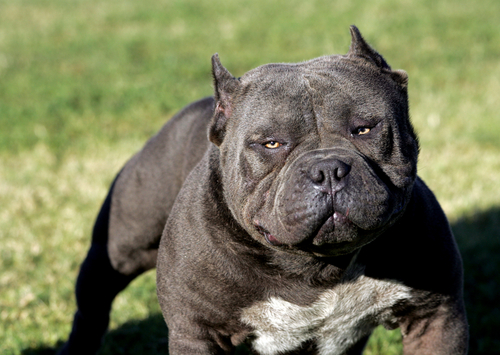

 For most of the 114 years since the American pit bull terrier was first recognized by the United Kennel Club, the breed was rightly seen as the perfect “nanny dog” for children because of its friendly nature, loyalty and stability. As the ASPCA notes, the pit bulls were “once considered especially non-aggressive to people.”
Today, as any owner of a “pit bull-type” dog* can attest, parents often recoil in horror when they spot one of these animals, pulling their children close as if to protect them from a marauding werewolf. Fanciful myths about the breed abound, and some public officials have compared their bites to those of sharks and tigers.
Since the 1980s, the media have falsely portrayed the pit bull as a bloodthirsty monster, inherently more dangerous than other strong breeds of dog. There is absolutely no factual basis for that narrative, but it’s led to a vicious cycle in which people who want a badass dog to fight, or to guard property, or to intimidate rival gangs tend to choose pit bulls (or Rottweilers, another much-maligned breed). Pit bulls are the dog of choice for irresponsible breeders, dog-fighters, people who want a tough-looking dog to tie up in their yard and those who refuse to have their male dogs fixed because they think those big, swinging balls makes them look tough by proxy (86 percent of fatal canine attacks involve an unneutered male, according to the American Humane Society).
A 2009 study in the Journal of Forensic Science ($$), found that the owners of vicious dogs, regardless of the breed, had “significantly more criminal behaviors than other dog owners.” The researchers added that “vicious dog owners were higher in sensation seeking and primary psychopathy,” and concluded that “vicious dog ownership may be a simple marker of broader social deviance.” And according to the ASPCA, “Pit Bulls often attract the worst kind of dog owners.”
All of those human failings lead to poorly socialized and potentially aggressive dogs. It is because pit bulls are disproportionately favored by these kinds of owners that they’re responsible for a statistically outsize share of serious attacks on humans. These incidents are then reported – and very often misreported – with breathless sensationalism by the media, and the cycle continues.
Meanwhile, advocates say that pit bulls are the most frequentlyabused, tortured, abandoned and euthanized breed of dog in the United States. Shelters across the country are overflowing with pit bull mixes. Because of their stigma, they’re often difficult to adopt out; a ride to the shelter is almost always a one-way trip for pitties.
We have tragically betrayed our children’s beloved nanny-dogs, raising them irresponsibly, training them to be aggressive and then turning them into pariahs when they behave as any dog would in similar circumstances.
The Facts
According to the American Veterinary Medicine Association, “controlled studies have not identified this breed group as disproportionately dangerous.” The American Temperance Testing Society (ATTS) puts thousands of dogs – purebreds and spayed and neutered mixed-breeds – through their paces each year. The dogs are tested for skittishness, aggression and their ability to differentiate between threatening and non-threatening humans. Among all of the breeds ATTS tested – over 30,000 dogs through May 2011 — 83 percent passed the test. How did pit bulls do? They showed an above average temperament, with 86 percent making the grade. Pit bulls are the second most tolerant breed tested by ATTS, after only golden retreivers.
Pit bulls do not have special “locking jaws” – that’s pure mythology. They don’t demonstrate some sort of special shaking action when they bite – all dogs display similar biting behavior. Pit bulls do not exert an unusual amount of bite-force for their size. Multiple studies have found that bite force correlates to body-weight, and tests of three breeds conducted by National Geographic found that the American pit bull terrier exerted less bite-force than German shepherds or Rottweilers.
While they have been a favorite of dog-fighters for a century, pit bulls weren’t originally bred for fighting. According to the United Kennel Club, sometime in the 19th century European breeders began crossing various terriers with bulldogs in search of a breed that had the former’s enthusiasm and the latter’s stamina and strength. The pit bull breeds that resulted were then imported and embraced “as catch dogs for semi-wild cattle and hogs, to hunt, to drive livestock, and as family companions.” (UKC also notes that pitbulls “have always been noted for their love of children,” but aren’t “the best choice for a guard dog since they are extremely friendly, even with strangers.”)
Pit bulls are among dozens of strong, muscular breeds of canine. All are capable of doing damage to humans if they’re not properly socialized and supervised. Most dogs do not, even when they’ve been neglected or abused. None are inherently monstrous – they are all just dogs. And we know what makes dogs of any breed more likely to be aggressive.
Karen Delise, research director for the National Canine Research Council and author of “The Pitbull Placebo,” has investigated hundreds of serious dog bite incidents in depth. As she explains:
My study of dog bite-related fatalities occurring over the past five decades has identified the poor ownership/management practices involved in the overwhelming majority of these incidents: owners obtaining dogs, and maintaining them as resident dogs outside of regular, positive human interaction, often for negative functions (i.e. guarding/protection, fighting, intimidation/status); owners failing to humanely contain, control and maintain their dogs (chained dogs, loose roaming dogs, cases of abuse/neglect); owners failing to knowledgably supervise interaction between children and dogs; and owners failing to spay or neuter dogs not used for competition, show, or in a responsible breeding program.
There are a tiny number of attacks that simply can’t be explained. Occasionally, a well-raised, beloved pet without a history of behavioral issues will hurt a human – dogs are animals, after all – but these incidents are incredibly rare.
PitBbull Takes Its Turn As Media’s Monster Dog
The pit bull is not the first dog to be seen as inherently dangerous. The media seem to feed off the idea of monster dogs — it makes great copy.
As Karen Delise details in her book, in the 19th century, bloodhounds were believed to be inherently vicious, having a taste for human blood. “Eventually,” she writes, “these bloodhounds fell from view, and we pushed other dogs into the spotlight, including the German Shepherd dog and the Doberman Pinscher.” (Dobermans were widely believed to have abnormally small brains, turning them into mindless killers, but this, like the pit bull’s “locking jaws,” was simply a myth.) Other breeds that have haunted the popular imagination in the past include mastiffs and Newfoundlands. In Canada, Siberian huskies have often played the role of killer-hound.
Delise, who reviewed news accounts of fatal dog attacks going back more than 100 years, also noted a shift in the way media report these incidents. Fifty years ago, she writes, dogs were “portrayed as sentient beings that reacted to pain, discomfort, or fear. Additionally, many reports of dog attacks conveyed the understanding that aggression was a natural and expected behavior of dogs in certain circumstances. Owners and/or victims were often identified in news reports as exhibiting behaviors (intentionally or unintentionally) that caused the dog to attack.”
That kind of understanding has since been replaced by an almost-single-minded focus on the breed of dogs that turn violent, stripped of any larger context.
Breed misidentification plays a significant role in the stigma attached to pit bulls. It’s difficult even for experts to properly identify a breed of dog. A study published in the Journal of Applied Animal Welfare Science ($$) found that “87.5% of the dogs identified by an adoption agency as having specific breeds in their ancestry did not have all of those breeds detected by DNA analysis.”
That problem is compounded by media sensationalism. Karen Delise studied every fatal dog bite reported in the years between 2002-2005, and found that “eleven dogs involved in fatal attacks with no Pitbull characteristics were counted as Pitbulls, while their ‘true’ breeds were not reported, and three dogs that were clearly not Rottweilers were identified as Rottweilers.” That was among a total of 47 fatal attacks (by all breeds) reported during that period.
This dog was involved in a fatal attack and the media called it a pit bull…
According to Delise, this dog was reported as a pit bull despite the fact that animal control officers told reporters that she was in fact a Labrador mix…
This kind of misidentification creates a feedback loop, as most studies of fatal attacks rely on media reports for breed identification.
The media’s role in amplifying the public’s fear of pit bull-type dogs was evident in a study conducted by the National Canine Research Council in 2008. When an Arizona woman was killed by one or more dogs identified as Labrador retrievers, one local newspaper reported the story. But that same year, when a California man was killed by one or more pit bulls, the incident was reported “by at least 285 media outlets, both nationally (in 47 U.S. states) and internationally (in eight other countries). MSNBC, Forbes, USA Today, Fox News, CBS News, and ABC News all picked up the story.”
And when an infant in New Jersey was reportedly killed by a Siberian husky, around a dozen local news outlets reported the tragic incident, according to the study. But when another infant was killed by what authorities described as a pit bull in Nevada the same month, it was reported by over 200 media outlets around the world, often with the word “pit bull” in the headlines. Like shark attacks, our perception of the risk associated with these dogs has a lot to do with this kind of sensationalism.
Dog Racism
Some people are understandably offended when the demonization of pit bulls is compared with bigotry against ethnic minorities, but there’s one aspect of the analogy that is just too apt to ignore.
Pit bulls are disproportionately involved in serious attacks on humans, just as African-Americans are found guilty of a disproportionate number of crimes in the United States. That’s simply what the raw data say.
Most people consider the claim that blacks are inherently more criminal than whites, based on that raw data, to be pretty darn racist as it ignores the social, economic and legal context of crime and instead ascribes it to some imagined genetic or cultural flaw among African-Americans.
And yet, when you strip away the overt falsehoods about pit bulls – those locking jaws and shark-like bites – the raw statistics, stripped of social context, is the entirety of the case against these animals (made even worse by the unreliable nature of data based on media-reported breeds in attacks).
So when Matt Drudge hypes stories of “packs” of black youths rampaging in America’s streets, he’s rightly called out for race-baiting. But when sex advice columnist Dan Savage, who writes numerous posts about pit bulls behaving badly with titles like, “Pit Bulls Should be Boiled Alive like Lobsters and Fed to Their Idiot Owners,” and compares these domesticated canines with wild tigers, he’s doing the exact same thing as Drudge. (Worse, Savage doesn’t appear to make any effort to confirm that the dogs implicated in the stories he promotes are actually pit bulls.)
Only a Monster Could Support Breed-Specific Bans
A number of municipalities have enacted breed-specific legislation (BSL), in some cases banning “pit bull-type” dogs (and/ or Rottweilers and other large breeds), and in others requiring that they be spayed or neutered, or imposing special restrictions on their housing.
These laws have been proven ineffective for the rather obvious reason that they fundamentally misdiagnose the causes of serious dog bites, focusing on breeds rather than the interactions of dogs and humans. There are numerous studies showing that BSL laws don’t result in any decrease whatsoever in serious dog bites (see here, here and here, and a summary of several others here).
According to the ASPCA:
There is no evidence that breed-specific laws—which are costly and difficult to enforce—make communities safer for people or companion animals. For example, Prince George’s County, MD, spends more than $250,000 annually to enforce its ban on Pit Bulls. In 2003, a study conducted by the county on the ban’s effectiveness noted that “public safety is not improved as a result of [the ban],” and that “there is no transgression committed by owner or animal that is not covered by another, non-breed specific portion of the Animal Control Code (i.e., vicious animal, nuisance animal, leash laws).”
Following a thorough study of human fatalities resulting from dog bites, the United States Centers for Disease Control (CDC) decided not to support BSL. The CDC cited, among other problems, the inaccuracy of dog bite data and the difficulty in identifying dog breeds (especially true of mixed-breed dogs). The CDC also noted the likelihood that as certain breeds are regulated, those who exploit dogs by making them aggressive will replace them with other, unregulated breeds.
The term “breed specific legislation” is inaccurate. All sorts of dogs get caught up in the tangle of BSL laws because the definition of a “pit bull-type” dog is subjective. Denver’s infamous pit bull ban, for example, defines it as “an American Pit Bull Terrier, American Staffordshire Terrier, Staffordshire Bull Terrier, or any dog displaying the majority of physical traits of any one (1) or more of the above breeds, or any dog exhibiting those distinguishing characteristics.”
What, exactly, are those physical traits? In the study cited above showing that adoption agencies frequently misidentify canine breeds, the authors conclude, “The discrepancies between opinions of adoption agencies and identification by DNA analysis suggest that it would be worthwhile to reevaluate the reliability of breed identification as well as the justification of current public and private policies pertaining to specific dog breeds.”
But the problems with BSL laws go way beyond their ineffectiveness at reducing serious dog bites. All BSL laws, even those that stop short of outright bans, result in beloved family pets with no history of behavioral problems being destroyed. Simply put, these are monstrous laws.
There are better alternatives. San Francisco (which has a dumb law requiring that only “pit bull-type” dogs be neutered), has a “bad dog court.” When a complaint is filed about an allegedly vicious dog, the animal and his or her owner has a right to a hearing where they can present exculpatory evidence. The dog court can order truly dangerous animals to be euthanized, but frequently the sentences include things like mandating that owners fix a fence or muzzle their dogs in public.
The Good News
Fortunately, attitudes are beginning to change as good humans rally around these wonderful, loyal dogs’ defense. Actor Linda Blair is best known for her role in the “The Exorcist,” but she now devotes her time to rescuing pit bulls and other unwanted dogs. Shows like “The Dog Whisperer,” which features superstar trainer Cesar Millan, whose personal dogs (“Daddy,” and then “Junior”) were pit bulls with calm temperaments and a lot of patience with smaller dogs, and “Pit Boss” – a reality series that follows Luigi “Shorty” Rossi, a little person who rescues pit bulls that are often bigger than him – help.
The fact that we now have an abundance of data showing that banning certain breeds of dog does nothing to decrease the number of serious dog bites helps as well. But really, public opinion is shifting because the case against pit bulls – like bloodhounds or Dobermans before them – was built on a shaky foundation of myths and media hype.
They’re just dogs.
* “Pit bull” is not a breed. It’s a term for a variety of breeds, including the American pit bull terrier, the American Staffordshire terrier, the Staffordshire bull terrier and mixes of those dogs. “Pit bull-type dog” is basically meaningless – they’re dogs with various phenotypical traits that subjectively fit the label.
