
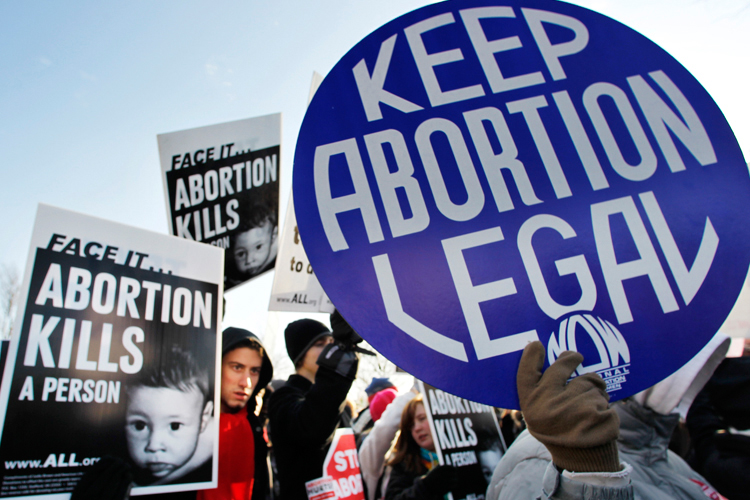

As the 40th anniversary of Roe v. Wadepassed, evangelical leaders marked the occasion with histories of how their community took up the anti-abortion cause. Mark Galli, editor-in-chief of Christianity Today, (with whom I engaged in a discussion-via-blog-post this past fall) has suggested the movement formed out of grassroots reflection on “the terrible and inevitable consequences of legalized abortion.” Albert Mohler, Southern Baptist Theological Seminary president, insisted it arose from moral outrage triggered by Roe v. Wade.
 Both histories provide pristine portraits of the origins of the evangelical right, suggesting its founders based their advocacy on scholarly assessments and aspired to noble political ends. But a history can be told that is significantly less flattering.
The right-wing evangelical movement was not an immediate backlash to Roe v. Wade. The evangelical community, unlike Roman Catholicism, showed little interest in combating abortion until almost 1980. As Jerry Falwell lamented in 1979, “The Roman Catholic Church for many years has stood virtually alone against abortion. I think it’s an indictment against the rest of us that we’ve allowed them to stand alone.”
Although evangelicals were mostly silent on abortion after Roe v. Wade, they were not silent on other political issues. Paul Weyrich, one of the evangelical right’s most influential founders, recalls that the movement initially emerged to defend racially segregated Christian schools from government intrusion:
[W]hat galvanized the Christian community was not abortion, school prayer, or the ERA [Equal Rights Amendment]. I am living witness to that because I was trying to get those people interested in those issues and I utterly failed. What changed their minds was Jimmy Carter’s intervention against the Christian schools, trying to deny them tax-exempt status on the basis of so-called de facto segregation.
In other words, as Randall Balmer has succinctly put it: “the religious right of the late twentieth century organized to perpetuate racial discrimination.”
Only after the movement was underway did it begin advocacy on abortion. It did so, in large part, based on highly dubious arguments advanced by the popular writer Francis Schaeffer.
Schaeffer held a master’s degree from Westminster Theological Seminary (though he went by “Dr. Schaeffer”) and argued, in 1979’s Whatever Happened to the Human Race? (co-written with the surgeon C. Everrett Koop, and offered as both book and film series), that legalized abortion represented an abandonment of the nation’s Judeo-Christian heritage. He is introduced in the film as “one of the world’s most respected thinkers”—a generous title given that Schaeffer plays loose with history, neglecting to mention that abortion was in fact legal when the nation was founded.
Schaeffer and Koop advance the argument that if evangelicals don’t mobilize to stop abortion, infanticide and involuntary euthanasia will soon become widespread.
They have to go back to Roman theologian Tertullian to reinforce their claim that the “orthodox position” is that life begins at conception, conveniently leaving out the fact that Church fathers Augustine and Aquinas—and most evangelicals up until the 1970s—are on the other side of the argument. As Aquinas put it (in a view that remained the official position of the Catholic Church from the medieval era to the mid-1800s), “The rational soul ought to be united to a body which may be a suitable organ of sensation… before the body has organs in any way whatever, it cannot be receptive of the soul.”
More sophisticated anti-abortion arguments were advanced once the movement was already underway, notably the 1982 publication of Michael Gorman’s Abortion and the Early Church or the 1984 publication of John Jefferson Davis’ Abortion and the Evangelical. But Schaeffer’s arugments are often cited by the founders of the evangelical right as what convinced them to take up the cause against abortion.
Just as influential, however, was pressure from Republican party operatives to form a movement that could steal socially conservative voters from Democrats. As Linda Greenhouse and Reva B. Siegel have written:
[F]eminist support for abortion rights had imbued the abortion issue with associations that could be tapped to mobilize a wide array of cultural conservatives… Strategists for the Republican Party approached Falwell and encouraged him to organize evangelicals as a ‘Moral Majority’ that would promote a ‘pro-family’ politics.
Once formed, the Moral Majority and its allies mobilized evangelicals to join Catholics in the fight against abortion by advancing a novel and tendentious interpretation of the Bible.
“The Bible clearly states that life begins at conception,” Falwell declared, referencing Luke 1:39–44 and Psalm 139:13–16.
“Abortion is not birth control nor family planning. It is murder according to the Word of God… It is time that medical students as well as every other person in our United States put those words ‘from the time of conception’ back into their thinking.”
Falwell and his array of allies disseminated this interpretation of the Bible, in a top-down political campaign, to millions of evangelicals across America, with mailers sporting titles like “Scriptures for Life.”
Given that the Bible, does not, in fact, teach that life begins at conception, evangelical scholars understandably emerged to challenge these views. The evangelical pro-life movement maintained momentum by actively suppressing such scholarship.
David Gareth Jones’ Brave New People was published by InterVarsity Press in 1984. The book, subtitled “Ethical Issues at the Commencement of Life,” argued for a moderate position on abortion, seeing embryos as morally valuable but not equivalent to children. Popular evangelical leaders across the country condemned the publication as a “monstrous book,” describing its author as on a “bandwagon bound for hell.” Evangelical outrage forced InterVarsity Press to withdraw a book for the first time in its history.
In 1989, Hessel Bouma III of the evangelical Calvin College teamed with several other Christian scholars to write Christian Faith, Health, and Medical Practice. They argued that the Bible does not actually teach that life begins at conception and that the new anti-abortion advocacy was unsupported by science, concluding while abortion may be morally wrong, “We should not support a right-to-life amendment that would grant personhood to fetuses from conception… personhood should be morally and legally granted to fetuses at the end of the second trimester.”
After the publication, Bouma was tarred a “pro-abortion” professor and Calvin College received a stream of demands that he resign. He later noted that many other evangelical scholars shared his view but were afraid to speak publicly about it in light of such reactions.
As the 40th anniversary of Roe v. Wade passes, it’s important to remember the both sides of the evangelical anti-abortion movement’s history. Yes, it did involve legitimate moral concerns about abortion, it did occasion serious reflection on the issue by evangelical scholars and pastors, and it did bring a formerly apolitical segment of America into the political process.
But its founding moral outrage stemmed not from Roe v. Wade, but from the prospect of government-imposed desegregation; it rest its intellectual foundation on highly dubious, non-scholarly arguments advanced by Francis Schaeffer; it mobilized lay evangelicals to action by telling them the Bible teaches something it does not actually teach; and it actively suppressed the scholarship of evangelicals who held alternative viewpoints.
Although it may be tempting to conclude with Mark Galli that “God uses the messiness of history to accomplish his will,” just because these strategies worked does not mean the movement has God’s endorsement.
Given the dubious origins of the evangelical pro-life movement, and the intractable nature of the conflict, perhaps the 40th anniversary of Roe v. Wade should serve as an occasion for evangelicals to reconsider their commitment to criminalizing abortion.
