
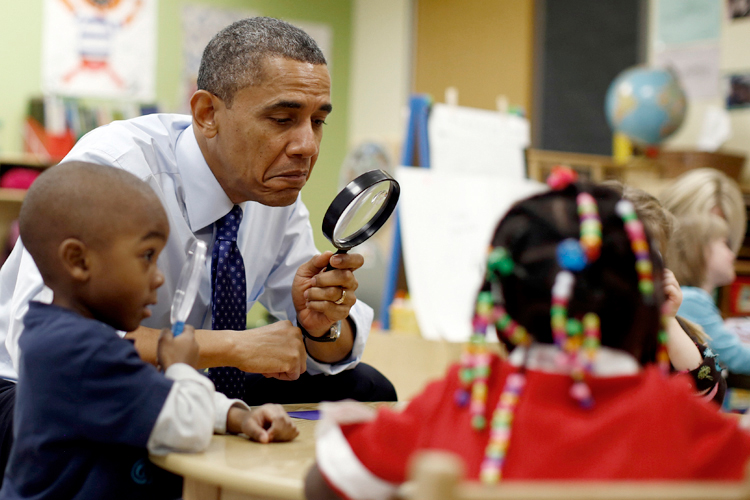

President Obama’s plan for universal preschool is as ambitious and crucial as his healthcare reform commitment, maybe more so. Citing research showing that investing a dollar in preschool saves $7 in the course of a child’s life, by improving their chances at finishing high school, avoiding early parenthood or prison, going to college and/or getting and holding a job, the president declared Tuesday night: “Let’s do what works, and make sure none of our children start the race of life already behind. Let’s give our kids that chance.”
On Thursday he unveiled a plan to partner with states to make universal preschool available to every four year old, and to expand programs for younger children from very low-income families via Early Head Start and other programs. “Fewer than 3 in 10 four year olds are enrolled in a high quality preschool program,” Obama declared after visiting one in Decatur, Ga. “The earlier a child starts learning, the better he or she does down the road. We are not doing enough to give all the kids that chance.”
Obama’s new crusade demands the question: If preschool is such a great value, why haven’t we made it a priority before?
The easy answer is that American social policy is rarely inspired by research. But the more honest answer is that preschool campaigns often get derailed by debates over how to provide it, and to whom, and at what cost. Preschool can seem like a social policy silver bullet: It can help kids do better in school, it can provide child care support for parents who need it; it can even serve as an employment program for teachers, aides and family support professionals, maybe moving some unemployed parents who need support for their kids into the workplace themselves.
The very fact that preschool proposals seem like the answer to so many social problems has led to a vexing outcome: they can be derailed by questions about costs, goals and turf, thus solving no problems at all. They are often oversold (the president may be making that mistake already.) “Can universal preschool solve all our problems?” a National Journal headline blared Thursday morning (a dumb headline on a smart piece). Of course, the answer is no – but done the right way, it can solve some of them.
I write from the perspective of someone who very much believes in the wisdom of investing in preschool, and who also knows the obstacles to enacting large-scale programs. Back in the 1980s, I worked for the California State Assembly Human Services Committee, which oversees subsidized childcare and preschool programs as well as welfare-to work programs. Later I consulted with an Oakland non-profit surveying the landscape of best practices in reducing urban poverty to promote what worked best.
Back then, and to this day, high quality preschool programs seemed to be the single best intervention to break the cycle of chronic poverty. And yet despite, or maybe because of, our many national, state and local efforts to build such programs for every family, truly large-scale success is elusive.
As Obama puts meat on the bones of his ambitious and hugely important new initiative, it’s worth visiting some long-standing obstacles to universal preschool. I’m giving this proposal an A-minus – and explaining why it wasn’t an A-plus at the end.
Here are the reasons even good plans stumble, and how the administration proposal addresses those problems.
….
They oversell its benefits.
Briefing reporters about the administration’s preschool proposals aboard Air Force One on Thursday, press secretary Josh Earnest repeated the president’s SOTU claim: “Every dollar we invest in a quality pre-school education will save seven dollars.” The number comes from Nobel Laureate economist James Heckman, whose findings are conservative compared to the claims of some advocates. So the White House isn’t pulling numbers out of the air, or peddling snake oil.
Still, Heckman’s work comes with a caveat: He studied the influential High/Scope Perry Preschool program, which served 123 African American children in Chicago in the 1960s (researchers also tracked a control group of the same size that didn’t go to preschool.) Perry indeed found remarkable gains in high school graduation and employment rates, and decreases in teen pregnancy, delinquency and crime rates.
When I first started studying preschool programs, Perry (and the long-term research into its results) was the gold standard, and it still is. But it was a small sample size in a high quality laboratory program that served children at age 3 and 4 (although Heckman says the unrivaled length of the study mitigates against its small sample size.) Other programs that have shown great long-term results target kids as early as infancy. Folks on the right are already picking at contradictions in the data the administration has used.
The best overview of the research, from an Ounce of Prevention study cited by the Center for American Progress, concluded that an at-risk child who doesn’t receive high-quality early childhood intervention is 25 percent more likely to drop out of school; 40 percent more likely to become a teen parent; 50 percent more likely to be placed in special education; 60 percent more likely not to attend college; and 70 percent more likely to be arrested for a violent crime. CAP CEO Neera Tanden, who cited those numbers in a Politico op-ed Thursday, says an overview of the literature shows about a 12 percent return on investment from high-quality programs. “To put those numbers in perspective, the stock market’s annual rate of return from the end of World War II through 2008 was only 5.8 percent,” Tanden notes.
The fact is, we don’t know how much a large-scale national preschool program would cost, let alone how much it would save in the long term. Obama is being intellectually honest when he uses Heckman’s data, but it should come with the fine print we find in advertising: results not guaranteed for all users. More broadly: Spending money on universal preschool targeted to four year olds will not deliver the kind of return on every dollar Heckman’s research found.
They fail to have a top priority.
Is Obama’s goal to close achievement gaps between poor children and the better off? Or is it to help parents by providing more high-quality childcare options? They’re not the same thing, although good programs can do both.
While the president’s Decatur speech was headlined “Preschool for All,” it’s appropriately aiming at lower income kids, who are less likely than upper middle class and wealthy kids to attend preschool. It will subsidize families up to 200 percent of the poverty level, and outline sliding scale services for those higher than that. It also contains new funding for programs that focus on even younger children from the poorest families, by extending the Early Head Start program that serves low-income infants and toddlers before they’re ready for Head Start.
That the president’s top priority is closing the achievement gap, rather than solving childcare problems, was clear from his remarks in Decatur. “Study after study shows the achievement gap starts out very young,” he told the crowd. “If they already have a lot fewer vocabulary words, if they don’t know their numbers and shapes, if they don’t have the capacity for focus, they’re gonna be behind that first day.” Good programs, Obama said, are “staffed with qualified, highly educated teachers. This is not babysitting. [Kids are] spending full days learning in classrooms with highly educated teachers.”
I support a national childcare initiative to deal with issues of quality, access and affordability. But we have to start somewhere, and Obama is starting in the right place.
They get bogged down in questions about the primary delivery vehicle: the public education system, or Head Start, or something entirely different?
“Preschool for All” appears to answer that question “all of the above” – and that’s the right answer, politically and pragmatically. No single existing program can serve all the children who need it, nor can any one program be ramped up quickly. The president also correctly avoids the turf battles that come with picking one system above all others.
Back in the late 1980s, Yale’s Edward Zigler, often considered the “father” of Head Start, proposed delivering childcare and preschool programs via the public school system with a bold “School of the 21st Century” proposal — and everyone from Head Start providers to school-voucher advocates howled at putting more money into our not-always-stellar education system. (Zigler’s plan eventually wove in those other programs to make the program less rigid and school-centric, but it remains a popular sort of pilot program, not a national entitlement.) Other plans have advocated a vast expansion of Head Start, because it already serves poor families and it provides a wide array of services, from dental care to nutrition to parent support.
Yet Head Start is dogged by questions about its effectiveness: a 2010 Department of Health and Human Services study found that overall, gains to students in the program faded by about third grade. Other longer-term Head Start studies have found lower drop out rates among graduates, but no Head Start research has found the kind of results boasted by Perry Preschool. (You’ll find that 2010 HHS study cited in every single conservative reaction to the president’s proposal, and lots of mainstream news stories, too.) And while one good thing about Head Start is that it draws teachers and aides from low-income communities, a downside is that it pays them poorly. Head Start is often defended at least partly as an employment and parent empowerment program, but it’s judged on its educational impacts, and they need to be greater.
The administration has already been working quietly on these issues: It’s gotten tougher on evaluating Head Start, and revoking contracts for programs that don’t work. Although Republicans like to focus on Head Start’s problems to undermine its fiscal support, “this White House is much more focused on evaluating and improving Head Start quality than the Bush administration was,” notes Tanden, who worked on these issues under Bill Clinton. And through its Race to the Top education reform effort, an “Early Learning Challenge” provided $600 million to 14 states to expand access to preschool and to improve its quality. The effort unveiled today is right to build on that approach. (And no, I’m not going to talk about the problems with “Race to the Top’s” K-12 test-hyping and teacher-blaming here; preschool is a tough enough subject.)
Kris Perry of the influential First Five Years Fund says the president’s decision to work through a broad array of existing providers, and to focus on the quality of the program, not the name of the agency on the front of the building, can help sell it nationally. “What’s important is that people see themselves in this proposal,” she says. “It recognizes that quality can be delivered in many forms, and says, ‘Once we tell you what high quality is, you’ll tell us how you’ll do it.’”
Tanden agrees, and also thinks the administration is right to try to get all programs to pay attention to education standards in the early grades. “The continuum is really important, from preschool to pre-K to kindergarten. You’ve got to give them the building blocks they need by the first grade. By third grade, we see there’s a fork in the road, and after that we can lose a lot of kids.” So even if programs aren’t run by or affiliated with public schools, they’ll need to pay attention to what schools demand, and the administration’s proposals require that. Interestingly, some of the states taking the lead on universal preschool – mainly pre-kindergarten for four year olds – are red states like Georgia and Oklahoma. Alabama is also moving quickly.
They’re either unclear on costs – or lowball them.
In its ambitious proposal for universal preschool for 3 and 4 year olds, the Center for American Progress estimates its cost at $98 billion. The administration is, for now, seeking universal programs for only four year olds via partnership with states, while also making some investments in programs for children three and younger. So it will cost significantly less. But so far the White House has said little about cost: It promised to include figures for the proposals in its next budget, but it promises the program will be revenue neutral. They may find a way to do it by cutting elsewhere and relying heavily on what states are already doing or planning, but I think it’s risky to pretend this can be done without new money.
….
Because it relies too much on research into a small, high quality intervention that’s never been scaled for its “$7 returns for every $1 spent” sloganeering, and because I’m afraid it’s lowballing costs, I’ve given the proposal an A minus rather than A-plus. But overall, I was surprised at how smart and comprehensive the plan is, and how much it learned from the mistakes of earlier initiatives.
Still, the operative word there is “plan.” Kris Perry says advocates have to pay close attention to the way it’s implemented, and she urges focusing more on the quality of the program than the number of kids served. “If you trade off key elements of the program as we go forward, you’re not going to see the results we’re promising. I think everybody should say ‘shoot for the moon, get a framework for good zero-to-five programming up and running while the president is still in office,’ and accept that we’re going to phase in funding over a longer period of time.” Perry compares it to the S-CHIP child insurance program inaugurated by Clinton and gradually expanded.
Some people may also worry that the president is using the language of “universalism,” which is what protects programs like Social Security and Medicare, when he’s proposing a very much means tested program with most resources targeted to the poor. I had a twinge of that myself, but I think he’s right. “Some people are complaining that it’s not really a ‘universal’ entitlement program like Medicare, but it doesn’t bother me,” says Neera Tanden. “You’ve got to get it to the people who need it most, and you wouldn’t want to supplant the money that upper middle class and wealthy parents are spending on their kids already. But it’s important to structure it so that you’re making good quality care affordable to more middle class families, too.” CAP’s research shows that kids from families making $50,000 a year are less likely to be enrolled in preschool than either poor kids or the wealthy.
Honestly, I’d love to see our public education entitlement begin at age three, for everyone, with targeted programs for even younger low-income kids. That’s the system enjoyed by many Western industrial democracies. We may get there eventually; this is the way to start. “It’s so hard to get politicians to do this because honestly, the true gains come 15 or 20 years down the road,” Tanden observes. “Where if you build a road, you see it right away, if you fund Social Security, seniors vote for you. As someone who’s been on the other side of this [in the Clinton White House], I think what they’re doing is really important. It’s a game changer.”
