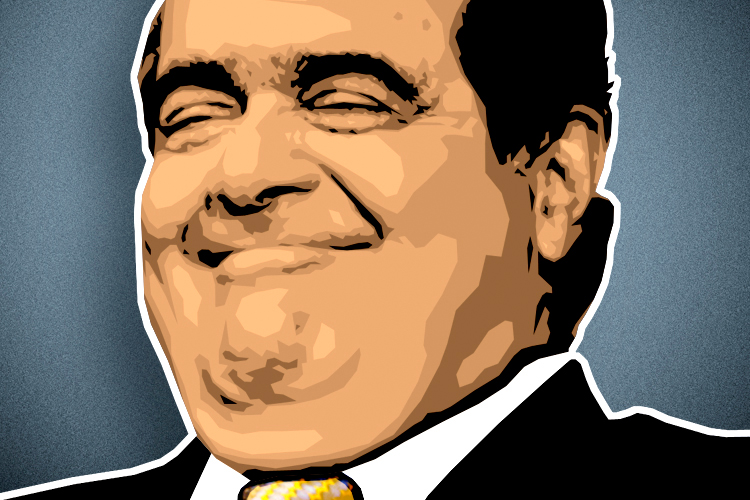

Scalia’s ugly racial cynicism
The Supreme Court justice treats voting rights as a goody given away by pandering politicians
By Joan WalshTopics: Voting Rights Act, Supreme Court, Antonin Scalia, Selma, John Lewis, John Roberts, Editor's Picks, News, Politics News
Four slow-moving ambulances brought up the rear as student leader John Lewis led 600 peaceful protesters dressed for church on the voting rights march that would become known as Selma’s Bloody Sunday, on March 7, 1965. They stayed peaceful; law enforcement officials didn’t. Trampled by police horses, choked by tear gas, beaten with billy clubs – Lewis had his skull fractured – the marchers would need more medical help than the four cars could provide. The ugly melee made national news that night: ABC broke into its presentation of “Judgment at Nuremberg” with footage of the violence, and viewers couldn’t be entirely sure where Nazi atrocities ended and their own country’s began.
Now, not far from Selma, Shelby County, Ala., is trying to take the teeth out of the Voting Rights Act that Lyndon B. Johnson hustled through Congress after Bloody Sunday. Even though the act was reauthorized by a Republican-dominated Congress in 2006 on a 98-0 vote in the Senate (it was 390-33 in the House), and signed by President Bush, and even though its constitutionality has been upheld by the Supreme Court four times, there is evidence that the current right-wing court majority would like to overturn at least part of it. Court conservatives once represented a reaction against the court’s supposed overreach into realms best left to Congress, and its willingness to ignore earlier court decisions. Now they seem set to say Congress has no business here, and that their Supreme Court predecessors who upheld the act were either mistaken or the blinkered creatures of their idiosyncratic eras.
Unbelievably, Antonin Scalia derided the act as a “racial entitlement,” prompting gasps from the crowd gathered to hear the arguments Wednesday. (As Rachel Maddow noted, Scalia seems to live for those gasps.) And he blamed Congress for pandering for votes by keeping that “racial entitlement” alive. The cynical Scalia sounded like Mitt Romney blaming his loss on President Obama delivering “gifts” to his coalition:
I don’t think there is anything to be gained by any Senator to vote against continuation of this act. And I am fairly confident it will be reenacted in perpetuity unless — unless a court can say it does not comport with the Constitution …They are going to lose votes if they do not reenact the Voting Rights Act. Even the name of it is wonderful: The Voting Rights Act. Who is going to vote against that in the future?
Indeed, the name of it is wonderful. With that remark, Scalia made clear (if he hadn’t already) that he’s more suited for the talk radio dial alongside Rush Limbaugh, Bill O’Reilly and Sean Hannity than he is for the Supreme Court bench.
The right-wing justice’s rant goes to the heart of long-held conservative ambivalence about democracy: that corrupt politicians will be able to buy off the rabble, with “spoils” or patronage or jobs; even outright gifts of cash. Only men of wealth, property and education could be trusted to rise above such rank bribery, which is why many states had property requirements and other limits on voting in the early days of our country; universal suffrage didn’t even reach all white men until 1830.
Still, Romney only railed against Obama providing “gifts” like healthcare to Latinos and contraceptives to women. Limbaugh called him “Santa Claus,” one of his nicer names for the president, for those popular new programs. A majority of Americans, O’Reilly opined during his election night self-pity party, “want stuff. And who is going to give them things? President Obama. He knows it, and he ran on it.”
But not even O’Reilly implied that the “stuff” Obama gave his voters included their constitutional right to vote.
As is his trademark, Chief Justice John Roberts put a more refined spin on Scalia’s elitist ranting. “Is it the government’s submission that the citizens in the South are more racist than the citizens in the North?” Roberts asked. To be fair, the gist of Roberts’ complaint seemed to be that federal oversight of a state function like voting regulations could only be compelled by compelling evidence of wrongdoing. Since it’s true that the South is no longer the place of violent Jim Crow – and it’s also true that some states that aren’t covered by Section 5 have taken steps to limit voting rights that civil rights advocates say have a discriminatory impact – Roberts and other court conservatives question whether it’s fair to single out the South for special, in-advance scrutiny of its changes to voter laws. “Why shouldn’t it apply everywhere in the country?” Justice Samuel Alito asked.
On JusticeWatch, Gilda Daniels criticizes the “assumption that because there are other wrongdoers that are not covered, Alabama, and states like it, should not be either. Essentially, they obliquely argue that if those other states get to have worse records than Alabama on voter registration and turnout then the federal government should not “punish” it with Section 5.” In fact, since 1965 other states and jurisdictions outside the South have come to be covered by Section 5 because of their egregious interference with the right to vote. But it is certainly true that some states that aren’t covered by Section 5 are imposing new voter restrictions: harsh ID laws in Pennsylvania, a cutback in early voting in Ohio and Wisconsin, and an end to the Sunday before Election Day voting hours that the black community had claimed for a last “Souls to the Polls” push in Wisconsin and other places. That doesn’t mean the covered states have stopped looking for ways to limit voting rights, but in a better world, Congress might well extend Section 5 to cover more states.
But this isn’t that world. Despite Johnson’s strong leadership, the 1965 Voting Rights Act passed with a higher percent of Republicans supporting it than Democrats, given that segregationist Democrats ran the South. But since then, the parties have to an extent traded sides. It’s true, and praiseworthy, that in 2006 Republicans supported the act’s reauthorization. But after President Obama was elected with record-breaking turnout by black and Latino voters in 2008, at least 38 states have tried to place new restrictions on voting, whether by increasing requirements to register or by limiting the number of days and locations where people can vote. Every single one of those laws, whether proposed or enacted, was sponsored by a Republican. Sadly, just since 2006, voting rights protection has become a partisan issue.
One of Shelby County’s central claims is that Section 5 is self-evidently outmoded in an age when we have a black president. But the act wasn’t designed to protect the rights of the occasional extraordinary African-American, like our first black president; a handful of blacks acceptable to the white power structure could vote back in Jim Crow Alabama, too. It was designed to protect the rights of all black voters, and of all voters.
The night before the 1965 Selma march finally made it to Montgomery, this time with federal protection, Harry Belafonte organized a gala celebration on a makeshift stage built of coffins. They had been donated by a black funeral home, one of those businesses that thrived under Jim Crow, since white undertakers wouldn’t bury the black community’s dead. Belafonte and Tony Bennett, Nina Simone and Joan Baez, Elaine May and Sidney Poitier, a dazzling roster of multiracial stars stood on those coffins and entertained a mostly black but multiracial crowd.
I’ve always found that image chilling and yet inspiring, as if Jim Crow lay in those coffins, and the entertainers were singing and dancing and telling jokes on its grave. Besides, the civil rights movement always defied death: Jimmie Lee Jackson, James Reeb and Viola Liuzzo died in the three weeks it took for several separate marches to finally cover the ground from Selma to Montgomery. Yesterday it felt as if Scalia lorded over that hearing on a bench built from figurative coffins, entombing the rights that Americans fought and bled and died for almost 50 years ago. If only his remarks could shock Americans in prime time, the way Selma interrupted “Judgment at Nuremberg” on that Sunday night almost 50 years ago, to inspire a new movement for voting rights.
Details on the Selma marches come from Rep. John Lewis’ fantastic 1998 memoir, “Walking With the Wind.” Read it.
Joan Walsh is Salon's editor at large and the author of "What's the Matter With White People: Finding Our Way in the Next America." More Joan Walsh.
You Might Also Like
More Related Stories
-
Bolivian plane suspected of carrying Snowden rerouted
-
Morsi takes to Twitter
-
Red-state women will transform America
-
Hummus: The yummy Middle Eastern invasion
-
Irish lawmakers back measure to allow for abortion in limited cases
-
Egyptian unrest squeezes Gaza
-
Female astronauts wear bras, says an astronaut
-
Bizarre gay pride photobomb makes it to front page of local paper
-
LeVar Burton explains how not to be killed by police
-
Meet the Wendy Davis truthers
-
Five states see new antiabortion laws go into effect
-
Egyptian protesters gather before military deadline
-
Gay and lesbian couples flock to California courts to wed
-
Justices Antonin Scalia and Elena Kagan hunt together
-
Edward Snowden has nowhere to go
-
Six amazing signs from the "Stand with Texas Women" rally
-
Edward Snowden releases statement from Moscow
-
X-ray vision, coming soon
-
Dark money group lies to IRS about being dark money group
-
Report: Computer user believed to be Adam Lanza discovered
-
Hey, GOP: Mexican immigrants aren't necessarily Democrats
Featured Slide Shows
7 motorist-friendly camping sites
close X- Share on Twitter
- Share on Facebook
- Thumbnails
- Fullscreen
- 1 of 9
- Previous
- Next
Sponsored Post
-
White River National Forest via Lower Crystal Lake, Colorado For those OK with the mainstream, White River Forest welcomes more than 10 million visitors a year, making it the most-visited recreation forest in the nation. But don’t hate it for being beautiful; it’s got substance, too. The forest boasts 8 wilderness areas, 2,500 miles of trail, 1,900 miles of winding service system roads, and 12 ski resorts (should your snow shredders fit the trunk space). If ice isn’t your thing: take the tire-friendly Flat Tops Trail Scenic Byway — 82 miles connecting the towns of Meeker and Yampa, half of which is unpaved for you road rebels. fs.usda.gov/whiteriveryou
Image credit: Getty
-
Chattahoochee-Oconee National Forest via Noontootla Creek, GeorgiaBoasting 10 wildernesses, 430 miles of trail and 1,367 miles of trout-filled stream, this Georgia forest is hailed as a camper’s paradise. Try driving the Ridge and Valley Scenic Byway, which saw Civil War battles fought. If the tall peaks make your engine tremble, opt for the relatively flat Oconee National Forest, which offers smaller hills and an easy trail to the ghost town of Scull Shoals. Scaredy-cats can opt for John’s Mountain Overlook, which leads to twin waterfalls for the sensitive sightseer in you. fs.usda.gov/conf
Image credit: flickr/chattoconeenf
-
Nordhouse Dunes Wilderness Area via Green Road, Michigan The only national forest in Lower Michigan, the Huron-Mainstee spans nearly 1 million acres of public land. Outside the requisite lush habitat for fish and wildlife on display, the Nordhouse Dunes Wilderness Area is among the biggest hooks for visitors: offering beach camping with shores pounded by big, cerulean surf. Splash in some rum and you just might think you were in the Caribbean. fs.usda.gov/hmnf
Image credit: umich.edu
-
Canaan Mountain via Backcountry Canaan Loop Road, West Virginia A favorite hailed by outdoorsman and author Johnny Molloy as some of the best high-country car camping sites anywhere in the country, you don’t have to go far to get away. Travel 20 miles west of Dolly Sods (among the busiest in the East) to find the Canaan Backcountry (for more quiet and peace). Those willing to leave the car for a bit and foot it would be remiss to neglect day-hiking the White Rim Rocks, Table Rock Overlook, or the rim at Blackwater River Gorge. fs.usda.gov/mnf
Image credit: Getty
-
Mt. Rogers NRA via Hurricane Creek Road, North CarolinaMost know it as the highest country they’ll see from North Carolina to New Hampshire. What they may not know? Car campers can get the same grand experience for less hassle. Drop the 50-pound backpacks and take the highway to the high country by stopping anywhere on the twisting (hence the name) Hurricane Road for access to a 15-mile loop that boasts the best of the grassy balds. It’s the road less travelled, and the high one, at that. fs.usda.gov/gwj
Image credit: wikipedia.org
-
Long Key State Park via the Overseas Highway, Florida Hiking can get old; sometimes you’d rather paddle. For a weekend getaway of the coastal variety and quieter version of the Florida Keys that’s no less luxe, stick your head in the sand (and ocean, if snorkeling’s your thing) at any of Long Key’s 60 sites. Canoes and kayaks are aplenty, as are the hot showers and electric power source amenities. Think of it as the getaway from the typical getaway. floridastateparks.org/longkey/default.cfm
Image credit: floridastateparks.org
-
Grand Canyon National Park via Crazy Jug Point, Arizona You didn’t think we’d neglect one of the world’s most famous national parks, did you? Nor would we dare lead you astray with one of the busiest parts of the park. With the Colorado River still within view of this cliff-edge site, Crazy Jug is a carside camper’s refuge from the troops of tourists. Find easy access to the Bill Hall Trail less than a mile from camp, and descend to get a peek at the volcanic Mt. Trumbull. (Fear not: It’s about as active as your typical lazy Sunday in front of the tube, if not more peaceful.) fs.usda.gov/kaibab
Image credit: flickr/Irish Typepad
-
As the go-to (weekend) getaway car for fiscally conscious field trips with friends, the 2013 MINI Convertible is your campground racer of choice, allowing you and up to three of your co-pilots to take in all the beauty of nature high and low. And with a fuel efficiency that won’t leave you in the latter, you won’t have to worry about being left stranded (or awkwardly asking to go halfsies on gas expenses).
Image credit: miniusa.com
-
Recent Slide Shows
-
7 motorist-friendly camping sites
-
Gripping photos: The people of the Turkey protests (slideshow)
-
The week in 10 pics
-
Photos: Turmoil and tear gas in Instanbul's Gezi Park - Slideshow
-
- Share on Twitter
- Share on Facebook
- Thumbnails
- Fullscreen
- 1 of 9
- Previous
- Next
-
The week in 10 pics
-
10 summer food festivals worth the pit stop
-
The week in 10 pics
-
The week in 10 pics
-
9 amazing drive-in movie theaters still standing
-
The week in 10 pics
-
The week in 10 pics
-
The week in 10 pics
-
The week in 10 pics
-
The week in 10 pics
-
The week in 10 pics
-
Netflix's April Fools' Day categories
-
The week in 10 pics
-
The week in 10 pics
-
The week in 10 pics
Related Videos
Most Read
-
We must hate our children Joan Walsh
-
NSA reportedly has secret data collection agreement with several European countries Prachi Gupta
-
The best of Tumblr porn Tracy Clark-Flory
-
James Clapper is still lying to America David Sirota
-
Thanks for nothing, college! Tim Donovan
-
Before Edward Snowden: "Sexual deviates" and the NSA Rick Anderson
-
You are how you sneeze Ryan O'Hanlon, Pacific Standard
-
SCOTUS: No right to remain silent unless you speak up Christopher Zara, International Business Times
-
The smearing of Rachel Jeantel Mary Elizabeth Williams
-
Texas Senate meets, promptly votes to recess until July 9 Katie Mcdonough
Popular on Reddit
links from salon.com

306 points307 points308 points | 14 comments

163 points164 points165 points | 22 comments

40 points41 points42 points | 6 comments
From Around the Web
Presented by Scribol
-
Michael A. Hardy: Being Whole
-

Rush Limbaugh: Fox News Ignored My Requests
-

Joseph A. Palermo: The Culture Wars Are Alive and Kickin' (A Disaster for Women and the Environment)
-

Keystone XL Foes Turn Focus To Local Government
-
Robin Koerner: The Triumph of Culture Over Politics: Edward Snowden and American Independence
-
Helicopter with Swedish tourists makes emergency landing in Hudson River
-
France's far-right political leader Marie Le Pen loses MEP immunity
-
Siberia helicopter crash kills 19
-
Kabul: Taliban attack on NATO contractor compound kills at least eight
-
Ricardo Reyes Zamudio, Mexican mayoral candidate, killed by gunmen


Comments
151 Comments