
Michelle Obama’s underrated role in gun debate

In a gun debate dominated by men, one person finally transcended it by speaking directly to black mothers

Topics: Michelle Obama, Black women, Guns, Gun Control, Chicago, Michael Bloomberg, Wayne LaPierre, Violence, Gun Violence, ,

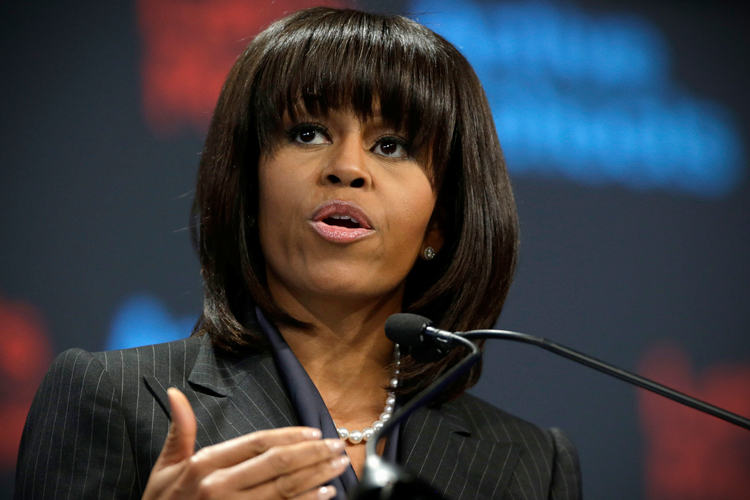
Michelle Obama's underrated role in gun debateMichelle Obama (Credit: AP/M. Spencer Green)

Much has been made of the prominence of men like President Obama, Michael Bloomberg and Wayne LaPierre in the nation’s current debate on gun safety reform. But less attention has been placed on the singular and transformational role of Michelle Obama.

The first lady elevated the conversation Wednesday, during a rare return to her hometown of Chicago. In a city ravaged by violence, with more than 500 gun-related homicides last year alone, she spoke eloquently — and apolitically — transcending the partisan politics that seem to subvert her husband’s efforts for reasonable gun control legislation.

But what was most unique was for whom, and to whom, Michelle spoke. Her words gave voice to an oft ignored (but disproportionately affected) victim of America’s gun violence: the black mother.

The first lady spoke of Hadiya Pendleton, the slain 15-year-old student, gunned down just blocks from the Obama’s Chicago home — and only days after Pendleton had attended the president’s second inauguration. With tears in her eyes, Michelle said, “Hadiya Pendleton was me and I was her.” The first lady went on to add that Pendleton’s family is “just like” her own.

It was a display of empathy rarely seen from one so seemingly privileged. Yet for Michelle Obama it was the most natural thing to say. This is a daughter of the South Side — fully aware of her place in the world. Her tears appeared all the more heavy, because she could easily imagine Sasha and Malia walking down the same streets that Hadiya did.

And herein lies the real power of America having its first African-American president and first lady: They are us

When Trayvon Martin was killed last year President Obama was reticent to address it. The nation quickly became polarized as early reports of the circumstances surrounding the teenager’s death suggested an all-too-common narrative of young black boys being suspected of crime — assumed guilty, before proven innocent. Yet this was different. A boy holding Skittles and iced tea being met with a fatal bullet wound to the chest resonated across racial lines. The president, speaking in the Rose Garden, sent an empathetic message to the parents saying, “If I had a son, he’d look like Trayvon.”


It was a simple truth, that held so much meaning.

For many African-Americans, the comment expressed a rare solidarity that Obama (despite his mixed heritage and desire to transcend race — as president of all) fully identified with them. As could be suspected, the president’s foes exploited the moment. Conservative talk radio’s Rush Limbaugh attacked Obama for inciting racial animus, and then-GOP presidential hopeful Newt Gingrich ignorantly questioned if Obama would care less if the boy were “a white.” America’s long history of ignoring, demeaning and marginalizing the lives of black men, women and children — were lost on the president’s critics.

The circumstances surrounding Martin’s death focused more on the peculiar stand-your-ground laws, police negligence and old racial codes. Though stricter gun control should have also been central to the debate, particularly since George Zimmerman’s past criminal record had not prevented him from legally possessing a firearm, the debate never happened.

The tragic deaths of 20 precious first-graders at Sandy Hook Elementary School in Newtown, Conn., at first appeared wildly different.

A movement followed, sparking legislative proposals requiring universal background checks for gun purchases and limited access to assault weapons and extended magazine clips.

The massacre has challenged the national consciousness, in part, because of the sheer optics: A presumably safe suburban town, innocent kids slaughtered — and all but one of those children were white. Perhaps race shouldn’t matter. But it does.

Anna Marquez-Greene was the only non-white child murdered in Newtown, yet her tender face resembles that of far too many black and brown children killed in America’s urban centers. Chicago’s gun violence seems to have been almost deliberately placed at the foot of the president, and perhaps that is serendipitous, as it has forced a broader conversation about what occurs every day in Newark, Baltimore, Detroit, Los Angeles and New York.

The assault weapons used at Sandy Hook — and the physical damage Adam Lanza wreaked — is hardly ever part of the urban experience. But the death toll for brown children is infinitely more. This is where Michelle’s words meet the souls of black folks.

The nation has cavalierly turned a blind eye as innocent African-American boys and girls were buried, one after the other. And life imitates art. Toni Morrison invokes these sentiments in the “The Bluest Eye,” saying of the sad demise of a black female child, “we acquiesce and say the victim had no right to live. We are wrong, of course. But it doesn’t matter. It’s too late. At least in my town, among the sunflowers and garbage of my town, it’s much, much, much too late.”

It is that kind of urgency which first lady Michelle Obama appears to have conveyed Wednesday — seeking to bring attention to the senseless violence in her town. Hopefully, it is not too late.

Edward Wyckoff Williams

Edward Wyckoff Williams is contributing editor at The Root. He is a columnist and political analyst, appearing on AlJazeera, MSNBC, ABC, CBS Washington and national syndicated radio. Follow him on Twitter .

Featured Slide Shows

7 motorist-friendly camping sites

close X
  • Share on Twitter
  • Share on Facebook
  • Thumbnails
  • Fullscreen
  • 1 of 9

Sponsored Post

  • White River National Forest via Lower Crystal Lake, Colorado
    For those OK with the mainstream, White River Forest welcomes more than 10 million visitors a year, making it the most-visited recreation forest in the nation. But don’t hate it for being beautiful; it’s got substance, too. The forest boasts 8 wilderness areas, 2,500 miles of trail, 1,900 miles of winding service system roads, and 12 ski resorts (should your snow shredders fit the trunk space). If ice isn’t your thing: take the tire-friendly Flat Tops Trail Scenic Byway — 82 miles connecting the towns of Meeker and Yampa, half of which is unpaved for you road rebels.
    fs.usda.gov/whiteriveryou


    Image credit: Getty

  • Chattahoochee-Oconee National Forest via Noontootla Creek, Georgia
    Boasting 10 wildernesses, 430 miles of trail and 1,367 miles of trout-filled stream, this Georgia forest is hailed as a camper’s paradise. Try driving the Ridge and Valley Scenic Byway, which saw Civil War battles fought. If the tall peaks make your engine tremble, opt for the relatively flat Oconee National Forest, which offers smaller hills and an easy trail to the ghost town of Scull Shoals. Scaredy-cats can opt for John’s Mountain Overlook, which leads to twin waterfalls for the sensitive sightseer in you.
    fs.usda.gov/conf


    Image credit: flickr/chattoconeenf

  • Nordhouse Dunes Wilderness Area via Green Road, Michigan
    The only national forest in Lower Michigan, the Huron-Mainstee spans nearly 1 million acres of public land. Outside the requisite lush habitat for fish and wildlife on display, the Nordhouse Dunes Wilderness Area is among the biggest hooks for visitors: offering beach camping with shores pounded by big, cerulean surf. Splash in some rum and you just might think you were in the Caribbean.
    fs.usda.gov/hmnf


    Image credit: umich.edu

  • Canaan Mountain via Backcountry Canaan Loop Road, West Virginia
    A favorite hailed by outdoorsman and author Johnny Molloy as some of the best high-country car camping sites anywhere in the country, you don’t have to go far to get away. Travel 20 miles west of Dolly Sods (among the busiest in the East) to find the Canaan Backcountry (for more quiet and peace). Those willing to leave the car for a bit and foot it would be remiss to neglect day-hiking the White Rim Rocks, Table Rock Overlook, or the rim at Blackwater River Gorge.
    fs.usda.gov/mnf


    Image credit: Getty

  • Mt. Rogers NRA via Hurricane Creek Road, North Carolina
    Most know it as the highest country they’ll see from North Carolina to New Hampshire. What they may not know? Car campers can get the same grand experience for less hassle. Drop the 50-pound backpacks and take the highway to the high country by stopping anywhere on the twisting (hence the name) Hurricane Road for access to a 15-mile loop that boasts the best of the grassy balds. It’s the road less travelled, and the high one, at that.
    fs.usda.gov/gwj


    Image credit: wikipedia.org

  • Long Key State Park via the Overseas Highway, Florida
    Hiking can get old; sometimes you’d rather paddle. For a weekend getaway of the coastal variety and quieter version of the Florida Keys that’s no less luxe, stick your head in the sand (and ocean, if snorkeling’s your thing) at any of Long Key’s 60 sites. Canoes and kayaks are aplenty, as are the hot showers and electric power source amenities. Think of it as the getaway from the typical getaway.
    floridastateparks.org/longkey/default.cfm


    Image credit: floridastateparks.org

  • Grand Canyon National Park via Crazy Jug Point, Arizona
    You didn’t think we’d neglect one of the world’s most famous national parks, did you? Nor would we dare lead you astray with one of the busiest parts of the park. With the Colorado River still within view of this cliff-edge site, Crazy Jug is a carside camper’s refuge from the troops of tourists. Find easy access to the Bill Hall Trail less than a mile from camp, and descend to get a peek at the volcanic Mt. Trumbull. (Fear not: It’s about as active as your typical lazy Sunday in front of the tube, if not more peaceful.)
    fs.usda.gov/kaibab


    Image credit: flickr/Irish Typepad

  • As the go-to (weekend) getaway car for fiscally conscious field trips with friends, the 2013 MINI Convertible is your campground racer of choice, allowing you and up to three of your co-pilots to take in all the beauty of nature high and low. And with a fuel efficiency that won’t leave you in the latter, you won’t have to worry about being left stranded (or awkwardly asking to go halfsies on gas expenses).


    Image credit: miniusa.com

  • Recent Slide Shows

  • Share on Twitter
  • Share on Facebook
  • Thumbnails
  • Fullscreen
  • 1 of 9

Comments

40 Comments

Comment Preview

Your name will appear as username ( settings | log out )

You may use these HTML tags and attributes: <a href=""> <b> <em> <strong> <i> <blockquote>