
Americans should expect acts of terror

Tom Brokaw was right: Our violent attacks abroad increase the chance of retributive attacks at home

Topics: Boston Marathon, Boton Bombings, Terrorism, Boston, Tom Brokaw, NBC, Drones, Barack Obama,

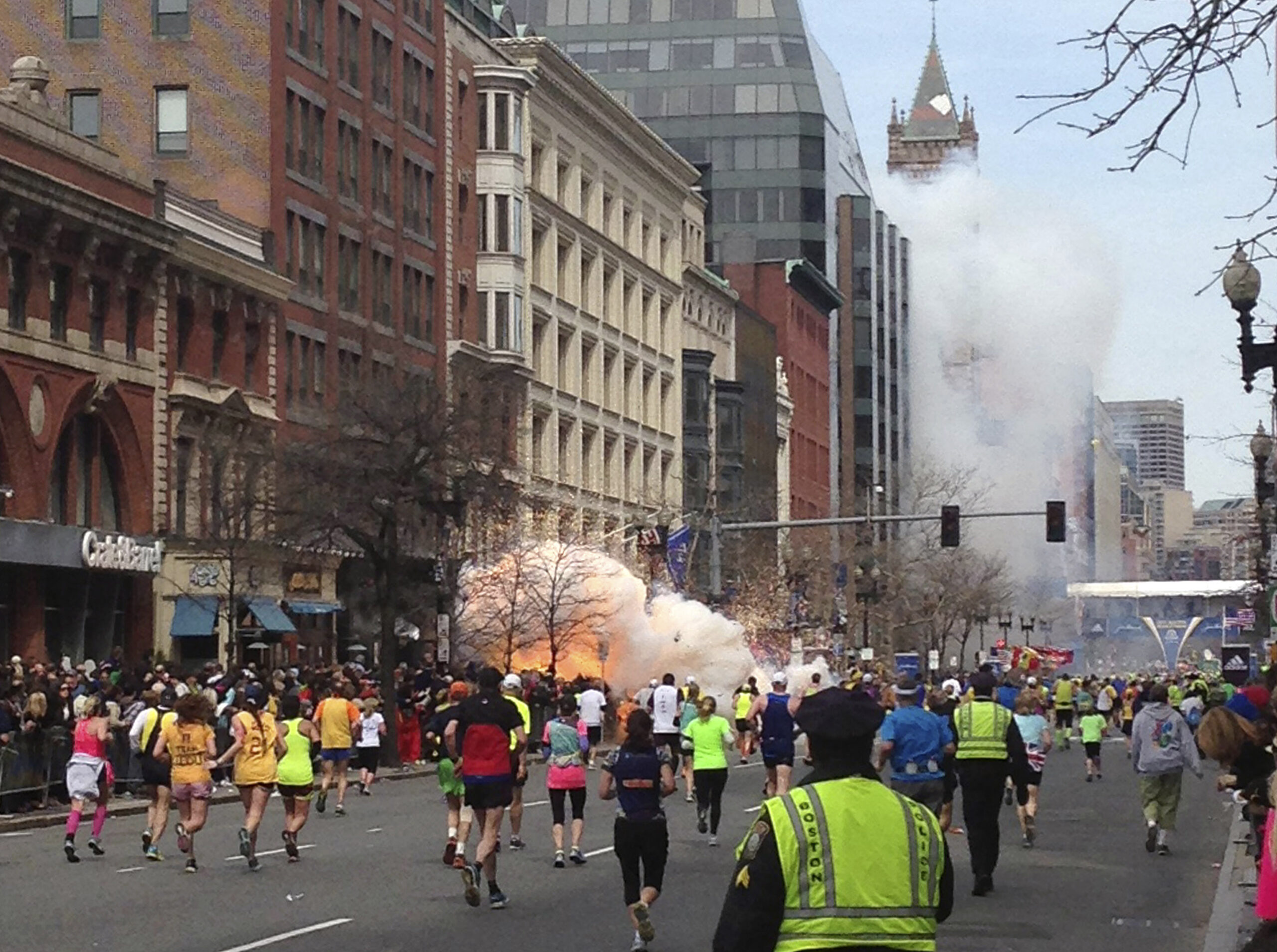
Americans should expect acts of terrorRunners continue to run towards the finish line of the Boston Marathon as an explosion erupts near the finish line. (Credit: Reuters/Dan Lampariello)

“The stuff we have done overseas is now brought back into our own front yards. America’s chickens are coming home to roost.” — Reverend Jeremiah Wright

In 2008, the hysterical backlash to the above comment by Barack Obama’s minister became a high-profile example of one of the most insidious rules in American politics: You are not allowed to honestly discuss the Central Intelligence Agency’s concept of “blowback” without putting yourself at risk of being deemed a traitor to country.

Now, five years later, with America having killed thousands of Muslim civilians in its drone strikes and wars, that rule is thankfully being challenged, and not by someone who is so easily smeared. Instead, the apostate is one of this epoch’s most revered journalists, and because of that, we will see whether this country is mature enough to face one of its biggest national security quandaries.

This is the news from Tom Brokaw’s appearance on “Meet the Press” last Sunday. Discussing revelations that the bombing suspects may be connected to Muslim fundamentalism, he said:

“We have got to look at the roots of all of this because it exists across the whole (Asian) subcontinent and the Islamic world around the world. I think we also have to examine (America’s) use of drones (because) there are a lot of civilians who are innocently killed in a drone attack in Pakistan, in Afghanistan and in Iraq. And I can tell you having spent a lot of time over there, young people will come up to me on the streets and say, ‘We love America, but if you harm one hair on the head of my sister, I will fight you forever.’ And there is this enormous rage against what they see in that part of the world as a presumptuousness of the United States.”

As one of the establishment’s most venerated voices, Brokaw is not prone to radical statements. But in a nation that often avoids acknowledging its own role in intensifying cycles of violence, it is unfortunately considered radical to do what the NBC News veteran did and mention that our violent attacks abroad increase the chance of retributive attacks at home.

Of course, Brokaw was merely stating the obvious: With America having killed thousands of civilians in its wars, we should be appalled by acts of terrorism — but we shouldn’t be surprised by them. We should know that violence will inevitably come from those like the Boston bombing suspect who, according to the Washington Post, “told interrogators that the American wars in Iraq and Afghanistan motivated him and his brother to carry out the attack.”


Noting this is not to argue that such attacks are justified or that we deserve them. It is only to reiterate what Brokaw alluded to: Namely, that blowback should be expected in this age of Permanent War and that one way to potentially avert such blowback in the future is to try to deescalate the cycle of violence.

To be sure, from the Rev. Wright to Republican presidential candidate Ron Paul, many have made these points before. But they have typically been ignored or lambasted for uttering the truth. Brokaw, though, can’t be so readily dismissed. He is a Walter Cronkite of his age, and, indeed, his declaration recalls Cronkite’s seminal moment 45 years ago.

Back in 1968, opponents of the Vietnam War were being marginalized in much the same way critics of today’s wars now are. But when such a revered voice as Cronkite took to television to declare the conflict an unwinnable “stalemate,” he helped create a tipping point whereby Americans began to reconsider their assumptions.

In similarly making such an assumption-challenging statement, Brokaw has followed in Cronkite’s heroic footsteps. The only question is: Will America finally listen?

David Sirota

David Sirota is a nationally syndicated newspaper columnist, magazine journalist and the best-selling author of the books "Hostile Takeover," "The Uprising" and "Back to Our Future." E-mail him at ds@davidsirota.com, follow him on Twitter @davidsirota or visit his website at www.davidsirota.com.

Featured Slide Shows

7 motorist-friendly camping sites

close X
  • Share on Twitter
  • Share on Facebook
  • Thumbnails
  • Fullscreen
  • 1 of 9

Sponsored Post

  • White River National Forest via Lower Crystal Lake, Colorado
    For those OK with the mainstream, White River Forest welcomes more than 10 million visitors a year, making it the most-visited recreation forest in the nation. But don’t hate it for being beautiful; it’s got substance, too. The forest boasts 8 wilderness areas, 2,500 miles of trail, 1,900 miles of winding service system roads, and 12 ski resorts (should your snow shredders fit the trunk space). If ice isn’t your thing: take the tire-friendly Flat Tops Trail Scenic Byway — 82 miles connecting the towns of Meeker and Yampa, half of which is unpaved for you road rebels.
    fs.usda.gov/whiteriveryou


    Image credit: Getty

  • Chattahoochee-Oconee National Forest via Noontootla Creek, Georgia
    Boasting 10 wildernesses, 430 miles of trail and 1,367 miles of trout-filled stream, this Georgia forest is hailed as a camper’s paradise. Try driving the Ridge and Valley Scenic Byway, which saw Civil War battles fought. If the tall peaks make your engine tremble, opt for the relatively flat Oconee National Forest, which offers smaller hills and an easy trail to the ghost town of Scull Shoals. Scaredy-cats can opt for John’s Mountain Overlook, which leads to twin waterfalls for the sensitive sightseer in you.
    fs.usda.gov/conf


    Image credit: flickr/chattoconeenf

  • Nordhouse Dunes Wilderness Area via Green Road, Michigan
    The only national forest in Lower Michigan, the Huron-Mainstee spans nearly 1 million acres of public land. Outside the requisite lush habitat for fish and wildlife on display, the Nordhouse Dunes Wilderness Area is among the biggest hooks for visitors: offering beach camping with shores pounded by big, cerulean surf. Splash in some rum and you just might think you were in the Caribbean.
    fs.usda.gov/hmnf


    Image credit: umich.edu

  • Canaan Mountain via Backcountry Canaan Loop Road, West Virginia
    A favorite hailed by outdoorsman and author Johnny Molloy as some of the best high-country car camping sites anywhere in the country, you don’t have to go far to get away. Travel 20 miles west of Dolly Sods (among the busiest in the East) to find the Canaan Backcountry (for more quiet and peace). Those willing to leave the car for a bit and foot it would be remiss to neglect day-hiking the White Rim Rocks, Table Rock Overlook, or the rim at Blackwater River Gorge.
    fs.usda.gov/mnf


    Image credit: Getty

  • Mt. Rogers NRA via Hurricane Creek Road, North Carolina
    Most know it as the highest country they’ll see from North Carolina to New Hampshire. What they may not know? Car campers can get the same grand experience for less hassle. Drop the 50-pound backpacks and take the highway to the high country by stopping anywhere on the twisting (hence the name) Hurricane Road for access to a 15-mile loop that boasts the best of the grassy balds. It’s the road less travelled, and the high one, at that.
    fs.usda.gov/gwj


    Image credit: wikipedia.org

  • Long Key State Park via the Overseas Highway, Florida
    Hiking can get old; sometimes you’d rather paddle. For a weekend getaway of the coastal variety and quieter version of the Florida Keys that’s no less luxe, stick your head in the sand (and ocean, if snorkeling’s your thing) at any of Long Key’s 60 sites. Canoes and kayaks are aplenty, as are the hot showers and electric power source amenities. Think of it as the getaway from the typical getaway.
    floridastateparks.org/longkey/default.cfm


    Image credit: floridastateparks.org

  • Grand Canyon National Park via Crazy Jug Point, Arizona
    You didn’t think we’d neglect one of the world’s most famous national parks, did you? Nor would we dare lead you astray with one of the busiest parts of the park. With the Colorado River still within view of this cliff-edge site, Crazy Jug is a carside camper’s refuge from the troops of tourists. Find easy access to the Bill Hall Trail less than a mile from camp, and descend to get a peek at the volcanic Mt. Trumbull. (Fear not: It’s about as active as your typical lazy Sunday in front of the tube, if not more peaceful.)
    fs.usda.gov/kaibab


    Image credit: flickr/Irish Typepad

  • As the go-to (weekend) getaway car for fiscally conscious field trips with friends, the 2013 MINI Convertible is your campground racer of choice, allowing you and up to three of your co-pilots to take in all the beauty of nature high and low. And with a fuel efficiency that won’t leave you in the latter, you won’t have to worry about being left stranded (or awkwardly asking to go halfsies on gas expenses).


    Image credit: miniusa.com

  • Recent Slide Shows

  • Share on Twitter
  • Share on Facebook
  • Thumbnails
  • Fullscreen
  • 1 of 9

Comments

312 Comments

Comment Preview

Your name will appear as username ( settings | log out )

You may use these HTML tags and attributes: <a href=""> <b> <em> <strong> <i> <blockquote>