
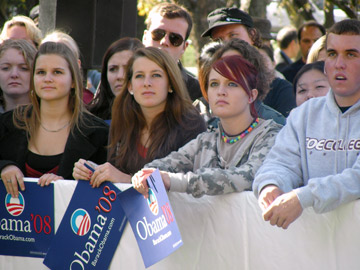

 The economy is personal. It colors our decisions about everything: when to have kids, what city to move to, who to vote for, who to sleep with. And nobody knows this better than the biggest generation in history: the Millennials. These 80 million Americans have come of age during the worst economic recession since the Depression, an experience that will have profound repercussions on our lives—and our political consciousness.
I call us the Crash Generation. For many of us in our twenties, 2008 was a period awash in exhilarating highs and terrifying lows. The words “depression,” “economic crisis,” “mass layoffs,” and “foreclosures,” along with “hope,” “change,” and “Obama,” all clogged the headlines and made their way into whiskey-fueled party conversations. Washington and the media had never been so frank about the cataclysmic proportions of a financial crash. And a candidate had never kicked young voters into such high gear like Barack Obama, who seemed to reflect the seismic demographic shift our generation was heralding. The mythic American dream-bubbles were bursting for young people at the exact moment we had begun to wield our political influence. That second half of 2008 was our JFK assassination. Our Vietnam. Our Great Depression.
Study after study finds that Millennials are “materialistic” or obsessed with money. But really we’re obsessed with the money we don’t have; put in political terms, we’re class-conscious. Thanks to Occupy Wall Street and Mitt Romney’s slipups, the concept of income inequality is finally part of the public conversation. The economic patterns of the past few decades, with the financial crisis as their crescendo, have yielded an atmosphere ripe for a youth-led social movement that hinges on our bottom lines. Because of our sheer numbers, we have enormous potential to transform waves into tsunamis, and we have already flexed our political muscle in two elections. Those of us who came of age when the bubble burst, particularly the downwardly mobile “privileged poor,” have a tangible common experience, a renewed indignation.
But too often, this indignation often has nowhere to go, and is enveloped in our frenetic lives of multiple jobs, demoralizing underemployment, or joblessness—the constant physical and emotional stress of keeping our heads above water. Years later, the status quo has not budged. We haven’t done much to shrink the income gap or encourage upward mobility. We haven’t gotten our leaders to address anemic state budgets, deregulation, unions’ decline, freelancers’ precarity, shrinking wages, student debt, or the insane cost of living in major cities. All those economic pressures have primed this era for an economic shift. Yet those same pressures limit our freedom to protest or push for policy changes. In other words, we’re pissed—but we’re paralyzed by the very forces we’re pissed about.
Right now, most of the permanent underclass feels politically frozen: When one missed paycheck means descending into poverty without a safety net, unions and political activism seem like a low priority. Educated young people are frozen, too—caught in the privileged-poor paradox. Our meager (or nonexistent) paychecks incite righteous anger—especially when we think of our middle class parents’ luck at their age—but they also choke our very ability to organize, create, and take risks. As our wages fall, our degrees lose value, prices of food and rent rise, and workdays expand, we have less and less time to read a book, to join a rally in the next town over, to hop a bus to Washington, to even have a hours-long discussion about politics with our friends. Most Millennials aren’t starving, Great Depression-style, but they are starved for a low cost of living and a baseline of economic freedom.
Here’s the good news: For every 10 twentysomethings seized with frustration, there’s one pushing the conversation forward and coming up with compelling solutions, however flawed or nascent. This seething discontent signals the start of a major shift. The fizzling of Occupy Wall Street, for instance, shouldn’t depress us; Roosevelt Institute fellow Dorian Warren recently reminded me that if this is our civil rights movement, we’re only in 1957—a year after the Montgomery bus boycott. So far, our empty wallets and our denial have hindered our ability to meaningfully influence policy, but that doesn’t mean it won’t happen soon.
Some people think that entrepreneurship, not government policy, will save Millennials. The truth is, not everyone has the support and connections to launch their own business or score a job at a scrappy start-up. Besides, start-up culture and economic reform aren’t mutually exclusive. In a post-recession era, both social change and entrepreneurism stem from being able to live securely and cheaply. A 2008 study from the RAND Corporation found evidence of “entrepreneurship lock,” where workers resist leaving firms offering health care due to the high premiums of the individual health insurance market. Compare this reticence to places like Norway: When journalist Max Chafkin visited the country in 2010, he reported on a spate of Norwegian entrepreneurs who not only were happy to pay high taxes, but attributed their penchant for risk-taking to a strong social safety net. (There are also more entrepreneurs per capita in Norway than in the United States. Same with Canada, Denmark, and Switzerland.)
Millennials are starting to realize that if their lives are going to improve, there needs to be policy that addresses unemployment, student debt, and income inequality. Young people like the ones striking outside McDonald’s in New York, or the students who won a minimum wage hike in San Jose, or the ones in Roosevelt’s Pipeline and Campus Network across the country—they’re all updating historic social movements (and the policies they’ve pushed) that have improved the lives of middle and working class Americans.
The future movers and shakers of the Crash Generation have a modern sensibility. We’re Internet natives. We’re optimists. We believe in community and the “sharing economy.” We’ve all but settled the culture wars. But we also have faith in the idea of government, if not its current reality, and we’re not afraid to engage with successful historical models.
