
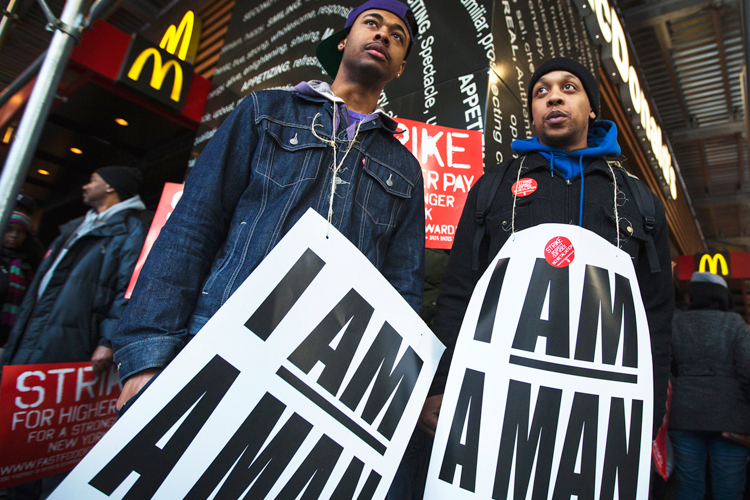

For the third time in five weeks, non-union fast food workers in a major American city are headed out on strike. Starting at 5 p.m. Central Time today, dozens of employees plan to walk off the job in St. Louis, following similar strikes in Chicago April 24, and in New York City on Nov. 29 and April 4. Like their counterparts in New York and Chicago, the St. Louis workers are demanding a $15 an hour wage, and the chance to form a union without intimidation.
“I just feel that if we don’t stand up now, it’s never going to happen,” said Tomecka Wilson, a 32-year-old who works for the seafood chain Captain D’s. “They’re making billions off of us making little to nothing. So they can afford to share a little bit more.”
Organizers expect 50 to 70 St. Louis workers to strike over the next 24 hours, including workers from McDonald’s, Wendy’s, Hardee’s and Domino’s. The strike got an early start this morning, when a group of workers at a Jimmy John’s went out on strike in protest over alleged humiliation by management: They say their boss required them to wear signs stating that they worked too slowly. “It’s clearly getting national traction,” said Ed Ott, a lecturer in labor studies for the City University of New York, consultant for unions, and board member of New York Communities for Change, the group spearheading fast food organizing in the nation’s largest city. “This is potentially the largest organizing drive in decades.”
Like the strikes by fast food workers in New York, and by a mix of fast food and retail workers in Chicago, the St. Louis campaign is backed by coalitions of unions and community organizing groups. The Service Employees International Union is a significant supporter of each of these campaigns, and of similar efforts elsewhere that have not yet gone public. According to organizers, last month’s strike in New York drew about 400 strikers, double the turnout from a previous strike in November. The Chicago strike drew about 300 (before that walkout, a leader of a group spearheading the effort had told Salon she expected 500).
Wilson, who’s pregnant and expecting to give birth in five weeks, told Salon that her job requires her to stay on her feet for several hours without breaks, taking orders, ringing up customers and making food – all while being yelled at by managers and customers. She said her feet are swollen to the point that she’s stopped wearing shoes outside of work, and her doctor has told her to wear a brace. But Wilson told Salon that she laughed off a manager’s suggestion that she take unpaid maternity leave, because the company’s low wages and insufficient hours have made that impossible to afford. Already, she said, “I’m borrowing to make ends meet.”
Wilson told Salon she lives with — and provides assistance to — her mother, who’s disabled, and her grandmother, who has dementia. Her future child’s father also works for Captain D’s. She said her sisters – one works as an IHOP server, one works at a hospital, and one is unemployed – won’t be able to afford to provide much support for the baby.
“I’ve only gained seven pounds since I’ve been pregnant,” Wilson told Salon. “And I’m supposed to be way bigger now.” She said she already depends for food on food banks, churches, and what she can eat at work. When her application for food stamps was rejected, “I sat there and I cried my eyes out.” “It feels like it’s set up for us to fail,” said Wilson. “And I don’t want to keep failing …” And so when organizers from the union campaign first came to talk to her at her store, “I was like, ‘Wow, what took you guys so long?’”
These fast food campaigns, and the recent strike wave against Wal-Mart, represent the most dramatic challenges by the embattled U.S. labor movement to two industries that increasingly define the new U.S. economy. The St. Louis campaign, called STL Can’t Survive on $7.35, is spearheaded by the labor-community organizing group St. Louis Jobs With Justice. “These are the fast growing jobs, but they’re also the lowest paying,” said Rev. Martin Rafanan, the campaign director for the effort. “So this is where we have to pay attention.”
The top three job categories measured by the Bureau of Labor Statistics are all jobs done by fast food or retail workers, and the dominant conditions in these industries also increasingly typify work in America: low wages, unreliable scheduling, miserly benefits and no unions. With an economy shifting further toward the service sector, and lower-wage “recovery” jobs replacing better ones lost in the recession, labor’s future depends in significant part on whether workers at companies like McDonald’s and Wal-Mart can – like garment and auto workers before them – band together and wrest some power from their bosses.
That’s a very difficult task, and not by accident: Political, judicial and economic assaults have weakened the protections the law offers workers to organize, and restricted the weapons at their disposal against management. The limits of some of labor’s other tactics – working through the government-supervised union election process; relying on P.R. campaigns to compel companies to negotiate; backing Democrats in hopes they’ll fix labor law – help explain why organizers are taking up the strike, despite all of the challenges that come with it.
Some of the features these recent strikes share in common can best be understood as strategies for dodging those obstacles: striking for just one day in order to draw more workers, and more attention, at less risk; citing labor law violations as a cause for the strikes in order to bolster workers’ legal protection; staging actions with a minority of the workforce in hopes that it will inspire more of their co-workers to get involved.
None of these strikes has so far brought their targets to the table. “It’s not something you can do in six months,” said Ott, a consultant for unions and former executive director of the New York Central Labor Council. “They’re laying siege to an industry, and they’re going to change it.”
The fast food campaigns’ choice to target all of the companies in the industry contrasts with other union campaigns that focus all of their firepower on making a public example of a single company, in hopes that a hard-fought initial victory will establish a new standard and compel competitors to concede more quickly. Going after the whole industry at once has serious drawbacks. It means a much lower ratio of organizing staff to workers. Customers may be less likely to punish or pressure any individual corporation if the message is that all of the bosses in the industry are at fault. Companies may be less likely to cave if they don’t have to worry about being singled out.
But Rev. Rafanan said that the focus on fast food as a whole offers a better chance to engage the public in a larger debate: “The question becomes, why does the industry not show any favor to workers by paying them a fair compensation that allows them to take care of their family?” Ott noted that organizing across employers played an important historic role in unionizing industries like healthcare in New York, and said that in fast food, it allows organizers to take advantage of the constant churn of workers switching companies within the industry. Kate Bronfenbrenner, who directs labor education and research at Cornell, told Salon last month that some of SEIU’s past efforts offer a path to victory: Beat up hard enough on all the companies in the industry, and eventually one of them will try to get a competitive advantage by being first to cave and cut a deal.
There’s no reason to think such a victory is anywhere close to happening. To win, organizers would need to convince CEOs (not the individual franchisees who own stores on paper) that negotiating with workers would be less painful than fighting with them. Whether that’s possible depends in part on how effectively these efforts cultivate leaders ready to organize their co-workers – and on how many more cities see strikes.
In the meantime, the campaign says that the strikes have achieved some local victories – individual stores where managers have responded by improving pay or scheduling. More significant is what hasn’t happened: Organizers say that in the vast majority of cases, workers who struck in New York and Chicago haven’t been punished for it. After each strike, workers returning to work have been accompanied into their stores by clergy, politicians or other community supporters, in actions meant to emphasize that the coalitions aren’t depending on labor law alone to keep bosses from cracking down on activists.
Still, Tomecka Wilson said she knows she’ll be taking a risk when she walks off the job in the morning. When she worked at Wal-Mart, she said, several of her co-workers were fired after talking to union organizers. But “I want to stand up, make things happen, make a change,” said Wilson. “So my daughter won’t have to go through this when she’s my age.”
McDonald’s did not respond to a request for comment about the ongoing organizing efforts last night. In a statement to Salon last month, the company said, “We value and respect all the employees who work at McDonald’s restaurants,” and touted “competitive wages,” “flexible schedules and quality, affordable benefits,” and “professional development opportunities” for employees.
