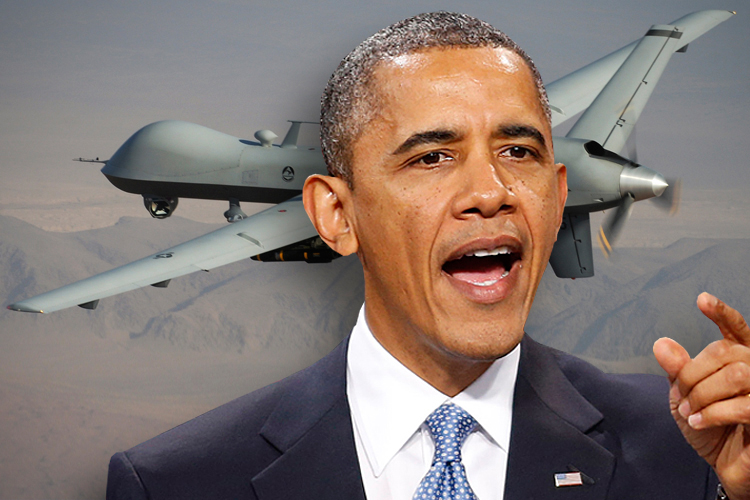

Obama’s drone speech will probably be maddening

His proposed reforms appear positive, but will he continue to ignore the real arguments against his policy?

Topics: Opening Shot, Barack Obama, Drone strikes, War on Terror, CIA, Targeted killing, Rand Paul, Eric Holder, Guantanamo, Civil Liberties, Anwar al-Awlaki, Editor's Picks,

Obama’s drone speech will probably be maddening (Credit: AP/Isaac Brekken/Lt. Col.. Leslie Pratt)

Today, Barack Obama will give a speech about drones. And about other stuff, like closing Guantánamo, but primarily about drones. It will … probably not remotely satisfy either his left-wing (and libertarian) critics who see his drone policy as an inherently immoral enterprise or his right-wing critics who think the president is not sufficiently committed to defeating Islamic terrorism. But it will probably do less to satisfy his right-wing critics, because Obama has apparently wrested control of our unmanned missile-launching flying machines from the CIA.

In preparation for the speech yesterday, the Justice Department acknowledged, officially, that the U.S. has killed American citizens in drone strikes. As Spencer Ackerman says, we’ve droned four Americans, “3 by accident.” (This is actually not counting all U.S. citizens killed in drone srikes going back to the Bush administration.) Eric Holder mentioned the deaths in a letter to Sen. Pat Leahy obtained by the New York Times. The letter is primarily a lengthy justification of the assassination of Anwar Awlaki. Of the other three, including Awlaki’s teenage son, Holder simply says they were “not specifically targeted.” So, whoops? Sorry, Samir Khan, Abdulrahman Awlaki and Jude Kenan Mohammad.

We’ll see if the president actually addresses the various legal and moral arguments raised by the prospect of a no-risk airborne robot assassination weapon, or if he just responds to straw men who say things like, “Why don’t you want the United States to kill terrorists?” I’m guessing more of the latter.


Aiding the president in his mission to respond to straw men will likely be most of the Republican Party, including its most prominent (and practically only) voice for civil liberties, Sen. Rand Paul, whose famous filibuster on the subject of drones was based solely on a so-far implausible hypothetical: that the president would authorize a domestic drone strike of an American citizen. Paul’s opposition to drones seems entirely based on the prospect of them being used in the U.S., where they are not actually necessary. (Our various police forces are perfectly capable of killing on their own, without killer flying robot help, thank you very much.) The senator is writing legislation banning the use of drones for surveillance without a warrant, which is at least a more realistic concern. (The legislation would permit drone surveillance of the Mexican border, of course.)

Hopefully the end of the CIA’s drone program will mean the end of “signature strikes,” in which anonymous foreigners who merely look like they’re up to no good are murdered, with bombs, by our intelligence agency. The Times says Obama has signed a new “classified policy guidance” that “will sharply curtail the instances when unmanned aircraft can be used to attack in places that are not overt war zones.”

But the president also “plans to offer a robust defense of a continued role for targeted killings.” We already know the basic rationale for drone strikes: They necessitate less risk (of American lives) than conventional military action and they remove the apparently uncomfortable question of what to do with terrorists who can’t be charged with conventional crimes. For the Obama administration, drones provide a handy replacement for the Bush administration’s use of indefinite detention, which was highly problematic, as various inmates at our Cuban military prison could tell you.

By focusing almost solely on U.S. citizens killed, purposely or not, in drone strikes, the press and the president’s political opposition have essentially ignored the most compelling moral arguments against the codification of a drone assassination policy. There are reasons countries like the U.S. do not officially assassinate individuals (even if, yes, the CIA has done so in the past, often unsuccessfully). There’s blowback, there’s “collateral damage,” there’s the threat that our policy will make Americans targets of other countries using the exact same rationale, there’s the fact that our military’s definition of “imminent threat” is laughably broad, and there’s the fact that extrajudicial assassination of individuals proven guilty of no specific crime is a pretty direct contradiction to our democratic tradition, a tradition we are regularly (and correctly) calling superior to the alternatives offered by various Islamic extremists.

The policy change seems to be a good sign. The speech will probably be maddening. The president may not even mention the policy change, because the CIA’s drone program, like the killing of Awlaki, is still officially classified, even though everyone knows about it. Maybe the president’s next policy shift can involve the absurd and ridiculous over-classification of everything having to do with national security and the actions of our intelligence agencies. An unintentionally funny paragraph in the Washington Post’s story on the coming speech captures what I imagine will be the basic thrust:

The president is expected to talk generally about the need for greater transparency in the drone strikes and may allude to the desire to give greater responsibility for those operations to the military. But he is likely to tread carefully on an issue that involves classified CIA operations.

So, expect vague generalities about transparency, I guess, because most of the stuff that seems to demand transparency is classified.

Alex Pareene

Alex Pareene writes about politics for Salon and is the author of "The Rude Guide to Mitt." Email him at apareene@salon.com and follow him on Twitter @pareene

Featured Slide Shows

7 motorist-friendly camping sites

close X
  • Share on Twitter
  • Share on Facebook
  • Thumbnails
  • Fullscreen
  • 1 of 9

Sponsored Post

  • White River National Forest via Lower Crystal Lake, Colorado
    For those OK with the mainstream, White River Forest welcomes more than 10 million visitors a year, making it the most-visited recreation forest in the nation. But don’t hate it for being beautiful; it’s got substance, too. The forest boasts 8 wilderness areas, 2,500 miles of trail, 1,900 miles of winding service system roads, and 12 ski resorts (should your snow shredders fit the trunk space). If ice isn’t your thing: take the tire-friendly Flat Tops Trail Scenic Byway — 82 miles connecting the towns of Meeker and Yampa, half of which is unpaved for you road rebels.
    fs.usda.gov/whiteriveryou


    Image credit: Getty

  • Chattahoochee-Oconee National Forest via Noontootla Creek, Georgia
    Boasting 10 wildernesses, 430 miles of trail and 1,367 miles of trout-filled stream, this Georgia forest is hailed as a camper’s paradise. Try driving the Ridge and Valley Scenic Byway, which saw Civil War battles fought. If the tall peaks make your engine tremble, opt for the relatively flat Oconee National Forest, which offers smaller hills and an easy trail to the ghost town of Scull Shoals. Scaredy-cats can opt for John’s Mountain Overlook, which leads to twin waterfalls for the sensitive sightseer in you.
    fs.usda.gov/conf


    Image credit: flickr/chattoconeenf

  • Nordhouse Dunes Wilderness Area via Green Road, Michigan
    The only national forest in Lower Michigan, the Huron-Mainstee spans nearly 1 million acres of public land. Outside the requisite lush habitat for fish and wildlife on display, the Nordhouse Dunes Wilderness Area is among the biggest hooks for visitors: offering beach camping with shores pounded by big, cerulean surf. Splash in some rum and you just might think you were in the Caribbean.
    fs.usda.gov/hmnf


    Image credit: umich.edu

  • Canaan Mountain via Backcountry Canaan Loop Road, West Virginia
    A favorite hailed by outdoorsman and author Johnny Molloy as some of the best high-country car camping sites anywhere in the country, you don’t have to go far to get away. Travel 20 miles west of Dolly Sods (among the busiest in the East) to find the Canaan Backcountry (for more quiet and peace). Those willing to leave the car for a bit and foot it would be remiss to neglect day-hiking the White Rim Rocks, Table Rock Overlook, or the rim at Blackwater River Gorge.
    fs.usda.gov/mnf


    Image credit: Getty

  • Mt. Rogers NRA via Hurricane Creek Road, North Carolina
    Most know it as the highest country they’ll see from North Carolina to New Hampshire. What they may not know? Car campers can get the same grand experience for less hassle. Drop the 50-pound backpacks and take the highway to the high country by stopping anywhere on the twisting (hence the name) Hurricane Road for access to a 15-mile loop that boasts the best of the grassy balds. It’s the road less travelled, and the high one, at that.
    fs.usda.gov/gwj


    Image credit: wikipedia.org

  • Long Key State Park via the Overseas Highway, Florida
    Hiking can get old; sometimes you’d rather paddle. For a weekend getaway of the coastal variety and quieter version of the Florida Keys that’s no less luxe, stick your head in the sand (and ocean, if snorkeling’s your thing) at any of Long Key’s 60 sites. Canoes and kayaks are aplenty, as are the hot showers and electric power source amenities. Think of it as the getaway from the typical getaway.
    floridastateparks.org/longkey/default.cfm


    Image credit: floridastateparks.org

  • Grand Canyon National Park via Crazy Jug Point, Arizona
    You didn’t think we’d neglect one of the world’s most famous national parks, did you? Nor would we dare lead you astray with one of the busiest parts of the park. With the Colorado River still within view of this cliff-edge site, Crazy Jug is a carside camper’s refuge from the troops of tourists. Find easy access to the Bill Hall Trail less than a mile from camp, and descend to get a peek at the volcanic Mt. Trumbull. (Fear not: It’s about as active as your typical lazy Sunday in front of the tube, if not more peaceful.)
    fs.usda.gov/kaibab


    Image credit: flickr/Irish Typepad

  • As the go-to (weekend) getaway car for fiscally conscious field trips with friends, the 2013 MINI Convertible is your campground racer of choice, allowing you and up to three of your co-pilots to take in all the beauty of nature high and low. And with a fuel efficiency that won’t leave you in the latter, you won’t have to worry about being left stranded (or awkwardly asking to go halfsies on gas expenses).


    Image credit: miniusa.com

  • Recent Slide Shows

  • Share on Twitter
  • Share on Facebook
  • Thumbnails
  • Fullscreen
  • 1 of 9

Comments

17 Comments

Comment Preview

Your name will appear as username ( settings | log out )

You may use these HTML tags and attributes: <a href=""> <b> <em> <strong> <i> <blockquote>