
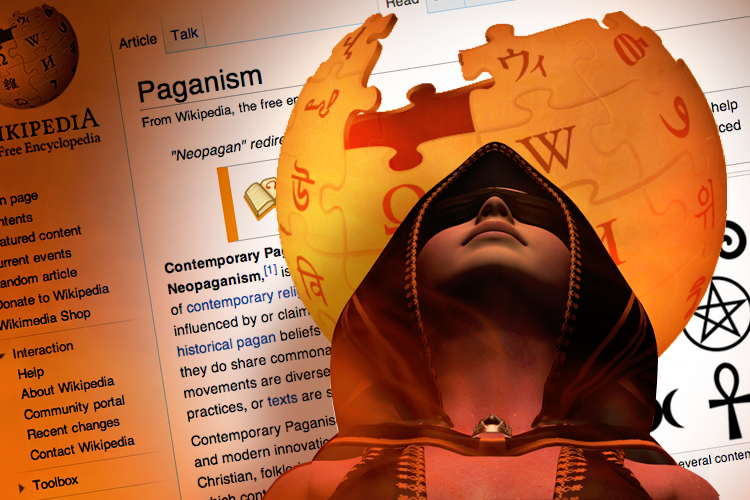

On Nov. 19, 2012, the Wikipedia page for the writer David Jay Brown was deleted. Not just hidden from sight to the casual reader, or cut to pieces by an overzealous editor, but removed once and for all. Despite his having authored numerous books and his appearances on multiple TV shows, the consensus view of the Wikipedia editors who cared to consider the matter deemed Brown not notable enough for inclusion in the online encyclopedia.
“Qworty” — the Wikipedia editor unmasked as the writer Robert Clark Young in Salon one week ago — played a leading role in instigating Brown’s deletion. As Qworty, Young denounced Brown as a “self-appointed spiritual savior” who had styled himself “a modern-day messiah who combined all of the powers of Jesus and Freud and Einstein and Marx and, oh why the heck not, Timothy Leary, lol.” Young also resorted to his go-to critique for Wikipedia pages he found wanting: He accused Brown of repeatedly editing his own page in violation of Wikipedia’s conflict-of-interest policies.
Brown contacted me soon after the publication of my first Qworty/Young story, but I didn’t examine his story close enough to figure out Young’s real gripe against him. Then, a week later, I started receiving emails from members of “the Pagan writing and publishing community” thanking me for unraveling the mystery of Qworty’s identity. According to them, Young had been guilty of waging a vicious and nasty war against prominent Pagans throughout 2012. Just a few days before Brown’s page was deleted, Tony Mierzwicki, a specialist in the practice of “ceremonial magick,” published an anguished alert at witchschool.com (“Witch School International: Your Online Pagan Education Starts Here”):
“SUPER IMPORTANT: WIKIPEDIA PAGAN PAGES ARE UNDER ATTACK: DELETION OF OUR LEADERS.”
At least a dozen “important Pagan” leaders had been marked for deletion by Young on grounds of insufficient “notability.” Included on the list was the author David Jay Brown.
Brown later told me that he doesn’t consider himself a leader of the Pagan community. The best guess is that Young targeted him along with the others because he was associated with the organizer of a prominent annual Pagan festival with whom Young was feuding. Once again, Young was turning the personal into the Wikipedia political, and proving that rogue editors have wide latitude at the online encyclopedia to pursue grudges. In this case, the motivating force was Young’s seeming hatred for New Age spirituality and anything that smacked of witchery. (I’ve reached out to Young for comment, and will update the piece with his response.) In his self-appointed guise as Wikipedia policeman, he went way out of his way to translate his prejudice into editorial policy.
* * *
David Jay Brown described himself to me as “basically a science writer.” He is the author, most recently, of “The New Science of Psychedelics: At the Nexus of Culture, Consciousness, and Spirituality,” published in May 2013 by Park Street Press. He has also published several anthologies of interviews with leading figures in the world of mind-altering trippy exploration, including Timothy Leary, Terrence McKenna and Alfred Hoffman. In an interview published in R.U. Sirius’ online journal Aceler8or, Brown is described as probably “the only writer in history who’s contributed to both the Buddhist wisdom publication Tricycle and the porn magazine Hustler.”
So is David Jay Brown “notable” or not? If you are someone who might be interested in the spiritual and neurochemical consequences of a mushroom trip, the answer, based on the evidence in the previous paragraph alone, would seem to be absolutely yes. This is especially true if you fall on the more forgiving side of Wikipedia’s great philosophical Wikipedia debate between “deletionism” and “inclusionism” As Nicholson Baker so memorably wrote five years ago, Wikipedia’s “infinitely expandable accordion folder” can fit, well, just about everything. So why not err on the side of open-armed enthusiasm? An encyclopedia big enough to fit a list of all 786 episodes of Pokemon surely can find the space for even demonstrably marginal writers about issues of Neo-Pagan concern.
Young subscribed to a more limited view of Wikipedia’s ambit, energetically devoting himself to pruning its branches wherever he could concoct a reason, and overwhelming his targets with a blizzard of Wikipedia jargon. Of course, one of the many ironies of his Wikipedia adventures is that he ended up cutting himself off at the stump by flagrantly violating the rules he was so devoted to enforcing. Even as he was accusing scores of people and pages for failing to live up to Wikipedia’s standards, he was manifestly guilty of violating both the letter and spirit of the rules in his own actions.
Consider, for example, Young’s attack on David Jay Brown:
The sourcing itself is an ugly testament to self-advancement, self-promotion, and self-love, as David Jay Brown constitutes nearly every single source himself — David Jay Brown and his friend using David Jay Brown himself as a source for an article about David Jay Brown himself. Incredible. It’s as though, in their minds, there is no universe at all outside of the mind of David Jay Brown.
Now consider some of the passages that Young included in various versions of the Wikipedia page for “The Death of the Death of the Novel,” an essay that he published in the Southern Review in January 2008.
Young’s thesis is that all arguments postulating the death of the novel are fallacious. Young goes back through literary history to show that F. Scott Fitzgerald, John Barth, Roland Barthes, Norman Mailer, Ambrose Bierce and others were incorrect when they claimed, at various times, that the literary novel was dead….
Editorial interest in “The Death of the Death of the Novel” was high as it began circulating among major journals in 2007. Publication offers came from The Writer’s Chronicle, the flagship publication of the Association of Writers & Writing Programs; the New England Review, a journal published by Middlebury College and the Bread Loaf Writers’ Conference; the Massachusetts Review, a journal published by Five Colleges, Inc.; the Southern Review, which is one of the leading scholarly journals in the United States; and even Pleiades, a student-run publication at the University of Central Missouri.
Yes, Robert Clark Young created an entire Wikipedia page devoted to analyzing and promoting an essay he himself had written, which argued that his literary analysis was superior to a choice selection of some the greatest writers of the 20th century. He even had the chutzpah to include the list of publications that, according to him, offered to publish the essay! In the annals of writerly self-promotion, Young deserves a Pulitzer. All by himself, Young has given Wikipedia’s deletionists a powerful upper hand over the inclusionists, because if the rest of the world’s writers followed the Wikipedia editing strategy employed by Young to lavish attention on their own work, even the most “infinitely expandable accordion folder” would have collapsed under the weight of all that self-serving ego long ago.
On May 21, “The Death of the Death of the Novel” was marked for possible deletion on the grounds of non-notability.
Wikipedia editors will be arguing with each other about how to define notability and what constitutes proper sourcing from now until Ragnarok. But what continues to amaze about Young is that the more we learn about his activities, the more it appears that it was routine operating behavior for him to attack others for doing what he did for himself every day. Again, such behavior by an editor who made more than 13,000 edits to Wikipedia over a six-year period is cause for real concern about how well Wikipedia’s internal safeguards protect its integrity.
Every page deleted or altered by Young on grounds of self-promotion or conflict-of-interest clearly deserves a second look. And that great effort is already well under way. The Neo-Pagans are clamoring for the return of some of their deleted pages and scouring those that survived the purge to see which of Young’s cuts will be reverted. But Young didn’t confine himself to questions of notability or conflict-of-interest when tangling with the Pagans; he also challenged the basic tenets of Pagan spirituality. Wikipedia, he argued, should be debunking such things as Wiccan rituals or the exploration of drug-induced conciousness-raising, rather than reporting them.
In May 2007, just two months after the creation of his Qworty account, Young made his feelings clear in a discussion of the merits of the Wikipedia page for Stregheria. “Stregheria” is an archaic Italian word for witchcraft, or folk healing. The term was resurrected in the 1980s by the Neo-Pagan author Raven Grimassi.
1) People who promote “witchcraft” are either charlatans or severely mentally ill. 2) A good number of these Strega folks are Satan worshippers, for whatever that’s worth. 3) The rest of them are a bunch of New Agers who have gone way, way, way over the deep end, spending too much time sucking on water pipes in Santa Cruz and imagining that their deceased Italian forebears are going to drop down out of the sky (or rise up out of Hell) with advice on imagined medical problems, real financial problems, horrible self-created relationship problems, etc.
Now, mind you, I am interested in improving the article, not in starting a flame war with a bunch of witches who think they can put a hex on me. I am not afraid of witches. They do not exist. Lucifer does not exist either, but if a few Italian-American New Agers on the West Coast want to worship Him in order to get their old boyfriends back, so be it.
As it stands, the article sounds like it’s talking about the Kiwanis Club. This is not an article about the Kiwanis Club. This is an article about mentally ill, delusional people who are worshiping Satan and their dead Roman or Neapolitan ancestors. We’ve got real cutting-edge science and sociology going on here — not. These people are greatly disturbed — they are not pursuing any kind of rational path.
There should be an NPOV [Neutral Point of View] way of getting across the idea that these folks are a whacked-out, highly marginalized minority with extremely dubious beliefs. There should be a polite way of saying this. If Wikipedia can offer a Holocaust Denial article that lets everybody know a certain group is seriously looped, then certainly it can do so about a pack of aging, overweight, chanting devil worshippers belly-dancing around the redwood trees.
Five years later, Young fixated on Jeff Rosenbaum, the organizer of the Starwood Festival, a long-running annual “Neo-Pagan, New Age, multi-cultural and world music” festival, deliriously captured by Paul Krassner in the Nation.. Young evidently saw Rosenbaum as the apotheosis of everything he hated — a self-promoting consorter with witches and warlocks who was actively creating and editing pages about his festival and the people who were featured speakers at it every year. Young began systematically targeting those pages for deletion.
Krassner wrote that Rosenbaum calls himself “a pantheistic social libertarian with a psychedelic spiritual orientation.” He is also the son of two Holocaust survivors and when I talked to him he wasn’t amused by Young’s comparison of Neo-Paganism to Holocaust Denial.
Young has accused Rosenbaum of exploiting Wikipedia to pump up attendance at a conference in which he had a financial stake. He seemed to delight in calling Rosenbaum an “arbcommed wikispammer,” referring to a mediation hearing at which Rosenbaum appeared before Wikipedia’s ultimate authority, the Arbitration Committee, on charges of spamming Wikipedia with self-promotional material.
Both Rosenbaum and Brown acknowledged to me that when they first started editing pages on Wikipedia, they were guilty of mistakes that violated Wikipedia policies against self-promotion. But Rosenbaum noted that the result of the ArbCom hearing in 2007 was that Rosenbaum was only cautioned to avoid “aggressive editing of articles where there is a question of conflict of interest.” Both Rosenbaum and Brown said that over the years they had learned how to more appropriately adhere to the spirit of Wikipedia polices. And Rosenbaum was utterly baffled that five years later, Young could get away with slandering him as an “arbcommed wikispammer” and using his involvement in editing Brown’s page as evidence for why it should be deleted. He was especially annoyed at the notion that because Young considered Neo-Paganism mystical mumbo-jumbo, it deserved no respect on Wikipedia.
If the non-verifiability of Neo-Pagan rituals and beliefs were grounds for deletion, he asked me, “then why aren’t pages about Christian figures deleted because Christianity can’t be proven?”
It’s a reasonable question. After all, first century A.D. Romans may well have considered Christians, with some justice, “to be a whacked-out, highly marginalized minority with extremely dubious beliefs.” Where matters of faith are concerned, what is the responsibility of an encyclopedia? Why should rituals involving pentagrams or psychedelic mushrooms be any less worthy of sober description than the transubstantiation of the body of Christ? What are the criteria for relegating something to the irrelevant, unworthy fringe?
“Where do you draw the line between something valid and something crazy?” said Brown. “Is that what you are asking? I don’t think Wikipedia needs to draw that line. I think it’s up to them just to report on what’s popular in the media or on the kinds of thing that people would want to look up on Wikipedia. Because there are plenty of things that are just not true that people are interested in learning about.”
Last week, Brown was understandably delighted to learn that his tormenter had been unmasked as a self-promoting violator of Wikipedia’s core principles. His immediate response? He engaged in a little revenge editing retaliation of his own. He swiftly edited Young’s page to include the Salon revelations, and then marked the page for deletion, using, he told me, “the identical criteria that [Young] used to mark the entry about me for deletion.”
Karmic retribution? Or just another example of how easy it is to take vengeful action on Wikipedia for personal reasons? Ironically, Brown also told me that he was unlikely to be successful in getting Young’s page deleted, because Salon’s series of articles on the Qworty affair had enshrined the entire saga as a notable moment in Wikipedia history. Young’s primary page is no longer marked for deletion.
Which is hilarious in its own perverse way, but I’m coming around to thinking that it’s probably a good thing. The closer we look at Qworty/Young, the more we are forced to grapple with the flaws built into the mighty Wikipedia machine. In the near future, unjustly maligned Southern writers and Italian witches will likely get a fairer hearing at the great encyclopedia experiment. Slowly, painfully, absurdly, but surely, some kind of more fully formed truth will emerge out of all the craziness.
