
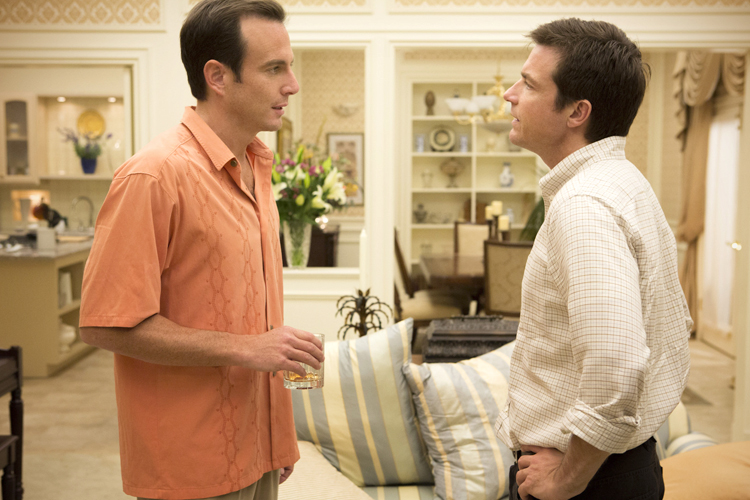

“Arrested Development’s” much-hyped, long-heralded, eagerly awaited fourth season arrived on Netflix this past Saturday night, a whole four days ago. “Arrested Development’s” creator, Mitch Hurwitz, cautioned against stuffing all the episodes in your eyes as fast as possible, but that was like a guy yelling about portion control at an all you can eat buffet. So a little less than 96 hours after “Arrested Development” debuted enough people have seen enough of it for it to have gone from being almost messianically longed for to more than a little roughed up. The dream of the thing has been replaced by the thing itself: Netflix’s stock took a turn on the strength of bad reviews, Hurwitz is sending out passive aggressive tweets about how critics are “resisting change,” and a friend of mine compared the new episodes to the recent “Star Wars” trilogy, which is like bringing Jar Jar Binks to a knife fight.
Maybe sometime in the future, I don’t know, a whole month from now — imagine, someone could possibly be watching new episodes of “Arrested Development” in a whole 30 days! — the series will be separable from the circumstances of its arrival. It is not yet. Expectations alter the viewing experience. Hype leaves an aftertaste. “Arrested Development’s” new season is a referendum on so many things, new business models, the strength and fickleness of fans, buzz and its flip side, whether creative freedoms are always good for creativity, and the speed at which we devour, discuss and opine on cultural products now. The 15 episodes of “Arrested Development” themselves, which start badly, but accumulate to something pretty good, would have to be a lot better than “eventually pretty good” to bear the weight of all of that. The new season of “Arrested Development” is not as excellent as the old seasons of “Arrested Development,” but what is?
The new season is structured as an anthology, with each episode focusing primarily on one character and hyperkinetically jumping through time to explain what happened to them since 2006, when season 3 ended. This structural complexity is an ingenuous way to deal with a logistical dilemma: the “Arrested Development” cast have other jobs and could not show up in the same place for very long. (There is one scene in which they all appear that gets cut up and used in many episodes. Liza Minnelli, Maria Bamford and Isla Fisher show up more than some regulars.) This is, obviously, a problem. The episodes are beyond intricate and do occasionally dovetail beautifully, but the structure is a workaround. “Arrested Development” is the story of a dysfunctional family, and in this season, they are barely a family.
Instead, the Bluths interact elliptically. A hand-me-down wig Lucille Austero (Liza Minnelli) has passed along to Lindsay (Portia Di Rossi) lets Lindsay go unrecognized by her nephew in one episode and get mistaken for a prostitute in another, only to end up in the trash and be worn by her father, George Sr. (Jeffrey Tambor), in another still. Something surprisingly similar happens with an ostrich. But these tenuous connections are no replacement for real interaction. The Bluths are almost all assholes — the show begins with Michael (Jason Bateman), who imagines himself as a good guy, doing some hilariously self-infatuated, terrible fathering — and prolonged exposure to any of them without another family member to be an asshole in a different way can get unbearably frustrating, if not downright boring. Some things, like George Sr. working a sweat lodge scam, were meant to be B-story lines, not 35-minute episodes.
The new season takes much longer than it should to get engaging. One of the ironies is that after all the back and forth about how you could — wait, you couldn’t! — watch the episodes in any order, one of the major problems is the order of the episodes. We all, like Lucille, have our favorite Bluths. Most of mine — Buster, Gob, Maeby, George Michael and Lucille — arrive in the last third of the season. Jeffrey Tambor is wonderful, but two episodes of George Sr. before Buster has gotten in more than a line or two is too many.
The structure of the new season inadvertently makes plain all that was almost annoying about the original series, but was not because its ingredients were kept in their proper proportions. Just as you want a pinch of salt in your cookie dough, not a pound, you only want 10 lines of Ron Howard narration in an episode, not 50. (Despite being on Netflix, where audiences are presumably watching episodes back to back to back, there is an unprecedented amount of Ron Howard exposition and renarration of circumstances we have just, like actually 10 minutes ago, seen take place.) Loosed upon us in greater quantities than before, it is clear George Sr., Lindsay, guest roles and being clever for cleverness’ sake were only not aggravating in the past because they were used in moderation.
And then in episode 5, Tobias Funke reads the “Eat, Pray” parts of “Eat, Pray, Love,” decides he wants “a new start” and gets the phrase “ANUSTART” put on his license plate, heralding the first of a dozen jokes revolving around the phrase “anus tart.” I laughed at every single one. It is possible my sanguine feelings about the new “Arrested Development” spring entirely from my affection for “anus tart” jokes, but that seems defensible to me. I can’t imagine any other show ever using “anus tart” once, let alone so many times and with so much care. Only “Arrested Development” could think of anus tart.
As the episodes go on, these sort of punch lines start to accrue, and, unlike anus tart, they are not all scatological or merely clever. (There is no show that can match “Arrested Development” for sheer joke-plot density.) The major riff of “Arrested Development” season 4 — a show all about barriers, in which the real-life actors are being kept from one another by forces beyond the creator’s control and the characters are trying to keep their emotional distance — is about walls. There’s a wall between America and Mexico the Bluths do and then do not and then do want to be built. There’s the virtual wall contained in an app called Fakeblock that George Michael is making that may ensure online privacy, or may just help people who play the wood block. Between these two projects and all the Bluths, there are dozens of misunderstandings about walls and their uses, a bravura, unbelievably well-planned and plotted series of punch lines that, unlike many other great “Arrested Development” jokes, have symbolic meaning too. (Check out the heartbreaker about Steve Holt, who returns looking like a 50-year-old man.)
Perhaps the strangest thing about the new season of “Arrested Development,” beyond whether it’s good or bad or pretty OK or pretty not OK, is Hurwitz’s continued devotion to wanting to make an “Arrested Development” movie. One of the through-plots of the season is Michael getting the rights from his family to make a movie about their life, a thread that presumably will get picked up if an “Arrested Development” movie happens. Hurwitz is good at seeing the insults coming, and he has Maeby — there is not enough Maeby in this thing — tell Michael, “Maybe you should think about TV?” “Arrested Development” has been extremely well served by being a TV show and it’s strange that Hurwitz, who expanded this season from 10 to 15 episodes, all of which come in at a little too bloated 30-plus minutes, would want to limit himself to something that’s two hours. (It’s also strange to think he could get more respect making a movie than he has this particular TV show.)
But if anything has killed the “Arrested Development” movie, it may be this season of the show. Can “Arrested Development” harness enough goodwill and energy to make a movie, or did it blow its wad on this new season, which is not nearly perfect enough to keep everyone convinced that “Arrested Development” is perfect? But “Arrested Development” was never perfect. This season may be even less perfect, but let not the fantasy of what it could have been be the enemy of what it is.
