
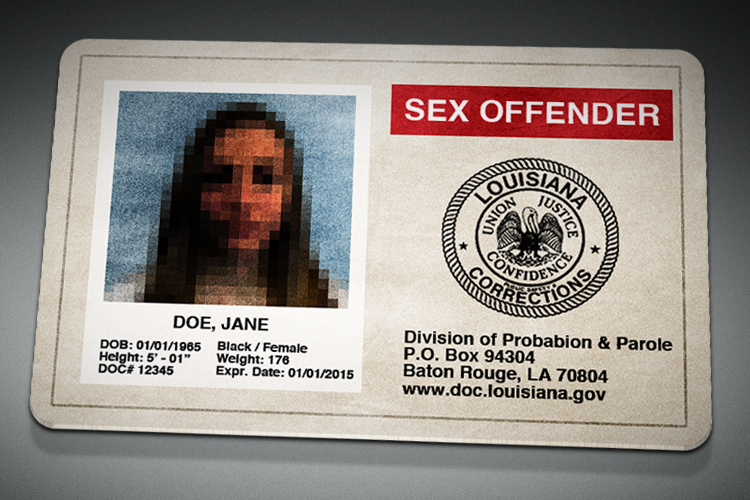

On the street since the age of 14, a girl became addicted to drugs. At 17, she was arrested for prostitution. Though there was no force and no minors involved, she was placed on the sex offender list in Louisiana, branding her ID with the words, landing her on an official website and forcing her to notify her neighbors.
“At 23, she was clean. She followed the rules society had for her; she said, ‘I’m going to change my life,’” said Deon Haywood, the executive director of Women With a Vision, a grass-roots community nonprofit in New Orleans.
But being branded as a sex offender, the legacy of an archaic law that branded the sale of oral or anal sex as a “crime against nature,” was only going to stand in her way. Thanks to a groundbreaking legal settlement this week, spearheaded by Haywood’s organization and a team of civil rights attorneys, that’s about to change, with 700 people convicted under the law about to be removed from the registry.
For decades, there have been two kinds of prostitution convictions in Louisiana: the kind that got you a misdemeanor charge, and the kind that got you a felony and landed you on the sex offender list. The latter, known as “crimes against nature,” began as a traditional anti-sodomy law and survived on the books as criminalizing the solicitation of oral and anal sex for money — that is, just agreeing to sell those sex acts for money. Police had discretion over who got what charge.
In practice — and particularly in New Orleans, whose police department is currently under a federal consent decree for discriminatory practices — that has meant the disproportionate charging of people of color and LGBT people for “crimes against nature.” The Department of Justice report on discrimination in the New Orleans Police Department noted that “in particular, transgender women complained that NOPD officers improperly target and arrest them for prostitution, sometimes fabricating evidence of solicitation for compensation. Moreover, transgender residents reported that officers are likelier, because of their gender identity, to charge them under the state’s ‘crimes against nature’ statute — a statute whose history reflects anti-LGBT sentiment.”
According to the Center for Constitutional Rights, 79 percent of those registered under the “crimes against nature” statute are African-American; 75 percent are women. As of 2011, 97 percent of the women on the sex offender list in the state were there because of a “crimes against nature” conviction. For already vulnerable people, the impact of such a registration can be devastating: “People affected by this law have been barred from homeless shelters, physically threatened, and refused residential substance abuse treatment because providers will not accept registered sex offenders at their facilities,” noted the Center for Constitutional Rights in a release on the settlement.
The first federal suit against the law, brought by the Center for Constitutional Rights, Andrea J. Ritchie and the Stuart H. Smith Law Clinic of Loyola University New Orleans College of Law, claimed that it violated the Equal Protection Clause, because it treated a certain class of offenders differently for the same crime. In the interim, the state Legislature repealed the law, but that didn’t help people who had already been convicted under it. On March 29, 2012, the United States District Court Eastern District of Louisiana in New Orleans ruled against state officials, noting that “the issue presented in this case is not about approval or disapproval of sexual beliefs or mores. It is about the mandate of equality that is enshrined in the Constitution.” That, too, did not apply universally and retroactively, leaving hundreds of people out in the cold. The attorneys filed a class action lawsuit accordingly, and this week, the state announced it would settle by removing the approximately 700 people convicted of “crimes against nature” from the list.
Baher Azmy, the legal director at the Center for Constitutional Rights, told Salon that the major hurdle had been putting the burden on the state to take people convicted of “crimes against nature” off the list, rather than asking that hundreds of often-disadvantaged people file in court one at a time. “This is not a population that is super empowered in the state of Louisiana,” said Azmy with some understatement.
Haywood says the people she works with now have a chance to slowly put their lives back together. “We have clients who are grandmothers … We had a client who got the charge over 20 years ago, got married, tried to put her daughter in an exclusive daycare. They refused her because of her ID,” she said. “We had a mother who turned her children over to a family member because of the damage caused by being on the list. We had women who experienced violence because they were on that list.”
Some of these people were convicted despite not actually engaging in illegal sex work. It was enough just to make a verbal agreement while approached on the street by an undercover police officer, leading the “crimes against nature” statute to be called “a talking crime” by advocates.
The settlement doesn’t mean the records will be expunged; background checks will still reveal that the individual has been on the sex offender list in the past. Still, there will be no new additions and no registry fees, requirements and visible stigma.
Says Haywood, “I challenge those people who say that change can’t happen in the South. Because it did. And don’t say the little man can’t win, because we did.”
