
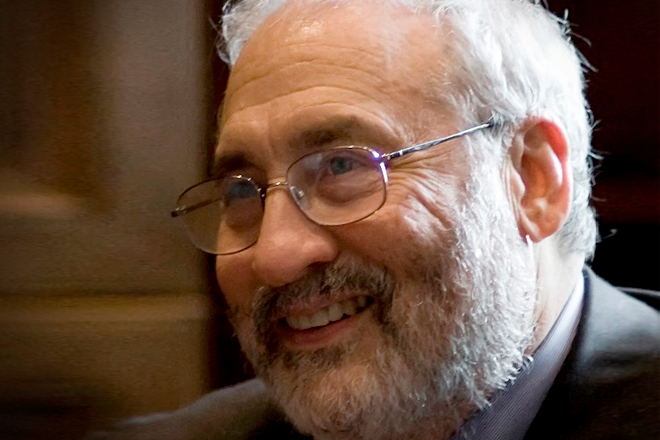

 Nobel laureate Joseph Stiglitz has been writing about America’s economically divided society since the 1960s. His recent book,The Price of Inequality, argues that this division is holding the country back, a topic he has also explored in recent research supported by the Institute for New Economic Thinking and others. On December 4, Stiglitz chaired the eighth INET Seminar Series at Columbia University, in which he presented a paper, “New Theoretical Perspectives on the Distribution of Income and Wealth Among Individuals.” In the interview that follows, he explores the themes of this paper, the work of Thomas Piketty, and the need for the field of economics — and the country — to come to terms with the growing gulf between haves and have-nots.
Lynn Parramore: You’ve mentioned that economic inequality was the subject of your Ph.D studies. How did you come to be interested in how income and wealth get divided up in society?
Joseph Stiglitz: First, when you grow up as I did in Gary, Indiana, it was sort of prototypical of a divided America. You had lot of people in poverty. We didn’t have the 1 percent, but we had the 5 percent. I had no idea what real inequality was like, but we had a lot of people at the bottom. And second, it goes back to the years I went to college and the Civil Rights Movement. You remember Martin Luther King’s march was a march for the end of discrimination and for economic empowerment. So I think a lot of us realized at that time that we weren’t going to fully address the problems of a divided America — of race discrimination — if we didn’t do something about the economic differentials.
LP: What’s new in your recent work on the distribution of income and wealth among individuals?
There are several things. There’s some debate about this, but I think most readers of Thomas Piketty’s book (Capital in the Twenty-First Century) get the impression that the accumulation of wealth — savings —is responsible for the rise in inequality and that there is, therefore, in a way,a link between the growth of the economy — the accumulation of capital— on the one hand and inequality and wealth. My paper begins with the observation that in fact, you cannot explain what has happened to the wealth/income ratio by that analysis. A closer look at what has gone on suggests that a large fraction of the increase in wealth is an increase in the value of land, not in the amount of capital goods.
LP: When you say “land,” you’re not talking about land in the Jane Austen sense, that is, agricultural land under the ownership of the lord of the manor, right?
JS: It’s not agricultural land, it’s the value of urban land. I would include in that, broadly, rents associated with natural resources (“rent” is an economic term for unearned revenue). It’s the value of existing assets. As a footnote, some of what has gone on, in addition to an increase in the wealth/income ratio, is a capitalization of the increase in other kinds of rents, like monopoly rents. If monopoly rents get increased, if the market power of firms relative to workers gets increased, as when you have the ability of a few, like the banks, to get government guarantees — the value of that is increased and gets capitalized. That increases wealth but it doesn’t increase capital. So it’s that distinction between wealth and capital that turns out to be critical. That’s the first idea.
The reason that’s important is that you then begin an inquiry into the explanations of why the value of the land or other sources of the value of rents would have gone up. A lot of my book,The Price of Inequality, is about why there has been an increase in rent-seeking. But the other part is more external in terms of the value of land or the value of assets. That, I suggest, is very closely linked with the credit system.
LP: How do you explain this link between credit and inequality?
JS: If you get a flow of credit increasing, as we’ve seen in the last few years —that flow of credit didn’t go to more wealth accumulation as we normally use the term in economics, as capital goods. What you got is an increase in bubbles of one kind or another.
What has happened repeatedly in recent years is that we’ve had monetary authorities allowing — through deregulation and lax standards —banks to lend more. But this lending has not gone for creating new business, not for capital goods. Disproportionately it has gone to increase the value of land and other fixed resources (buildings, real estate, etc). And that’s what everybody was worried about. So in that sense, in that discussion that occurred with quantitative easing—nobody linked that with inequality or linked it with the overall macro growth. The links with inequality are twofold: one is that at a very, very macro level, if more of the savings of the economy leads to an increase in the value of land rather than the stock of capital goods, then worker productivity won’t go up. Wages won’t go up. So some of what is going on is that we haven’t been doing the kind of investment that we should be doing.
But the other part that’s probably more important is that when you deregulate, you allow more lending against collateral. Then those who have the assets that can be used for collateral see those assets go up in price, like land. And so those who hold wealth become wealthier. The workers, who have no wealth, don’t benefit from that expansion. So the link is that credit affects land prices and fixed asset prices, and those go disproportionately to the rich. And that is a major part of the increase in the wealth. That’s one strand of my paper.
The other strand of the paper was an attempt to lay out a general theory of the transmission, you might say, of wealth and other advantages across generations, and trying to identify, very broadly, forces that would lead to a more unequal distribution and forces that would lead to a more equal distribution. You could almost say it’s a taxonomy — it’s a framework for thinking through things. And when you start to think about it, you see that there are many more forces going on right now for increasing inequality. And that’s also a framework for policy prescriptions. So if we have more economic segregation in a world in which we have local schools, locally financed schools, we’re going to get inequality in education, and therefore the children of rich parents are going to get more human capital.
This model actually provides a very robust general theory explaining inequality. There are many other wrinkles in the paper, but the final insight is that when you think of policies that are going to address inequality of wealth, you have to be very thoughtful about what economists call “incidence of taxes.” If most of the savings is being done by capitalists, and you tax the return on capital, then they will have less to invest. That would mean, over the long run, that the rate of interest would go up. That would therefore undo some of the intent to lower the income of capitalists.
LP: How do you prevent that negative effect of taxes on capitalists?
JS: One way you might think about preventing that from happening would be making sure that the government invested — took up some of money from tax revenue and invested in capital itself. That would prevent the rate of return from rising. Not all of this is all worked out, but it’s trying to say that some of the statements that Piketty made that you should just tax capital may have been overly simplistic.
LP: In your paper, you indicate that the power of the 1 percent to exploit the rest seems to be increasing. Why is this happening? Are there limits to this exploitation?
JS: In a more careful, academic way of putting it I would say that one of the explanations of what is going on is increased exploitation. You see the ratio of wages to productivity going way down, and that certainly is consistent with increased exploitation. And you see that the ratio of CEO pay to worker pay has gone up. So what I would say is that some of the explanations have to do with weakened worker bargaining power, weaker unions, asymmetric state liberalization where capital moves but labor can’t move, corporate governance laws that provide relatively little check on abuses of corporate power by CEOs, and an increase of monopoly power because of network externalities.
So there are certainly a number of factors that would lead one to suggest that overall there is an increase in market power. There are some things where there’s more competition — because of the Internet, for example, there’s more competition on the price side, but overall, when you look at the ratio of wages to productivity, there’s a marked increase in market power.
Probably there are limits — sometimes the degree of exploitation is expressed as the ratio of wages to marginal productivity of labor, and when that ratio gets down to zero – that’s a limit! What I would say is that things could get much worse if we don’t do something. That’s a relevant issue. What’s important is whether or not we’re on a path that’s looking worse and worse.
LP: You suggest that monopoly power is on the rise. What role does this play in income and wealth inequality?
JS: The holders of monopoly tend to be very concentrated. When you look at the Forbes list, the top two are both monopolists. [Bill] Gates got his money through monopoly power, and [Carlos] Slim got his money through monopoly power in Telemex. It’s not a statement that they weren’t efficient or they didn’t do things well. They may or may not have been innovative — there’s a lot of criticism about Microsoft but we don’t have to go there. But what we can say is that a lot of the income they got was through the exercise of monopoly power, and I don’t think anybody would doubt that. So when you look at the top, it’s monopoly power.
LP: Many neoclassical economists have argued that when people contribute to the economy, they get rewarded proportionally. Is this model breaking down?
JS: Yes. I think that the thrust of my book, The Price of Inequality, and a lot of other work has been to question the margin of productivity theory, which is a theory that has been prevalent for 200 years. A lot of people have questioned it, but my work is a renewal of questioning. And I think that some of the very interesting work that Piketty and his associates have done is providing some empirical basis for doing it. Not only the example that I just gave that if you look at the people at the top, monopolists actually constrain output.
It’s also true that people who make the most productive contributions, the ones who make lasers or transistors, or the inventor of the computer, DNA researchers — none of these are the top wealthiest people in the country. So if you look at the people who contributed the most, and the people who are there at the top, they’re not the same. That’s the second piece.
A very interesting study that Piketty and his associates did was on the effect of an increase in taxes on the top 1 percent. If you had the hypothesis that these were people who were working hard and contributing more, you might say, OK, that’s going to significantly slow down the economy. But if you say it’s rent-seeking, then you’re just capturing for the government some of the rents.
LP: How can we prevent inequality from getting worse?
I divide it into two parts: what can we do to reduce inequality of before-tax and transfers income, and what can we do to improve the after-tax and transfers income. The first part is things like higher minimum wages, stronger unions, better education, and stronger enforcement of anti-trust laws and corporate governance laws. Those are the kinds of things that are likely to improve the before-tax and transfers income. The second part is addressing things like capital gains taxes, the preferential treatment that mainly benefits people at the very top, and better redistributive policies. Those would help the after-tax and transfers income become more equal.
