
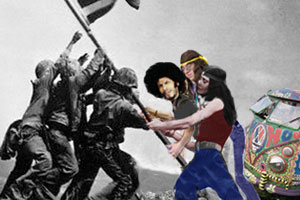

Complaints that the current generation is inferior to the preceding one are probably as old as human history. The ancient Greeks were given to lamenting the loss of their fathers’ manly virtues; the Romans were forever looking back to a Golden Age of heroic simplicity; the Renaissance was driven by a desire to recapture the lost greatness of the ancient world. If Cro-Magnon man was able to write, he would no doubt have lamented the passing of the noble Neanderthals.
So it is hardly surprising that the baby boomers, that vast cohort of Americans born between 1945 and the early 1960s, have been compared unfavorably — often by themselves — to their parents’ generation. In this view, the “Greatest Generation” — the term coined by Tom Brokaw, who in his bestselling book modestly maintained that it was the greatest generation any society has ever produced — was a race of heroes, humble in demeanor but towering in achievement, who rebuilt America after the Depression and defeated the Axis in World War II. They then returned home and made a whole bunch of babies, pampered kids who got stoned in the ’60s and ’70s, went into mutual funds in the ’80s, bought sub-zero refrigerators in the ’90s, and are now preparing to irritate not just their children but their grandchildren with their endless boasting about how hip they were. The Greatest Generation vs. the Me Generation. D-Day bodies vs. decaf lattes. No contest.
Leonard Steinhorn’s “The Greater Generation” sets out to turn this picture on its head. For Steinhorn, the “Greatest Generation” did its duty honorably in defeating Hitler, but melted under fire when it returned home and faced racism, sexism, homophobia, intolerant moralism, and general Organization Man uptightness. It was the baby boomers who won these wars. And Steinhorn maintains that their achievement is all the greater because unlike World War II, they were not ones they had to fight. “Greatness can be measured not only by the decisions we must make, but by the decisions we choose to make,” Steinhorn writes. “Two generations stared at the same shortcomings, inequities and hypocrisies of American life, but it was the Baby Boom generation that chose to tackle them, to hold this country to its grand ideals, to agitate for justice when it would have been easier to remain docile and silent, and we are a better nation because of that. It is why this generation’s accomplishments eclipse what came before it, and why the Baby Boom must be recognized as the Greater Generation.”
According to Steinhorn, a professor of communication at American University and a former political speechwriter, the boomers have failed to get credit in part because of our belief that only epic deeds count. “One of our prevailing cultural assumptions today, fueled by the media’s insatiable need for narrative arcs, is that the only path to greatness is through sacrifice and suffering … But what gets left out of this narrative is the heroism of daily life, of changing institutions and compelling society to live up to its ideals. What gets left out is the idealistic legwork of democracy.”
Steinhorn advances a double argument, demythologizing the Greatest Generation while praising the deeds of the boomers. In his view, the heroes of Tarawa and Bastogne dropped the ball when the war ended. “When they returned home after the war and it came time to defend the freedoms they defended overseas, the Greatest Generation turned out to be generally resistant or mute.” Indeed, Steinhorn argues that when it came to societal values, the Greatest Generation had feet of clay — and their lower extremities remained suitable for pottery well into old age. “If most Greatest Generation Americans had their way, Baby Boomers would have transformed precious little in American life Well into the 1990s, polls showed Greatest Generation majorities opposing interracial marriage, objecting to working mothers, supporting discrimination against gays, clinging to the notion that husbands belong at work and wives belong at home, and insisting on the old rule that young people should be taught to follow their elders, not think for themselves.”
By contrast, Steinhorn writes, boomers were passionate idealists who demanded that America live up to its ideals. Disillusioned by official lies about Vietnam, appalled by America’s pervasive racism, rejecting double standards for and discrimination against women, unwilling to blindly accept authority, the boomers fought for a more tolerant, enlightened, transparent and just society. Rather than being moral relativists or anything-goes nihilists, Steinhorn argues, they in fact embodied a deeply ethical and committed vision. “Given the Baby Boom’s staunch values, their devotion to egalitarian and inclusive principles, how curious that some critics accuse Boomers of lacking a moral compass and imposing a reckless relativism on the rest of society,” he writes. “Conservative critics such as William Bennett, George Will, Sean Hannity and Robert Bork condemn Boomer liberalism for ‘unilateral moral disarmament,’ to quote Bennett, for an unwillingness to ‘make judgments on a whole range of behaviors and attitudes.’ But this analysis is flawed and misguided — it simply misreads Baby Boom culture.” In the end, says Steinhorn, what “perturbs these critics is that their version of morality has been superseded by Baby Boom morality, and in a sly effort to undermine Boomer liberalism, they attempt to trivialize it.”
Steinhorn likens right-wing critics of the boomers and their liberal ethos to Luddites — they are a doomed band of reactionaries, shrilly inveighing against a society and a new system of values that have left them behind. The conservative rump appears disproportionately influential simply because they make more noise, and the media loves controversy. Today’s boomers are quiet because they have won: While in the ’60s they vigorously protested injustice, “there’s less to incite Boomer outrage as the country marches haltingly and imperfectly but relentlessly toward Baby Boom norms. It’s the angry cultural Luddites who command the media platform today.”
Steinhorn dismisses the fact that conservatives have run America for most of the boomer era, that they currently control all three branches of government, and that George W. Bush, a radically conservative president, was reelected despite a disastrous war, a staggering economy and a domestic record that can charitably be described as sodden. For Steinhorn, the apparent ascendancy of conservatism is misleading. The red states are not really coming — they’re going. Objects in the mirror are smaller than they appear. Sept. 11 simply delayed the inevitable: Bush was reelected not because most Americans shared his “moral values” but because they believed he was a better leader in the fight against terrorism. Steinhorn feels that no long-term conclusions should be drawn from his reelection. Indeed, he argues that conservative politicians have prevailed only because they disingenuously adopt boomer positions and rhetoric: “conservatives are able to gain whatever traction and followers they have not because of what they believe but because of their anti-establishment way of expressing it.”
Steinhorn concedes that the conservative assault on the boomers has “succeeded in discrediting Boomers personally — surveys show majorities of Americans view Boomers as arrogant, ambitious, self-centered, selfish, materialistic, and less patriotic than others … But that’s a Pyrrhic victory at best because conservatives haven’t succeeded in their larger goal of discrediting Boomer norms and values.” Right-wingers may pack the courts with Federalist Society reactionaries like Samuel Alito and win some elections, but in the long run they’re doomed: “however much political power these social conservatives may accumulate, theirs is a worldview that is becoming increasingly obsolete.”
At a time when facile potshots at boomers are in vogue, Steinhart’s unapologetic celebration of the boomer legacy is refreshing, and much of his argument is convincing. Polls and in-depth studies such as Alan Wolfe’s “One America, After All” show that most Americans do indeed subscribe to the core boomer values of tolerance, equality and individual choice. America is never going to return to the ’50s, when conformity, strict morality and hierarchy — not to mention racism, sexism and homophobia — played a far greater role than they do now. (Homophobia alone still lives on, according to Wolfe — an analysis borne out by the gay marriage wedge issue.) Political analysts who overreacted to Bush’s reelection — and the Democratic establishment, which refuses to challenge Bush on his inexplicably perceived strength as a “strong leader against terror” — could use some of Steinhorn’s optimism about Americans’ fundamental liberalism to stiffen their spines. There is good reason to believe, as Steinhorn and other analysts, including John Judis and Ruy Teixeira, have argued, that long-term demographic trends in the U.S. are working against conservatism: Not only are the Greatest Generation conservatives dying out, the “cosmopolitan” boomer outlook is dominant and will only become more so.
However, “The Greater Generation” is too superficial and boosterish to really shed much light on the confused and contradictory state of American society, culture and politics today. Steinhorn’s Panglossian view of Boomers as paragons of enlightenment and open-mindedness may be gratifying for liberal boomers weary of the criticisms heaped on them by Rush Limbaugh and his braying ilk, but in the end it seems overblown, sentimental and windy, like an updated Elks Club oration in praise of diversity training. Even the most self-satisfied boomer must be taken aback by from-the-pulpit pronouncements like “We live in the Baby Boom era of American history, and despite our flaws and blemishes as a nation, we are a more benign and virtuous nation than at any time in our history.” Throughout “The Greater Generation,” it is axiomatic that “baby boomer” is a synonym for everything good, tolerant and wise — so that when lauding a boomer factory owner, Steinhorn can write, “Jeff quite candidly admits the gut temptation to exercise power and lash out when workers doubt him, but the Baby Boom part of him keeps that very human temptation in check.” Such passages border on the ludicrous.
Certainly there are things to celebrate in the baby boom legacy, many of them so deeply ingrained in our culture that we simply take them for granted, and Steinhorn deserves credit for reminding us of them. But he overdoes it. He exaggerates the boomer-era legacy and glosses over the ways boomers have failed to live up to it. In the end, he fails to acknowledge that boomers are not really as different from their parents, or for that matter from every generation, as they would like to believe.
One of the problems with “The Greater Generation” is revealed by its title. Comparing the virtues of succeeding generations is a dubious exercise, especially when their members lived through periods as radically different as World War II and the ’60s. The issue is agency. Leaving aside the obvious definitional and chronological difficulties — many of the boomers’ achievements were set in motion by men and women from the Greatest Generation — is it really fair to say that a group consisting of millions of people “did” anything? Steinhorn is right that the boomers ended up sharing similar values, but that begs the question of how they arrived at those values. Did the boomers end racism, open up opportunities for women, humanize the workplace? Of course, all those things happened on their watch. But weren’t boomers — at least to a large degree — just along for the historical ride?
I pose the question because in reading Steinhorn’s book, I became aware of a considerable disparity between the exalted claims he made for my generation’s achievements and my sense that in my own life, I had done little or nothing to change the world — at least certainly not in the ways that Steinhorn discusses. Yet my résumé is about as representative of the middle-class boho version of boomer-dom as you can get. I was born in 1953 — which left me a little too young to have been atop the barricades in 1967, but nonetheless put me chronologically in the center of the boom. I grew up in Berkeley, Calif., the Green Zone of the Left Coast counterculture. I marched to protest the Vietnam War and UC-Berkeley’s People’s Park debacle and the killing of Martin Luther King Jr. My best friend in high school was a black guy who was into Husserl. I had hair halfway down my back and listened to Hendrix and read Nietzsche and dropped acid at 18. I dropped out of Yale after one semester and went to work at a shipyard in southern Virginia — beating Vietnam when I read the number “285” in a paper outside a Greyhound bus station. I worked at a motley collection of jobs for seven years before I decided that Mario Savio might have been wrong about the odious operation of the machine and enrolled at Berkeley. I got my M.A. in English lit, drove a taxi and freelanced before getting my first real job in journalism. Now I am a fully accredited member of the boboisie, shlepping my daughter off to her soccer games and rejoicing in at least a few appliances worthy of being ridiculed by David Brooks.
If this formulaic, flashback-riddled résumé doesn’t qualify me as a boomer par excellence, what would? And that’s the problem. I’m reasonably happy with my unoriginal little life story and have no desire to disavow it, but there’s nothing in it that lives up to the “heroism of daily life” that Steinhorn proclaims is my generation’s achievement. A few protest marches aside, I didn’t actually do anything except bounce through life like a pinball whacked by the transcendental flippers of the ’60s. To be sure, many boomers did far more — some got involved in politics, others went underground, others risked family and societal disapproval to break the color line (as my own Greatest Generation parents did, at a time when it wasn’t easy for a white woman to marry a Japanese-American man), others risked ridicule or rejection by applying for jobs that women weren’t supposed to apply for. And of course there were those who really were heroic, who marched through the Deep South for civil rights or fought for gay rights in the ’60s. (Although most of those activists were pre-boomers: The “when born” definition of the boomers, 1946-1964, doesn’t track perfectly with the “big years” of 1964-1968.) But most did not. Like me, they found themselves swimming in a current that was already there.
It may not be fair to use one case study as a sociological argument. But sociological generalizations are more convincing when they are grounded in everyday reality. Steinhorn argues that the boomers took action, and that their deeds in fighting racism, sexism, etc., stand up to the Greatest Generation’s actions at, say, Omaha Beach. But with a few exceptions like James Meredith, on the face of it the comparison is absurd, and Steinhorn presents no arguments — and more important, no fine-grained personal stories — to support it.
What the boomers undeniably did, and what probably remains their signal, if ambiguous and sea-changed legacy, was to expand their minds — whether through drugs, rebellion, music, a surfeit of leisure, hedonism and higher education, or who knows what historical alchemy. Expanding one’s mind may be heroic in its own way, especially if you were in the group over by the outhouse that took the brown acid. And several million expanded minds perhaps can change a society. But such changes are more subterranean and unreadable than Steinhorn acknowledges.
To question exactly what the boomers did isn’t to single them out for criticism. As Steinhorn notes, if the boomers had been pinned down on Omaha Beach, there is no reason to think they wouldn’t have done exactly what their elders did. Boomers did it in Vietnam, and boomers and their children are doing it in Iraq. A generation doesn’t get to choose its war: Every soldier who has ever faced death is as heroic as any other soldier. The point is not to question the boomers’ character, but to acknowledge that the concept of a “heroic generation” conceals deeply problematic assumptions about the nature of history, individual action and societal changes.
Yes, it is true that America changed, and in many ways for the better, between 1945 and the present. And yes, my generation had something to do with it. But Steinhorn’s account makes it seem as if we boomers (who in 1964 ranged in age from about 1 to 19) all realized one day that America was racist, misogynist, authoritarian, etc., and decided to stage a gigantic sit-down strike. But with the exception of the civil rights movement and the antiwar movement, this heroic model simply doesn’t apply — not even in “daily life.”
Moreover, even the iconic civil rights and antiwar movements cannot be entirely claimed by boomers. It was a member of the Greatest Generation who was responsible for the publication of the Pentagon Papers. And most of the leaders of the civil rights movement were also born well before 1945. It is true, as Steinhorn argues (and as the sociologist Karl Mannheim pointed out long ago), that a generation should be defined thematically, not chronologically. Nonetheless, the fact that so much of the boomer legacy was forged by men and women who not only did not belong to the boomer generation, but had a completely different worldview, is inconvenient for Steinhorn’s neat division.
More important, the social movements Steinhorn celebrates did not appear ex nihilo in the ’60s: They reflected underlying forces and trends in American society — in particular radical changes in capitalism, mass media and higher education — that started earlier. Steinhorn briefly acknowledges the role of higher education and the mass media, but he is so intent on making the boomers the authors of social change that he pays insufficient attention to these structural factors. Take perhaps the single most monumental change Steinhorn cites: the female transformation of the workforce. He wants to give boomers the entire credit for this. But this is facile, a kind of generational version of the “Great Man” — or, in this case, “Great Woman” — school of history. Feminism and feminist ideology played a role in that transformation, but not nearly as large a role as economic factors and the exploding number of women entering college.
As for the boomers’ accomplishments, Steinhorn exaggerates them, and downplays or ignores developments that present them in a less flattering light. As noted above, the generally conservative trend of American politics over the past 28 years is a serious problem for his thesis. If boomers are so liberal, why did they, in combination with their elders, elect Richard Nixon, Gerald Ford, Ronald Reagan and the two Bushes? Steinhorn argues that deep cultural shifts and politics don’t necessarily track, and that most Americans don’t pay that much attention to politics. But the fact that they don’t itself raises serious questions about how much boomers actually care about their supposedly hard-won ideals, and whether they are willing to sacrifice anything to realize them.
Take “diversity,” which Steinhorn rapturously celebrates as one of the boomers’ great victories. It is undeniable that America is a far less racist nation now than it was in the ’50s. One of the most valuable aspects of Steinhorn’s book is its reminder of the crude racism, sexism, homophobia and anti-Semitism that plagued America a mere half-century ago. And it is also undeniable that many Americans have put their money where their mouth is: As Steinhorn proudly points out, marriages between members of different races and ethnic groups have exploded. But America continues to be profoundly segregated, and people of color are still the poorest and least educated members of society. There is no easy solution to this problem, of course. But the fact that Nixon’s resentment-based “Southern strategy” and its various permutations have proved to be so politically effective suggests that America’s racial landscape is not as rosy as Steinhorn thinks. Steinhorn makes much of diversity training, multicultural college curriculums, and political correctness (which he seems to regard as a positive term). But these phenomena, while they may demonstrate the racial goodwill of the boomers — or perhaps simply their dutifulness — are mostly meaningless gestures. America has better racial manners now, but the largest problems remain unsolved.
Steinhorn’s domesticated, Ben & Jerry’s vision of boomers cannot be separated from his dismissive view of the ’60s. “As we peer through the media looking glass today, most images of Baby Boomers seem stuck in the Sixties, when youthful Boomers quite brazenly confronted status quo values and norms,” he writes. While acknowledging that “the Sixties experience is a central helix of the baby Boom DNA,” he argues that “to focus only on the Sixties is to miss the more significant story of how this generation, ever since the Sixties, has transformed our institutions and changed our norms.”
But the ’60s (which really started in 1964 or perhaps 1966 and lasted until the end of the Vietnam War) played a far more central, and uncanny, role in the formation of the boomer ethos than Steinhorn acknowledges. That wild, anomic decade cannot be easily tamed; it doesn’t fit into his genial, well-behaved vision of nice boomers practicing diversity. Perhaps he stays away from it because it has provided endless cannon fodder for conservative boomer-bashing wags, Steinhorn’s bête noirs. But the fact remains that the ’60s were the heart and soul of the boomer era, its climax — and in some ways its grave.
The happy Candide of the Movin’ On Jeans set, Steinhorn sees the boomers as the vanguard in an inexorable march progressing toward the best of all possible boomer worlds. But the ’60s, the crucible in which the boomers were tested, were not ultimately about “progress” or even “values.” They were a jungle, a chaotic amalgam in which the Romantic exaltation of the individual mingled with an inchoate, post-Beat rejection of authority and occasional infusions of hard-nosed political activism. What emerged from this feverish stew, once the drugs wore off, the Vietnam War ended and most people had to get jobs, was far less orderly, neat and liberal than Steinhorn believes.
In fact, not one but several boomer sensibilities emerged from the ’60s. Steinhorn’s analysis is not fine-grained enough to distinguish between the various quite different offshoots of the ambiguously individualist boomer ethos. He focuses on the mainstream liberal branch, which accepts the role of government, believes in redistributive justice, and tends to vote Democratic. But an equally important branch is the libertarian, which rejects big government, sees redistribution of wealth as bureaucratic theft, and tends to vote independent. Libertarian boomers reject liberal pieties and do-gooderism, the qualities that make up the heart of Steinhorn’s boomer virtue. Yet libertarianism and its cousin, an aggressive meritocracy, are increasingly dominant forces in American life. This is why affirmative action, for all its racial “virtue,” is on life support, and more important, why Americans are unconcerned that the gulf between the rich and the poor keeps getting wider.
Steinhorn’s vision of a happy, decent and virtuous boomer America is accurate enough as far as it goes, but it leaves out one little thing: money. Steinhorn celebrates the way boomers remade the workplace, making it more individualistic, free, innovative and nonhierarchical. He denies that the boomers sold out: “The media … prefers the stereotypical storyline about Boomers, that they rejected capitalism in the Sixties and then sold out to become grasping yuppies in the Eighties, so they’re not really a generation of reformers but a generation of self-inflated narcissists. Yet the truth is that most Boomers never really rejected capitalism in the Sixties and most never bathed in its excesses in the decades since — from the Sixties onwards they’ve simply wanted to make our system more responsive and humane.”
As examples of this new, enlightened approach to the system, Steinhorn cites the trend toward open workstations, nonhierarchical org charts, companywide brainstorming, socially responsible investing, etc. All of which is no doubt true. But Steinhorn has nothing to say about the explosion of service-sector McJobs with dreadful health benefits, or downsizing, or indeed the whole phenomenon of essentially unchecked capitalism, in which a company’s stock price and the profits its shareholders get are the sole determinants of whether thousands of employees are laid off. When it comes to these issues, far more fundamental than whether the boss allows his subordinates to vent, the boomers’ vaunted virtue suddenly disappears. Whenever boomer virtue runs up against the bottom line, the bottom line tends to win. Steinhorn is right in insisting that this does not prove that boomers are hypocritical — or at least not any more hypocritical than any other generation. Few boomers, as he points out, were Marxists in their youth. But this kind of, ah, accommodation does nudge the Boomer halo just a tad.
Steinhorn is right that the boomers are responsible for a fundamental change in America’s manners, and to a lesser degree in its mores. It is no longer acceptable to openly disparage ethnic groups or paternalize women. But manners, and even goodwill, do not run society. It is difficult to escape the conclusion that the real impact of the boomer sensibility is on interpersonal relationships and subjective attitudes; it has little tangible impact on American society. Thus, boomers support diversity training (but not national programs to address inner-city poverty), multiculturalism (but they take no interest in foreign news or culture), and environmentalism (as long as they don’t have to change their lifestyle at all).
In “Bobos in Paradise,” the conservative writer David Brooks mocks the consumerism and “hip” affectations of boomers (echoing, ironically, a virtually identical critique by the left-wing writer Thomas Frank). Steinhorn attacks Brooks’ book as part of a “prolonged culture war against Boomer liberalism and society.” It’s understandable why Steinhorn read it this way: Brooks himself seems confused about whether to regard his subjects as his enemies or his doubles, a confusion reflected in the book’s clumsy, uncertain transitions between neutral observation and heavy-handed satire. (There may also be an ex post facto interpretation involved: After writing “Bobos,” Brooks was given an Op-Ed column in the New York Times, in which he squandered in record time whatever goodwill he had earned from the left. Those expecting Brooks the open-minded intellectual and sophisticated cultural critic discovered instead a partisan publicist for the right.) But despite its snark, Brooks’ book is far more equivocal and even affectionate toward the boomers than Steinhorn acknowledges. In “Bobos” (Brooks’ neologism for “bourgeois bohemians”), Brooks acutely sums up Bobos as a group that tries to have it both ways: “Bobos are reconcilers, after all, so maybe it is inevitable they would strive to blur their duties with their pleasures, making the former more enjoyable and the latter more tame.” And Brooks concludes his book by praising Bobos for making politics more centrist and civil (this was before George W. Bush), improving capitalism and generally making life more pleasant.
If Brooks sees a downside to the Bobo era, it is a kind of genteel mediocrity. Bobos have a lukewarm spirituality, and it is unclear what they really care about. Brooks does not invoke Nietzsche’s flealike “last man,” the decadent Mr. Nice Guy of the Apocalypse whose spiritual horizons have disappeared, but you can feel him peering over the Pottery Barn sofa.
Brooks’ Bobo is drawn with more sophistication than Steinhorn’s boomer. But in the end, the two versions are pretty similar. Boomers are well-meaning, responsible, tolerant, open-minded citizens who are basically content with the status quo. In this light, all this arguing about whether the boomers are heroes or sellouts seems faintly ridiculous. It seems more likely that a hundred years from now, historians will neither exalt nor disparage the boomers. They will remember them as a generation that inherited a world at peace and a country of unprecedented prosperity, who did their best to make it a little better and have some fun while doing it. Yes, there was Vietnam, and the weird maelstrom of the ’60s. But taking the long view, the boomers sailed on calm seas. Ironically, after all the acid and rebellion and strangeness, they may simply go down in history as a generation, in the words of the Chinese proverb, that was lucky enough to live in boring times.
