
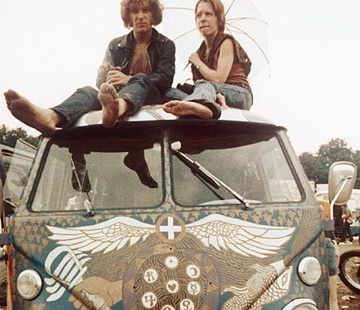

The ’60s refuse to go away. Like a weird long-lost love affair that has half-faded from memory, a mysterious sun that is always setting, they lurk perpetually just over our national horizon, emitting a strange glow. They have become a myth — perhaps they were a myth even when they were happening — and like all myths, their effect can be stultifying. One of that era’s dangerous icons, Friedrich Nietzsche, warned his nonexistent disciples against uncritical veneration. “You revere me: but what if your reverence tumbles one day?” he wrote in “Thus Spoke Zarathustra.” “Beware lest a statue slay you!”
A number of revisionists have challenged the romantic view of the ’60s. In his bestselling 1987 book “The Closing of the American Mind,” Allan Bloom attacked the era’s signal artistic achievement, rock music, as a debased form of pseudo-revolt. More recently, in his laudatory book about the boomers, Leonard Steinhorn drew a distinction between their real achievements and what he sees as the anarchic excesses of the ’60s. In “The Conquest of Cool,” Thomas Frank went further, arguing that the ’60s were a gigantic fraud. “The relics of the counterculture reek of affectation and phoniness, the leisure-dreams of white suburban children like those who made up so much of the Grateful Dead’s audience throughout the 1970s and 1980s,” Frank writes.
Gerard DeGroot is thus not the first ’60s debunker, but he may be the most thorough. In “The Sixties Unplugged: A Kaleidoscopic History of a Disorderly Decade,” he sets out to demolish once and for all the cant, hyperbole, romanticism, wishful thinking and just plain stupidity that continue to swirl around that era like a giant light-show blob. “For too long, the Sixties has been a sacred zone,” DeGroot, a historian at the University of St. Andrews, writes. “But cast aside the rose-tinted spectacles and we see mindless mayhem, shallow commercialism, and unbridled cruelty … Revolution was never on the cards. Chauvinism and cynicism got the better of hope and tolerance.”
“The ’60s” means two things: a decade, and the counterculture that made that decade famous. DeGroot deals with both, but his main, polemical interest is the second: He aims to cut the counterculture down to size. Much of his approach is straightforward: He chronicles what its heroes, leaders, groups and movements actually said, did and achieved, as opposed to what later observers believed they did. He has done a prodigious amount of research: His biblography cites more than 400 books and articles. DeGroot offers a lively tour of the various permutations of yippie doctrine, how Bernadine Dohrn used sex to manipulate her fellow revolutionaries, the history of the Diggers and what set off the 1968 French student protests (it involved a charge that government policy was creating “sexual misery”).
Along the way, DeGroot unearths some fascinating and often hilarious historical nuggets. After a 1963 Beatles concert in Cambridge, England, for example, “the seats and floor were soaked with urine,” leading to all sorts of serious explanations: One doctor opined that “this sort of activity was important for young women because it made the pains of pregnancy easier … when they grew up and got married.” No less a personage than Noel Coward likened Beatlemania to “a mass masturbation orgy.” Another eye-opening morsel involves ’60s fashion: After the miniskirt hit America, the San Diego Padres baseball team “desperately tried to boost attendance by hosting Miniskirt Days, with free admission to women so attired.”
But DeGroot also employs a more ambitious and unorthodox technique, using what he considers the decade’s truly important events to reveal the ultimate insignificance of the counterculture. His book is broken into 67 shortish sections, most of them dealing directly or indirectly with the counterculture, but a number covering extraneous subjects: the Sharpeville massacre in South Africa, the Vatican’s “Humanae Vitae” encyclical, the Arab-Israeli Six-Day War, the Watts riots, the Vietnam War and so on. By placing the decade’s cultural convulsions in a global perspective, DeGroot makes them look considerably less monumental, and a lot more irresponsible, than they did when examined through the glass of a bong, darkly.
This may make DeGroot sound like a finger-wagging moralist. He is, a little, but he doesn’t get carried away — and his critique comes from the left, not the right. Unlike Bloom or many conservative critics, DeGroot doesn’t see the ’60s as the decade when everything went wrong. He regards the counterculture as a sometimes innovative, often fun but essentially superficial phenomenon, one that achieved very little and may have actually backfired.
On the scanty plus side of the ’60s ledger, DeGroot lists the “longterm effects of the sexual revolution,” which resulted in “sexual relations [being] accepted as the business of the individual rather than the state.” He sees gay liberation as the most impressive outcome of the sexual revolution: Although he acknowledges that women gained sexual freedom as a result of the ’60s, he is harshly critical of what he sees as the era’s decoupling of sex from love (in which he echoes Bloom), as well as what he claims was its rampant sexism.
DeGroot’s overall attitude toward the counterculture is illustrated by his qualified praise for the British mods and the Dutch Provos, two ’60s movements. What DeGroot likes about them, tellingly, is that they were superficial, basically just interested in having fun, and were utterly unpretentious about their superficiality. As this predilection suggests, what irritates DeGroot the most about the counterculture is its pretentiousness and self-delusion. Much of his book is dedicated to chronicling the intellectual confusion, grandiosity and ineffectiveness that plagued the decade’s youth movements.
DeGroot’s evil eye is particularly acute when it comes to dissecting the archetypal ’60s conflation of personal liberation, murky spirituality and “revolutionary” politics: He reminds anyone who needs reminding that much of ’60s political radicalism was half-baked, self-indulgent, and almost insanely pie-in-the-sky. For example, he cites the fact that during one 1967 antiwar march on Washington, participants “decided it would be fun to levitate the Pentagon. Quite a few hippies were sufficiently stoned to convince themselves that America’s biggest building actually did rise.” But worse than that silliness, in DeGroot’s view, was yippie leader Jerry Rubin’s solemn belief that “theatrics of this sort could end a war.” “It was a total cultural attack on the Pentagon,” Rubin said. “The media communicated this all over the country, and lots of people identified with us, the besiegers.” DeGroot comments, “In truth, self-indulgence undermined otherwise impressive commitment.”
DeGroot argues, accurately in my view, that student and radical protests against the Vietnam War did not end the war or even change the minds of most Americans, who began turning against the war for their own reasons. The fact that Nixon narrowly beat Humphrey in 1968 is the strongest evidence that the antiwar movement did not achieve its goals. DeGroot praises the antiwar movement insofar as it was serious, dedicated and willing to do the hard, unglamorous work of organizing and winning over Middle Americans. But as he documents, the crazy self-indulgence of the counterculture and the limitations of its leaders prevented it from doing that necessary work. What DeGroot says about the German radical leader Rudi Dutschke could apply to the counterculture as a whole: “The demonstrations showed that Dutschke had a remarkable talent for focusing people’s outrage and transforming it into a willingness to take to the streets. But, like hundreds of would-be revolutionaries, he made the mistake of confusing a mass march with a mass movement … The difficulty lay in converting a momentary fondness for protest into a commitment to protracted struggle.”
DeGroot also harshes the hippie mellow. He compares them unfavorably to the beats, asserting that the beats offered a critique of society while the hippies simply embraced a do-anything ethos. “Hippies sincerely believed that what was sordid or soul-destroying could be willed out of existence — ugliness could be made to disappear simply by wishing for a better world,” he writes. “A vague millenarian philosophy was constructed from romantic myth — an airy concoction which had as much historical foundation as a fairy castle.” That dreamy myth was all well and good, but someone still had to cook the food, pay the bills and generally take care of business. DeGroot points out that the hippies, like the entire ’60s counterculture, never really came to terms with the reality principle. The logistical debacles at music festivals like Woodstock and the Isle of Wight (where the organizers failed to provide enough food and the line for the last, nauseating hot dogs was 300 yards long) were the inevitable consequences of living in never-never land.
DeGroot points out that most ordinary citizens, whether in America or Europe, never joined the counterculture and in fact were repelled by much of it. The social revolution envisioned by the New Left, student leaders and hippies never happened. Instead, DeGroot argues, “the most profound revolution that occurred was the emergence of a consumer society.” Like Thomas Frank on the left and David Brooks on the right, DeGroot claims that while the era’s ideologues, dreamers and assorted wild men and women were ranting about this and that, getting stoned and having lots of sex, their dissent was simply being commodified. The would-be world changers ended up co-opted and marketed to.
And meanwhile, society moved to the right — thanks in part to the left-wing counterculture. “The Sixties was the time when the postwar consensus began to disintegrate, when society polarized and liberalism went into steep decline,” DeGroot writes. “Perhaps the most enduring bequest of the decade is the convenient gallery of scapegoats it provided. To this day, people have been eager to blame their problems — moral decay, crime, violence, and the plight of the family — on a permissive generation of misfits, delinquents, and revolutionaries more powerful in myth than they ever were in life.”
DeGroot’s claim that large numbers of people still use the ’60s counterculture as a scapegoat seems exaggerated to me, and his account of the collapse of the postwar consensus doesn’t assign sufficient weight to race, the single factor most responsible for it. But in general his revisionist take, while not particularly original, is on the money — as far as it goes.
“The Sixties Unplugged” succeeds in demonstrating the political shortcomings and self-delusions of the counterculture. DeGroot is a fine social historian. He’s excellent at surveying the ’60s from 30,000 feet, where anyone can plainly see that the freaks ended up cutting off their hair, consumer capitalism triumphed and the world did not change. DeGroot’s clear-eyed demythologizing is salutary. But when it comes to cultural history, which calls for a more intimate, less empirically oriented approach, his book is less compelling.
Perhaps DeGroot, Brooks and Frank are right, and consumerism was the ultimate victor in the ’60s culture wars. The weight of evidence is certainly on their side. But this conclusion somehow seems insufficient. At issue is the vexed question of subjective experiences and their impact, or lack thereof, on social change. DeGroot writes, “‘You weren’t there; you can’t possibly understand’ often passes for effective rebuttal, even among those who think themselves serious historians … But none of this is remotely relevant. The important point is that I have formed my opinions on the basis of recent research rather than on golden memories of a life once lived.”
Of course, DeGroot is right that a historian need not have been present to form legitimate opinions about a given period. And he is also right that even if you were present, nostalgia can distort your views. But when one is writing a cultural history, not just a social one, the question of subjectivity becomes more complex. A good cultural historian is like a biographer: He must be capable of empathizing with his subjects, seeing the world through their eyes. Equally important, he must also consider that historical change does not always take place for obvious reasons. Even a narcissistic, indulgent or just plain silly era can change the world, in ways that are as imperceptible as the workings of evolution.
There is a reason that the ’60s have become fabled unto the point of myth, one that goes beyond mere nostalgia. It is simply that they were profoundly different, for reasons that are too complex to fully understand. At their most intense, the ’60s were the equivalent of living inside a modernist work of art. To his credit, DeGroot cites numerous figures who discuss this uncanny quality. The British novelist Angela Carter said of Swinging London, “I’d like to be able to dismiss it all as superficial and irrelevant to what was really going on, people arguing about Hegel and so on, but I’m forced to admit that there was a yeastiness in the air that was due to a great deal of unrestrained and irreverent frivolity … There’s no denying that toward the end of the decade everyday life … took on the air of a continuous improvisation … Carpe diem.”
DeGroot concludes that the net result of this “yeastiness” was a retreat from a commitment to social justice. “The Sixties was the selfish decade, a time of fragmentation when social harmony was abandoned in favor of factionalized goals.” There is much truth in this appraisal. But is it the whole truth? Couldn’t it also be true that by shaping the sensibility of a generation, the ’60s changed society in ways so profound that no election, poll or economic analysis can measure them?
DeGroot quotes Peter Coyote, the actor who was a cofounder of the San Francisco-based Diggers, saying, “Any structure is mutable, but once you’ve chosen it, you have to accept it — if you’re ever going to get any depth. Because depth only comes in the struggle with limits.” DeGroot uses this eloquent statement to point out that the hippie exaltation of pure freedom turned out to be a dead end. But what DeGroot doesn’t explore is the fact that Coyote’s eloquence itself bears witness to the intense exploration he undertook. In other words, Coyote would not have arrived at that wisdom, that moderate vision, had he not first gone through the extremes of ’60s folly. One of the quintessential ’60s concepts was that “the journey is the destination.” There’s no room for this idea in DeGroot’s approach.
In some ways, criticizing DeGroot for not exploring the subjective aspect of the ’60s is unfair: It’s asking him to have written a different book. In his introduction, he writes, “I am aware that I stand to be criticized for not giving due weight to the subtle achievements of the decade’s rebels and movements. For that I plead guilty — I did not feel the need to add to the chorus of praise for individuals whose profile was impressive but whose achievements were frail.” That’s fair enough, but DeGroot glosses over the distinction between “subtle” and “frail” — and it’s precisely there that the debate lies.
DeGroot makes a strong case that the ’60s counterculture achieved almost nothing, that the era was a brief, trivial and weird spasm that left only fragments in its wake. It’s hard to argue with him. Yet that strange decade seems to be in our collective bloodstream. In physics, the same phenomenon can be defined as a wave or as a particle. And in the mists of history, perhaps “nothing” and “everything” are sometimes indistinguishable.
