


Photo courtesy of Heymann Brothers Films
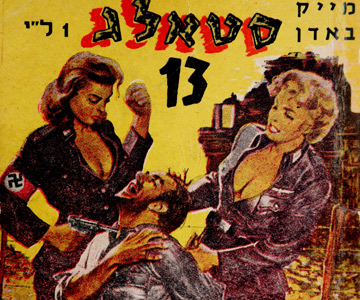
Taking their name from the Nazi prison camps in which they were set, Stalags were Israeli pornographic paperbacks featuring Nazi themes.
How do you make a movie about a disreputable and totally defunct literary genre? That question never quite gets answered by Ari Libsker’s hour-long documentary “Stalags,” but the questions Libsker raises about truth, fiction, sexuality and post-Holocaust Jewish identity are so interesting the film’s lack of cinematic sensibility may not matter. For some reason Libsker shot most of “Stalags” on black-and-white video, a distracting and perverse choice given that the Nazi-themed pulp novels of his title sported titillating covers in lurid color. Maybe he wants to dampen the sensationalistic aspect of his subject matter, but there’s really no way to do that.
As many older Israelis evidently remember, the then-new nation was afflicted by a perverse pop-culture craze in the early ’60s, at a time when nearly half the population consisted of Holocaust survivors, nationalist sentiment ran high and moral codes were extremely puritanical. Yet the newsstands in the Tel Aviv bus station sold racks of semi-pornographic pulp novels known as “Stalags,” whose utterly implausible, Penthouse Forum-meets-Marquis de Sade plots ventured into the most forbidden terrain imaginable. Stalags all followed essentially the same formula: An American or British World War II pilot (generally not Jewish) is shot down behind enemy lines, where he is imprisoned, tortured and raped by an entire phalanx of sadistic, voluptuous female SS officers. His body violated but his spirit unbroken, the plucky Yank or Brit escapes in the end to rape and murder his captors.
Stalags thrived for a few years and then disappeared, banished to the memory hole as a massive cultural embarrassment. Libsker meets a couple of the dubious characters who collect them; one insists that his face be obscured on camera (like a corporate whistleblower or a child molester on “60 Minutes”), and also appears to believe that the scenarios depicted actually occurred during World War II, or at least could have. (Just in case you’re wondering, there were no female SS officers, nor any other women assigned to guard Allied POWs.) Israel’s national library appears to contain a trove of them, buried deep in the catalog software and hidden from public view. Yet as some Israelis who were children and teenagers at the time testify, the Stalags provided sexual titillation in a society that repressed it, and also the illicit thrill of accessing a dark, secret recent past their European-born parents never discussed. They offered a Stockholm-syndrome equation of evil with eros and a juvenile revenge fantasy, all rolled into one.
As an outsider to both Judaism and Israeli society, I don’t find the existence of the Stalags mysterious in the least. Given the scale of trauma that brought the State of Israel into being, and brought so many of its inhabitants over the sea, some kind of twisted and perverse fantasy reaction was inevitable. As Libsker’s film further explains, the televised trial of Nazi war criminal Adolf Eichmann transfixed Israelis in the early ’60s, providing many younger people their first look at the horrific and dramatic events many of their parents had witnessed first hand. The Stalags may be understood as a dream-world, midnight version of the Eichmann revelations.
Libsker tracks down a former Stalags author, who still seems injured that the phenomenon did not bring him massive literary fame, along with a publisher who cheerfully shrugs the whole thing off: We gave the public what they wanted, and who am I to judge? But “Stalags” is most interesting when Libsker explores the deeper significance of this craze, as it reflects Israel’s pseudo-pornographic relationship to the past. Many Jews and non-Jews remain fixated on salacious details of the Holocaust, such as the “Night Porter” idea that female camp inmates ensured their survival by sleeping with German officers, or that the Nazis maintained brothels of Jewish women at Auschwitz and other camps. Such things may have happened here and there, but they are not clearly attested, and in any case fade into total insignificance against the scale of the tragedy.
“Stalags” comes with a perfect companion piece, a short film called “Two Women and a Man” by avant-garde Israeli artist Roee Rosen, who has offended audiences worldwide with his interactive exhibition “Live and Die as Eva Braun.” I can’t tell you much about “Two Women and a Man” without giving Rosen’s gambit away, but it purports to be a film about Justine Frank, a rediscovered Belgian Jewish surrealist of the 1930s and ’40s whose pornographic and scatological art outraged even her artistic peers by repurposing Jewish themes and images in many distasteful directions. Not to be missed if you’re fond of intellectual parlor games.
“Stalags” and “Two Women and a Man” are now playing at Film Forum in New York. Other engagements will follow.
