
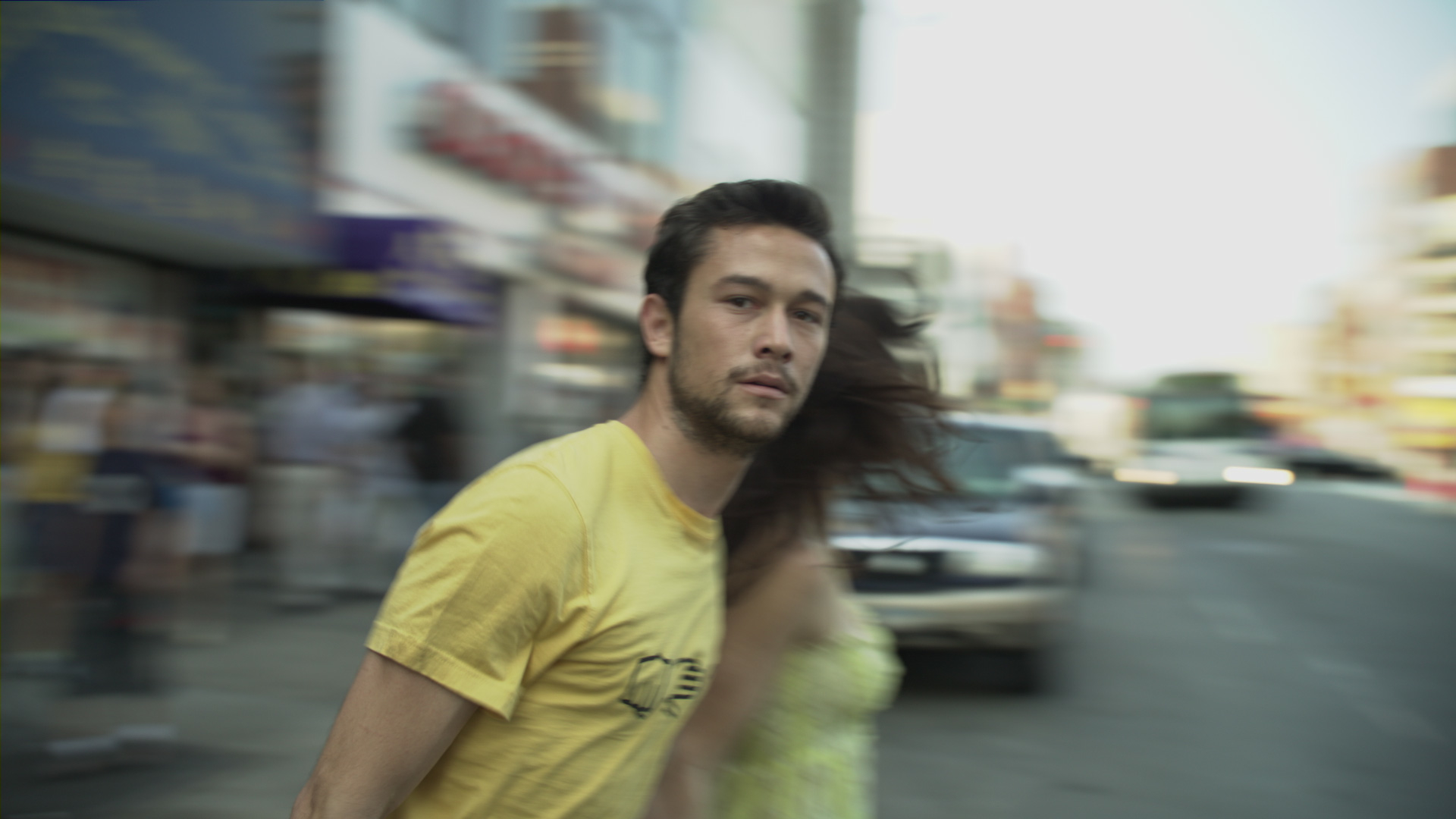

At the ripe old age of 28, Joseph Gordon-Levitt is simultaneously a showbiz old pro and one of the hottest young acting talents to emerge in this decade. When Gordon-Levitt played his first high-impact dramatic roles in edgy, independent films like “Mysterious Skin” (2004) and “Brick” (2005), there were a handful of snickers at first: Wait, isn’t that Tommy, the teenage kid from “3rd Rock From the Sun”? It was indeed, but Gordon-Levitt has been acting since early childhood. He had an extensive TV résumé long before the first of his 133 “3rd Rock” episodes — with recurring roles on “Roseanne,” “The Powers That Be” and the early-’90s “Dark Shadows” reboot — and he damn sure hasn’t let that role define his subsequent career.
Gordon-Levitt’s movies since his “Brick” breakout have quite frankly been hit and miss, with an accent on miss. Scott Frank’s intriguing neo-noir “The Lookout” generated a cult following, but highly anticipated films like Kimberly Peirce’s “Stop-Loss” and Spike Lee’s “Miracle at St. Anna” wound up impressing neither audiences nor critics. Frankly, I think Gordon-Levitt is a difficult actor to cast correctly. He’s handsome, intelligent and funny, but his demeanor always seems a little aloof, as if he’s hiding a secret or smiling at a private joke. He’s too charismatic to play the second banana in most movies, but doesn’t seem perfectly suited as the romantic lead either.
At least, he didn’t — not until busting out his Hall & Oates dance moves in this summer’s chronologically challenged rom-com “(500) Days of Summer,” which became a modest hit. This year he has also established himself as a viable action-spectacle supporting character in “G.I. Joe: The Rise of Cobra” (he’s in both the film and the video game), before returning to home turf with the low-budget New York indie “Uncertainty,” a tricky narrative experiment from the writing-directing duo of Scott McGehee and David Siegel (“The Deep End” and “Suture”).
“Uncertainty” is a carefully structured but largely improvised film — that’s actually not a contradiction — which is two different movies at once, both of them about Kate (Lynn Collins) and Bobby (Gordon-Levitt), a semi-hip young urban couple facing an unexpected pregnancy and all the Big Life Questions that come with it. In the opening of the film, they flip a coin on the Brooklyn Bridge, and then sprint away on foot into two parallel but separate story lines: “Yellow,” a Manhattan thriller involving a lost cellphone, armed assassins and mysteriously large sums of money; and “Green,” a low-key domestic drama, mostly set at the Queens home of Kate’s South American immigrant parents.
I can’t explain it a whole lot better than that, except to say that both actors are tremendous and that there’s a lot of poetry and ambition to McGehee and Siegel’s project. Even though the stories are so disparate, and the characters themselves come to seem like different people, there are areas of near-intersection: The doubled twosomes drink coffee at the same time, have sex at the same time and go (or do not go) to the same downtown party. The Green couple pick up a stray dog on the street; the Yellow couple kill some time, during their ill-advised extortion scheme, by going to see “Stray Dog,” the 1949 Kurosawa noir.
I’m not quite sure that “Uncertainty” hangs together as well as it might — if anything, the Yellow story is too outrageous, and the Green story too muted — but the unshowy, street-level cinematography by Kathy Li is wonderful and, as I told Gordon-Levitt when he called me last week, it’s great to see a film supposedly set in New York that was actually 100 percent shot there.
“Shooting on the street like that — I mean, it was explosive,” he said. “Maybe that’s a bad word for it. There’s so much energy pulsing through New York City, and film sets are already very high-energy places. When you put that in the middle of New York, it gets pretty intense.”
As ever, Gordon-Levitt was among the most pleasant and personable conversationalists in the business. He claimed to remember an interview we did two and a half years ago in Austin, Texas, and signed off (as he did the last time) by urging me to plug his “collaborative online art project,” which gives him a way to engage with the public that’s distinct from his movie-actor persona. As far as his reported role goes in Christopher Nolan’s upcoming — and much blog-drooled — “Inception,” Gordon-Levitt would only say that yes, he’s in it, and he’s promised not to talk about it. Like I say, an old showbiz pro, in a 28-year-old body.
I guess one of the things that’s nice about shooting on the streets of New York is that people just aren’t that impressed, right? They’re like, “Ah, another film shoot? Who cares?”
True enough. They just want to get where they’re going. It’s hard to shoot a scene when you have to watch out for bike riders on the Brooklyn Bridge. Staying in character, and making sure you don’t get hit. Acting is a challenge, man.
With “(500) Days of Summer,” “G.I. Joe” and now “Uncertainty,” you seem devoted to appearing in every possible kind of movie within a single year.
Well, thank you. I guess I have an eclectic taste, I don’t just like one thing. Contrast is key. What do they say? Variety is the spice of life. My favorite actors are the chameleons, guys like Daniel Day-Lewis, Billy Bob Thornton, Meryl Streep, people who are always different.
But do you concentrate on that? I mean, are you thinking, “I want to do something totally different from the role I just did?” Or did things just fall out that way?
To be honest, that’s not really what I think about. Here’s the way it works: I just see a lot of scripts, and if I like one of them, then I try to get the part. A lot of the scripts I see I don’t particularly like, so I don’t try to get those parts. And then some of the ones I do like, I don’t get the part. But somewhere in there there’s a decision, whether or not I want to pursue a given piece of material. I wouldn’t say I think that much about what I just did, so much as I think about how I feel about the piece that’s in front of me right now.
This particular movie, “Uncertainty,” was created in a highly unusual fashion. Have you ever done anything before with this much improvisation to it?
No, no. This was a unique creative process that the filmmakers, David and Scott, pretty much innovated. I don’t know, maybe other people have done it this way before, but I certainly haven’t done it this way before. They wrote a script, it just didn’t have any dialogue. The story was all very meticulously and thoroughly thought through. It’s not one of those improvisational movies that sort of meander along the way real life does.
And, by the way, I love some of those movies, like Cassavetes, you know, “A Woman Under the Influence,” something like that. I love that movie, and I don’t exactly know what their creative process was on those Cassavetes movies. But “Uncertainty” is different. It’s not so much a slice of life. It’s a highly structured, precisely told story. It’s just that any given moment was left up to that actual moment.
So the movie diverges, right at the beginning, into these two stories, the Yellow story, which is a thriller, and the Green story, which is more like a quiet, indie-film-type family drama. Did you shoot them separately?
Yeah. We shot all of the Yellow story first, and then we shot all of the Green story.
And when you shot them, were you aware of the parallels, or the areas where the stories kind of imitate each other or brush up against each other? Was all of that in the script?
Yeah, we were really aware of that. Those were things that Scott and David were very precisely orchestrating. It’s all there in the script. It’s not like we just shot two different stories and then mingled them together in the editing room. That’s, I think, where a lot of the most beautiful and telling parts of the movie are, in the juxtapositions between what’s happening in one world and what’s happening right at the same time in the other world. Which is a construct that definitely doesn’t exist in your more conventional movie, and I think it’s one of the most stimulating aspects of this one.
Since you shot the Yellow story first, that must have affected the experience of shooting the Green story.
Yeah, definitely. I think it raised the stakes. And I think we weren’t forced to make those Green scenes real dramatic, you know what I mean? The stakes were already so high, the tension and intensity of the movie were there already. We’d done that, we’d been yelling and running and shit. I think that gave us the freedom and confidence to let the Green scenes be very organic and natural, not force them. Often what happens in drama is that people don’t want them to be boring, you know? So they try real hard to make it really intense. The truth is, that’s not how a lot of those conversations really go.
I understand you and Lynn Collins and the directors did an unusual amount of rehearsal before the shoot.
Yeah, we did a lot of rehearsal. We spent a solid month hanging out, walking around New York, going to different places, talking about the characters and playing some of the scenes. We also played out a lot of scenes that weren’t in the story, stuff that happened before the story takes place: How the characters met, how they fell in love, what it was like the first time they had sex, when they first started getting serious. We had all that under our belts by the time we started shooting.
And wasn’t there some kismet at work in the casting too? You and Lynn are so great together, and I’ve heard that you auditioned together, even though you hadn’t even met each other before.
Pretty much. I think we had met before, but we didn’t really know each other at all. We auditioned together, and that audition was one of the favorite audition experiences of my life. I’ve been on a lot of fucking auditions, and to be honest auditions are generally devoid of any creative spark. [Laughter.] Everyone understands that it’s a process you have to do, but it’s not ideal. You’re in some office and you’re reading some scene in the wrong place or whatever. This audition was just Scott and David and me and Lynn — and I still feel like it was some of my favorite acting I’ve ever done. It was just really immediate and resonant. I loved it. As soon as we were done with that, I was like, “I really want to do this. I hope they let me do this. I hope they let me do this with her.”
Filmmaking is so mysterious in that way. Some directors rehearse and rehearse and rehearse, and some don’t want to rehearse at all — show up, do the scene in a take or two, and go home.
Yeah, in “Mysterious Skin” we didn’t rehearse, almost at all, and I think it was a wise choice for that movie. Filmmaking is like catching lightning in a bottle. You only have to capture that thing once, and then you have it. So you do whatever needs doing to try to ramp up to it happening right then and there. You don’t want it to happen before the cameras are rolling.
“Uncertainty” was different from a normal rehearsal process because “Uncertainty” is different from a normal filmmaking process. The scenes weren’t written, so you could almost classify the rehearsing as writing. Not that we were writing anything, but we were creating what the movie was going to be, not just practicing what we already knew it was going to be.
“Uncertainty” is now playing at the IFC Center in New York, with more cities to follow. It’s also available on-demand via IFC In Theaters, on many cable-TV systems.
