

Two days into the 2006 Tribeca Film Festival, the mood of this year’s crop of independent films appears strikingly dark, even set against a clear, cool and lovely New York spring. It’s as if this festival can’t escape its roots. It was born while the dust of 9/11 was still settling in lower Manhattan, quite literally, and four years later the shadow of that day’s events still seems long indeed.
There are plenty of films in this festival that do flow from 9/11, whether directly or not: Jeff Renfroe’s thriller “Civic Duty” (see below); the documentary “The Journalist and the Jihadi,” about the murder of Wall Street Journal reporter Daniel Pearl (which I haven’t seen yet); and the Humvee-load of Iraq war documentaries, which I’ll discuss in a future dispatch. But murderous darkness comes in many varieties, and wasn’t invented in 2001.
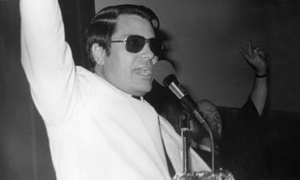
I can’t imagine anyone not being both horrified and fascinated by Stanley Nelson’s “Jonestown: The Life and Death of People’s Temple,” but if you grew up in the ’70s in the San Francisco Bay Area (as I did), you’ll have that special cold-sweat feeling of revisiting an old trauma that has never quite been dealt with. It’s one thing to know that on Nov. 18, 1978, a Pentecostal minister named Jim Jones persuaded 909 of his followers to kill themselves — most by drinking poisoned Kool-Aid, infamously — in the jungles of Guyana. That’s become a dark legend of recent cultural history.
It’s another thing to face the truth about Jones and his congregation: If they were a deranged, quasi-Maoist personality cult (and they certainly had become one by the end), they also were a multiracial and progressive political force, a combination of socialism and evangelical Christianity that seemed irresistibly attractive to many, many alienated people in the California of the 1970s. As Nelson details, Jones was a poor white kid from Indiana who grew up with an unusual sense of compassion for and connection with African-Americans — but also with remarkable oratorical powers and a strange preoccupation with death.
Nelson has interviewed many surviving members of People’s Temple, including two of the five — just five! — who escaped into the jungle rather than killing themselves on that day in 1978. Of course you know what’s going to happen, and Nelson shows us pictures of the dead early in the film. But nothing, and I mean nothing, can prepare you for their stories of what actually happened, of holding a wife who has willingly drunk poison, or watching your infant son froth at the mouth and die. (We even hear audiotapes made as Jones exhorts his flock, over a chorus of weeping and moaning: “Die with a degree of dignity! Don’t lie down in tears and agony!”)
But worse than that devastating history, and worse than the Khmer Rouge-goes-to-1984 atmosphere of Jonestown itself, where Jones’ (aka “Dear Comrade Leader”) recorded rants were broadcast over a speaker system 24/7, is the inescapable fact that decent and good people by the hundreds believed that this man had set them free, and followed him into death without hesitation. Jonestown was built not by neo-Nazis or born-again Left Behinders, but by a coalition of liberal-to-radical African-Americans and whites. Were they brainwashed? Well, sure. But what will haunt me forever is that the pictures don’t lie: Those people loved each other and were happy. That’s scarier than anything else. Jonestown is where the dreams of the ’60s went to die and rot in the tropical heat.
By far the best drama I’ve seen so far is “The Yacoubian Building,” an extraordinarily rich three-hour social epic from young Egyptian director Marwan Hamed (adapted from the novel by Alaa Al-Aswany, a bestseller throughout the Arab world). This is also a dark work, but the somber quality here is one of profound and fatalistic tragedy. Late in the film, Zaki Pasha (played by Adel Imam, one of Egypt’s biggest stars), a gentlemanly, Europeanized older man who clearly represents a fading way of life, stumbles into a downtown Cairo street and exclaims, “Look at this ruined country!” That’s the mood of this film in a moment.
For those who wonder whether the Arab world is capable of introspection or self-criticism, “The Yacoubian Building” is an eloquent answer. Watching this film is like having scales pulled from your eyes: The Egypt we see here is a vibrant but deeply troubled country, torn between Western capitalism and Islam, between a glorious past and an uncertain future, between (as in the last scene) the chansons of Edith Piaf and the ceremonial ululation of Arab women.
The edifice of the title (which really exists) is a once-grand Cairo apartment complex built in 1934; in its immense, rambling suites live decaying examples of old money (like Zaki), rising professionals and the nouveau riche, while the poor squat in semilegal rooftop huts. So Hamed’s cast of characters encompasses many strata of Egyptian society and encounters a laundry list of social issues, from government corruption and the oppression of women to homosexuality and the rise of Islamic fundamentalism.
If this is a familiar social-melodrama structure, it never feels forced or formulaic, largely thanks to the wonderful cast and the prodigiously gloomy atmosphere of the Yacoubian itself. Besides the pathetic but charming Zaki, we have the closet-case newspaper editor (Khaled El-Sawy), the ruthless businessman who has risen from poverty (Nour El-Sherif), the lovely innocent led astray (Hind Sabry) and the poor student drawn to Islamic extremism (Mohamed Imam). And that’s leaving out the French chanteuse, the secret second wife, the scheming Coptic Christian brothers (I can’t tell whether some ethnic or religious slur is suggested here) and Zaki’s crazed, vengeful sister. This is exactly the kind of unexpected foreign film a small distributor could have cashed in on a generation ago, but the odds that “Yacoubian” can find an American audience are, sadly, pretty long.
You may well get to see Emmanuelle Bercot’s trashy but highly absorbing “Backstage,” which stars Emmanuelle Seigner as a dead-eyed, ice-blonde pop star in the Madonna-Debbie Harry vein, and Isild Le Besco as the fan from nowheresville who is half-accidentally drawn into her inner circle. It’s a convincing study of the sheer boredom of celebrity life and the obsessive fervor of fandom. If none of that is anything new — you could call this “All About Eve” with Parisian locations and a dance-mix soundtrack — Bercot is a confident and ruthless filmmaker who delivers the skin, the madness and the sense of lurking evil this genre demands.
None of these films, however, were among Wednesday’s principal red-carpet world premieres, which were held at the Tribeca Performing Arts Center, perhaps a quarter-mile from Ground Zero. Those offered appropriate doses of celebrity ogling, but the mood was subdued, the auditorium was far from full and the films were a mixed bag. (It’s possible that Tribeca organizers have finally overextended, now that the festival has grown by seven- or eightfold and spilled all over Manhattan.) The evening’s prime slot was filled by “Civic Duty,” a claustrophobic, low-budget thriller starring Peter Krause (Nate from “Six Feet Under”), who also produced the film, as a downsized accountant obsessed with the possibility that his new Arab neighbor may be a terrorist.
It’s a gloomy, intense and effective little picture, without being the least bit original. This kind of movie backs its characters and audience into a tight box: Either the neighbor is or he isn’t, and either way Krause’s Terry is a cable-news-addicted paranoid sociopath. Krause, Kari Matchett (as his understandably alienated wife) and Khaled Abol Naga (as the maybe-jihadi neighbor) all give strong performances, and Richard Schiff of “West Wing” fame has a nice turn as the authority figure who just won’t listen (in this case an FBI agent). Director Jeff Renfroe shows flashes of David Fincher-like flair, on about 1 percent of Fincher’s budget, but there’s nothing here (including the final twist) you haven’t seen before.
Earlier in the evening, a far more sober and less glittery crowd gathered for the premiere of “Walker Payne,” a well-constructed small-town drama set in the coal-mining country of southern Illinois, circa 1958. Given the pedigree of writer-director Matt Williams (a veteran TV insider who created “Roseanne” and “Home Improvement”), I was pretty much expecting American optimism and easy shtick. But while “Walker Payne” is a highly conventional film with its laugh lines, implausibly sexy girls and tear-jerking moments in all the right places, it too is a downbeat fable of poverty and desperation.
Jason Patric plays the title character, a skirt-chasing, out-of-work miner who’s being harried by his harridan ex-wife, Luanne (Drea de Matteo, of “Sopranos” fame), for child support money. Patric makes Walker such a lovable rogue, and de Matteo makes her character such a money-grubbing dragon, that we almost don’t notice that her case is pretty reasonable, on the face of it. But there’s no work in town, so instead of feeding his daughters, Walker goes skinny-dipping in the old mine pit with the fetching new bank teller from the big city (KaDee Strickland).
“Walker Payne” is redeemed from total triviality, in fact, by its darkness. Sam Shepard is brilliant as Syrus, a sharp-dressed, gospel-singin’ and monumentally dubious character who drags Walker and his beloved pit bull into the clandestine dog-fighting world across the state line in Kentucky. Shepard is much better at this kind of American Satan role — at times he seems to be channeling Robert Mitchum’s classic turn in “Night of the Hunter” — than he was in “Don’t Come Knocking,” his recent and rather dull collaboration with Wim Wenders. Between him, de Matteo and the dogfights, Williams’ pedestrian drama actually strikes a spark, and ends on a surprisingly Dostoevskian note.
Stay tuned: I’ll be back with many more films, though not necessarily more cheerful ones: a controversial documentary about Golden Gate Bridge suicides, a tale of death row in Iran, a story about an all-night bender in Dallas, multiple visions of the Iraq war, how Colombia’s drug kings brought vice to Miami and much, much more.
