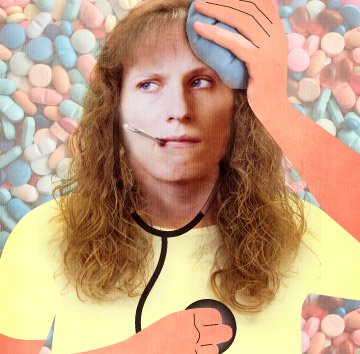
Sick in the head

I've diagnosed myself with heart attacks, blood poisoning, meningitis and multiple sclerosis. Turns out, what I had was hypochondria.

Editor's note: Excerpted with permission from "Well Enough Alone" (Riverhead, 2008).

By Jennifer Traig

Pages 1 2 3
  • S S S
  • RSS

Read more: Life Features, Memoirs, Health, Medicine, Doctors, Disease, Life

Life

June 21, 2008 | I had my first heart attack when I was 18. I was striding across campus when it hit, like a bomb going off in my chest. My left arm went numb, and it got harder and harder to breathe. I was used to being sick -- by the time I started college, I'd already had skin cancer, meningitis, pancreatitis and blood poisoning -- but this was a whopper, and I was knocked over by the crushing pain. This was different. This could kill me, kaboom, right there on the quad.

I had to get to a hospital. I still don't know how I got to the student clinic, how I got across the campus and up the stairs, but I did. I staggered through the double doors and collapsed into a chair.

"I'm having a myocardial infarction," I gasped, when I was finally ushered into an exam room. "Heart attack," I added, when this failed to produce a crash cart.

"I know what a myocardial infarction is," the nurse said, casually taking my vitals. "You're not having one." She pressed a stethoscope to my chest.

"Well, it could be a stroke," I conceded.

"You're not having a stroke."

"I think we should run some tests."

"Haven't we seen you in here before?"

"Once or twice."

The nurse stood up and placed her stethoscope in her pocket. "You're fine," she said. "Your vitals are normal. You're a perfectly healthy 18-year-old girl. I promise you're fine. Go out, take a walk. It's a gorgeous day and you're not dying."

It was a gorgeous day, and I wasn't dying. I'd been spared, by fate or just dumb luck. This, too, had happened many times before. The skin cancer turned out to be ballpoint ink; the meningitis, hay fever; the pancreatitis, too many candy bars; the blood poisoning, ill-fitting shoes. I did not have lupus, multiple sclerosis, Huntington's disease or Hodgkin's, Crohn's disease, diabetes, myelitis or muscular dystrophy.

What I did have was hypochondria, which meant that every other disease was inevitable. I might have escaped the heart attack and the Hodgkin's, but surely something serious was only a matter of time. I could not leave well enough alone, and once dengue fever was ruled out I would return with malaria. There were just so many diseases out there, all strange and for the most part unavoidable. There was, for instance, foreign accent syndrome, the bizarre but real neurological condition that transformed native West Virginians into Eliza Doolittle overnight. There was pibloktoq, a seizure condition common to Greenland Eskimos that compels them do things like destroy furniture, disrobe, scream obscenities, and eat feces. There was SUDS, the mysterious disorder that claimed healthy young Asian men in their sleep, and even though I was neither, my father had been born in China, so who's to say I couldn't catch it from him.

You could catch lots of things. Maybe you'd get paragonimiasis, and parasites would eat you; or you'd get pica, and you'd eat them. Anything was possible.

It's hard to say when the hypochondria started. I'd been worried about my health for as long as I could remember, the anxiety growing like a tumor, each year introducing a new way to die. There were so many ways to go. Besides diseases there were poisons everywhere you looked. A whiff of the wrong fumes and you'd have instant brain damage. Mistake the glass cleaner for Kool-Aid, and who wouldn't, they were both blue, and you'd need a new liver. By age four I knew to avoid the skull-branded bottles under the kitchen sink, but what about natural toxins? The local landscaper had thoughtfully mined the front yards of our family-friendly neighborhood with all manner of poisonous plants. My parents had warned us to steer clear of the oleander and holly berries, but sometimes a brush was unavoidable. What if I forgot and stuck my pollen-coated fingers in my mouth? What if I sneezed, open-mouthed, and a gust of wind blew a blossom in? It didn't seem likely, but it was possible, wasn't it?

The scariest plant of all, of course, was the family tree. When a fourth-grade assignment required me to compile my own I took less note of when ancestors died than what of: did we have a lot of heart disease in our family? Any lupus? MS? How about Hodgkin's?

There was remarkably little cancer, it turned out. Hypochondria, however, was in ample supply. The tendency to fear the worst was right there with our short legs and big feet. I had relatives who couldn't breathe, and others who couldn't swallow, and a number who suffered from vague, lingering conditions that required me to forfeit control of the television when they came to visit and to please not wear the loud shoes. There was the musician who was more adept at what doctors dryly call the "organ recital," the litany of abstract complaints that is the hallmark of the hypochondriac.

My favorite hypochondriac was a cousin thrice removed who was convinced she had stomach cancer. Sure she was dying, she was too afraid to go the doctor until the pain became completely unbearable. Her stomach tumor was born six hours later. He weighed seven pounds, and they named him Francis.

Who knew what bombs were ticking inside you. Even if you didn't inherit any of the awful genetic diseases you could always catch something: Ebola or malaria, hepatitis or TB. You could pick up a virus, an environmental disease, an infection or a parasite. And then there's the endless list of worms, thousands upon thousands, crawling in and crawling out: fluke and flatworm, beef worm and tapeworm, roundworm, pork worm, threadworm, heartworm, hookworm. Worms surpass us in both number and fortitude; several thousand nematodes aboard the Space Shuttle Columbia survived the crash. Worms will certainly eat you when you die and perhaps well before. Pinworms might invade your rectum; flatworms, your bladder; guinea fire worms might consume your flesh from the inside out. It could happen. It's been happening for eons. The guinea fire worm, in fact, is what you see in the caduceus, wrapped around the rod. Healers used to slit the skin open and draw the critter out with a stick. Yes. Gross.

Next page: Most doctors would rather see a patient with suppurating genitals than a hypochondriac

Pages 1 2 3
  • S S S
  • RSS