
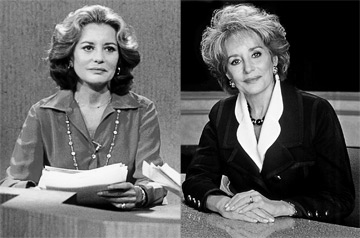

It’s tough not to distrust an autobiography in which the author refuses to disclose her exact age. But Barbara Walters does just that on page 14 of Audition, her memoir, which hits stands on Tuesday. “I am now in my seventies, and that is as specific as I will get,” she writes in an opening-sentence parenthetical in the chapter “My Childhood.” Too bad for the optimistically ageless Walters that Wikipedia, the Internet Movie Database, Yahoo and several prominent astrology sites have all felt free to get more specific than she: The television journalist was born on Sept. 25, 1929; she will turn 79 this year.
But Walters’ bizarre coyness at the start of what she clearly feels is a soul-baring work — “In this book I basically bleed for 570 pages, ” she told columnist Cindy Adams — is merely symptomatic of the slightly prim distance she keeps from her own beguiling, twisty, readable story.
Walters has essentially produced a printed version of the perfect Barbara Walters TV interview, in which she coughs up tantalizing nuggets about her love life (an affair with the married Sen. Edward Brooke of Massachusetts, who teases her about being the oldest woman he’s ever dated, while she tells him he’s “the blackest man” she’s ever been with); her troubled childhood (Walters’ mother once sent her to her father’s nightclub to plead with him not to abandon the family); and her own buried insecurities (“I desperately wanted playmates, to have friends over to my house, to belong instead of always feeling like an outsider”). There are barrels of personal trivia (“I developed the bladder of a camel … I don’t perspire”) and a heaps of solemn self-diagnosis (“I knew that I had my mother’s love, and I remember her often saying that she wished she had six of me … But in my mind then, it didn’t seem like enough”) and more Borscht-belt comedy about her eccentric Jewish relatives than Woody Allen’s “Radio Days.”
The steady clip of interview fodder is diverting but somehow sterile and performed. It’s so hard to divorce her style from her story that I found myself often imagining her paragraphs, many of which include questions she’s asking herself, as Vaseline-lensed exchanges, with Barbara Walters leaning in conspiratorially and asking, “But was it a tewibble childhood?” while across from her, Barbara Walters takes a meaningful pause and replies softly, “I had wuv. I never wacked for food or clothes.”
Walters’ descriptions of on-scene, in-person, heavily (and often too cozily) sourced television journalism may seem exotic to anyone who’s grown up in the age of tabloid TV, and especially to those who now consider journalism, of both the celebrity and political varieties, to be an art best practiced at the computer in pajamas.
But Walters’ career spanned (and in fact, she helped shape) the transformation of news into entertainment and entertainment news into uncut gossip. Walters, with her inimitable interrogatory style and drive to plumb the depths of prominent personalities transformed presidents into regular Joes, murderers into celebrities, and celebrities into commodities to be haggled over by morning shows.
It is surely fortuitous, if not planned, that Walters’ book is being published right now, smack in the middle of Hillary Clinton’s historic run for president and at the moment Katie Couric’s ticking time bomb of a tenure at CBS seems primed to explode.
Walters was the first female co-host of the “Today” show and the first woman to co-host a network news program. Her 1976 move from NBC’s “Today” to ABC’s evening news program, for a then-unprecedented million dollars, created a media shit-storm that makes Couric’s ascension to the solo anchor chair at CBS feel like it took place during a warm summer rain shower. As Walters describes, in a paragraph that still feels uncomfortably relevant 30 years later, “A woman doing the network news was unheard of and certainly not something I had ever considered. The prestigious position had always been a male bastion, and the prevailing thought was that delivering the news about politics, wars, and natural disasters would not be taken seriously if done by a woman.”
After weeks of public negotiations with the two networks, Walters, like Couric, decided to leave the comfortable climes of morning television. “What an event it will be,” she remembers her agent telling her. “You’ll be making broadcast history. You’ll be changing the world for other female journalists.” Naturally, when she finally made the leap, NBC preempted her by announcing they were cutting off negotiations because of her high-maintenance demands.
Walters, who comes off as more than a little ambivalent about her own role as a groundbreaking professional woman, casts herself as a reluctant history maker. “It was not in my nature to be courageous,” she writes, “to be the first. I was the same person who chose the so-called lesser sorority in high school rather than take a chance on not being chosen at all.”
Walters nonetheless takes care to report on the very public drubbing she received at the hands of her male peers during the summer between her departure from “Today” and the start of her tenure at ABC. “I am trying to have an open mind about it,” was the less-than-supportive statement her future co-anchor Harry Reasoner made to the papers. CBS News president Richard Salant asked, “Is Barbara a journalist or is she Cher?” while Walter Cronkite announced that Walters’ move gave him “the sickening sensation that we’re all going under.”
Walters is clearly still pretty pissed, if ultimately triumphant. With all the men in her business whining publicly about the news industry going to hell in a (woman’s) handbag, she notes that when she got her big salary, “you know what? Almost every television journalist, including Harry Reasoner, walked into his boss’s office, demanded a raise — and got it. Well, you’re welcome.”
She also doesn’t have a great deal of sympathy for any trials faced by those younger newswomen whose world she changed. While she spares precious few words about Couric, the journalist and pop-culture pioneer who will most often be mentioned alongside her in the future, Walters allows a paragraph or two about the softer waters into which Couric belly-flopped two years ago when she left for CBS.
“There was little uproar over the salary CBS was giving her,” Walters writes. And, she adds, “NBC gave her the most glorious send off … There was a gala going-away party for her … and an equally warm welcome awaiting her at CBS.” Walters grudgingly concedes that in 2006, “there were articles and editorials about whether Katie would succeed, but nothing scathing or mean when she left NBC; no lies and nothing deliberately hurtful.” Perhaps Walters is forgetting the great “gravitas” debate of ’06, as well as the reams of personal criticism aimed at Couric, her makeup and wardrobe teams, and her clickety heels. Or maybe Walters simply, and perhaps rightfully, feels that those obstacles were nothing compared to the mountain of gender resentment and antipathy she scaled.
“Perhaps my experience was the price of being first,” she writes. “Back in 1976 you could freely attack a woman for wanting to attempt to do a so-called man’s job, especially in the holier-than-thou men-only news departments. Many people still believed that women were supposed to know their place — and stay in it … Today, that same attitude would not only be politically incorrect, but the backlash would be enormous.”
Whatever resentment she still carries about the professional hurdles she faced, Walters saves plenty of recrimination for herself, in chapters about her adopted daughter and her mentally retarded sister, both named Jackie.
Under the J.K. Rowling-esque heading “The Hardest Chapter to Write,” Walters delves at least partway into the emotional turmoil she experienced as mother to an unhappy daughter who was unsure whether people liked her because of who she was, or because her mother was Barbara Walters. “I thought my Jackie had a pretty happy childhood,” writes Walters. “She doesn’t seem to think so.” Jackie got involved in drugs, gangs and heaps of trouble before being packed off to a three-year rehabilitation program in the Midwest. Now a happy adult, and reconciled with her mother, Jackie Danforth runs a similar program in Maine.
But Walters cannot stop picking at the scab of what went wrong between them. She asks herself question after question about what she did wrong, each of them an onion-peeler that would make any of her guests shed a tear. “Could I have done more? If I had not been concentrating so much on my own work … would I have known more?”
The questions about her retarded sister are even harder, since it is Walters’ contention that her ambivalent feelings about her sibling are what drove her to become who she is. She loved Jackie, who she surmises might have been diagnosed as autistic and lived a far better life today. But she also hated and resented her “for being different, for making me feel different.” Walters’ guilt over her relationship with Jackie so propelled her that she considered calling her autobiography “Sister.”
“Much of the need I had to prove myself, to achieve, to provide, to protect, can be traced back to my feelings about Jackie,” writes Walters, and it is in this confession that readers learn a crucial truth, both about Walters’ historic career and about the changes in attitudes about women and work that have been wrought in the decades it spanned. Approaching 80, Walters clearly feels she still needs to pathologize and diagnose her own ambition, to make excuses and explain away her own freakish impulses toward success.
For all of Walters’s brassiness, it’s an apologetic approach to power, one that will hopefully be unfamiliar to women raised in a world in which we have female news anchors, female executives, and female candidates for president.
As for Clinton, the other “first woman to …” likely to be on readers’ minds as they page through “Audition,” Walters has mostly kind words. She describes one of the first times she ever wore pants, rather than a skirt, for an interview, on a trip to the White House during a snowstorm. Walters pulled on snow boots and hauled ass from New York to Washington only to find her subject in pants as well. That’s right: Both Clinton’s and Walters’ big pantsuit debuts occurred on the same day! As the journalist bizarrely notes, “She looked great. Mrs. Clinton is quite small on top but rather large in the hips. The pants flattered her figure, and now one rarely sees Senator Clinton in anything but pants suits.” (I somehow skimmed over Walters’ thoughts on the breadth of Henry Kissinger’s shoulders and his preference for double-breasted jackets.)
Hillary Clinton appears later in the book, as Walters trips down memory lane through Great Interviews Past. Talking to Walters after the publication of “Living History,” the former first lady claimed that she’d stayed with her straying husband, despite friends’ advice to the contrary, because “your friends won’t be there at three in the morning,” a recollection that leads one to believe that in Clinton’s world, apparently no one but her is ever awake when you need them at 3 in the morning.
Walters’ only mention of Barack Obama is a self-deprecating story about how, upon meeting the senator, she asked him to appear on her chat fest “The View.” Obama told Walters that he’d already appeared on the show in 2004 to promote his book “Dreams of My Father.” “I’m so sorry I wasn’t on the program that day,” she recalls telling him, to which he responds, “Oh … but you were.” Whoops.
There are a lot of these silly, star-larded, but sometimes astute anecdotes in “Audition,” and it’s part of what makes the book compulsively entertaining, if ultimately shallow. At one point, she compares knitting enthusiast Monica Lewinsky to Madame Defarge from “A Tale of Two Cities,” and asks her, “Are you knitting the names of people you want to destroy?” Lewinsky, whom Walters describes with acidic condescension as “the kind of girl who gives you hugs,” doesn’t catch the reference. But the passage is a sad reminder of what Walters understood, though Lewinsky may not have, about the impulses of the sharks then circling the former intern.
Walters has a decent sense of humor about herself, and treading gingerly, she even acknowledges the myriad ways in which she, her interviewing style and her distinctive R-less speaking voice have been lampooned by generations of comedians like Gilda Radner (whose Baba Wawa character probably helped seal its inspiration’s place in the celebrity firmament) and Johnny Carson, who could not stop jeering at “What kind of a tree would you be?” — the question she once asked Katharine Hepburn in an interview. Walters insists defensively that it was Hepburn who first compared herself to a tree.
The parts of Walters’ memoir that have already generated the most ink — and will undoubtedly eat up the most television time (Walters is scheduled to appear on “Oprah” on Tuesday to discuss her book) — are the personal revelations about her dating life, specifically about the affair with Brooke. Walters also lingers sparingly, and unemotionally, on her marriages, and on relationships with other big-name men like John Warner and Alan Greenspan, whom she used to confuse with another concurrent boyfriend, Alan Greenberg. Hilariously, Walters also writes that Greenspan pushed her to read “The Fountainhead” and “Atlas Shrugged,” Ayn Rand’s Objectivist classics for aspiring fascists (Walters claims that the books had no effect on her save the wish that her parents had named her after Rand’s heroine, Dagny.)
Surely the finest and most revealing moment in “Audition” comes near the end, when Walters describes being interviewed by Oprah Winfrey, for O magazine, on the occasion of her retirement from “20/20.” Oprah asks her what it “means” to be Barbara Walters, a question that may exceed even the high Walters-ian bar for pop-psych pseudo-depth. Walters responds that she’s not sure. “I realize how blessed I have been but sometimes I still feel inadequate,” she tells Oprah. “I don’t cook. I can’t drive. Most of the time, when I look back on what I’ve done, I think: Did I do that? Why didn’t I enjoy it more? Was I working too hard to see?”
As Walters reports in her book, “I looked up at Oprah and saw that she had tears in her eyes.” And there it is, the meaning of Barbara Walters. She can even make her interviewer cry.
