

Pastor Chris Stephens runs his church services like a rock show. Colored strobes dance across the stage, electric guitar solos punctuate the hymns, and his sermons are filled with exhortations like, “We need a God explosion.” The roughly 2,000 worshipers who belong to Faith Promise Church know to expect a blunt-talking believer when they come to Sunday services, a man unafraid to take a stand for Jesus.
So it was no surprise two years ago when Stephens devoted a sermon before the presidential election to a discussion of God’s hopes for the ballot box. “If you are a Democrat or a Republican before you are a Christ-ocrat, you are an idol worshiper,” he told his congregation. As he explained it, God cared most about just a few core issues in 2004: ending abortion, opposing gay marriage, appointing conservative judges and ensuring the freedom to pray in the public square. Christian voters, he told his congregation, ignore these issues at their own peril. “If you reject Christ, if you have never been born again, you are not going to heaven,” he said at the end of the sermon.
Pastor Stephens’ message did not endorse any candidate or party, but it clearly pushed a platform more closely associated with Republicans than with Democrats. And versions of that message were repeated at born-again churches across the Bible Belt state of Tennessee, along with Sunday morning voter registration pleas. The effect was spectacular. Among the 51 percent of registered voters who identified as white evangelical Christians in exit polls, the highest percentage of any state in the nation, President Bush won by a margin of 3-to-1, allowing him to carry Tennessee by 14 points.
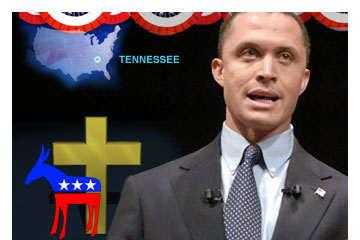
But visit Stephens this year, and he will freely admit that many of Tennessee’s evangelical voters are more ambivalent about voting for Republicans in this election. The biggest reason, he believes, is the deteriorating situation in Iraq. “So many people are angry at the president,” he said last Sunday, after inviting this reporter into his office after services. Polls nationwide have shown that evangelical support for Republicans is slipping. But in Tennessee a second big reason is the public message of Rep. Harold Ford Jr., the Democratic candidate for Senate, who hopes to become the first black senator from the South since Reconstruction by appealing to religious voters. “The church advertising has been brilliant,” Stephens said. “He presents himself very well.”
Stephens was referring to a 30-second television spot that shows Ford strolling through the pews of his childhood church. “Here, I learned the difference between right and wrong,” Ford tells the camera, explaining that he is glad his family forced him to worship as a child. “If advertising didn’t work, Madison Avenue wouldn’t be spending billions of dollars,” Stephens said of the ad. “And those folks sitting there listening to Harold Ford sit in the pew and talk about his grandmother taking him to church and all that, I think it can be effective for him.”
The church spot is just one part of a campaign by Ford to make his faith a central issue in the campaign, breaking with recent Democratic tradition in the hopes of helping to tip the balance of power in the Senate. On the campaign trail, Ford portrays himself as a moderate, saying he opposes the politics of House Minority Leader Nancy Pelosi, endorses the House Republican immigration plan, and supports a state ban on gay marriage. To prove his point, Ford’s get-out-the-vote rallies often double as prayer meetings. During a recent debate with his Republican opponent, former Chattanooga Mayor Bob Corker, Ford repeatedly asked state residents to give him their prayers along with their votes. On his Web site, under the banner “My Faith Is My Guide,” Ford writes that he is running for Senate “to put my faith and beliefs into action.”
There are signs that Ford’s decision to wear his religion on his sleeve is having an effect. At the end of September, a statewide poll showed that just 47 percent of white evangelicals supported Bob Corker, Ford’s Republican opponent, while 28 percent supported Ford and 25 percent were undecided. The poll results broke a long-standing maxim of state politics: Churchgoing whites reflexively side with the Republicans by overwhelming margins. “In the Senate race that pattern is completely gone,” said Ken Blake, who oversaw the poll for Middle Tennessee State University. According to Blake, Ford’s use of faith has “muddied the waters” for white evangelicals. “It makes them not quite so sure that he is the bad guy and Corker is the good guy.” Among all of the state’s likely voters, numerous recent polls show that the race remains a statistical dead heat.
Outside the University of Tennessee football game on Saturday, Ford had no problem explaining the inroads he appears to be making among evangelical voters compared to 2004, when he worked on the campaign of Democratic presidential nominee John Kerry, who lost the state by double digits. “Kerry and I are very different people,” Ford said, as he hurried toward the gates of Neyland Stadium, having arrived at the game against the University of Alabama deep into the second quarter. “I serve a big God, he gives me strength every day, and I go to work. I am not that smart. I don’t try to outsmart him. I just go to work every day.”
Just hours earlier, Ford’s opponent, Corker, had taken direct aim at those bona fides as he worked the crowd of thousands who had gathered in orange T-shirts and parkas to tailgate the game. In the mountainous eastern end of Tennessee, football games at Neyland Stadium have an importance that rivals Sunday church, and come with just as many unique rituals. Grown men dressed in incandescent orange will wait for hours in the hopes of bumping chests with University of Tennessee players as they make their way into the stadium, which has enough seats for 104,000 spectators, or about 60 percent of Knoxville’s population. For statewide political candidates, it is not an occasion that can be missed. Both Corker and Ford camps came equipped with signs and stickers. Ford’s supporters gave out free chili. Corker’s offered bottles of water and candy.
“I am more fully representative of Tennessean values,” Corker claimed, as he made his way through the orange-clad masses, with Fred Thompson, the former Tennessee senator and television actor. “I mean, we are so different on those issues. I mean, it is like worlds apart.” A short man with a frenetic need to shake hands, Corker came to politics after making millions in construction and real estate, and has earned the support of many in the business elite and the state party establishment. But along the way he has struggled to shore up the support of the Republican evangelical base, having burned many bridges over his past support for abortion. He is uniquely vulnerable to Ford’s attempts to peel off religious voters. “You come across folks who are disenchanted, who feel like they have lost their voice because their candidate wasn’t elected,” explained Jennifer Little, the first vice chairman of the Hamblen County Republican Party, who is working for Corker’s victory. She was referring to the bad blood that remains from Corker’s hotly contested Republican primary, in which he beat out two other candidates with superior credentials among the pro-life community, Ed Bryant and Van Hilleary.
In fact, there are clear signs of strife within the state’s evangelical base. Tennessee Right to Life, the state’s largest pro-life lobby, has declined to endorse Corker because in 1994 he refused to say life begins at conception and in 1995 he opposed a state budget amendment that would have limited state funding for abortions. “That energy certainly is not there for Mr. Corker,” said Brian Harris, the organization’s president. “I think there is a broad sense that Republicans have squandered the opportunity.” But Harris does not stop there. When asked if he is concerned about a Democratic Senate possibly blocking pro-life Supreme Court justices, he said there are risks that the state group will take to stand up for its principles. “I think there could be something gained for the pro-life movement, even if the Republicans have to lose a majority in the House or the Senate,” Harris continued. “I think there is going to have to be a lot of work after the election to see if the Reagan coalition can be put back together in Tennessee.”
Corker blames his lag in the polls among churchgoers less on his own record than on pressures from outside the state. “The national climate, no doubt, is affecting a lot of things,” Corker said, as he walked the crowd. “I would be remiss not to acknowledge that.” There is some evidence to back him up. A Newsweek poll last week found that the GOP’s religious base is badly eroding outside of Tennessee as well, amid concerns about Iraq and the recent Republican page scandal. Only 60 percent of white evangelicals said they planned to support Republican candidates, down from 74 percent nationwide who supported Bush in 2004. Other national polls by the Pew Research Center have tracked steep declines in evangelical support for Republicans ever since Hurricane Katrina.
The GOP seems to believe that Ford’s appeal to its most reliable voters is working. In recent days, the Republican National Committee has attempted to reverse the troubling polls in Tennessee with a television ad that both attacks Ford’s religious credentials and invokes that old standby of American politics, racial fear. The ad attempts to tie Ford to pornographers and Playboy playmates based on rather thin circumstantial evidence. The ad also plays on racial prejudices by showing a fictional white woman asking Ford, a bachelor, to call her for a date. The tactic has earned the condemnation of both the NAACP and Corker himself, who claimed he was unable to convince the party to take it down. (An earlier ad by the National Republican Senatorial Committee, called “What Kind,” attacks Ford over a soundtrack of funk music for a number of votes in Congress.)
The RNC has now announced it will no longer air the Playboy spot, but the message has already sunk in. Ford has been forced to admit attending a 2005 Super Bowl party sponsored by Playboy. At Neyland Stadium, as they waited for their candidate to arrive at the Tennessee game, Ford supporters were taunted by apparently inebriated fans in orange who shouted, “Hugh Hefner and Harold Ford,” and “Ford for senator? How about Ford for Playboy?”
For his part, pastor Stephens says he is still skeptical of Ford’s message, even as he admires his style. As a policy, Stephens does not endorse any particular candidate, or turn away those parishioners who support Democrats. But he says he has heard from churchgoers about concerns over Ford’s record on abortion, which includes several votes against banning so-called partial-birth abortion, a position Ford says he has since abandoned. He also worries that even a conservative Democrat would find himself unable to buck his party on crucial issues in such a polarized political climate. “A senator can’t vote his conscience. He’s got to vote party line,” Stephens said. “That’s what is going to hurt Harold Ford Jr.”
But those concerns have not stopped Stephens and others from paying attention to Ford’s religious message. Blake, the Tennessee pollster, points to recent surveys that describe the large value evangelical voters place on politicians who simply speak about their faith. “What evangelicals really want out of a political leader, in addition to policy, is a leader who will be bold about their faith,” he said. In February of 2005, a statewide poll of white evangelicals found that 54 percent believed Bush could increase belief in God around the country, compared to just 37 percent who thought he could end the ban on prayer in public schools or 31 percent who believed he could outlaw abortion.
Even if Ford does not win a majority of Tennessee’s white evangelical vote in two weeks, he will at least have proved that churchgoing voters are willing to look again at Democratic candidates who are proud of their Christian values, a tidal-wave shift from 2004. “Jesus, he doesn’t ride a donkey, nor does he ride an elephant,” Stephens explained, adding that he will probably not devote an entire sermon this year to the election. “He just doesn’t.” For the moment, that may be all Harold Ford Jr. needs to hear.
