
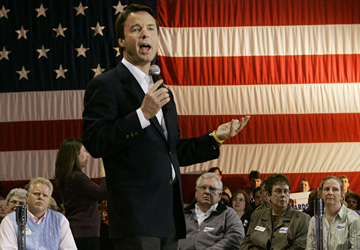

John Edwards sat down with Salon Tuesday night after the former North Carolina senator spoke to about 800 Iowans at a town meeting at Prairie High School here.
Tonight was a sort of normal event, where your wife Elizabeth’s cancer was very much in the background. Did you sense that as well?
I did. I think that’s largely been true since the first week. The first week it was very intense. We were in New Hampshire yesterday and did similar events, and it was very much the same. Now Elizabeth gets a lot of attention and you could see the crowd gathered around…
I’m not saying that anyone didn’t know.
They know. But I think people are still capable of feeling good feelings towards Elizabeth and at the same time focusing on the things that matter for the country. You notice I said that you could ask Elizabeth a question if you wanted to, and nobody had any questions.
Did you learn anything about yourself over the last two weeks, since the public announcement that Elizabeth’s cancer had returned?
I think it reaffirmed what I already believed. Which is — having gone through the loss of Wade [the Edwardses’ 16-year-old son, who died in a 1996 car crash] and Elizabeth’s first bout with cancer — it is true that it is a driving force in our lives, our desire to serve the country. And I think it was just reaffirmed in the face of very obviously difficult circumstances.
Elizabeth has announced that you plan to hire a tutor to help home-school your two youngest children, Emma Claire and Jack, in the fall so the family can be together on the campaign trail. Have you realized how many conservative votes you could get if you play up your plans for home schooling?
I hadn’t thought about that.
I assume that evolution will not be part of the curriculum.
It’ll be part of our curriculum.
Other than thinking about it, have you made any arrangements for home schooling?
No. We haven’t even talked to the children about it, which we have to do.
If there is one word that I have heard from you in this campaign — in your criticism tonight of “incrementalism” and in your New Hampshire speech last month about “transformational change” — it’s the word “bold.” I didn’t hear this from you four years ago at this time.
You probably never heard it from me.
What changed?
Circumstances. I think things have changed for America. Our standing in the world has gone down. The war in Iraq has gone downhill. Our healthcare systems have become more dysfunctional. And both climate change and energy use have gotten worse. I think it’s what’s needed under the circumstances. I think it’s also combined with me being more seasoned and more comfortable with taking stronger, bolder positions.
Do you think the Democrats went wrong by playing the incremental game for too long?
I’m not interested in analyzing going back. It’s a completely reasonable question. I think, going forward, it’s not where our party needs to be, and it’s not what America needs. “It” being incrementalism.
Going back to your being more “seasoned.” What are the lessons that you carry out of 2004 about running for president?
That you need a clarity and a depth about what you want to do as president. You really need to have spent a lot of time thinking about it. And developing very specific ideas about how to complete that vision. Otherwise it’s just rhetoric. You need to know what you want to do as president, and the voters have to know it.
Is that why, unlike last time, the issue formation in this campaign came first rather than something being done in the summer and the fall? I recall that your “Two Americas” speech [about the gap between rich and poor] wasn’t delivered until the end of December 2003.
That’s absolutely right. I think that voters deserve to know what I want to do as president, so they’re going to know.
On Iraq, since we both can count votes, do you think there is any chance that the Democrats in Congress will stand firm on demanding a timetable for withdrawal [in the supplemental appropriation for the Iraq war]?
They obviously don’t have the votes to override the veto. But they’re also not required to send the president what he wants. I think they should continue to stand firm. I think they should send him a bill that continues to fund the troops and provides for a draw-down. Then it’s the president’s responsibility to see that the troops get the support they need. I would not let him continue on this course if I had control.
Is there a danger that the Democrats could end up looking like they’re the obstructionists? Like Newt Gingrich versus Bill Clinton on shutting down the government?
I think this is different than that particular example because it’s war and it’s about life and death. I think the reason that the Democrats were voted into office in November is that the country wants them to do something different about Iraq. So I think, in many ways, there’s a mandate to do something different and to stand firm.
Are you confident that if the Democrats stood firm, Bush, who is certainly the most stubborn president of our lifetime, would back down? or would it just ratchet up into a confrontation?
Why should we presume that he won’t back down, and therefore we must back down? That’s not what we should do. We should be strong for the troops, for America and for the entire world. The Democrats need to be strong. That’s what we ought to do. That’s what I’d do.
Going back a little — today, I reread your 2005 “I was wrong” about Iraq Op-Ed in the Washington Post. I also remember the speeches you were giving and what you were saying during the run-up to the war. Looking back on it, what mistakes did you make personally and how would you not make those mistakes as president?
In that specific case, there were two major mistakes that led to the vote. One was relying too heavily on information provided by others about the presence of weapons of mass destruction. That information didn’t just come from the [Senate] Intelligence Committee; it also came from a lot of Clinton people who said the same thing.
It was all totally consistent. But I should have been more questioning about it in hindsight. More skeptical. The second thing — and this is actually the more difficult thing, looking back — is that I felt great conflict at the end about giving George Bush this authority because I didn’t trust him and I didn’t trust his motives. I didn’t know, in fairness, that they would be so incompetent in the administration of the war. But I had real doubts and reservations about that — and I ended up erring on the side of giving him the authority, and I think that was a mistake. I should not have done that.
For the future, it has made it much clearer to me what I would do under similar circumstances. Which is gather the information as best I could. Get people who have a very different view in front of me to express their view. Be certain that I had all the contrary information, and not be swayed by the advocacy of one side or the other, but instead make a very independent judgment about what makes sense under the circumstances. That’s what I’d do.
Looking back on it, there was a certain mood in the Democratic caucus in the Senate. I remember the pressure being put on [the late, liberal Minnesota senator] Paul Wellstone, of all people, to vote for the war because the assumption was that the Democrats couldn’t look weak.
I will tell you this: Making a mistake, which I did, about something that important gives you enormous strength going forward. Because now I have absolutely no hesitation standing behind my independent judgment about what needs to be done. I don’t care if it’s popular or unpopular. Or what the political considerations are. You probably see some element of that in everything I’m doing.
Staying with the Iraq thing one beat longer. When you were running last time, you were on the Senate Intelligence Committee and you had all these top-secret briefings about lots of things. This time — with the exception of [New Mexico Gov.] Bill Richardson, who has his own foreign-policy experience — you are the only serious Democrat running who is not in the Congress getting secret briefings. Is that an advantage? a disadvantage? Or does that put you in a different place?
Specifically [in reference to] Iraq or in general?
In general.
I think in general it’s a huge advantage because I think I [have] the perspective — an outside-Washington perspective. I think it would be possible for me to have an inside-Washington perspective, and I don’t want one. I think that I understand and see things the way that most Americans do. And, particularly, I’m not caught up in the day-to-day petty bickering that goes on in the Congress … I’m not in the business of legislating anymore. I want to be president of the United States. I want to lead. And there is a significant difference between those two. And they have very different responsibilities, so I think it is very helpful for me.
Turning to something different, there was that whole blogger controversy in your campaign. [Two bloggers working for Edwards resigned from the campaign after their commentary on their personal blogs came under fire from right-wing groups.] I wondered if you drew any larger message about the role of bloggers in a presidential campaign.
I think bloggers in general are a very healthy thing. I think it’s good for democracy … I think that the thing that we’re having to learn is how they can be actively engaged in a presidential campaign. I think one of the pitfalls that we’re faced with is that America to some extent — the traditional media to some extent — still apply the same standards to a blogger that they apply to anyone working in the campaign: i.e., anything they say or do indicates what the candidate believes or to some extent indicates what the candidate stands for. And hold the candidate accountable for that. And I think the nature of blogging is that bloggers say what they think. And as you know, in our case, this was something that came before these bloggers were working for me. So you want to give independence, you want them to be able to speak and to speak freely. But I think we’re all in a sort of brave new world in figuring out how to do that.
By their very nature, bloggers are people who are off-message.
And on the edge. I don’t think they should be required to be on message. I think they’re being measured in this new evolving world of the blogosphere, but some of the measurements are old and traditional. And I think it’s that conflict that is creating an issue and probably will for some time to come.
If someone who was in a campaign 10 years ago had published a pamphlet that some interest group was really upset about — with the oldest technology in the world, a printing press — it would have been a somewhat similar flap.
Sure, sure. Bloggers by nature, as you know, are right at the edge. That’s how they operate. It’s how they get their message across and how they get heard.
Do you have any sense of the role that blogging and the Web will play in this campaign?
I think we all are learning. But I have a sense of it. I think they’re going to play an important role. That’s what it feels like to me.
An important role in terms of differentiating between candidates or in mobilizing voters?
Getting information out there that’s not getting out there any other way.
One of the things that I found interesting when you mentioned it today was the creation of 1 million public service jobs. Is this a new idea for you?
It isn’t new today. Last summer when I laid out a whole agenda of about what to do about poverty, that was one of them. I called them “stepping-stone jobs,” which is the same thing.
In similar fashion, poverty wasn’t a theme in your speeches at this point four years ago. But you played up your background [as the son of a millworker]. Is poverty the missing step connecting your autobiography with your policy proposals?
I don’t know if I can be that analytical about it. I think the truth is that towards the end of the presidential campaign and the primaries, I began to talk about poverty because it fit perfectly into the “Two Americas” discussion. And I realized then — I could feel it internally — that I had a real passion about it. And then it became a real personal cause for me since then. I’ve done so much work on it. I’ve been in 25 states that I’ve been in poverty centers, community action centers, spent time with families. About half the country. Don’t hold me to that number, but it’s been a lot of different places, including a lot of places here in Iowa. I can see the faces of all the people that I met with and hear the desperation in their voices. As long as I’m alive and breathing it will be an issue for me.
In your speech tonight, referring to terrorism, you talked about how Bush and Cheney want us to cower. . . .
They believe in a parental government. They don’t believe it in the sense that they think that big government should solve all the problems. But they believe it in the sense that they don’t exhibit confidence in the power of Americans to do great things and be strong and courageous. And that’s amazing for a Republican president. And they tap into fear as the mechanism for accomplishing it. I just think it completely underestimates America.
The larger sort of question is: Do you buy the notion, as Cheney has said, that what the Bush administration calls the “war on terror” is a struggle that will be going on all of our lives?
There is a struggle that certainly will go on for some time. But I do not define the struggle the way he does. He wants to talk about this as war, the war on terror. And this struggle is one that has many layers. One layer is the only one they like to talk about, which is violent, radical Islam. Is this a threat to the security of the world? It absolutely is. But there are many components of that struggle that they never talk about, which are the underlying causes, which is the underlying capability of the terrorists to recruit. It is a multi-causal thing. It is young people not being educated, being educated in madrassas, living lives of poverty and hopelessness; corrupt regimes. There are multiple contributors to the undercurrent that allows terrorism to be a force in the world. Can we stamp it out entirely no matter what we do? Probably not. If we do all the things today that we should be doing, we can weaken it to the point that America and the rest of the civilized world can manage it.
So it won’t be the defining issue of the ‘teens and ’20s of this century?
I think that depends on what we do. It depends on what we do.
Last question. Do you regret voting for the Patriot Act?
No, no. What I do regret — put this in there if you’re going to write it — is that it was hurried, it was rushed, it wasn’t challenged the way it should have been. There are provisions in there — sneak-and-peek search provisions, provisions about libraries — that never should have sailed through like they did. That I do take responsibility for voting for. I along with the other members of the Senate who voted for this. But there were things that needed to be done. We had huge problems with the sharing of information that needed to be fixed. But it should have been done the right way.
