

It is a paradox of the presidential primary season: Democratic voters — and, yes, reporters — claim to crave a wide-open, spirited fight for the nomination, yet simultaneously are eager to pronounce the race over before a single vote has been cast. From Ed Muskie in 1972 to Howard Dean four years ago, history should have taught handicappers that betting the mortgage money on the odds-on favorite is a mug’s game.
Hillary Clinton is the latest beneficiary of this premature rush to certainty. Clinton’s meet-her-again-for-the-first-time rollout has softened her image, repositioned her as the Democrats’ most experienced candidate, airbrushed away her years of ambivalence on the Iraq war and turned her 1994 healthcare reform debacle into a scars-to-prove-it asset. At the same time, her campaign has shown uncharacteristic flashes of boldness from small matters (putting together a “Sopranos” parody video in a week, featuring Bill and Hillary) to large (matching John Edwards with a full-coverage-for-everyone healthcare plan).
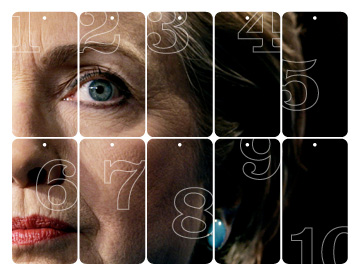
All this has led to the latest episode of I-is-for-Inevitability. Despite the growing (and, in some cases, the grudging) sense that the former first lady’s nomination is preordained and the primaries mere formalities, Clinton still must avoid a dirt-road-in-rainy-season ration of potholes on the way to the Denver Convention. Here are 10 factors that could permanently postpone the Hillary-for-president balloon drop:
1) When bad things happen to good candidates
Since James Monroe’s “Era of Good Feeling” romp to reelection in 1820, front-runners have all endured a week, a month or an eternity when the media mood shifts and the polls plummet. Despite a few notes of skepticism in the spring when Barack Obama first displayed his fundraising prowess, Clinton has yet to go through even a single bad-hair day.
Something will inevitably arise to remind voters of her vulnerabilities. It could be, say, a maladroit response to a voter’s question, a new fundraising scandal or an effective attack ad targeting her. The best justification for the endless campaign season is that it replicates (as much as anything possibly can) the stresses of actually serving in the White House. Some candidates — Dean, for example — never recover from their first crisis, while others — like Bill Clinton in 1992 — thrive on them.
Up to now, the Democratic debates have been as decorous as a student-council election in a 1950s sitcom. That will change as the time grows short — and Clinton’s challengers grow desperate. Until the New York senator stares down a roomful of rivals on the attack, or glares her way through a media feeding frenzy, she is not ready to be crowned as the 2008 nominee.
2) Political calendar choler
The order of the early caucuses and primaries can set Clinton up for a string of stinging setbacks. Her weakest state, at the moment, is Iowa where the opening-gun caucuses play a disproportionate role in shaping the contours of the contest. Clinton is locked in a three-way battle with Edwards and Obama in this state of notorious late-deciders who can stampede away from the favorite in, well, a New York minute.
A memo put out by the Obama campaign last week argues that the race is close in Iowa “not because it’s the one state in the union immune to Senator Clinton appeal. It is because voters are paying close attention … As other early states get more engaged, we will see a much closer race.”
Handicapping Iowa at this stage is nearly impossible. Polls have the accuracy of a blunderbuss, in part because there is no certainty how many Iowa Democrats will actually attend the caucuses. Private estimates from campaign officials range from 125,000 (roughly the 2004 turnout) to a historic high of 200,000. Pollster Mark Blumenthal on his blog points out, “Since late July, we have seen 13 different Democratic polls in Iowa taken by 11 difference pollsters. Each pollster does things differently, so we have 11 different conceptions of ‘likely caucus-goers.'”
What this means, in reality, is that Hillary Clinton could easily finish second and conceivably even third in Iowa. Potentially dragging her down is a quirk in Iowa Democratic rules that encourages backers of candidates with less than 15 percent support at a caucus site to switch to another contender. The best guess is that these second-choice voters are more likely to go to, say, Edwards or Obama than Clinton.
If that happens, “Hillary in Trouble” becomes a major headline coming out of Iowa. Virtually all current polls give Clinton a 2-to-1 lead in New Hampshire, but it is too soon to pronounce these numbers definitive. Most Granite State voters remain up for grabs — a CNN-WMUR poll in late September found that 55 percent of New Hampshire Democrats are still trying to decide on a candidate.
In theory — though it has not been demonstrated by his campaign so far — Obama should be the ideal New Hampshire candidate. The state has a long history of opting for soft-spoken reformers running against the anointed favorite: Gary Hart (1984), Paul Tsongas (1992) and even Bill Bradley (2000), who came within less than 7,000 votes of pulling off a major upset against Al Gore.
After New Hampshire, the Democratic race may be quickly redefined as Clinton vs. the anti-Hillary. Especially if the alternative is Obama, he will have the money and the momentum to battle the former first lady in the next primary state, South Carolina, with its heavy concentration of African-American voters. All this sets up a scenario under which Clinton loses the nomination in the simplest fashion possible — by failing to win an early state.
3) The Bill comes due
The wild-card factor in 2008 is the most important political spouse in American history. Bill Clinton has bequeathed his wife experience by association and has revived talk of the “Buy One, Get One Free” deal originally offered the voters in 1992.
But the ex-president in the past has also (how can we put this delicately?) displayed a predilection for creating soap-opera moments unrelated to his policy-wonk side. The unprecedented financial questions raised by his frenetic speechmaking and his fundraising for his foundation and library also could become an issue in the closing weeks of the campaign. In short, even if the nation is freed from any more fervid discussions of “the Clinton marriage,” the 42nd president’s role in the 44th president’s White House may give Democrats pause when it is time to actually vote.
4) Some other candidate gets his act together
“Barack Obama, please call your office. Your charisma has been located.”
In truth, the first-term Illinois senator has more than enough time to relaunch “Obama-mania.” At this point four years ago, John Kerry was broke, had just shaken up his campaign staff and was attracting smaller crowds than an itinerant Bulgarian poet. Obama, with more than enough money to compete with Clinton all the way to the Democratic convention, is her most formidable rival. All of the adoring crowds that flock to his appearances in Iowa and New Hampshire want him to be president some day. Obama’s challenge in the months ahead is to convince these erstwhile supporters that he is ready to be president in 2009.
Edwards may be running a one-state strategy, but because that state is Iowa, which he almost carried in 2004, he remains the candidate best positioned to break out with a dramatic victory. For Bill Richardson, in particular, and perhaps Joe Biden and Chris Dodd, there remains the possibility of gaining instant credibility by beating expectations in Iowa.
5) A cautionary tale
Perhaps the emblematic moment for Hillary Clinton came at the end of the Dartmouth debate late last month when she could not even offer a straight answer about whom she would root for in the wildly improbable situation that her beloved Chicago Cubs played her adopted New York Yankees in the World Series. The higher Clinton rises in the polls, the more she avoids uttering anything besides perfectly constructed paragraphs of poll-tested mush. On her recent swing through New Hampshire, she offered a stirring portrait in amiable inaccessibility.
This level of mind-numbing caution sadly may be what is required to run a successful campaign against the Republicans in the fall 2008 election. But it is not what voters in Iowa and New Hampshire expect during the early going. The last presidential candidate to smugly bank on his last name — Bush, in this case — lost the 2000 New Hampshire primary by 20 points to John McCain.
Presidential primaries are also a way for Democratic voters in particular to demonstrate their taste, discernment and individuality. Voters this year know they are not choosing a president, but rather a nominee in a race in which all the mainstream Democratic contenders would be credible candidates in November 2008. When the risks of a mistake are this small, primary voters can easily balk at voting for the favorite. After all, where is the fun in trailing along at the tail end of an imperial procession?
6) Hillary the hawk or “I ran straight to the center”
As the only Democratic presidential candidate to vote for the Senate resolution declaring Iran’s Revolutionary Guard to be a “terrorist organization,” Clinton revived suspicions that she may be the most hawkish, er, centrist Democrat in the race. The New York senator had successfully joined the Democratic consensus against the Iraqi misadventure, but her cover-her-right-flank vote on Iran may yet prove a problem with antiwar voters in Iowa and New Hampshire. There is a window of vulnerability for any presidential candidate in embarking on a general-election strategy before winning the primaries.
7) The anti-royalist rebellion
Although Clinton has deflected this question in several debates, there is a lingering uneasiness about the White House being reserved for just the Bush and Clinton families for 24 years. Voters could have banana-republic problems (not the clothing store) with living in a country where the Oval Office is reserved solely for the spouses and children of presidents.
8) The Karl Rove factor
Democratic voters may wonder why Rove and Rudy Giuliani have been boosting Clinton as the all-but-certain Democratic nominee. Maybe Karl and Rudy just possess a shrewd understanding of the inner workings of the rival political party. Or maybe they are secretly salivating at the thought of running against a Democratic nominee whose negatives invite an armada of Swift-boat attacks. More than 40 percent of the electorate have held an unfavorable view of Hillary in every Gallup Poll in the last two years. (In contrast, Obama’s unfavorable rating is 27 percent and Edwards’ is 31 percent in the latest Gallup Poll released earlier this month.)
Among Democrats, however, Clinton is currently regarded as the most electable candidate against the Republicans. But that image of invincibility might not survive a few rough weeks of campaign news or a setback in, say, Iowa. In that case, win-back-the-White-House-or-else Democratic voters may worry about spending a month of the fall campaign arguing, yet again, over Hillary’s miraculous track record as a commodities trader.
9) If she hasn’t closed the deal by now
Hillary Rodham Clinton has been in the public eye for nearly 16 years. Yet despite her strong overall lead, more than half the Democratic voters (in almost every poll) prefer other presidential candidates. For all her success at rebranding herself this year, it is worth asking what more can she do to win over the still skeptical wing of the Democratic Party?
10) The iron law of politics
Surprising things happen. The future is not an unchanging extrapolation from today. “Expect the unexpected” is an expression that anyone over the age of 17 finds a cloying cliché. But when it comes to a presidential campaign — more than two months before the Iowa caucuses — it is also a perfect description of reality.
Hillary Clinton is unquestionably the most likely person to be both the Democratic nominee and the next president. But there are hardly any guarantees, despite a media consensus prematurely handing her the nomination. She once boasted that she’s “in it to win it.” Now it is up to the New York senator to prove it.
