
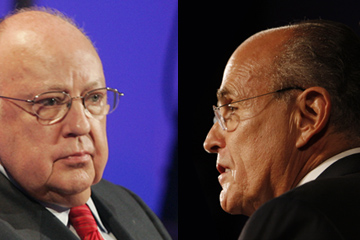

In two recent televised interviews, investigative reporter Wayne Barrett ventured an educated guess about the identity of the unnamed heavy in former ReganBooks publisher Judith Regan’s lawsuit — the suit in which Regan claims that her former bosses at News Corp., the parent firm of Fox News, want Rudy Giuliani to be president. A longtime observer of Giuliani from his perch at New York alternative weekly the Village Voice and the author of “Grand Illusion: The Untold Story of Rudy Giuliani and 9/11,” Barrett takes as a given what many observers suspect, that the executive whom Regan claims urged her to lie to protect Giuliani is none other than Fox News chief Roger Ailes.
“The funny thing about Judith Regan’s complaint is that she doesn’t refer to Roger Ailes by name for the first 16 pages, right?” Barrett told Keith Olbermann of MSNBC on Wednesday. “But Roger Ailes is … clearly the person she is referring to as this senior executive who made all these suggestions to her.”
The next day, on “Democracy Now,” host Amy Goodman opened her segment with Barrett by stating as fact that “Regan … was talking about Roger Ailes.” Barrett responded, “I’m sure you’re correct.”
Ailes was a veteran GOP political operative before he launched Fox News in 1996, and is also a personal friend and former employee of Giuliani’s. (Read more here.) But is he really the unnamed “senior executive” in Regan’s 70-page complaint?
A spokeswoman for Regan, Kelly Mullens, declined to comment. “The complaint speaks for itself,” said Mullens. Terri Everett, a News Corp. spokeswoman, would say only, “We think the entire lawsuit is preposterous. I’m not going to dignify any aspect of it for you.” But whether or not Regan’s claims are true, and regardless of the merits of the suit, the behavior alleged and the incidents described in the complaint do seem to correspond with the known history of relations between Judith Regan and Roger Ailes, former friends who apparently became enemies. In particular, Regan’s allegations about an incident involving a cellphone seem to point directly at Ailes.
Back in the early ’90s, Regan became a publishing hotshot by signing celebrities to write million-selling books. One of her best-known scores was the first book by right-wing radio talker Rush Limbaugh, which became a runaway bestseller. Even before “The Way Things Ought to Be” was published, the rising radio star signed on with Ailes to do a syndicated TV show. Ailes was a Republican media consultant who had worked in the presidential campaigns of Richard Nixon, Ronald Reagan and the first George Bush, and also in the first, failed mayoral bid of Giuliani in 1989. Ailes became the executive producer of “Rush Limbaugh.” During the four years the show lasted, Limbaugh gave repeated on-air shout-outs to “my editor,” Regan, for whom he wrote a second bestseller, called “See, I Told You So,” in 1993.
In 1994, Rupert Murdoch lured Regan away from Simon & Schuster to start her own line of books as part of HarperCollins, the publishing house owned by Murdoch’s News Corp. Reportedly key to Murdoch’s successful pursuit of Regan was his promise to give her a TV talk show of her own. Regan taped pilots for both FX and Fox’s broadcast network, but neither was picked up.
Ailes, meanwhile, went to work for Murdoch in 1996 to start a new cable news channel. Now Ailes and Regan had both Limbaugh and Murdoch in common — and Ailes, as head honcho at Fox News, was able to make Regan’s on-air dreams come true. On the schedule when Ailes launched Fox News on Oct. 7, 1996, was, at last, a real Judith Regan talk show. Called “That Regan Woman,” it anchored the network’s weekend prime-time lineup. Regan told a reporter that Ailes had named the show. “People were always asking him what ‘that Regan woman’ was like … It had a nice ring to it, so we went with it.” Regan would host a talk show for Ailes at Fox News, off and on, for six years. In its final incarnation, the program was known as “Tonight With Judith Regan.”
In the spring of 2001, Regan signed Bernie Kerik, commissioner of the NYPD, to write an autobiography about his rise from son of a prostitute to head of the nation’s largest municipal police force. The book, “The Lost Son,” was published on Nov. 14 of that year. Around that time, the publisher and author also became embroiled in a romance, despite the fact that Kerik was juggling a wife and another girlfriend.
On Nov. 28, 2001, while at Fox’s studios in Manhattan doing a photo shoot, Regan discovered that her cellphone was missing from her purse. Returning to her office, she was also unable to find a credit card and a necklace that had been in the bag. Soon, police officers were searching the studios and questioning individuals who had been at the photo shoot. The New York Times described homicide detectives going to the homes of Fox staffers after midnight to ask questions and take fingerprints. Regan’s cellphone was found in a garbage can outside the studios; she later discovered the necklace in the bottom of her bag. The credit card turned up at a pharmacy.
Subsequently, there has been disagreement over what action Regan took in response to the theft. “Several sources” told the New York Daily News that Regan called the police chief, Kerik. Regan insisted to both the Daily News and Newsday that she had only contacted a chief of detectives named Thomas Fahey. In a March 2002 story, the New York Times quotes Kerik as saying he didn’t know what his subordinates had done till later.
In her complaint, Regan now says that only Kerik had the authority to send detectives to Fox staffers’ homes to investigate a possible petit larceny, but that the unnamed senior executive, who knew of her affair with Kerik, tried to pin the blame on her. The language the complaint uses to describe the executive’s characterization of Regan’s actions — “out of control” — is very similar to phrases attributed to Roger Ailes in press accounts at the time.
According to a December 2001 Daily News story, “Fox News Chief Roger Ailes [told] Regan that she overreacted.” In Newsday’s version, a Fox spokesman said Ailes had “told [Regan] she was out of line.” The next day, a Newsday follow-up reported that Ailes had assured a group of makeup artists who were questioned by detectives, and who were considering a lawsuit against Regan, that they no longer had to work with Regan if that was their preference.
In her complaint, Regan describes introducing Kerik to the unnamed senior executive, “who was also a close ally of Rupert Murdoch,” and “confid[ing] in this executive regarding the details and nature of her relationship with Kerik.”
“At the end of 2001,” continues the complaint, “this senior News Corp. executive knew full well that Kerik and Giuliani — fresh from carrying the heroic halo of September 11th — were well-positioned for greater political power. So when Regan became the victim of a theft at the Fox News Channel, and Kerik — not Regan — used his authority as NYC Police Commissioner to send NYPD detectives out to investigate, this executive spun the story that it was Regan — not Kerik — who caused the detectives to knock on the doors of Fox News employees, and that it was Regan — not Kerik — who was out of control.”
“Inside the company, this senior News Corp. executive openly blamed Regan for the incident, even though he absolutely knew that it was not the case. He convinced others (including Rupert Murdoch) that somehow Regan was out-of-control.”
Kerik’s last day as police commissioner was just weeks after the cellphone incident. On Jan. 1, 2002, Mike Bloomberg became mayor of New York and Ray Kelly became police commissioner. Now a private citizen, Giuliani formed the consulting firm Giuliani Partners, which Kerik immediately joined. Late in 2002, Regan broke off her yearlong affair with Kerik after learning that his wife was pregnant. Around the same time, Regan ended her stint as a Fox News host. Variety reported that Regan gave up her show and walked away with a deal to do a series of interview specials on Fox’s broadcast network, but Salon was unable to find any evidence that such specials ever aired. She did host one special on Fox News in the fall of 2004.
Two years later, in December 2004, President Bush nominated Bernie Kerik — at Giuliani’s suggestion — to succeed Tom Ridge as the head of the Department of Homeland Security. At that time, Regan’s affair with Kerik was not public knowledge.
According to Regan’s complaint, the unnamed News Corp. executive became concerned that what Regan knew about Kerik would derail the nomination and thus damage Giuliani’s political prospects. Interestingly, Regan uses a reference to on-air practices at Fox News to describe the executive’s behavior. “In December 2004, this News Corp. senior executive told Regan that he believed she had information about Kerik that, if disclosed, would harm Kerik’s Homeland Security nomination, and more importantly Giuliani’s planned presidential campaign. This senior executive was concerned about this information being made public, and counseled Regan to lie and withhold information from investigators concerning Kerik. In fact, as is typically done when Fox News on-air talent and commentators receive their ‘talking points,’ this executive attempted to influence any information Regan might be asked to give regarding Kerik.”
After Kerik’s nomination crumbled, nominally because of a “nanny problem,” his affair with Regan became public knowledge. Within days, New York Post columnist Andrea Peyser had written two columns about the romance, in which unnamed friends and associates of Regan’s told Peyser in great detail about Kerik’s alleged inability to accept the end of the relationship and his supposed post-breakup habit of stalking both Regan and her son.
If the unnamed executive had really pressured Regan to keep silent about the affair, the point was now moot. So was his alleged advice that she withhold documents from investigators to protect his nomination. According to Regan, however, as of 2006 News Corp. executives still sought to defame her, in part to discredit anything she might want to say about Kerik and Giuliani.
In Regan’s version of events, her various nemeses at News Corp., including the unnamed “senior executive,” saw their opportunity to bring her down late last fall. They had already “laid the groundwork for smearing Regan” with the 2001 cellphone incident, according to Regan’s complaint, when Regan decided to publish a book by O.J. Simpson. Regan signed the disgraced football star to write “If I Did It,” in which he would all but confess to the murders of his ex-wife Nicole and her friend Ron Goldman. The project collapsed in November 2006 amid public outcry and condemnation in the media, and Regan lost her job a month later. (Officially, Regan was fired for anti-Semitic remarks; she denies making any such statements.) Much of the media outcry about the Simpson project came from within News Corp. itself, from Fox News’ own talking heads, including Bill O’Reilly, Greta Van Susteren and Geraldo Rivera.
In her account of the cellphone incident and, notably, when she alleges what could be construed as criminal behavior, Regan does not use names. She describes two senior executives advising her to withhold information from government investigators, but does not disclose their identities. When Regan is describing behavior that could bring only civil penalties, however, she names names without hesitation. On Page 16 of her complaint, in which she describes how the O.J. controversy offered her enemies a new chance to damage her, Regan finally uses the name Roger Ailes.
First she outlines a conspiracy against her by News Corp. “senior executives.” “[They] instigated, authorized and directed their own employees … to participate in the smear campaign against Regan.” Then she accuses Ailes of being the instigator. “Rupert Murdoch has publicly stated that Roger Ailes is the one who called him on his ranch in Australia in November 2006 to discuss how News Corp. should deal with the controversy surrounding the Simpson project.”
A 2007 New York magazine article on the affair similarly blamed Regan’s downfall not on Jane Friedman, Regan’s boss at HarperCollins and a longtime rival, but on Ailes. “It was decided that Regan should be … the lightning rod, let her take the abuse from journalists,” reporter Vanessa Grigoriadis wrote. “Many have suggested that Roger Ailes was the architect of this strategy, given the fact that a lot of the heat was coming from people within the News Corp. universe, notably from Ailes proteges like Bill O’Reilly.”
And heat did come from O’Reilly. Always strident, O’Reilly was positively venomous when it came to the Simpson project and the people behind it. On the Nov. 17 episode of his show last year, O’Reilly and guest Geraldo Rivera discussed boycotting the book and the accompanying televised interview already taped by Regan, and O’Reilly announced his belief that those responsible for the Simpson book and interview should be punished. “Americans have got to draw a line in the sand here. We now can become a force, we the people, to punish the people who are rewarding Simpson,” O’Reilly said. “We can punish them by not watching it, and not buying the book. Now I’m trying to get that word out.” Three days later, though he was out of the country on vacation, O’Reilly made a special call into his own show to gloat over the book’s cancellation. He claimed that his network had been key to the book’s demise. “Here, Fox News stepped up big. And once we did, the folks got it, because, obviously, we have a very big reach.”
There’s no evidence tying O’Reilly’s crusade against the Simpson project directly to Ailes, but O’Reilly does not make a secret of his gratitude to the man who made him a star. In 2004, when former “O’Reilly Factor” producer Andrea Mackris sued O’Reilly, claiming sexual harassment, O’Reilly showed the depths of his allegiance to Ailes. In an interview at the time of the suit, O’Reilly told Newsday that Ailes was “the greatest guy in the world. He’s got a blood brother forever.” Moreover, as Regan herself notes in her own complaint against News Corp., Mackris’ lawsuit said that O’Reilly had threatened Mackris with the combined power of himself and Ailes working together. Mackris’ suit alleged O’Reilly had said, “If you cross Fox … it’s not just me, it’s Roger Ailes who will go after you. I’m the street guy out front making loud noises about the issues, but Ailes operates behind the scenes, strategizes and makes things happens so that one day, bam! The person gets what’s coming to them.”
