

“Don’t forget,” my husband says as we leave the house at 5:30 in the morning on Election Day. “Have fun.”
It’s pretty dark in Toledo at that hour, and the light rain doesn’t help. And on top of that, I’m scared. I’m headed to a polling place to work. It’s my first time as a poll worker — and I will be the presiding judge. I had gone to the polling place the night before to set up the voting machines, and was relieved that two of my three co-workers were old hands at this. They knew where the tables should go and how the voting logs were to be kept. Given my own minimal training for the job, or lack thereof, I sure didn’t. I might have been the one in charge, but they were the ones who knew what had to be done - and how to do it.
I had signed up with the Lucas County Board of Elections to be a poll worker because I wanted to see firsthand what it was like. I had seen the long lines in 2004 and heard the stories about disenfranchised voters in my state, and how voting problems in Ohio might have determined the outcome of the presidential election.
Plus, I needed a few extra bucks.
I am assigned to Ward 4, Precinct D. I know the area well. Both my parents were born in homes less than a mile from here, and I grew up nearby. It was traditionally a Polish neighborhood until white flight took hold; many of us still make the pilgrimage to Stanley’s 5-Star Market for its fresh kielbasa. I’ll be working in the Thurgood Marshall Building, more commonly known as the Toledo Board of Education, which is halfway between the factory where DaimlerChrysler makes the Jeep Liberty and the streets where some Nazis marched a little over a year ago, setting off a race riot. The actual polling place is in the boardroom, and Precinct D shares the space with two other neighboring precincts of Ward 4.
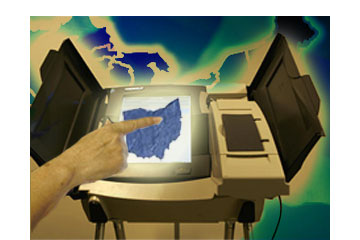
In setting up the Diebold TSX voting machines the night before, nearly every number on the machine had to be documented: the serial number of the machine; the number of the seal on the memory card slot; the number on the seal affixed to the front panel of the machine. I had worked with Jon and Ken, our Republican judges, and Shirley, a fellow Democrat and newbie, to remove old seals, test machines, and reseal them so they couldn’t be tampered with overnight.
The movie that we saw during training went over this quickly; it doesn’t go so quickly when you’re setting up four machines.
On Monday night, I had also written down two sets of numbers, one before the test and one after. I panicked when another precinct judge asked why I had so many numbers recorded. I stammered, saying I thought we were supposed to write everything down. Isn’t that what the poll worker manual says to do?
She replied that she doesn’t usually record everything twice, since the serial numbers stay the same. She usually just notes the new seal numbers next to the old ones and assumes they’ll figure out what she means at the Board of Elections.
I had been somewhat cowed when she left, until Jon smiled and reassured me, “There’s nothing wrong with being thorough.”
On Tuesday morning, the whole dance of unsealing and resealing machines happens again, with a difference: This time, we’ve loaded the memory cards, which contain the actual ballots, into each machine.
We’re still getting machines up and running at 6:30 a.m. when the voters start coming in. We try to get one machine going so they can at least begin voting with that one, but as we’re trying to do this, more people are coming in and we still have to check IDs - it’s a new law in Ohio, everyone has to produce one - and have them sign in. We check IDs, get a signature, activate their voter access cards, log them into the clerk’s book, and check them off on three different official registration lists. The voter takes the voter access card, which is coded for our precinct, sticks it into the voting machine, and then the machine is ready to accept a vote.
Finally, everything seems to be in good working order. We’re busy. At times, people are waiting for machines, but it’s still early in the day and there’s a definite congeniality in the air. People are excited about voting and happy to be there. The old-timers tell me that, for a non-presidential election, the turnout is looking pretty good.
It’s quickly clear that the voter access cards are going to be our biggest problem. They’re the size of a credit card and just as easily pocketed. Voters are supposed to hand the cards back to us after they’re finished voting, but it’s a major challenge just to keep them from wandering off with the cards. Each precinct has only 10, and one of ours isn’t working right anyway. It keeps jumping out of the machine while people are still voting. I cover the bad card in “I Voted Today” stickers and stash it with our other supplies.
Some of the elderly people need help. These are the folks who don’t use computers at home, and they’re understandably nervous. If it’s something simple, like how to get the voter access card into the slot, one of us will jump up and help. At other times, people will have questions about the ballot. At that time, whoever is helping the voter will call for a member of the opposite party - there are two Democrats and two Republicans at our precinct.
“Why is there only one name for this race?” one gentleman asks. I am asked that again and again, and keep having to explain that the candidate is running unopposed.
“Well, should I vote for him or not?” the man asks. All I can say is, “Sir, I’m here to help you vote, not to help you decide. You can do whatever you like.”
He laughs at me.
Besides the ID law, another new wrinkle in this election is that our polling place is to have a manned precinct locator table at the front of the room. Whenever a voter comes in, we ask his or her address and look up the street in a large book. The voter is then directed to the correct precinct table. On a few occasions, the voter is directed to another polling place altogether. We are to all take turns working at this table.
As the day wears on, one of our voting machines starts to act up. The printer within the machine is Diebold’s answer to a voter-verified receipt. Voters can open a viewing door on the printer housing and check to make sure that the touch-screen machine accurately recorded their vote on the receipt tape. If there is any question about the election, the theory goes, ballots can be hand-counted from these receipts. On this machine, once the printer has started printing, it won’t stop. Even after a voter has walked away from it, we can still hear the printer whirring away. Although our poll worker manual didn’t address this situation, Ken unlocks the printer housing and jiggles it. Like a toilet after the handle has been rattled, it stops.
My husband had advised me to take a book with me, but I barely get a chance to open it; we are that busy. Many voters come in holding sample ballots that have been sent out by the political parties, labor unions and special interests.
A gentleman has been taking a very long time at one of the voting machines, to the point that my co-workers are beginning to wonder about him. The voter looks up and motions to me to come over to him. He points to the screen, where there are four signatures scanned in. He asks me what they’re doing there.
I explain that those are the signatures of the members of the county Board of Elections, signifying that it is an official ballot for this county.
“Well, that’s confusing. I didn’t know that would be there. They shouldn’t have it there to confuse people.”
I assure him that no harm was meant, and he tells me he will file a complaint with the board about it. He seems quite pleased by this.
The stream of voters is steady throughout the day, until 4 p.m., when the stream becomes a flood. Suddenly, we are swamped. We are working furiously to keep up — checking IDs, having voters sign in, counting them, recording them in another book, and getting their voter access cards activated. We expected a rush as people got off work, but I don’t think anyone expected this volume. Some of the voters tell us that they’ve heard reports on the radio that there is a record turnout within Ohio for a non-presidential race.
Shirley the Democrat is in charge of checking IDs and signing people in. Ken the Republican is activating the cards and handing them to voters, as well as retrieving them after they have been used. He and Shirley are fuming at each other: She wants to hand voters the cards while they are standing in line; Ken wants to hang on to them. I’m staying out of it.
In a way, working at a polling place is like being on a 13-hour road trip. Even when you’re traveling with people you love, nerves can get frayed as you encounter twists and turns. These aren’t people we love — some of us have just met — but we’re all on this road together.
I ask a few first-time voters why they have decided to come out and vote today. Lakeisha smiles shyly and shrugs. “If I don’t vote, I can’t complain, right?”
Nineteen-year-old twins have come with their father. Each of the young men is holding a sample ballot. They say that they are there because they want to elect people who stand for their ideals, and to vote on issues.
They ask me, “Are these machines secure?”
I’ve been dreading this question all day. Just a few nights before, I had watched “Hacking Democracy,” a documentary that showed how easily the machines could be tampered with.
My honest answer: “I don’t know.
“I know we don’t have independent audits of them to make sure they haven’t been hacked. I wish I could tell you that they are 100 percent safe, but I can’t say that with any certainty.”
They shift from foot to foot as they stand in line, looking as if they are about to sprint to the machines. When their turns come, they take their time at the machines, studying the ballot carefully and referring back to their sample ballots.
I am hoping, for their sakes, that the machines are honest, and that they can vote their ideals.
It is 7:20 p.m., just 10 minutes until we close up shop. An attractive woman signs in and is outraged at what she sees in the signature book. Her daughter has not voted. She takes out her cellphone and we hear, “Janielle? Get down here and vote. No, don’t tell me that. I know you didn’t because I just signed the book and your name isn’t in it. You’ve got 10 minutes, girl.”
Janielle comes in, sheepishly smiling. When she tells us her name, we tease her, saying that her mother was getting ready to light into her the minute she walked through the door. Standing at the voting machine behind me, her mother doesn’t look up. She just says, “You got that right.”
They vote, and at 7:30 we begin closing the machines. We are tired, and it’s easy to make mistakes. The poll worker manual is even more confusing than usual. One machine locks up as we are printing the voting reports. We attempt to call the troubleshooter, but we can’t reach him. We finally get it working, but I am nervous that it won’t be accurate. At this point, though, it can’t be helped, and the locked and sealed printer canister already holds one report for that machine, printed before it froze. We load the printer canisters into a large green bag and seal the bag.
We have numerous forms to sign, Jon, Ken, Shirley and I. We’re the last ones out, and I apologize for my inexperience, for holding them up, for not being more on the ball with all this. I thank them again and again for all their help.
“Hey,” Jon says, giving me a wave. “Thanks for taking it on. See you at the next election.”
