
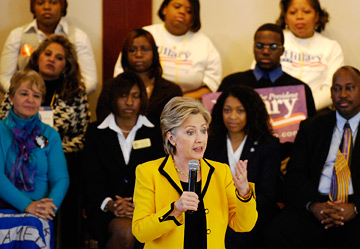

If Hillary Clinton fails to wrest the Democratic presidential nomination from Barack Obama, there will be plenty of second-guessing about how she ran her campaign. What if her loyalty to campaign manager Patti Solis Doyle and chief strategist Mark Penn had not prevented her from demoting them sooner? What if her electoral strategists had better understood the power of caucus states and the way in which votes cast there translated into delegates? What if she had actually planned for the month following Super Tuesday, thereby preventing Obama from posting the 11 straight wins after Feb. 5 that provided him the pledged delegate lead he enjoys today? But beyond these questions, one little-discussed factor (with direct or indirect relation to all of the above) appears to have had fatal consequences for Clinton’s campaign: She failed to mount a strong enough challenge to Obama’s claim on the African-American vote.
Though a majority of black voters may inevitably have gone for Obama, nothing precluded the wife of the so-called first black president from keeping Obama’s margins among blacks significantly narrower — say, losing to him by 4-to-1 or even 3-to-1, rather than the devastating 9-to-1 margins by which Obama has often won African-American Democrats. “The Clinton campaign has been focused on Barack Obama’s performance with white working-class voters in a few states, but they fail to mention Senator Clinton’s abysmal performance with black voters all over the country,” says political consultant and Obama supporter Jamal Simmons. “She has gone from leading among black voters to losing them 90 percent to 10 percent in Pennsylvania. One would expect Obama to win these voters, but 90-10 is a total collapse that Obama is not experiencing among any constituency. Simply put, Hillary Clinton has a black problem.”
Outside of Missouri and maybe Delaware, staying competitive among black voters wouldn’t have tipped any states for Clinton from the losing to winning column. But had she improved her performance to just 20 percent, she would have significantly reduced, if not eliminated entirely, her national popular-vote deficit (even without the disputed Florida and Michigan returns). And because the formula for assigning delegates favors the candidate who wins delegate-rich urban areas, Clinton could have limited the lopsided delegate-per-vote ratio Obama enjoyed in states ranging from Alabama to Maryland to Wisconsin.
Since the days of Adlai Stevenson — which is to say, since the civil rights movement finally guaranteed the franchise for black voters — the fate of candidates favored by so-called wine-track Democrats usually ends the same way. From Eugene McCarthy to Ted Kennedy, from Jerry Brown to Howard Dean, they make a big initial splash with the white liberal base, only to end up high and dry when working-class whites and blacks together align behind somebody else. What makes Obama different is that he has unified white liberals and African-Americans — a powerful coalition Clinton needed to prevent. Given that roughly three in five black Democratic voters are women, Clinton’s blunder here was preventable, and it may well have doomed her 2008 bid for the White House.
With Indiana and North Carolina voting tomorrow, the consequences of Hillary Clinton’s low standing among black voters will once again be on display. She may win Indiana (polls show a tight race) and keep her expected loss in North Carolina to single digits. But with a better showing among black voters, these two outcomes might be a solid win and a narrow victory, respectively, and a net gain rather than a loss of delegates in the two states combined.
For all the talk now in the post-Rev. Jeremiah Wright phase of the campaign about the reasons for doubting Obama’s electability, it is worth noting that black Democrats were initially among those most skeptical — maybe “cynical” is the better word — about the prospects of Illinois’ junior senator. The widespread apprehension among African-Americans was not personal to Obama so much as it was historical, rooted in the deeply held suspicion that neither America nor even the multicultural Democratic Party was ready to nominate, let alone elect, a black man for the presidency.
This reality was made plain to me last December at an Obama rally headlined by Oprah Winfrey at the football stadium on the campus of the University of South Carolina. Tens of thousands of African-Americans came to Columbia that Sunday morning, many driving hundreds of miles from points elsewhere in the state or region, to see Obama and Winfrey appear side by side. I expected these black attendees to be already in lockstep behind Obama, and some were. But many people I interviewed said they were not convinced he would be the nominee or president; some said they came out that day to pay witness to the historical fact of his candidacy, not his inevitable presidency.
In fact, poll results as late as October 2007 showed a solid majority of African-Americans expressing their support for Hillary Clinton’s candidacy. This was a natural reflex, of course. The former first lady, after all, is the wife of a president once almost universally beloved of African-Americans. So what went wrong?
In quick succession, three things happened in the month and a half between Thanksgiving and the New Hampshire primary. First, Oprah’s unprecedented mid-December endorsement of Obama sent a clear signal to her mixed-race female-dominated audience that they should feel as comfortable having Obama on their living room television screens for the nightly newscast as they do having her there during late-afternoon coffee talk. Next, in January, white Iowans sent a safe-harbor signal to black Americans wary about the Democratic Party nominating a black candidate that it was OK to get behind Obama. Hillary Clinton had no control over either of those developments, of course. And a top Obama advisor confirmed to me that the campaign was already tracking movement by black voters toward Obama by Thanksgiving.
But Clinton did have (or should have had) control over the third factor: the behavior of her campaign and of Bill Clinton from that point forward. Yet, through a series of intended or unintended developments — from Bill’s “fairy tale” and “false premise” comments concerning Obama’s stance on the Iraq war, to hints of black-brown animosities between African-American and Hispanic Democrats, to Hillary’s incessant “not qualified to lead” insinuations about Obama — the Clinton campaign signaled that if they were going to lose the black vote, they might as well turn it into an advantage with other elements in the Democratic coalition, notably white working-class voters.
Consequently, in a short span Hillary transformed from a celebrity into an object of scorn among numerous black Democrats. Was it inevitable? “I think once Obama became perceived as a viable candidate by the African-American community — that is, after Iowa — Clinton never had a chance to get any significant black vote,” electoral analyst Charlie Cook, of the “Cook Political Report,” told me. “I think President Clinton’s statements, and the interpretation of his statements, hurt with white liberals. But she was already hemorrhaging her black support and ultimately was destined to get very little.” Cook’s “perceived as viable” qualifier here is crucial. Obama was never guaranteed to be perceived as viable, even by African-Americans, as those October 2007 polls amply demonstrate.
That may help explain why South Carolina Rep. James Clyburn, the highest-ranking African-American in Congress, went from cautioning Bill Clinton to “chill out” in January to lambasting him by late April. “I think a lot of Clinton surrogates have been marginalizing, demonizing and trivializing Obama,” Clyburn bristled recently. When the former president complained that the Obama camp was playing the race card, Clyburn responded by dismissing the assertion as “bizarre” and reminding the public in a New York Times report that “it was the black community that bellied up to the bar” when Clinton faced impeachment. “I think black folks feel strongly that this is a strange way for President Clinton to show his appreciation,” Clyburn scoffed.
To understand the power of the black vote thus far in the 2008 Democratic primary, consider the fate of the two candidates in their own home states, both of which voted on Super Tuesday, Feb. 5.
Unsurprisingly, a whopping 93 percent of African-Americans in Illinois supported Obama. And even though New York was and surely will remain his low-water mark for black support, 61 percent of black New Yorkers still voted for him. Maintaining that level of support buffered Obama against the disparity in his performance among white voters in the two states, which were mirror opposites: 57 percent of whites backed him in Illinois, but in New York 59 percent of whites voted for Clinton. Consequently, despite their nearly identical home-state levels of white support, Obama netted more pledged delegates from Illinois (55) than Clinton did from New York (46), even though New York had far more delegates at stake.
In fact, by combining the delegate-earning power of Obama’s black support in the metropolitan New York area — along with the African-American pockets along the I-90 corridor from Buffalo to Syracuse to Albany — with his black support in Philadelphia and Pittsburgh two weeks ago, Obama’s Illinois victory effectively neutralized his net delegate loss in New York and Pennsylvania. That’s right: Clinton squeezed out the same number of net delegates from her 17-point win in New York and 9-point win in Pennsylvania as Obama did in his 31-point win in Illinois — even though New York and Pennsylvania combined (232 and 141 pledged delegates, respectively, for a total of 373) awarded nearly two and half times the delegates that Illinois did (153).
Nor can the results in those three states be dismissed as a case of Obama’s manipulating the caucus system to squeeze out delegates from low-turnout contests, because Illinois, New York and Pennsylvania were all primary states — and closed, registered-Democrats-only primary states at that. The combined returns from the three states, in fact, produced 118,603 more popular votes for Obama than for Clinton.
What might the situation look like now if Clinton had managed to keep Obama’s 90 percent black support just to 80 percent? It’s impossible to know for certain, because it depends on where specifically — in which states and districts — she garnered those extra black votes. But NBC News political director and delegate math expert Chuck Todd ventured a conservative, back-of-the-napkin estimate. “I’m not sure how many more delegates she would have gotten at 20 percent performance, but I’d guess roughly 25 to 30,” Todd told me. “That may not seem like a lot, but it would have swung the net delegate margin by 50 to 60, or about a third of his current pledged delegate lead.”
To supplement Todd’s delegate estimates, I looked at something much easier to compute: the extra popular votes Clinton would have amassed in 13 primary states with significant black populations — Alabama, Delaware, Georgia, Louisiana, Maryland, Mississippi, Missouri, New Jersey, Ohio, Pennsylvania, Texas, Virginia and Wisconsin — had she won just 20 percent of the black voters in those states. For obvious reasons, I kept Illinois and New York off the list, but you’ll notice that Arkansas, South Carolina and Tennessee are also missing. Why?
Like New York, Arkansas was a home game for Clinton and, at 25 percent, she exceeded the 20 percent threshold. In South Carolina she came pretty close (19 percent), perhaps because at that early juncture, and following her comeback win in New Hampshire and her caucus victory in Latino-dominated Nevada, some cynical black voters remained unconvinced that Obama had the juice to win the nomination. (The morning of the South Carolina vote, Bill Clinton made his controversial Jesse Jackson comparison in an effort to pre-spin Hillary’s expected loss, but it’s unclear whether many blacks in South Carolina would have heard about his comments prior to voting.) As for Tennessee, it voted on Super Tuesday, long after Obama was viable, but Clinton again exceeded the threshold (with 22 percent), perhaps as a result of her husband’s connections to the state via Al Gore. But whatever the reasons, the notion that Clinton was doomed to 10 percent or less of the black vote everywhere is simply untrue. The above figures strongly suggest that she could have done better.
And the difference it would have made is striking: In those 13 other states, had she drawn just 20 percent of the African-American vote, Clinton would have shifted more than 270,000 votes from Obama to herself, a net swing of more than half a million votes. Which, by the way, is roughly the amount by which she trails Obama in the overall national popular vote right now. Just imagine how hard Clinton’s spokesman Howard Wolfson would be spinning right now if Clinton were tied in the popular vote without Florida and Michigan, while still trailing among pledged delegates.
All of which brings me to a final point about the concentrated power of the black vote in the 2008 Democratic primary: The black vote was to Obama what small-state white voters in the Electoral College were to George W. Bush in 2000 — namely, a concentrated bloc of voters whose power magnified their preferred candidate’s electoral support beyond their absolute numerical value. For African-Americans, this should come as a pleasant irony, given the controversies about the counting of their votes in Florida in 2000 and in Ohio four years later.
Meanwhile, Hillary Clinton has not given up on African-American Democrats. As Indiana and North Carolina approached, she seemed to be trying to build on her Pennsylvania victory by reaching out anew — perhaps especially to African-American women. The most obvious evidence of this is Clinton’s new television ad featuring America’s most prominent contemporary black poet, Maya Angelou. “She intends to help our country become what it can become. She dares to say human beings are more alike than we are unalike,” says Angelou in the ad. “I have found the person I think would be the best president for the United States of America.”
The problem for Clinton is that too few other African-Americans, male or female, have reached this same finding. In her inimitable meter, Angelou proclaims in the ad that she “watched [Clinton] become interested in public health and in education for all the children — and I watched her stand.” But Clinton failed to stand for African-American Democrats when the chance presented itself late last fall and into early January, even if doing so meant firing key staffers or dressing down her own husband. Doing that might have denied Barack Obama the near-universal claim to their support he now enjoys, and the black-white coalition he built from it. For Hillary Clinton, the price of that failure may turn out to be nothing less than the nomination itself.
