

On Oct. 4, 1961, stand-up comic Lenny Bruce appeared at San Francisco’s Jazz Workshop. Recalling the first gig he had played in the city four years earlier, at another North Beach joint called Ann’s 440, he acted out an imaginary conversation between himself and his agent.
Bruce: What kind of a show is it, man?
Agent: Well, you know.
Bruce: Well, no, I don’t know, man…
Agent: Well, it’s not a show. They’re a bunch of cocksuckers, that’s all. A damned fag show.
Bruce: Oh. Well, that is a pretty bizarre show. I don’t know what I can do in that kind of show.
Agent: Well, no. It’s … we want you to change all that.
Lenny: Well — I don’t — that’s a big gig. I can just tell them to stop doing it.
Bruce then did a routine that was to become one his most famous, in which he examined the phrase “to come”:
“To” is a preposition, “come” is a verb, the verb intransitive.
To come. To come.
I’ve heard these two words my whole adult life and as a kid when they thought I was sleeping. Tooo commmme…
It’s been like a big drum solo.
Did you come? Did you come? Good. Did you come good?
… Now, if anyone in this room or the world finds those two words decadent, obscene, immoral, amoral, asexual — the words “to come” really make you feel uncomfortable — if you think I’m rank for saying it to you … you probably can’t come.
Bruce brought the house down. But among the guffawing hipsters, goateed existentialists and black-bedecked jazz fans (tenor great Ben Webster was also on the bill) was a man who was not laughing. He was a San Francisco policeman named James Ryan, who had been sent to the club by his sergeant, James Solden, with instructions to see if anything of a “lewd nature” was going on.
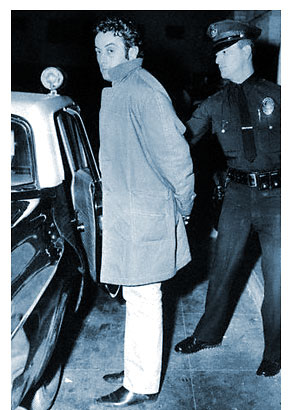
Ryan was horrified by what he heard. “Jeez, you know,” he told Solden, “I can hardly believe this myself. The man is up there onstage and he’s performing and he’s taking the term ‘cocksucker’ and using it.” After a brief conference, Ryan and Solden decided they had heard enough to arrest Bruce. As the crowd from the 10 p.m. show left, Ryan and Solden informed Bruce and the club owner they were arresting the performer for obscenity and escorted Bruce to the police call box in front of Enrico Banducci’s Hungry i. Along the way they had a conversation about obscenity stranger and funnier and, as events would show, more tragic than anything even Lenny Bruce could have dreamed up.
“I took exception. I took offense,” Solden told Bruce. “We’ve tried to elevate this street. I’m offended because you broke the law. I mean it sincerely. I mean it. I can’t see any right, any way you can break this word down, our society is not geared to it.”
Bruce said, “You break it down by talking about it … How about a word like ‘clap’?”
“Well, ‘clap’ is a better word than ‘cocksucker,'” Solden replied.
“Not if you get the clap from a cocksucker,” Bruce rejoined.
Bruce was taken in a paddy wagon down to the Hall of Justice, booked on misdemeanor charges, and locked up in a cell until the club owner bailed him out. He returned to the Jazz Workshop in time for his 1 a.m. show, announcing as he walked onstage, “You’ll never guess where I’ve been. I’ve been busted.” A little later, he said, “I’m sorry if I’m not very funny tonight, but I’m not a comedian, I’m Lenny Bruce.”
It was the first of eight obscenity busts that were to consume, and ultimately help destroy, the life of one of America’s greatest comedic satirists and verbal performers.
Lenny Bruce’s legal ordeal is one of the most shameful chapters in the cultural history of postwar America — a persecution that obsessed Bruce, drained his creative energies, bankrupted him, and allowed the demons that always haunted him to take over. Bruce died of a morphine overdose in 1966, but as Vincent Cuccia, one of the New York D.A.’s who prosecuted Bruce’s last obscenity case, said, “We drove him into poverty and bankruptcy and then murdered him. We all knew what we were doing. We used the law to kill him.”
Bruce makes a very difficult martyr — he was too irascible, too self-destructive, too perverse, too unclassifiable. But he is a martyr nonetheless — a heartbreakingly vulnerable renegade who was broken by the final tail-lash of the dying dragon of American Puritanism.
Has that dragon really died? It’s true that no comedian or author or singer will probably ever again be led away in handcuffs for using what some beat cop decides are offensive words — certainly not for saying that Eleanor Roosevelt “had the nicest tits of any lady in office” or doing a shtick about a wife who returns home to find her husband screwing a chicken. But the outdated obscenity laws and murky Supreme Court rulings used to arrest and convict Bruce remain, a testament to our nation’s complete inability to deal with the issue of obscenity. (Indeed, as Ronald Collins and David Skover point out in their excellent book, “The Trials of Lenny Bruce,” his final New York conviction has never been formally overturned: In the eyes of the law, disgracefully, Lenny Bruce remains a criminal.)
Most tellingly, the highest powers in the land are still eminently capable of using those laws to crack down on material they deem immoral — even if millions of Americans spend billions of dollars a year consuming that material. The issue today is not dirty words or offensive comedic routines, but pornography — America’s favorite not-so-secret vice and the bête noire of cultural conservatives and religious fundamentalists. (At least the official bête noire: According to many in a position to know, the most Bible-thumping types tend to be the most avid watchers of porn.) Pornography may not be as inspiring a subject to defend as a Lenny Bruce spritz, but free speech is free speech. It’s also hard to avoid the feeling that Attorney General John Ashcroft and his ilk, who are constantly calling for a return to the good old days of clear moral guidelines and harsh sanctions, would have been among Bruce’s most zealous persecutors.
On Aug. 7, Ashcroft’s Justice Department announced a 10-count indictment against a porno production company called Extreme Associates. The owners of the company, Robert Zicari and Janet Romano (aka “Lizzie Borden”) were charged with distributing obscene films and video clips through the U.S. mail and the Internet. The move was expected. The conservative groups that regard society’s tolerance for pornography as a sign of hideous moral decay, and that make up the Bush administration’s political base, have been critical of Bush for not launching an anti-porn war sooner. Attorney General Ashcroft is a fervent born-again Christian who met with anti-porn crusaders before Sept. 11; his planned crusade was derailed by the terrorist attacks. (Under Clinton, not surprisingly, prosecuting porn was a low priority — and during those years, the industry took off in meteoric fashion.)
What is peculiar about Ashcroft’s war on porn is its obvious futility. Only someone with the burning, itching faith of a Jimmy Swaggart would believe that an industry that now generates an estimated $8 billion to $10 billion annually and involves mainstream, blue-chip companies could realistically be closed down, or even significantly curtailed: Like it or not, the porn toothpaste is out of the American tube, and it won’t go back in.
Legally, Ashcroft is on strong ground: pornography is obviously obscene, and obscene speech can be restricted. But law and the real world have diverged here to the point of absurdity, and a common-sense analysis reveals his singling out the Extreme films to be ludicrous. With the possible exception of “Forced Entry,” in which an actress was apparently actually beaten (albeit with her consent), the Extreme Associates movies deemed obscene by the feds — “Extreme Teen #24,” “Cocktails #2: Director’s Cut,” “Ass Clowns #3: Director’s Cut,” and “1001 Ways to Eat My Jizz” — don’t appear (to judge by the images on the Extreme Web site) to be fundamentally different from the standard run of porn films. Raunchier, maybe; a little more outrageous, perhaps. But not in an altogether different league. Once you’re in the realm of hardcore, drawing distinctions about what is and isn’t obscene becomes an exercise in Aristotelean hairsplitting, using Clarence Thomas’ fabled pubic hair. As Susannah Breslin noted in a Salon piece two years ago about the L.A. police department’s crackdown on so-called extreme porn, “It remains unclear why 100 men masturbating on a woman is less protected by the First Amendment than, say, three men doing the same thing.”
A scene in which Bush and Ashcroft are sitting around discussing this important matter of First Amendment law could only be done justice to by Lenny Bruce. “John, I love ya but I gotta tell ya, you’re back in the friggin’ Middle Ages with this no-more-than-four-dicks-at-one-time thing. Times have changed. Even when I was a frat boy, a couple dozen weenies was no big deal … Tell you what I’ll do, I’ll do ya a favor and cut it off at 50. More than 50 shmucks, we shut ’em down.” “Fifty! Mr. President, with respect, that’s outrageous. How about 35?”
The real target of Ashcroft’s zeal is obviously not the supposedly “unacceptable” porn made by Extreme Associates, but pornography itself. As already noted, however, it is a singularly empty crusade, apparently intended mainly to score political points: Although Ashcroft has the full weight of obscenity law on his side, that law — always hopelessly ambiguous and vague — has become completely meaningless. It has been trumped by money and reality.
Obscenity law, as Lenny Bruce learned to his sorrow, is probably the most contradictory and murky area in jurisprudence — it’s so open-ended that it can justify virtually any conclusion, and so empty of meaningful or even coherent content that it has increasingly been ignored. The landmark Supreme Court obscenity case remains Roth vs. the United States (1957). As Collins and Skover point out, the majority opinion, written by Justice William Brennan, was Janus-faced. Free-speech absolutists took comfort in Brennan’s statement that any work containing “even the slightest” meaningful content was protected by the First Amendment. Conservatives celebrated the decision’s explicit declaration that obscene speech, being essentially worthless, was not protected; and they cheered the justices’ affirmation of “the social interest in order and morality.”
The heart of Roth is the following famous formula for determining obscenity: “whether to the average person, applying contemporary community standards, the dominant theme of the material as a whole appeals to prurient interest.”
For Bruce and some of his many lawyers, the last clause — “appeals to prurient interest” — seemed to offer a powerful line of defense. As Bruce — who understandably became increasingly obsessed with the law — analyzed it, “I must get you horny — that’s what it means. If I do a disgusting show … that’s not obscene.” But Roth was vague on this point too: In a footnote, Brennan noted that prurience included “a shameful or morbid interest in nudity, sex or excretion” that was described in a manner going “substantially beyond customary limits of candor.” Prosecutors seized on this point to attempt to prove that Bruce was guilty of obscenity.
A subsequent Supreme Court ruling, Miller vs. California (1973) reaffirmed Roth, but retreated slightly in a more conservative direction. Chief Justice Warren Burger came up with a new qualifying test, the famous “LAPS” formulation: In addition to deciding whether a given work depicted or described sexual conduct in a prurient way, the familiar “average person applying contemporary community standards” was to decide “whether the work, taken as a whole, lacks serious literary, artistic, political, or scientific value.” This replaced the earlier, nonmajority formula that a work had to be “utterly without redeeming social value,” thus making it slightly easier to find works obscene.
At the end of his career, in an extraordinary interview, Brennan admitted that his Herculean attempts to come up with a workable obscenity formula — he penned seven obscenity decisions — had failed. Speaking to journalist Nat Hentoff, a staunch Bruce defender and free-speech advocate, Brennan said, “I put 16 years into that damn obscenity thing. I tried and tried, and I waffled back and forth, and finally I gave up.” The key point, for Brennan: “If you can’t define it, you can’t prosecute people for it. And that’s why … I finally abandoned the whole effort.”
The tragic ordeal of Lenny Bruce demonstrates both the emptiness of the Supreme Court’s obscenity rulings and the way that social mores — which in practice were sometimes nothing more than the beliefs or tastes of one or two beat cops or local D.A.’s — rose up to fill the void left by the law’s absence. When the law is silent or meaningless, it usually means that society is conflicted or confused — and at such times, mere power wins. In Bruce’s case, it was a power that was waning — but it had enough venom left, enough prosecutors and judges and policemen, to destroy him.
From this perspective, Ashcroft’s anti-porn crusade — if serious and not merely a show for right-wing consumption — could be a power move in its own right, a gamble that those millions of Americans who enjoy porn will be too ashamed to acknowledge it, that no one will resist a massive crackdown on X-rated material. If that proves to be the case, those on the right could dream that pornography’s hole card — its prevalence — might be trumped by the overwhelming force of the law. (That is, of course, if the Bush administration really has the stomach to pursue its crusade, face down the Fortune 500 companies that beam porn into hotel rooms, and split the right wing into its libertarian and moralist factions.) After all, by the standards of both Roth and Miller, one would have to say that all pornography is obscene on the face of it: If pornography doesn’t appeal to “prurient interest,” what does? Nor does the “average person applying community standards” offer hope to civil libertarians: A close reading of Miller shows that those standards are not to be used to determine whether a given work or type of work is widely accepted by the community — which would of course leave porn protected — but only whether that work depicts sexual activity in an offensive way and lacks serious artistic, etc., value.
In other words, pornography under America’s current vague obscenity law is clearly obscene — indeed, the point is virtually tautological — and thus has no First Amendment protection.
But it doesn’t matter. The law will follow reality — which is why it’s time to get rid of our outdated obscenity laws altogether. (Laws protecting minors from viewing or being depicted in obscenity, of course, should remain on the books.) When laws become embarrassments, mere empty gestures pointing at a moral code more honored in the breach than in the observance, they should be whacked. Porn isn’t going anywhere, any more than all the other mixed-up, loud, brilliant, obnoxious, seductive, vulgar, stimulating, offensive, wild, blandly corporate, deeply personal messages that blare from every nook and cranny of this juiced-up lowrider of a society.
And in some small, indirect but important way, we have Lenny Bruce to thank for that. Lenny Bruce, who refused to shut up. Lenny Bruce, who shoved “nigger” and “kike” and “cunt” and “cocksucker” in our faces, sometimes to enlighten, sometimes to amuse, sometimes just to shock. Lenny Bruce, who stood everything on its head, a whirring mixmaster of rage and compassion and ugliness. Lenny the dizzying master dramatist, shtickmeister of the Yiddish id-ish. Lenny marrying the stripper, screwing everything, and boasting about it all so exquisitely loud that our hypocrisy and envy would flare up high and show us a way out of the dark. Lenny for the Jews, Lenny for the blacks, Lenny for justice, Lenny for nothing and no one, Lenny whose only real subject was the void at his own center he endlessly pursued through great tales and dark cities, Lenny dying again and again and dying really finally for our sins, and his own.
Lenny’s 1961 arrest at the Jazz Workshop was the only one of his busts that had a happy ending. He was fortunate enough to get a learned and conscientous judge, Clayton Horn, who four years earlier had acquitted the beat poet and publisher Lawrence Ferlinghetti on obscenity charges brought against him for publishing Alan Ginsberg’s “Howl.” Horn had relied on Roth for that decision, and he instructed the jury according to the liberal interpretation of Brennan’s ruling: They were to consider the work as a whole; foul language of itself was not obscene; if the work had any redeeming social value, it was not obscene. The jury found Bruce not guilty.
Before Bruce experienced the learned justice of Horn, however, he fell into the less-than-Solomonic hands of a 61-year-old judge named Albert A. Axelrod. Judge Axelrod will not go down as one of history’s great jurists, but he was nevertheless immortalized by the man he wanted to throw in jail. The perfectly named Axelrod apparently believed in dispensing justice out of his gut, an area that was only uncertainly connected to such things as Supreme Court rulings. Faced with Bruce’s lawyer’s arguments that the police officers had not looked at Bruce’s work as a whole — a standard clearly laid down in the landmark Roth case, four years earlier — Axelrod stated, “You don’t have to have the whole performance to be obscene. I think that the way any word is used or spoken during that performance which has an obscene meaning within that definition, that there is a violation.” Later, when the defense attorneys again raised similar Roth-based points, Axelrod went off his axle: “I don’t need any points and authorities to tell me that this language which was used and which was quoted by the officer and the context in which it was used is obscene. Now, if the Supreme Court takes a different view, that is up to them. But to me, it is obscene and I certainly wouldn’t let my grandchildren sit in and listen to a show like that. Now, that is my opinion.”
Collins and Skover note, “So much for judicial acumen and deference to the highest court in the land.”
Axelrod ended up by granting a 30-day stay so that Bruce’s lawyer could transcribe a tape of the performance. But his parting words for Bruce made it clear that for him, the trial was a mere formality and Bruce had already been found guilty. “It is my understanding [Mr. Bruce] has a show Sunday. If there is any repetition of this conduct, I’ll deal with him accordingly. I want to caution you right now that if I get a report in the interim that you repeated any of the language or anything obnoxious, you will take the consequences. Is that clear? … Let that be a warning to you.”
Axelrod closed with what proved to be a world-class understatement: “From your testimony here, I just have a little feeling that the lesson hasn’t gotten home.”
A slightly different account of Axelrod’s admonition appeared in the San Francisco Chronicle, which reported that he said, “I’m cautioning you know that if you say anything obscene at your performance, I’ll hear about it … if I get a report that you have repeated this language, you’d better bring your toothbrush with you when you come to court again.”
Two days later, Lenny Bruce played San Francisco’s Curran Theater. Faced with jail if he so much as said a bad word, Bruce went off on Axelrod:
Dig Axelrod: “I warn you, Lenny Bruce, if I hear those words…” If he hears from somebody else that I talked dirty tonight, then I’ll be in court again. “If I hear it, you’d better bring your toothbrush.” Hmm … now … “Bring your toothbrush.” This means two things to me. The first thing … that we were compatible, because a toothbrush is an intimate thing, everybody knows that.
The judge making a homosexual play for Lenny: It was pure Bruce, perversely defiant, recklessly brilliant. It’s one thing for Shakespeare to write “Thou, rascal beadle, hold thy bloody hand: why dost thou lash that whore? Strip thy own back, thou hotly lusts to use her in that kind, for which thou whip’st her.” Bruce said it when he knew the beadle was hotly lusting to whip him. He couldn’t help it — he wasn’t just riding the whirlwind, he was the whirlwind. He went on and on, deriding Axelrod, mocking his pious invocation of his grandkids by imagining him screwing Bruce’s ex-wife and playing along with her kinky fantasy that he was her grandfather. It was a free-associative tour de force that went on for more than three hours.
“Let me tell you the truth,” Bruce once said. “The truth is what is. And what should be is a fantasy, a terrible, terrible lie somebody gave the people long ago.” Stripping off all illusions can be a noble task, and an incredibly funny one if handled by a comic master like Bruce. But when the laughter dies, what is stripped away may look less like illusion than human skin.
Bruce lived by that knife edge, and died by it. But it feels right to freeze him forever in one moment, not the bloated, confused, bitter junkie he became but the sharp young hipster, the cat who cracked up Miles, who could keep all the balls in the air at the same time and who, one San Francisco night in 1961, before they broke his spirit, when a bust was just a fly on his ass, threw it back in their face, running it all down, free.
