
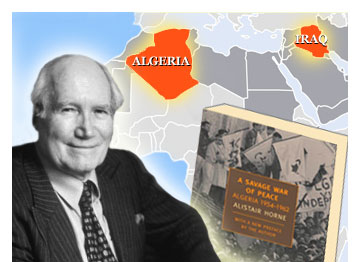

Sir Alistair Horne may be the only author in the world whose books have been read and praised by George W. Bush, Ariel Sharon and Robert Fisk. Not to mention by much of the senior military staff of the U.S. Army, Middle East scholars, State Department policy wonks, and realpolitik statesmen. The distinguished British historian, author of 18 books, became the talk of the U.S. chattering classes when it was revealed that President Bush was reading his classic account of the 1954-1962 Algerian War, “A Savage War of Peace.” Indeed, Bush was so impressed with “A Savage War of Peace” that he invited Horne to come to the White House for tea and a talk last Thursday.
“He wrote me the most charming handwritten letter, said he was very interested in my books, and wanted to know more. He said ‘A Savage War of Peace’ has been most useful. I was quite stunned,” said Horne.
Horne declined to go into details about what they talked about, saying their conversation was off the record. “He was extremely courteous, very cheerful, loves jokes and he couldn’t have been more charming. I was very honored,” Horne said. “He was very determined. ‘We’re not going to give up, we’re not going to give up,’ he repeated from time to time. He was very interested in my book, had obviously read it most thoroughly, as he had my other book, ‘The Price of Glory’ [about the WWI battle of Verdun]. He had put in a lot of work. Where he finds the time I don’t know. We discussed the book in depth. We disagreed about a few points. I didn’t entirely agree with his admiration for Tony Blair, but that was a matter of personal predilection.”
For Horne, such access to the highest levels of power is not unusual. He was a friend of the Conservative British Prime Minister Harold Macmillan, and wrote his biography. Former Israeli Prime Minister Ariel Sharon said that “A Savage War of Peace” was his favorite bedside reading, and that one of Horne’s earlier books, “To Lose a Battle: France 1940,” helped him win the 1973 October War against Egypt. In 2003, Horne was knighted for services to Franco-British relations, going into the knightly ranks with another Briton noted for his keen analysis of the days when the Blitzkrieg raged and the bodies stank, Mick Jagger. His current project, undertaken at the subject’s invitation, is a biography of Henry Kissinger, focused on the single year 1973. (“Most people measure their material in feet,” Horne said, explaining why he didn’t take on Kissinger’s entire life. “His material is said to total 33 tons.”)
That “A Savage War of Peace” is on the Bush administration’s must-read list is one of the more remarkable intellectual ironies in recent years. Horne’s book recounts the inevitable defeat of a colonialist power at the hands of a small but determined group of insurgents, the National Liberation Front, who effectively used terrorism to win their nation’s freedom — not exactly the sort of book you would expect Bush and his inner circle to curl up with. As Horne notes, the Algerian War “remains on the statute books as a prototype of the modern war of national liberation.” Nelson Mandela’s African National Congress guerrillas and Palestinian leaders both studied it, Horne points out. So did al-Qaida. And now, so has George W. Bush.
What the Bush administration is hoping to learn from Horne’s book, of course, is exactly the opposite of what Mandela and Arafat were looking for. The latter were searching for information that would lead to victory over occupying powers; Bush officials are looking for clues that will allow them to prevail over a stubborn insurgency, or failing that, find a viable exit strategy. But there do not appear to be many useful lessons in Horne’s book for Bush except “don’t.”
I met Horne when he was visiting San Francisco last week. We spoke for several hours at his daughter’s house. (Full disclosure: His daughter, Alexandra Berven, is a friend of mine.) At 81, Horne remains razor-sharp. A charming British gentleman with the amiable manners and curmudgeonly good humor of an honorary Oxford fellow — which is not surprising, since he is one — he enlivens his analysis of the contemporary world scene with analogies to Napoleon and references to Talleyrand and Churchill. His specialties are France and military history, but he has also written about, among other subjects, Canada, Germany and Chile. Alexandra described his politics as “to the left of Genghis Khan but to the right of Margaret Thatcher,” but added, “He’s not a party ideologue — I think his politics are driven by whether people are doing idiotic things.”
Horne didn’t vote for British Prime Minister Tony Blair, and initially supported the Iraq war because of his concern for Britain’s special relationship with America, and because he was misled by the bogus intelligence. But he has since recanted and calls the war an enormous blunder. Blair, he said, should be impeached for war crimes. He discreetly avoided saying anything so incendiary about the Bush administration, although he threw some sharp elbows at the neoconservatives who played such a large role in drumming up the war.
Horne’s opinions, whether one agrees with all of them or not, are untainted by the partisan rancor of American politics. He is refreshingly unafraid to puncture pieties of the left and right alike. He calls for a nuclear-free zone in the Middle East and wants Guantánamo shut down immediately, but warns that hasty withdrawal could empower the jihadists. He attacks neoconservatives who used what he calls “Holocaustology” to justify invading Iraq, but blasts the Muslim world for its backwardness. He thinks we should bring in Indian mercenaries to fight in Iraq and says the way to solve the problems in the Middle East would be to turn Gaza into another Dubai — and “get the priests out of there.” He brings a long historical perspective and six decades of experience to bear on the affairs of the day.
Given that “A Savage War of Peace” is being read as a mirror of the current war, what does Horne think are the parallels between Algeria and Iraq? “The first one is the difficulty of combating insurgents with a regular army,” he said. “Too heavy forces, too much collateral damage. The second is porous frontiers. In Algeria, they had Morocco and Tunisia on either side, so the FLN could stage raids and then go back across the border so the French couldn’t get them. Now you’ve got a similar situation in Iraq, with Syria and Iran. The third is the tactic of targeting local police. In Algeria, the insurgents were just a handful compared to what you’ve got in Iraq. They realized that they couldn’t beat the French army, so they attacked the local police who were loyal to the French. This was enormously successful. The French had to take the army back from search and destroy missions to protect the police. So both the police and the army were neutralized. The insurgents in Iraq have copied the Algerian experience to great effect.”
Horne turned to the parallel that he feels most passionately about. “The fourth thing, and this is the painful issue, is torture or abuse,” he said. “In Algeria, the French used torture — as opposed to abuse — very effectively as an instrument of war. They had some success with it; they did undoubtedly get some intelligence from the use of torture. But they also got a lot of wrong intelligence, which inevitably happens. But worse than that, from the French point of view, was that when the news came out in France of what the army was doing, it caused such a revulsion that it led directly to the French capitulation. And not only revulsion in France, but revulsion here. JFK, as a senator, took up the Algerian cause quite strongly partly because of the human rights issue.
“I feel myself absolutely clear in my own mind that you do not, whatever the excuse, use torture, let alone abuse,” Horne went on. “In one way, of course, abuse is not as bad as torture, but in another way it’s worse because it’s senseless. It doesn’t achieve anything. Abu Ghraib was just appalling. In the Algerian war, the media was very primitive — it took about a year to actually get the news into the press in France. There was no television then. With Abu Ghraib, the images were on Al-Jazeera the next day. The impact, across the whole of the Muslim world, is enormous. What do you get for it? Nothing.”
Horne noted that one of the less-known effects of torture is its effect on those who carry it out. “The damage done to the torturees is awful, but an extraordinary thing is the terrible corruption of torture on the torturers. I’ve followed it up quite a lot in France. There are mental hospitals that have a lot of ex-soldiers from 50 years ago who are still suffering from what they had to do.”
Horne went on to tell of a chilling encounter he had with Gen. Augusto Pinochet, the Chilean dictator who was responsible for thousands of extrajudicial executions and “disappearances,” and widespread torture. According to Human Rights Watch, “torture of political detainees in clandestine detention centers was systematic throughout the Pinochet regime, often overseen by doctors expert in keeping victims barely alive.” More than 30,000 Chileans were tortured, according to an authoritative Chilean report. “I had the very good fortune once to interview General Pinochet in 1987, when he was still in power. ‘A Savage War of Peace’ had been translated into Spanish. I think I was the first gringo journalist to talk to him, largely because he’d read that book. He started off the interview by saying how much he’d liked it. I thought, this is not something to be missed. So I said, ‘Well, of course I don’t have to tell you that the French army won the battle of Algiers through the use of torture, but it cost them the war.’ Pinochet looked me absolutely straight in the eye and said, ‘Well, yes, but in Chile we never tortured.'”
In a subsequent phone interview, Horne related an oddly similar encounter — although he didn’t characterize it that way — he had with former Defense Secretary Donald Rumsfeld two years ago. “I was invited to the Pentagon to have lunch with Donald Rumsfeld and it was suggested that I might take a copy of ‘A Savage War,'” Horne said. “This was in May 2005, the year after Abu Ghraib. The lunch was called off, so I left the book. I thought, he’s an incredibly busy man, I ought to just highlight various passages that I think are of relevance to Iraq. They were mostly to do with torture.
“What I didn’t know was that at that particular moment they were having a real soul-searching over Abu Ghraib at the Pentagon,” Horne went on. “Rumsfeld wrote back rather tersely, ‘As you well know, we do not believe in torture.’ ‘As you well know’ was his way of saying, ‘You’re a bloody fool. Shut up.’ I wrote back to him rather apologetically, saying I hoped he didn’t think I was being presumptuous and that what I was really trying to say was that the Americans and British were both singing from the same song sheet [on torture]. I got back a very charming letter saying we were indeed both singing from the same song sheet.”
The fifth parallel Horne saw between Algeria and Iraq is the one that now confronts the Bush administration: an exit strategy. “In Algeria, the war went on for eight years, and the military, rather like the military in Vietnam, had a very good case for saying they were winning it,” Horne said. “But de Gaulle decided they had to go. They were negotiating for months with the FLN, like the peeling of an onion. The French lost every bloody thing, including the rights to oil. They had to pull out all 1 million pieds noirs.” The pieds noirs, of whom Albert Camus is the most famous, were French colonial settlers, many of whom traced their roots in Algeria back to the French conquest in 1830. “One of the worst things that happened in Algeria was what happened to the Harkis, the Algerians who were loyal to France,” Horne explained. As he relates in his book, the Harkis were slaughtered by their vengeful countrymen after the French left, with an estimated 30,000 to 150,000 perishing. “Absolutely appalling. I fear that we’re going to have a Harki situation or much worse coming up in Iraq, because of the numbers involved. The savagery in Iraq is worse than what it was in Algeria.”
Horne believes that America’s exit strategy must take into account an updated domino theory. “When the domino theory was applied to Vietnam, it was much despised. People said it didn’t mean a thing. But here I think it does, because an over-speedy exit from Iraq is going to leave a vacuum with possibly terrible consequences,” he said. “Take Saudi Arabia. Are we going to have another Iranian revolution there? I would think it’s really ripe for it. Even aside from al-Qaida, there’s an awful lot of opposition to the Saudi royal family. And then you’ve got the question of Iran, which could emerge as the most powerful power in the area. So I’m just extremely glad I’m not George W. Bush because I don’t know how you can get out gracefully.”
Horne said that the Democrats’ policy on Iraq, which calls for phased withdrawals, runs the risk of opening the doors to chaos and assisting the insurgents. “If Barack Obama is going to run on a ticket of saying we are going to pull everything out by such and such a date, that seems to me to be — I don’t want to sound as though I’m an ardent hawk, because I’m not — a real ticket of encouragement to the insurgents.”
The hasty-withdrawal-leads-to-chaos argument, of course, is one shared by Bush. Bush himself cited “A Savage War of Peace” in support of this thesis at a lunchtime seminar with conservative authors and journalists in March of this year. According to the Weekly Standard’s Irwin Stelzer, right-wing historian Andrew Roberts presented a history lesson that echoed the beliefs of George W. Bush. Roberts’ teachings, which were avidly received by the president, were to not set a timeline for withdrawal, to stand fast in the face of domestic defeatism, to be unafraid to intern enemies for indefinite periods of time, to cling to the alliance of English-speaking peoples, and to remember we are fighting an enemy that cannot be appeased.
Stelzer writes that in the course of Roberts’ discussion of withdrawal, Bush asked for “examples of occupying forces remaining for long periods of time, other than in Korea. Malaysia, said Roberts, where it took nine years to defeat the Communists, after which the occupying troops remained for several years. And Algeria, added Bush, citing Alistair Horne’s ‘A Savage War of Peace’ for the proposition that more Algerians were killed after the French withdrawal than during the French occupation.”
Actually, Bush was wrong about the casualties. What Horne wrote is that between 30,000 and 150,000 Harkis were killed after the war, and that the entire conflict cost the lives of considerably more than 300,000 Muslims — possibly as many as a million, which is the official Algerian figure. But beyond that, it’s hard to see what in “A Savage War” would serve Bush as a historical justification for remaining in Iraq. It’s easy to imagine Bush regarding France’s disgraceful abandonment of the Harkis as a cautionary tale that applies to America. But the two situations are completely different. Iraqis are already being slaughtered in horrendous numbers, thanks to our invasion, and it is unclear whether an American withdrawal will make that better or worse.
The real moral lesson Bush should draw from the betrayal of the Harkis is obvious: We need to immediately provide assistance and U.S. citizenship to the thousands of Iraqis who sided with the U.S., and who now face death in their native land. As George Packer pointed out in a recent New Yorker piece, no such help has been offered. And it is painfully clear that it is not going to be.
Horne’s key argument is that France lost the war because it lost its political will. What Bush seems to have taken away from the book is that that won’t happen to him. I posed the counterargument to Horne that the insurgency in Iraq has been largely fueled by the fact that even ordinary Sunnis and Shiites, as well as jihadi extremists, perceive the U.S. as an occupying Western force.
“As long as we’re there, we’ll be attacked,” I said. “But if we leave, they won’t have us to unify them, and the non-jihadist insurgents may turn on the jihadists.”
Horne nodded. “Yes, they see us as crusaders. Henry Kissinger has a very interesting theory which I go along with. I know the word ‘mercenary’ has a terribly pejorative sound in American ears — you think of the Hessians, the ‘bloody lobsterbacks.’ But Henry’s idea is that you bring in neutral people. He mentioned the Indian army. What you need in Iraq is a kind of mercenary force. Say the Indians have a huge army, which they have difficulty in paying. So we buy a division or two. We have the Gurkhas, but unfortunately, there are only a brigade of them. We need more. We need some country that is not a crusader, not tarnished, to take over.”
I said that barring the arrival of the Gurkhas, it sounded like he was pretty pessimistic that there could be any outcome in Iraq short of a regional meltdown or an internecine blood bath. “Actually, I’ve become more optimistic than most people I know,” Horne replied. “Optimistic in my pessimism. Taking the long-term historian’s view, one of these days they’re going to start running out of suicide bombers. Even the Japanese ran out of kamikazes at the end of the last war. Remember the anarchist movement at the end of the 19th century? They murdered an American president [McKinley], two French presidents and a Russian czar. Everyone was terrified of the anarchists who walked around with a bomb with a fuse burning. Then suddenly one day, they disappeared. They just simply disappeared. This is my optimism, that this may happen.”
Horne advanced a creative solution to the Middle East mess. “I have a Jewish ex-Baghdadi friend in New York, Ezra Zilkha, who has made a huge fortune in banking. This is what I’d call the Zilkha plan. Take the worst place in the world, the most miserable, inefficient, god-awful, messed-up place: Gaza. Make a mini-economic miracle there. Create something like Dubai. Have a duty-free port. Dubai has nothing that Gaza hasn’t got. It’s got the sea, and if the Israelis would let them use it, it’s got natural gas.
“Now, I’m reminded of one of my heroes, Talleyrand,” Horne continued. “He was a real old rascal. But among his many very wise statements, he said, ‘Wherever there’s trouble, look for a priest.’ He was a defrocked priest so he knew what he was talking about. Honestly, if you look at it, in Northern Ireland, trouble was caused largely by priests on one side or the other. And what’s happened in Northern Ireland? The solution has nothing to do with religion. We got the priests out of there, thanks to the EU. The best thing it ever did was make Ireland prosperous. And prosperity made up for religion. This is the only hope for the Middle East, to somehow neutralize the mullahs by creating a small economic miracle. To persuade young Muslims that there’s a better life than blowing themselves up by running casinos and whorehouses and hotels and what have you.”
Horne then turned his historian’s eye on Islam. “Don’t you think, when you look at Islam — and I don’t want to get my knees shot off or my head taken off — you see the most terrible incompetence compared to the rest of the world? Take Pakistan compared to India. India is the most enormous mess, but it’s a democracy and it works. Pakistan has always been a disaster. Name me one single Islamic country that has been a success. Turkey, but it’s secular. Take England. One of the troubles we have with the Muslim population is economic. Within our Asian population, the Indians’ earnings are something like 10 times that of the Muslim population. This must say something.”
I said that Islam had never had an Enlightenment or a decisive church-state split, when the ideas of all-embracing political Islam were decisively rejected. This stood in the path of modernism.
“Absolutely,” Horne replied. “In terms of European history, they’re at the time of the Inquisition.”
“But I think that the West must also share some of the blame for the tardiness of the Muslim world as well,” I said.
“How come?” Horne asked.
“Because of repeated colonialist maneuvers by England, by France, notably England’s occupation of Iraq in the earlier part of the 20th century.”
“It’s not a bright story,” Horne agreed.
“There were many attempts, in Egypt, in Iraq and elsewhere, where Arab countries attempted to create constitutional democracies that were squelched,” I went on. “I’m not saying they were advanced movements, but they were effectively suppressed by the colonialist powers because they didn’t want them to gain independence. This is not a blank-check excuse for the backwardness of the Muslim world, but it plays a role as well.”
“Can I throw out, against that argument, two former French colonial properties — Vietnam and Algeria?” Horne said. “Vietnam is the new Malaysia, it’s the new Taiwan. You go to Saigon and you think it’s a sort of an American fantasy. By contrast, look at Algeria. What a mess. In Algeria, in the civil war that started in 1990, perhaps 200,000 were killed, and nobody knows quite what they were fighting for. It’s like the Thirty Years’ War in Europe. Vietnam suffered far, far more during its war, in terms of casualties and destruction, than Algeria did. I think the Muslim world ought to take a serious look at that and ask themselves why.
“Now, on the other hand, on your point, I know Egypt well, I served there in the army,” Horne said. “In Egypt we did sit on the Egyptian anti-royal movement because they were nationalists and they really wanted us out. We didn’t want out. The same was true with the French in Algeria.”
I asked Horne if he had a sense of why the Bush administration was so hellbent on this war, even before 9/11. One of the most-discussed issues in America today, I told him, is why did this war happen? Horne said he could lend his own personal experience toward an answer. “In April 2002, I was lecturing to 24 U.S. generals, four-star generals, the top brass in Europe, in France, and it was absolutely clear to me that they were all set to go to war in Iraq,” he said. “They were discreet about it, but they pretty well knew what spots they were going into. There was the commander of the 3rd Division, the commander of the 3rd Corps, and it was all set up. That was a year before the war. Then, six months later, I was lecturing at the marvelous VMI, the Virginia Military Academy, where General Marshall graduated. At dinner there were some very bright colonels — it’s colonels who run armies, not generals — from the Pentagon. One of them said to me, ‘Remember what they said about the First World War, “the trains have left the station”‘? That was October, and the trains had left the station. Actually, I think they’d pretty well left the station by the April before.”
With a roguish glint in his eyes, Horne suddenly asked, “Would you have Tony Blair sent to the Hague for war crimes?”
The question was obviously designed to prompt me to ask him the same question, so I did.
“Yes, actually, I would, I would,” Horne replied. “I wonder to what extent the British tail wasn’t wagging the American dog. I worked for British intelligence, so I know a little bit about whether it’s good or bad. There is a notion that the British secret service is the best in the world. That belief dies hard. I have a feeling we’ve sold you an awful lot of crap. I may be wrong, this is a pure hunch.”
But what would the British motivation be for ginning up this war?
“It’s a mystery to me because I always regarded Blair before this as absolutely the original trimmer — someone who would trim his sails to whatever the media said he should do,” Horne replied. “Then suddenly he goes out on a limb on this one thing. To me it’s a mystery. It’s a kind of zealotry. He is our neocon. I think it’s a certain sort of arrogance. He wanted to be liked, he liked the White House. He liked being there with Clinton, liked being there with Bush, liked feeling like he was important. I question whether America would have gone in if the British had said, ‘Invade Iraq? No way.’ To my mind it’s done immeasurable damage to the special relationship, which I value immensely.
“Just quite simply, I think Blair should be impeached for lying. Either he lied or he was lied to and was therefore incompetent. The Iraqi weapons, the yellowcake. I’m being extremely disloyal to my country, but I think we have a lot to answer for. It’s infuriating — it’s always infuriating when the French prove to be right,” Horne said, laughing. “I had a great friend, Richard Cobb, a historian at Oxford, who used to say, ‘Wonderful country, France. Pity about the French.’ I don’t go that far. I say ‘Wonderful country. Pity about the Parisians.'”
I asked Horne what he thought the genesis of the war in America was. “What about the very delicate subject, I hesitate to raise it in Washington, of the Israeli tail wagging the American dog?” asked Horne. “Have you read Tom Ricks’ book [‘Fiasco’]? He discusses the influence of, I don’t know what you would call it, Holocaustology. There are three people he cites in that book — [former third-ranking Pentagon civilian Doug] Feith, [former Undersecretary of Defense Paul] Wolfowitz and [key neocon strategist Richard] Perle. At some point in Ricks’ book, each one cites the Holocaust as being a reason for going into Iraq. ‘If we don’t go into Iraq, this is going to happen again.’
“Now, it’s a very sensitive subject; nobody’s more aware of that than me. I’ve had eight books published in Israel. I know that at least one of them helped Sharon win the ’73 war. So I think I can say fairly hard things that other people might shy away from,” Horne said. “But it seems to me that to say the Holocaust made the invasion of Iraq essential is rather like the French saying in 1940 we’re going to fight this new war with the weapons of 1918. It’s simply historically not useful. In practical terms, has it actually pushed a future Holocaust further away or has it brought it closer? I think it’s brought it closer. Look at this ghastly war with Hezbollah — the first war that Israel’s lost. Hezbollah had primitive rockets. What’s going to happen when there are rockets that can reach every single part of Israel? I think Israel is in a very dangerous position.”
I told Horne that when I was reading “A Savage War of Peace,” I thought it had some relevance to the Iraq war, but much more relevance to the Israeli-Palestinian conflict. The Israelis are not colonialists in the same way as the French were, I said, but like the French they’re facing a classic national liberation struggle.
“I think you’re right,” Horne said. “You know, I discovered that my book was Sharon’s favorite bedside reading,” he laughed. (In a piece last year in the British newspaper the Telegraph, Horne wrote about this, saying, “It seemed he was reading it from left to right, and got the message entirely wrong.” He added, “On the whole, my sympathies have instinctively been with Israel.”)
Horne provided a fascinating historical gloss on how the U.S. botched Iraq. “One of the stupidest things the U.S. did, and this comes out in Ricks’ book and Rajiv’s [Rajiv Chandrasekaran’s “Imperial Life in the Emerald City”], was disarming the Baathists, the Iraqi army,” Horne said. “I mean, honestly. To go back in history, we beat Napoleon in 1814 and sent him to Elba. Then he had this amazing comeback in 100 days and very nearly beat the hell out of us at Waterloo. How did he manage to resurrect his army? Because the stupid fat king didn’t pay them! He stood down Napoleon’s army. They were all these old soldiers who weren’t paid. It was the same thing in Iraq. There were what, a half a million men, and we just said, ‘Go home.’ You don’t think they’re going to set up a kebab stand in Baghdad. They’re going to use their weapons. We created the insurgency there.”
Horne then sprung another one of his now-familiar sly rhetorical questions. “Do you think we were enticed into Iraq by Osama bin Laden?”
I replied that Horne had pointed out in his book that it was Insurgency 101 to use terror to make your adversary respond with such disproportionate force that the population goes over to you. “I think we gave him a gift beyond his wildest dreams,” I said.
“Yes, we always assume that our adversaries are stronger than they really are,” Horne said. “Except when it comes to Germany. Osama is rubbing his hands in glee. Everything’s going his way.”
I asked Horne how he would rate the Iraq episode historically? One Israeli historian, Martin van Creveld, said that Iraq was “the most foolish war since Emperor Augustus in 9 BC sent his legions into Germany and lost them.”
Horne laughed. “Chou en-Lai was asked what he thought of the French Revolution and he said, ‘It’s a bit too early to say.’ I think it’s too early to say about Iraq. A tactical disaster, yes. Strategic — maybe. What I worry about, and I don’t know if this is a strategic or a policy disaster, is that we’re fighting the wrong war in the wrong place.”
What would be the right war in the right place? “I think I would have kept out of Iraq altogether and used special operations to track down al-Qaida,” Horne said. Then, inadvertently echoing one of Rumsfeld’s most infamous lines, he said, “But the trouble with all wars is that you fight them with the weapons you’ve got, not the weapons you wish you had. Take the British bomber command in WWII. Why did we blast the hell out of German cities? Because it was the only weapon we had. We built these bombers and if we had built attack bombers, light bombers, maybe we would have been much more effective. But this was the weapon we had. In Iraq, the weapon you have is the most efficient air force, the most efficient army. It was brilliantly done from a military point of view. But not a strategic one.”
I told Horne that I noticed that he, like almost all historians, wrote about terrorism in a completely nonjudgmental way, as a military tactic, whereas journalists, under pressure to express moral outrage on behalf of their countrymen, have difficulty doing so.
Horne nodded. “Yes, that’s very true. If terrorism is effective, you become a freedom fighter. As Talleyrand said, ‘Treason is a matter of dates.'”
