
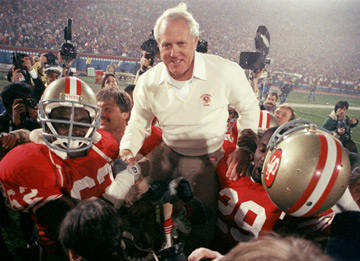

Since 1981, there has been one pleasure I have been able to count on every week: Watching the 49ers on Sunday. I have fallen off a bit in these last few years, but over a 20-year stretch, I think I missed only one game.
The true pleasures in life are not always august. In fact, maybe most of them aren’t. Alfred Hitchcock’s anthologies — which rejoice in titles like “Happy Deathday!” — slam Kierkegaard to the turf, and P.G. Wodehouse and Georges Simenon don’t even let Robert Musil and Cervantes get off the line of scrimmage. As I get older, and small pleasures can be hard to come by, I value the things that brought me happiness, any kind of happiness, a little more, the way you treasure the memory of a face or a place that you may not see again.
And so when I heard the news July 30 that Bill Walsh had died, those decades of winning Sundays came back to me, long vanished but still buzzing with excitement, like the sound of a big crowd as you approach the stadium. Those Sundays were a gift that I and thousands of other San Franciscans will never forget. And Bill Walsh was the man who gave us that gift. Actually, two gifts: He gave us championships, and he gave us a special style of football. Call it the beautiful game.
The beautiful game, o jogo bonito, refers to the unique flair of Brazilian soccer — graceful, flowing, with velvety, uncannily accurate one-touch passes. The Brazilians, at their best, seem to samba down the field, barely touching the ground. American football, too, had its version of the beautiful game. Bill Walsh created it, his players executed it, and no one could stop it. The result was a kind of football never seen: beautiful football, football as a work of art.
There are certain times when a sports team captures something essential about its city. You think of the swagger of the New York Yankees. The blue-collar grit of the Pittsburgh Steelers. The flash and dazzle of the Los Angeles Lakers. Walsh’s 49ers mirrored their city, too, but in perhaps the most unlikely way of all. The qualities San Francisco is famous for — beauty, sophistication, intellectuality, artistry, eccentricity, hipness — are the last ones you would think would translate into success on the football field, that arena of blood and sweat and mayhem. But Walsh succeeded in forging a team that not only exemplified those qualities, but kicked the league’s ass while doing it. The city of “slim, swivelling hips,” as Chicago newsman Mike Royko once derisively called San Francisco, smashed its way into football immortality.
Throwing out the strike-shortened 1982 season, the 49ers won an average of almost 12 games a year in the 18-year period between 1981 to 1998 — a period of sustained excellence unmatched in the post-AFL-merger era. They won five Super Bowls in 14 years, the most of any team in that period of time, and came within two plays (a ludicrous pass-interference call on Eric Wright against the Redskins and a last-minute Roger Craig fumble against the Giants, both of which are still seared into my memory) of going to two more. Perhaps the most amazing statistic is this one: Between 1981 and 1989, the 49ers had a better regular-season record on the road than any other team in the NFL had at home.
But the numbers don’t tell the whole story. For that, we have to go to the cold, clear, chess-grandmaster brain of Bill Walsh. And the players whose talent he recognized, and who he fit into his system the way Miles Davis fit Herbie Hancock and Ron Carter and Wayne Shorter and Tony Williams into his second quintet. The comparison to soccer and jazz isn’t accidental. Because the real innovation Walsh brought to pro football was controlled improvisation.
Walsh didn’t invent the so-called West Coast offense by himself. As my colleague King Kaufman has pointed out, he built on the concepts of Sid Gillman, the great passing-offense genius from the early AFL days. He was also indebted to Don Coryell, who, like Gillman, coached the San Diego Chargers, and the legendary Paul Brown — both major innovators in opening up the passing game. However, it was under Walsh that the West Coast offense came to fruition and revolutionized the game.
Gillman and Coryell pioneered the concept of using the pass to set up the run, making running backs and tight ends as well as wide receivers key parts of the passing game. They favored precise pass routes in which the quarterback’s footwork was timed to the pattern. For the system to succeed, the quarterback had to make a succession of quick “reads” and hit the open receiver. Walsh kept those elements, but brought in two new ones that proved decisive. More than anyone before him, he emphasized the short or “horizontal” passing game, using quick slants and curls run by backs, frustrating a defense by hitting it underneath the coverage or in its seams again and again, picking up six or eight or 12 yards as easily as more plodding teams picked up three or four on off-tackle running plays. And he pioneered the use of option routes, in which his receivers were given the freedom to change their patterns in precise ways, depending on where the defense lined up.
Walsh’s intricate system was enormously challenging for the quarterback, who not only had to go through his reads in a second or two with 300-pound defensive linemen barreling in on him, not only had to know where as many as five receivers might be at any given moment, but also had to know where those receivers would be if they changed their routes. Could Walsh find players to make it work? He drafted a skinny kid named Joe Montana out of Notre Dame, who many scouts thought lacked the arm strength to play in the NFL, and later picked up a USFL retread named Steve Young. Walsh also saw something in a young receiver out of tiny Mississippi Valley State named Jerry Rice, who was ignored by many NFL teams because he had only run a 4.7 in the 40.
It turned out that the skinny quarterback from Notre Dame had something that the scouts couldn’t measure: an unflappable poise and a killer instinct. The USFL retread turned out to be a quarterback so electrifying in his combination of speed and accuracy that, as Atlanta defensive end Tim Green once told me, his coaches warned the defense not to knock Montana out of the game, because they didn’t want to face Young. And Jerry Rice, despite only clocking a 4.7, turned out to have something they call “football speed” — a gear fast enough to let him run all the way to the Hall of Fame, and be almost universally recognized as the greatest wide receiver of all time.
When Walsh’s former players paid tribute to him after his passing, their most moving words concerned Walsh’s belief in them. Young said, “Bill was blessed with one of the greatest gifts you can have, which is the ability to see the future potential of another human being.” Dwight Clark, whose “Catch” in 1981 started the 49ers’ epic run, said, “He was a guy who believed in me before I believed in me.” Rice simply said, “I came to San Francisco, and I found another father, Bill Walsh.”
The 49ers always had great athletes — Rice and Young (who may have been even faster than Rice), and Roger Craig, the superb all-purpose back who was seemingly created to play in Walsh’s system. But what made Walsh’s offense so gorgeous was its precision, born of hundreds of repetitions in practice, and its analytical sophistication. Just when you knew the swing pass to the back would work, Walsh would call it. Just when the linebackers came up, the tight end would go deep over the middle. Watching Walsh’s team run his first 25 scripted plays — he was the first coach to do that — was like watching a game of scissors, paper, rock. Walsh always seemed to guess right.
Walsh not only wanted to win, he wanted to win his way — in style. Mike Holmgren, one of the many Walsh assistants who went on to great success in the league, said, “I always said that he was an artist and all the rest of us were blacksmiths pounding the anvil while he was painting the picture.” But it was perhaps linebacker Keena Turner who best captured the essence of Walsh’s unique approach. “When writing his script, he didn’t believe that running the football was the way to get there,” Turner said. “It had to be prettier than that — beautiful in some way.”
The true testament to Walsh’s genius is that he made the brutal sport of football a sweet science, like boxing. Detractors dismissed the 49ers as a “finesse” team, an insult that is actually the highest of compliments: To execute something with finesse in football is incredibly difficult. In fact, it’s remarkable that any coherent style at all, let alone one that can be called beautiful, can emerge from a game as savagely physical as football. But under Walsh, the 49ers had style to burn.
So did Walsh. With his white hair and professorial mien, always seeming to be deep in abstruse thought on the sideline, he was the perfect leader for his team. His image exemplified the triumph of brain over brawn. That was true in a way, but it was also misleading. The 49ers never lacked brawn: Their ferocious defense, led by the one-man wrecking crew Ronnie Lott, was as responsible for their success as their storied offense. As for Walsh, he wasn’t just an artist with a chalkboard, but a fierce competitor and a tough, no-nonsense man who was famous for letting even his most beloved players go when he thought they were through. Like most great coaches, Walsh was a complex human being, not entirely readable to his players when he was coaching them. Coaches usually need to keep a certain distance from their players, even if they’re friendly with them. But unlike some coaches, he turned out to be as fine a friend and mentor to his players after he left the field as he had been a coach on it. In one of many emotional tributes his former players paid to Walsh, Turner said, “I never saw him turn a guy down for support in those years after retirement.”
Walsh did it his way, and his way happened to reflect the qualities his city most cherished in itself. But above all, he won. And by winning, he gave the city an enormous boost when it needed it most. In 1981, San Francisco was still reeling from double tragedies that had struck in 1978: the Jonestown massacre and the murder of Mayor George Moscone and Supervisor Harvey Milk by Dan White. When the 49ers won their first Super Bowl, the city finally had something to cheer about. And as the years went on, we kept on cheering.
We were blessed all those years, and we knew it. We were spoiled, and we knew it. We knew it was too good to be true. We kept waiting for it to end, and were overjoyed and amazed that it didn’t. Now it has ended, with a thud. And now that the 49ers have fallen on hard times, along with the rest of the teams in the Bay Area, and we realize how damn hard it is just to get to .500, that whole endless time of winning seems even more miraculous.
Yet the team that Walsh built is inscribed in the city’s DNA forever, like the cable cars and “Howl” and the Grateful Dead and Herb Caen.
It’s 1989, and the 49ers are playing in their third Super Bowl. It’s Bill Walsh’s last game. I’m watching it with my friend Mark, with whom I’ve watched almost every game for eight years. The 49ers are losing. Montana is leading them down the field but there’s only a minute left, and it’s second-and-20. This is it. As Montana drops back, I feel a strange kind of time-stopping heartache I haven’t felt since I was a kid, the pain of having bought into a team all the way. You have to earn that kind of pain with years of loyalty. And then Jerry snatches the ball out of the air 27 yards down the field, and a few plays later John Taylor runs one of Walsh’s trademark routes, a skinny post, and Montana hits him with the winning touchdown, and that pain is gone, and it’s one pain that never comes back, it’s gone for good, and we’re all roaring and through the open window you can hear people shouting down the street too, and all across the city the cries are echoing off the roofs.
