
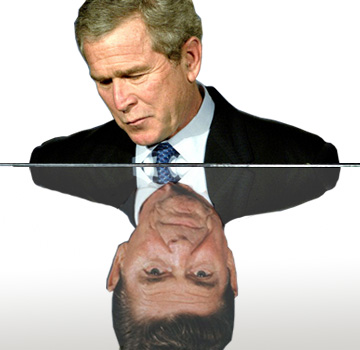

George W. Bush has modeled his presidency after Ronald Reagan‘s. At Reagan’s funeral in 2004, Bush eulogized him in words clearly intended to reflect himself. “He was optimistic that a strong America could advance the peace, and he acted to build the strength that mission required,” Bush said. “He was optimistic that liberty would thrive wherever it was planted and he acted to defend liberty wherever it was threatened … When he saw evil camped across the horizon, he called that evil by its name.” Bush sees his “war on terror” as the equivalent of Reagan’s war against communism. The “axis of evil” has replaced the “evil empire,” but the grand struggle is the same.
For Bush, Reagan epitomized resolution, moral clarity and a refusal to compromise on basic principles. Bush sees these qualities as admirable in their own right and as political winners. He believes his father lost the 1992 election to Clinton because he waffled on taxes and projected an image of weakness. Determined not to suffer the same fate, Bush has embraced a macho, tough-guy pose and refused to compromise. Success, for him, means never changing your mind and never saying you’re sorry. He sees himself as carrying on Reagan’s right-wing legacy.
But Bush is embracing a mythical Reagan, an unyielding right-wing ideologue who never existed. The truth is that insofar as Reagan’s presidency was successful, it was precisely because he was willing to accept policies that flew in the face of his conservative principles. On the three issues dearest to his heart — cutting taxes, shrinking big government and confronting the Soviet Union — Reagan ended up adopting policies completely at odds with his rhetoric. Reagan never acknowledged that he had abandoned his bedrock positions. Indeed, he was not aware that he had, and that’s the enduring conundrum of his presidency. He was a sincere master of illusion who somehow convinced not only himself but his fellow Americans that the fissures and contradictions in American life were not real. As Garry Wills noted in his brilliant 1987 study, “Reagan’s America: Innocents at Home,” In “Reagan, luckily, all these clashes are resolved. He is the ideal past, the successful present, the hopeful future all in one … he spans the chasm by not noticing it. He elides our cultural inconcinnities.”
Reagan came into office as a far more radical ideologue than Bush. In his televised 1964 speech on behalf of Barry Goldwater, the event that made him a national political figure, he denounced coexistence with the Soviet Union as appeasement and demanded that America confront “the most dangerous enemy that has ever faced mankind in his long climb from the swamp to the stars … You and I have the courage to say to our enemies, ‘There is a price we will not pay.’ There is a point beyond which they must not advance. This is the meaning in the phrase of Barry Goldwater’s ‘peace through strength.'”
Reagan shared Goldwater’s belief that instead of regarding a nuclear war as unthinkable, America should embrace the possibility of such a war. In his bestselling 1960 book, “The Conscience of a Conservative,” Goldwater argued that America should “perfect a variety of small, clean nuclear weapons,” which could be used on the battlefield against “vulnerable Communist regimes.” Failure to defeat the Soviet Union, Goldwater argued, meant surrender. Goldwater and Reagan’s policy was completely at odds with the balance-of-terror credo of “mutually assured destruction” that guided American policy throughout the Cold War. Widespread public fear that such policies risked triggering a nuclear war with the Soviet Union helped contribute to Goldwater’s landslide defeat by Lyndon Johnson in the 1964 election. But Reagan embraced this position because he was convinced that doom was at hand. “The inescapable truth is that we are at war,” Reagan said, “and we are losing that war simply because we don’t or won’t realize we are in it. We have ten years. Not ten years to make up our mind, but ten years to win or lose — by 1970 the world will be all slave or all free.”
Reagan’s positions on domestic issues were just as extreme. A bitter opponent of “big government,” he advocated making Social Security voluntary and attacked the New Deal even after a Republican president, Dwight D. Eisenhower, had accepted it. As a pitchman for General Electric, Reagan traveled around the country preaching the gospel of free markets, blasting “statism” and arguing that social programs like welfare were turning the United States into a socialist state that would fall like ripe fruit into the hands of the communists. He lavished praise on Johnny Rousselot, a congressman who acknowledged being a member of the far-right John Birch Society. In short, he subscribed to the inflammatory ideas of the early ’60s new right, which saw its most explosive growth in Southern California and featured luminaries like Phyllis Schlafly and John A. Stormer, author of the bestselling anti-communist paperback, “None Dare Call It Treason.”
Reagan never repudiated any of these right-wing political positions. Yet as president, he caved in on every one of them. As Joshua Green argued in 2001 in the Washington Monthly, “beyond his conservative legacy, Ronald Reagan has bequeathed a liberal one.” After taking office, he promised to “rebuild the foundation of our society” by slashing the size of the federal government, but during his eight years in office, the federal government expanded. He inveighed against the deficit, but on his watch the deficit grew enormously. Instead of killing Social Security, he saved it with a $165 billion bailout. And, most heretically, he raised taxes — a whopping $100 billion increase over three years, the largest increase in almost 40 years.
The same pattern applied to his foreign policy. When Mikhail Gorbachev appeared, Reagan proved flexible enough to negotiate with him, outraging hardliners Richard Perle and Caspar Weinberger, who argued that he was falling into a Soviet trap. Although he clung to the end to his delusional “Star Wars” program (which was seemingly inspired by the 1940 film “Murder in the Air,” in which Reagan’s heroic G-man saves a secret “inertia projector” that can bring down enemy planes), he signed a crucial 1987 disarmament treaty with the USSR, the Intermediate Range Nuclear Forces treaty, that marked the beginning of the end of the Cold War.
Whether or not Reagan’s buildup of the U.S. military was responsible for the collapse of the USSR, as conservatives would have it, or that the sclerotic system collapsed of its own dead weight, thanks to the vision of Mikhail Gorbachev, as liberals argue, Reagan came around to seeing the evil empire as an interlocutor, a state like any other that had interests and could be talked to. It was not just realism, but idealism, that drove Reagan’s stance toward the Soviet Union. The man who once beat the drums for the ultimate nuke-’em hawk, Barry Goldwater, wrote in his memoirs, “My dream, then, became a world free of nuclear weapons and for the eight years I was president I never let my dream of a nuclear-free world fade from my mind.”
None of this is to suggest that Reagan was not a deeply conservative president. He did cut taxes (before raising them) and set out to shrink the federal government. He squeezed welfare programs hard. He campaigned against abortion and moral decline. He unfailingly sided with big business. He was vehemently opposed to environmentalism. Although he failed to carry out most of his right-wing agenda, he did carry out some of it — with devastating consequences.
By backing the dictatorial regime in El Salvador, which he saw as a bulwark against communism, Reagan abetted a brutal civil war that cost 75,000 lives. Similarly, his support for the Nicaraguan Contras, whom he infamously described as “the moral equivalent of our Founding Fathers,” led to fighting that killed as many as 50,000 people. Instead of building on Jimmy Carter’s breakthrough at Camp David, his incompetence and unwillingness to challenge the right-wing Israeli government of Menachem Begin severely weakened America’s ability to broker a Mideast peace. As the Washington Post’s David Ignatius wrote, “The Reagan years saw the demise of the Great American Mediation Machine in the Middle East.” The consequences of Reagan’s Mideast failures haunt us today.
No one should lionize Reagan as a secret liberal. Much of the good he accomplished was inadvertent — indeed, he often didn’t seem to know what he was doing. He tended to muddle through, often in defiance of his own professed beliefs, yet always oblivious to the contradiction. Sometimes good things resulted from this, but so did catastrophic ones — the prime example being the Iran-Contra debacle, a grotesque affair that violated Reagan’s own strictures against dealing with terrorists, subverted the U.S. Constitution, cost America foreign-policy credibility, and permanently tainted Reagan’s legacy.
Bush sees himself as following in Reagan’s footsteps, crusading against “Islamofascist” evil, fighting a Churchillian battle to final victory. But Bush was watching the Reagan movie, not the Reagan reality. The truth is that when Reagan was confronted with Soviet aggression, he was all talk and no action. He did engage in a little covert action against Central America and Afghanistan, and a few made-for-TV wars against opponents like Grenada, but those were foes so weak that even the Harlem Globetrotters would be ashamed to take them on. As Wills points out, Reagan responded to Soviet provocations, and Mideast terrorist bombings that resulted in massive American casualties, by doing … nothing.
“When the Soviets imposed martial law in Poland, shot down a Korean airliner, backed Syria in the Lebanon war with Israel, and continued building the European pipeline, Reagan did not ‘go to the source’ of what he called all the world’s troubles,” Wills wrote. “He did not even punish weaker intermediaries — by letting Poland go into default, for instance, or mounting a punitive raid in Lebanon after the truck bombing that killed 241 marines.” His passivity enraged his right-wing supporters, who wanted him to break out the big stick. Jeane Kirkpatrick wrote that “Ronald Reagan resembles Jimmy Carter more than anyone conceived possible.”
Wills argues that Reagan, for all his hard-edged rhetoric — or perhaps because of it — never really had the stomach for military confrontation. In his sunny imaginary world, all conflicts would be resolved magically. “Reagan was always Reagan, trusting more to words than actions, to weapons bought than weapons used. He actually believed that if one just took a tough stance, then bullies would scatter. When they failed to, he bought a bigger bomb and assumed it would work next time.” Faced with bad news, Reagan would simply deny that anything had happened or adroitly change the subject. The day after the Beirut bombing, Reagan invaded Grenada, and when soon afterward he pulled U.S. troops out of Lebanon, the public didn’t hold him accountable for the debacle.
Faced with this legacy, Bush has drawn precisely the wrong lessons from it. Determined to live up to an imaginary Reagan, he clings rigidly to positions and allies — from Iraq and tax cuts to Gonzalez and Guantánamo — where Reagan would have yielded to reality. Paradoxically, Reagan’s sunny belief in the power of rhetoric, of make-believe, prevented him from being a true ideologue. The happy ending was going to roll across the big American screen no matter what the Soviets did. There was a certain inadvertent wisdom in Reagan’s naiveté. At the very least, it kept him from pursuing dangerous hobby-horses.
Bush evinces the intellectual aridity of the true believer who has nothing else to cling to. Bizarrely, he seems to genuinely fear that Islamist radicals have the power to destroy the world — and his actions are helping make that absurd thesis less implausible. This kind of monomaniacal obsession would be utterly foreign to Reagan, who thundered against terrorism but (judiciously) cut and ran when terrorists blew up U.S. troops in Lebanon.
Bush’s supporters have predictably tried to exhume the Great Communicator from the grave to support the Iraq war. And it isn’t hard to find Reagan speeches in which he sounds like Bush. But Reagan would never have let a few ragged religious fanatics take over the starring role in his epic. He would assuredly have invaded Afghanistan, but he would never have invaded Iraq.
During Reagan’s second term, when his conservative supporters realized he was not going to live up to their expectations, they blamed moderates, who, they said, were tying his hands. Their deluded mantra was “let Reagan be Reagan.” Bush is the living embodiment of that dream of a “real” Reagan. But the figure from the past is a fake, a Freddy Krueger, wearing a mask adorned not with a smile but a twisted grimace. By summoning up the wrong Reagan, Bush has brought to life not an American dream, but an American nightmare.
