
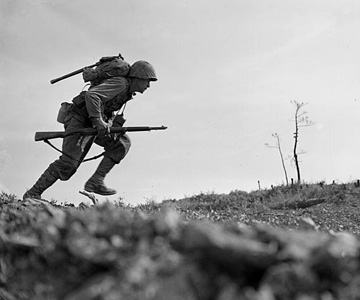

Sixty-two years ago, the greatest conflict in the history of humanity came to an end. Fifty to 60 million people had died. Many millions more were wounded or had lost their homes. Nations were shattered. The most appalling genocide ever had taken place. And for the first time, nuclear weapons had been used, raising the specter of human extinction.
Every way of trying to tell a story this vast carries with it blind spots, reveals its own assumptions and biases. Ken Burns’ “The War” is no exception. But this magnificent 15-hour series will stand as one of the most extraordinary accounts of war ever made. Panoramic in its sweep, unflinching in its openness to all the faces of war, crafted with rare intelligence and sensitivity, “The War” is an epic achievement.
Burns’ subject has always been America. From “The Civil War” to “Baseball,” from “Jazz” to “The West” (for which he was executive producer), to “Thomas Jefferson” to “Mark Twain,” Burns has sought out subjects that are deep in the American grain, themes and people that illuminate our history, our ideals, our triumphs, our failures. He is obsessed with the things that hold America together, that define it, that are quintessentially ours.
The danger of being America’s Storyteller is that you can end up producing Norman Rockwell history — sweet and satisfying, but sentimental. “The War” is the latest in a long line of celebratory works about World War II and the American heroes who fought it, including Tom Brokaw’s “The Greatest Generation” and Steven Spielberg’s “Saving Private Ryan”and “Band of Brothers.” Those are praiseworthy works, ones that don’t minimize the hideousness of combat or the moral ambiguity of war. But Burns’ goal was more ambitious: to tell the whole story, to write a warts-and-all history of World War II. Was he the right man for the job?
In her review of the series in the New York Times, Alessandra Stanley argues that he wasn’t. She criticizes the documentary for approaching the war from an American perspective — that is, for being a documentary made by Ken Burns. “Examining a global war from the perspective of only one belligerent is rarely a good idea,” Stanley argues. Pointing out that America’s self-centered ignorance helped lead us into the Iraq debacle, Stanley concludes that despite its virtues, “The War’s” parochialism leaves it fundamentally flawed.
Stanley is right about Iraq and right about the dangers of American parochialism. She’s also right that “The War” is parochial: It’s about America from beginning to end. But she’s wrong to conclude that this viewpoint is pernicious. That notion — that a documentary is automatically suspect if it limits itself to one national perspective on a global war — is dubious. Countless successful historical works about wars are limited to a single national perspective. Stanley’s criticism is driven by her frustration with the blinkered state of American culture. But for every American who becomes more jingoistic and insular because they watched “The War,” there will probably be five who are inspired by it to learn more about the world outside America. In any case, history isn’t a zero-sum game. There is room both for a documentary that takes a global view of WWII and for Burns’ approach.
The real issue is whether Burns’ vision, his take on the war, is adequate to its subject. “The War,” like all of Burns’ work, is essentially elegiac. An elegy, while at bottom an affirmation, is deeper and darker than a celebration. It contains the sense of tragedy, the note of fatality, the long view of time and loss. Burns is not a polemicist or a critical documentarian. He makes deeply emotional films that pluck at America’s mystic chords of memory. In the case of World War II, this approach feels absolutely right.
World War II was not Vietnam or Iraq. It was a war forced on the United States, a struggle to the death against an aggressive and powerful enemy. As one of Burns’ characters, former Marine torpedo bomber pilot Sam Hynes, points out, there are no good wars, but there are just and necessary ones. The idea of a necessary war has been debased by our current president, who has tried to don the mantle of Winston Churchill by claiming that his war of choice in Iraq is part of the “defining struggle of our age.” But World War II really was necessary. There are controversies about the war (Burns, in a rare but nevertheless huge lapse, fails to address one of the biggest: whether we were justified in dropping atomic bombs on Japan). But few question whether it needed to be fought.
The war brought the entire country together in a way that had never happened before and probably never will again. We paid a terrible price — not, as Burns acknowledges, as terrible as that paid by the other major combatants, but a terrible one nonetheless. After four years of bitter struggle that cost 400,000 American lives, we won. The struggle is long over. The men and women who won the war are dying. The memories are fading. If you can’t make an elegiac film about this subject, you can’t make one about anything.
James Joyce defined the sentimentalist as “he who would enjoy without incurring the immense debtorship for a thing done.” But Burns is not a sentimentalist here: He’s a lyrical historian. By looking unflinchingly at the horror of war, the devastation it wreaks on countries, people, families and individuals, he earns the right to his lyricism. Yes, Wynton Marsalis’ deep-dish soundtrack, filled with folk strains and bluesy notes made in America, poignantly evokes our shared national experience. Yes, Burns tugs at our heartstrings with majestic images of American sunrises and photographs of ordinary Americans pulling together, whether on Iwo Jima or in the factories of Mobile, Ala. But there is far more footage of the darker reality of war — the mangled bodies of the dead. Those stirring images of America the beautiful, those shots of determined Americans, are never allowed to function merely as patriotic synecdoches. “The War” is a war monument, but it’s one that recalls the Vietnam Memorial, with its shattering wall depicting the names of the fallen, far more than a conventionally heroic statue.
Burns and his team, including his longtime collaborator, the fine writer Geoffrey C. Ward, and a group of extraordinary archivists, interviewers and editors, studied every aspect of America during the war. They unearthed a stunning collection of photographs, written documents, radio broadcasts and films, a magnificent treasure-trove of the past. But above all, they found the American men and women who fought the war abroad and endured it at home.
Burns hangs his narrative on four American towns: Waterbury, Conn.; Sacramento, Calif.; Mobile, Ala.; and Luvurne, Minn. These places serve as microcosms of the entire country. Burns explores the way the war changed these towns and paints quick portraits of each, but they aren’t his real focus. They’re of interest only because they were the hometowns of his central characters — the young men who went off to fight and the mothers, fathers, sisters, brothers, children and friends who waited for them at home.
Burns put out a call for WWII vets before arriving at his locations and chose carefully from among those who responded. Not only did they have to be from the four towns (there are a few eloquent exceptions, like writer and ex-infantryman Paul Fussell and memoirist and ex-Marine pilot Sam Hynes), but they also had to be the right kind of people — neither inarticulate nor glib. It was important to find individuals who represented a wide spectrum of experience, who could speak about killing and watching buddies be killed, who were prisoners and volunteers and pilots and infantrymen and wives. They had to be real.
The search paid off. Burns’ characters, now old, experienced the full gamut of the war’s horror and heartbreak. They are stoic and funny, angry and forgiving, bitter and serene. Each has a different personality; each had different experiences. As the searing memories return, emotions often overcome them. None of them speaks “the truth” about the war, but they all speak their own truth, and their stories cut to the heart.
Few viewers will forget Quentin Aanenson, the Minnesota farm boy who became a fighter pilot and who decided to stop making friends after he watched his buddies die around him one by one. Or Raymond Leopold, a young Jewish man from Waterbury who was trained as a sniper, but whose desperate commander turned him into a medic after he removed a bullet from his own leg in the brutal fighting in the Italian campaign. Or Glenn Frazier, who survived the Bataan Death March only to end up in a prison camp in Japan, knowing that if the Americans invaded, his brutal captors would immediately kill him. Or Katherine Phillips, a young woman from Mobile who volunteered at the Red Cross.
Burns’ series presents the war as it felt to America at the time. By avoiding omniscient, ex post facto knowledge, it restores the sense of uncertainty about the war’s outcome that prevailed then. Every WWII buff knows that the Battle of Midway was the turning point in the Pacific War, and, with Stalingrad, one of the decisive battles of the entire war. Burns, however, gives it a relatively cursory treatment. This is legitimate, because Americans didn’t know that it was a turning point at the time.
“The War” makes no attempt to be comprehensive. The causes of the war are only quickly discussed, and its aftermath hardly at all. Those who want a discussion of how Yalta affected the postwar world will be disappointed. The debacle at Dunkirk, the Blitz and the Battle of Britain, the war in the North Atlantic, the campaign in Norway, and the decisive battle of El Alamein, to mention only a few examples, are dealt with cursorily. Other significant events like the sinking of the Bismarck, the French Resistance and the death of Mussolini go completely unmentioned. Because these events didn’t mean that much to Americans, they play only a small role in the film. It doesn’t matter — Burns didn’t set out to make a definitive history of World War II.
But having said that, one of the series’ many virtues is that it highlights forgotten battles and campaigns. How many Americans know that the U.S. Army was humiliated in its first major campaign in Tunisia? Or have ever heard of the battle of Peleliu, which many vets said was worse than Guadalcanal?
“The War” cuts back and forth between huge military campaigns and personal tragedies, battles over machine-gun nests and furlough romances. We learn how Americans at home learned to save bacon grease to make munitions, how black GIs were brutally discriminated against at home, and why the nation was shocked when Life magazine first showed images of dead Marines in the Pacific, nearly two years after Pearl Harbor. (Little has changed: the American press is still leery of showing the deadly realities of war.) But through it all, a thread always runs through the narrative, a thread made up of many American voices.
One of the most memorable is that of Al McIntosh, the editor of a small Minnesota weekly newspaper. His editorials are low-key but eloquent in their simplicity and good-heartedness. He describes harvest time, and sends Christmas wishes to the troops, and remembers the red-headed boy who was a checker in the local grocery store, a kid who was always going places and who was just killed in action. Beautifully read by Tom Hanks, his columns serve as a kind of Greek chorus throughout the series, the voice of ordinary America.
But the film’s deepest, darkest thread is the heart of war, the experience of combat. If Burns had wanted to make a safe, patriotic tribute, he could easily have downplayed this element. Instead, he makes it one of the central themes of the film — perhaps its central one. Again and again, his characters relate what being forced to kill others, seeing their buddies killed, and constantly facing death themselves, did to them. By the end, no one can have any illusions about the devastating effect of combat on human beings.
Or about how the war touched every corner of America. When the narrator informs us, not once or twice but three times, that young men from each of the four towns had been killed in the same battle, the incredible reach of the war hits home.
“The War” is neither nihilistic nor triumphant. There are inspiring trumpet blasts here, like the moment when the Nisei soldiers of the 442nd Regimental Combat Team, the most highly decorated unit in the history of the U.S. Army, put their bayonets on their rifles and started forward to attack the Germans after learning of FDR’s death. They said they were doing it for “the old man.” Daniel Inouye told his incredulous commanding officer, “Sir, I can’t stop them.” FDR had ordered them to go into concentration camps because they were of Japanese ancestry, but he had also given them a chance to prove their loyalty by fighting. It was that they chose to remember.
But there are also stories that drown out the trumpet blasts. Like the tale of a young wife and mother who, when told that her husband had been killed in action, “let out an unearthly howl.”
And there are prosaic tales of love. As he endured hell on the bloody Anzio plain, Babe Ciarlo, an Italian-American from Waterbury, kept sending cheerful letters to his mom that made it sound like he was eternally stuffing his face in a “chow line” that did not exist. The photograph of his mother, an immigrant who spoke no English, embracing Ciarlo as he prepared to leave for war, appears again and again. Her anguish, barely disguised by a wavering smile, stands for that of all the mothers in the world.
It all piles up, the incredible saga, the haunting images, the gut-wrenching words, until by the end you are emotionally spent. You know that everything you have seen, all the heartbreak and death and fear and madness and hope, is only an infinitesimal part of the war.
The vets are dying, a thousand of them a day, but the legacy of the war is inscribed in our national DNA. Every American, of whatever age, is likely to take something deeply personal away from “The War.” For me, that moment came when Burns looks at the fate of the Japanese-Americans on the West Coast, many of them farmers in the Central Valley, who were shipped off to desolate camps in remote areas across the West. One of those camps was Amache, in Colorado. As the narrator describes the evacuation, a photograph of the camp appears, its shabby, drafty, uninsulated wooden huts lined up beneath the towering, snowy Rockies.
My father, who grew up in a tiny farm town near Turlock, Calif., and whose ambition at that time was to become the biggest chicken farmer west of the Mississippi, was one of the 110,000 Japanese-Americans who were packed on trains. He was sent to Amache.
My family has talked about going with my dad to Amache for years, but we’ve never done it. Joe is 82 now, and I don’t know if we’ll make it. As the image of those shacks filled the screen, part of his wartime experience was commemorated forever — not just for me, but for everyone else who watched. And I suspect many Americans who view “The War” will have such a moment.
“The War” is many things, but above all it is an act of affirming memory. To remember, even the most painful things, is to shine a light into the past. By bringing back the war, in all its shame, heroism, ugliness and, yes, glory, Burns allows us to touch not only what makes us Americans but also something larger: our common humanity. That’s an achievement that will last.
