
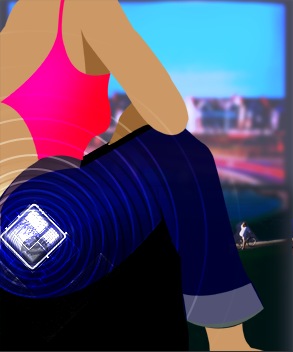

Worry no more, doting parents! Whether it’s your little pumpkin’s first day walking home from school by herself or the millionth time you’ve lost her at the mall, the BabysitterTM will track your sweetpea’s location from a jelly bean-sized microchip implant, discretely tucked under her collarbone. You’ll be able to chart her every move. What better way to give her independence, and put your mind at ease?
Also available: The Constant CompanionTM lets you keep a watchful eye on grandma or grandpa, even when you can’t be by their side; The Invisible BodyguardTM offers freedom from fear so you can enjoy the fauna and foliage when eco-tourism takes you to kidnapping hot spots around the globe. Coming soon: The INS Border PatrollerTM; the Maximum Security GuardTM; the Personal Private EyeTM; the Micro-ManagerTM.
Alas, this is not as far-fetched or as futuristic as it sounds. The whoa-dude notion of surveillance chips being installed in human beings is poised to cross over from the realm of science fiction into everyday reality, and soon. One technology with the deliciously sci-fi name of the “Digital Angel,” a prototype of which will be unveiled next month, could be implanted under the skin and used to monitor not only the chip-wearer’s location, but vital signs like heart rate and body temperature. Other devices, worn externally like bracelets or pagers, are already in use and invite us to embrace electronic monitoring in specific environments — like a theme park, college campus or construction site — for our fun, health or safety.
What’s disturbing is just how quickly these devices, which only recently would have been laughed off as a cyborg fantasy, are becoming accepted. Amazingly, it was but two years ago that a British cybernetics professor pulled what then seemed like a futuristic stunt; temporarily installing electronics in his arm to control his computer remotely.
Now having a personal chip is becoming, well, not quite the norm but a ready possibility. Kevin Warwick, the cybernetics prof, says, “As the topic becomes more accessible in the media, people get used to the idea; it’s not such a frightening thing … If it’s not there this year, it’s only a year or two downstream.” A Japanese firm is already testing chips to track lost relatives. And the New York Times, in a nod to what its editors imagine the future might hold now that the human genome project is complete, asked several designers to suggest how we might carry around a chip encoded with our unique genetic sequence “for perfect identification in matters medical, official, criminal or otherwise.” Some of the possibilities portrayed in the July 9 Sunday magazine: a “decoder” ring, an implant in the human iris to be read with a retinal scanner, even an oval-shaped “genegg” for the belly button.
With commercial interests hard at work to spread the gospel of human tracking and monitoring — voluntarily, and for our own good, of course, and others normalizing chip implantation, it might not be too soon to start preparing for a whole new silicon craze. Excuse me, but is that a chip in your ass?
Global Positioning Satellite (GPS) technology already exists to track us wherever we might care to go — the problem is keeping the sensor up and running, giving off signals all the time from inside of our bodies. Thus far, the biggest technological challenge is energy; a tracking chip needs a power source. Think how annoying it would be to have to plug your arm into the wall to recharge yourself like a pesky cellphone; besides, it would make it near-impossible to thwart kidnappers or retrieve lost kiddies if rescuers didn’t find the missing before the charge died. There’s also the vexing dilemma of getting the chip and its power source small enough for comfort and aesthetics. Who wants an unsightly chip bulge?
Chris Hables Gray, an associate professor of computer science and the cultural study of science and technology at the University of Great Falls in Montana, says that researchers have been working to find just such a small, self-generating power source by tapping everything from body heat to the electrical pulses in the muscles. There’s even been talk of putting teensy-weensy nanotechnology machines to work as miniature waterwheels in the bloodstream so the heart itself could be the power source. The heart running your chip: It’s practically poetic.
But now one company claims that it has cracked this power-source conundrum, and that it has a patent on the solution, although executives won’t yet reveal the technical details of how it actually works. Applied Digital Solutions didn’t invent it, but purchased the patent for a “personal tracking and recovery system,” which the company has dubbed Digital Angel.
According to CEO Richard Sullivan, Digital Angel combines GPS wireless communications with biosensors, powered by body heat in the form of a dime-sized chip, which can be embedded in a watch, bracelet or medallion, even under your flesh — should the FDA approve such an invasive thing.
“It’s like a live radio signal all the time,” he says. Sullivan sees a $100 billion potential market for the technology, which is still under development with help from researchers at Princeton University and the New Jersey Institute of Technology. The company will hold a gala in New York in October to show off the prototype, and try to drum up investment to finance actual products.
And the potential applications, should the thing actually work as the company claims it does? Just use your imagination, folks. Sullivan envisions kiddies having their own Digital Angels watching over them in case of a snatching. Or, caretakers installing them in patients with Alzheimer’s disease to prevent the old folks from wandering off. And just wait until the military gets a load of this — one in every soldier to track not only their whereabouts, but their very mortality, in real time. The same would go for employees in extremely hazardous workplaces, such as nuclear power plants.
Come to think of it, a medallion worn around the neck that’s powered by your very body heat doesn’t seem any more invasive than some of the things that companies already do to their employees, so why not a chip in every last cube!? Better still, dispense with those pesky keycards to get in and out of the office, and just have the whole thing implanted in your left butt cheek.
If you’re not already wondering how you and your loved ones made it this far without a single chip implant, just consider all the medical applications. Picture a system that would constantly monitor a heart disease sufferer’s pulse rate or a diabetes patient’s sugar levels and notify medical help when things were looking dangerous. We accept pacemakers as a necessary and important technology to extend and enhance the quality of lives. How is this any different?
Sullivan brushes off concerns about privacy by promising that the chip-wearer will be able to control when he or she is, uh, switched on or off, although he won’t yet say how exactly that will work. The Digital Angel Web site puts it bluntly: “The unit can be turned off by the wearer, thereby making the monitoring voluntary. It will not intrude on personal privacy except in applications applied to the tracking of criminals.”
Maybe so, but the potential for abuse is so ludicrously high that it’s almost impossible to overstate. You can just see the Michael Douglas–Sharon Stone Hollywood version, where the jealous husband gives an opulent anniversary watch with the chip inside it to his cheating wife, so he can obsessively monitor her movements, her body temperature, the very acceleration of the pounding of her heart rate … until she figures it out, and puts the chip to work — against him.
To makers of tracking technologies, these Big Brother worst-case scenarios sound like the same griping that has met all sorts of other advancements we now blithely accept, like Social Security numbers, credit cards that catalog our every purchase and even e-mail.
“We believe that the benefits of the technology to a parent looking for a child at a theme park or a student feeling safe walking across campus, far outweigh some of those concerns,” says Tom Turner, senior vice president of marketing and business development for a company called WhereNet, which makes a technology that can be used to find people or objects in a specific, local environment. “It’s individual choice.”
So far, WhereNet has licensed its technology to companies that make bracelets worn on the wrist or pager-like devices carried in a pocket or purse. It’s in use at a water park in Denver and on the campuses of the University of South Florida in Tampa and the University of South Alabama in Mobile. Turner sees a future for such gadgets on cruise ships, in gated communities and at shopping malls.
Brendand Fitzgerald, the president of Microgistics, which makes WalkMate, the device used by college students to alert campus police if they’re in danger, also thinks the benefits are greater than the risks. “If you were working in a hazardous industrial environment, you would want to know that you could push a button and have someone help you if you need help. ‘I fell into the vat of boiling acid!'” Safety first is a logic that’s hard to argue with, even when it starts to veer from help when you need it to totally transparent surveillance when you’re at work.
And, like almost everyone else I talked to in this field, Applied Digital Systems’ Sullivan dismisses nagging doubts about what it means to literally wire ourselves up. “By our own nature, we tend to avoid things we know the least about and gravitate towards those that we do know. Some of the things that have made the most positive contributions to our lives are the things that there are the most concern about. Like any technology, it’s really in the hands of the user,” he says. Translation: it’s Galileo vs. the church all over again.
OK, Dr. Jekyll, you’ve convinced me. I’m ready for my implant. Let me be the first to sign up for my very own chip body modification. What list do I put my name on? In fact, I want my chip secured on the outside of my skin where I can show it off to everyone as a sign of just how wired I’ve become — surely it will be the next big thing filling the void left by the waning trendiness of tattoos, piercing, scarification: chipification.
However fashionable or discreet tracking devices might become, not everyone is titillated by the possibilities. “I think most people would be repulsed by the idea. This is just a sort of modern version of tattooing people, something that for obvious reasons — the Nazis tattooed numbers on people — no one proposes,” says Bob Gellman, a Washington privacy consultant. “You can do anything you want voluntarily. You can tattoo a bar code on your forehead if you want.”
But the real question, as he sees it, is who will be able to demand that a chip be implanted in another person — a parent in a child; a prison in an inmate; the INS in an undocumented illegal alien found in the country; an employer in an employee as a condition of being hired?
“I’m sure there’s a strong argument that implanting a chip in a person is unconstitutional. It would be cruel and unusual punishment,” he says. And for now the legal and social questions of who could turn such a chip on or off and who would have access to the information generated by such a chip is “a totally unexplored area,” says Gellman, adding: “And probably one better off left unexplored.”
Others see the chipification of humans as all but inevitable. Chris Hables Gray, professor, self-proclaimed “cyborgologist” and author of the forthcoming book “Cyborg Citizen,” says that it really doesn’t matter whether or not the “Digital Angel” flies in October. “If this company doesn’t do it, someone else will,” he says. And watch out when they do.
“They will start implanting them in prisoners, parolees, child abusers, sex offenders and drunk drivers,” he predicts. Gray says that it’s been a military project for some 20 years to find a way to track every soldier on the battlefield. Remember when Oklahoma City bomber Timothy McVeigh complained having been a part of a Gulf War experiment that implanted a chip in his butt? “McVeigh kept saying that he was being controlled by a chip in his ass,” says Gray. The cyborgologist isn’t saying he believes the bomber, of course, but cites circumstantial evidence that the military may have been experimenting with such tracking devices, and “if the military starts to say we will put these chips into every Marine’s ass, they have no protection from that.”
No matter how creepy we find the prospect of such a technology, we can’t stop its creation — nor would we necessarily want to. “Technology is continually trumping the constitutional guarantees that we have,” says Gray. He’d like to see protections against the misuse of such chips as they become commercially available: “Citizens could ask for a law that made it a crime to put these into a person without their permission, and to forbid, under any conditions, for the government to put these into prisoners, parolees, illegal aliens, soldiers, citizens.” He’s even proposed — “only half joking” — a “Cyborg Bill of Rights” to help ensure that “new technologies are chosen democratically and we do not have to accept every new technology that invades our freedoms.”
– – – – – – – – – – – –
Meet Gus, the cyberkitty
All paranoia and conspiracy theories aside, it’s alarming how quickly a new technological “option” becomes a requirement. The microchipping of pets is a case in point.
Take Gus, a 14-year old Balinese blue-point cat with a bad habit of running away from home. “He’s a conniving little runt,” says his owner, David Huffman, affectionately. “He’s a little man in a cat suit that escapes anytime he has the chance.”
The wily kitty refuses to be saddled by a collar with an identification tag. “He just pulls it off. I don’t know how he does it. He’s a nudist,” huffs Huffman. After the naked cat’s fifth recent breakout, when Huffman went to pick up the critter at San Francisco Animal Care and Control, a staffer gently recommended that he have his wanderlusty pet technologically enhanced, for the animal’s own good, of course.
Gus now sports a tiny microchip, which was implanted in his shoulder with a syringe and identifies him — permanently. “Cat modification!” exclaims Huffman, with geeky glee — he’s a dot-com CEO.
The way this cat-chipping works is really quite simple. Gus has an id number (No. 401 278 486B) embedded under his skin on a microchip about the size of a grain of rice. Huffman’s address and contact information are kept in a database, maintained by the American Kennel Club so if the footloose cat is picked up by a vet or shelter anywhere around the country he could theoretically be scanned, matched with his owner in the database and reunited. The scanner sends a radio wave to the microchip and activates it to respond with the info.
More than 670,000 animals — including no less than 134,007 cats, 54 pot-bellied pigs and five emu — have been enrolled in the American Kennel Club program so far, and almost 35,000 lost pets have been recovered, according to the organization. Huffman shelled out $70 for the “installation,” which took just a few minutes, and paid a $12.50 enrollment fee to keep his info in the contact database. “Gus has no choice. It’s a violation of his animal civil liberties. He calls the ACLU all the time,” he kids. “This is like kitty Lojack,” boasts Huffman of his “cyberkitty’s” techno body modification.
All the strays adopted from the San Francisco animal shelter now have such identification chips implanted under their skin. According to the American Kennel Club, a number of localities — Columbia, S.C.; Indianapolis, Ind.; Albuquerque, N.M.; and Dade County, Fla.; among them — have adopted ordinances requiring such chip implants. What has been a novelty is now required.
Nevermind some animal organizations’ skepticism about the effectiveness of using a microchip to bring home a lost pet, and the grousing of grumpy cultural commentators — like National Public Radio’s Andrei Codrescu, author of a collection of essays entitled “The Dog with a Chip in his Neck” — who mock the chip-enhanced furry friend as yet another symptom of the idiocy of modern life.
Better still, Applied Digital Solutions, the company behind the “Digital Angel,” is in the process of acquiring Destron Fearing, one of the main creators of the chips for animals, to create a kind of monster surveillance technology company.
Huffman is unmoved by the creepy overtones of “improving” a cat with a chip: “He’s a cyborg. But we all are,” he muses. “I use a cellphone, and drive a car. That makes me a cyborg. He’s just a more fully integrated cyborg.” In fact, Huffman, who heads a Bay Area start-up called Linkify says that he wouldn’t mind being a bit more fully integrated himself. How would he feel about having a chip implanted in him? “If I ever had amnesia, then they could tell me who I was. That might not be a bad idea,” he says.
