
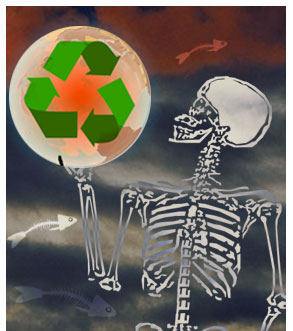

If you want to get someone’s attention, tell him that the movement he’s dedicated his life and career to is dead.
If you really want him to take notice, declare that his own strategies and tactics dealt the fatal blows, but he’s too blind to see that he’s still beating a corpse.
And if your aim is actually to force him to stand up and fight, announce all this publicly to the very generous folks whose grants fund his programs and paycheck.
In the self-published paper “Death of Environmentalism: Global Warming Politics in a Post-Environmental World,” released at the Environmental Grantmakers Association meeting in Hawaii in early October, Michael Shellenberger, a political strategist, and Ted Nordhaus, a political pollster, argued that “modern environmentalism is no longer capable of dealing with the world’s most serious ecological crisis.” Their wide-ranging 36-page indictment charges that the country’s largest environmental organizations have spent 15 years and hundreds of millions of dollars fighting global warming but have “strikingly little to show for it.”
It’s a heartfelt, sweeping, even anguished J’accuse, urging a dark night of the soul for environmentalists, challenging them to reckon with both how bad and how urgent their predicament really is. It laments that the environmental establishment’s current approach to fighting global warming is hopelessly wonky, mired in technical policy fixes, like raising CAFE (Corporate Average Fuel Economy) emission standards on cars or mandating cap-and-trade schemes on CO2-emitting power plants. The organizations suffer from pigheaded “policy literalism,” refusing to recognize that they’re in the middle of a culture war that won’t be won by “appealing to the rational consideration of our collective self-interest.”
The paper suggests that if environmentalists want Americans to join them wholeheartedly in the struggle to save the world, an ambitious, perhaps utopian, strategy is required: nothing less than an inspiring vision of an environmentally sustainable future that Americans will actually want to live in.
The attack struck a nerve. In early December 2004, Sierra Club executive director Carl Pope fired back with a 6,500-word response. Addressing grantmakers who might have received the paper, he called it “unclear, unfair and divisive” and “self-serving.” But even as he enumerated what he saw as the essay’s multiple factual errors and misinterpretations, he conceded that they made “one extremely compelling point.”
He even quoted it: “Perhaps the greatest tragedy of the 1990s is that, in the end, the environmental community had still not come up with an inspiring vision, much less a legislative proposal, that a majority of Americans could get excited about.” But Pope argued that a similar case can be made about the left in general. And for him that’s a “case for modernizing the left not killing environmentalism.”
Adding fuel to this political funeral pyre, former Sierra Club president Adam Werbach inserted his own “autopsy” into the mix with a speech — titled “Is Environmentalism Dead?” — that he delivered to a sold-out crowd of 250 at the Commonwealth Club in San Francisco in early December.
Werbach, who became the 46th president of the organization at age 23, and used his youth to sell the middle-aged movement to a new generation, said that in doing so, “I was like a hospice worker trying to make the last days of environmentalism as painless as possible.”
With self-mythologizing flair, he declared, “I will not longer call myself an environmentalist,” in working to build a broader progressive movement. “Environmentalism is dead in no small part because it could never match the right’s power to narrate a compelling vision of America’s future,” he eulogized.
Werbach, whose talk grew out of conversations with Shellenberger and Nordhaus, was even more radical, arguing that environmentalists should simply come out as progressives, unafraid to alienate whatever conservative allies they might have in the process.
All this public mourning of environmentalism might puzzle the many green groups that have seen their membership rolls swell under the Earth-last rule of President George W. Bush. Not to mention the countless activists and small grass-roots groups that do the local-yokel heavy lifting on green issues. As the Bush administration continues its rollback of 30 years of environmental protections, though, one thing is indisputable: Whatever environmentalists are doing isn’t enough.
But the question of what to do about this sad state of affairs is by no means answered by the critics. It’s easy enough to declare that a movement has failed to achieve its most urgent goals and to call for a compelling new vision that will invigorate activists, persuade the mainstream, and motivate politicians. It’s much, much harder to come up with the goods.
In the aftermath of last year’s presidential election, environmental activists did their best to claim a kind of victory in defeat, pointing to particular legislative accomplishments at the state and local levels. But John Kerry’s loss and the expanded Republican majorities in the House and Senate represented a stunning setback.
Environmentalism is a basic plank of the Democratic Party and the left in the United States. There could not have been a clearer choice between the two candidates, when judged on environmental issues. And yet it didn’t matter at all. While Bush’s election doesn’t represent a repudiation of environmentalism, it does show that the environment is not the top issue right now.
“Here we are pushing these little solutions: ‘Wow, we got a renewable energy standard passed in Colorado!'” says an exasperated Shellenberger. “Meanwhile, the whole country is making a beeline to the 19th century in terms of its values.”
Nordhaus says he’s glad the big green groups will be there, fighting the defensive battles of the next four years, but that isn’t enough. “There’s still going to be no shortage of defensive battles to fight. But if all that you’re doing is fighting defensive battles, you’re going to lose. You’re under siege. You need to go on the offensive. You need to create new debates, new arguments, new constituencies.”
Nordhaus argues that the underlying problem is that American values have shifted, elevating the private over the public, the individual over society, and that skepticism about the government is at an all-time high. “Bush’s election in 2004 was not an isolated incident. This was the result of large-scale social, cultural and political trends that have been happening in this country over 20, 25, 30 years, and if we don’t figure out how to change that, none of this stuff is going to matter.”
The problem is not that Americans don’t care about environmental issues. Pollsters will tell you that most of them do care, just not very much. Support for environmental issues is broad but shallow. In other words, if you phrase the question correctly, you could get a huge majority of Americans to say that they care about the environment. But when it comes to naming what matters to them most, the environment usually doesn’t even make the top 10, Shellenberger and Nordhaus claim.
For instance, when asked, “What’s the most important problem facing the country today?” only 2 percent of 400 likely voters interviewed in Pennsylvania answered that question with “the environment,” even when they were given the chance to name their top three responses. In contrast, 38 percent said the economy and 28 percent said unemployment, according to a study that Nordhaus’ firm, Evans/McDonough, conducted before the November 2004 election.
One green-business expert, Joel Makower, says part of the problem is that activists don’t fully appreciate that the word “environment” means different things to different people. For some, it means big, global-scale issues, like global warming, biodiversity, a hole in the ozone layer. Others think locally — their neighborhood watershed, the leaky landfill down the street. Still others treasure their ability to hunt, fish, swim, hike and canoe in parks and public lands; and a fourth group thinks about fighting crime, graffiti, traffic, pollution and litter when they think about “environmental” issues. “So, it turns out where you stand on the environment has a lot to do with where you sit,” Makower says. Just because you want the farmland near your subdivision protected from development doesn’t mean you’re concerned about global warming.
Mark Dowie, the author of “Losing Ground: American Environmentalism at the Close of the 20th Century,” a 1995 critique of the movement, praises the malcontents as “affection” critics operating on the inside of the movement. (Shellenberger and Nordhaus have both done lots of work for green groups. Werbach risked being fired from his current gig as executive director of Common Assets for giving the speech.)
But Dowie argues the critics don’t go far enough: “The lesson that this movement has to learn, which I don’t think is learned yet, is that our government in America is not going to be the salvation of our environment. Government in America is going to be economic, not ecological, in its orientation. I would say, forget the government. Putting a lot of resources into lobbying the government is a foolhardy venture. This government in particular doesn’t give much of a rat’s ass about the environment. Environmental protection is going to come from civic action as much as government regulation.”
Shellenberger and Nordhaus don’t believe that activists have to give up on government. But they do believe that the approach has to change. Instead of telling Americans why they should be concerned about, say, global warming, Shellenberger and Nordhaus believe that activists could best further their anti-climate-change agenda by taking on the issues that voters — and thus politicians — already care about, while fixing the environment at the same time. Like the economy and jobs.
For instance, instead of presenting the nightmare future that will result if America doesn’t take action on global warming — soon! now! yesterday! — environmentalists need to change the conversation: “We don’t have to talk about global warming,” Shellenberger says. “What we need to talk about is what we want America to look like: what a sustainable, economically prosperous America looks like in the 21st century, and what we need to do to get there. And we need to articulate that in the context of a vision that does something about global warming, but also, more importantly to the average American, offers something more than that to them, offers them hope for their own future, for the kind of life they want to live.”
Werbach, who is friends with Shellenberger and Nordhaus, echoed that think-positive sentiment in his talk to the Commonwealth Club: “I have come to believe, after a decade’s work on this issue, that saving ourselves depends not on our ability to shock but rather to inspire.”
But if you have trouble imagining a message that could get millions of Americans excited and simultaneously fight global environmental destruction, you’re not the only one.
“It’s hard to get aspirational around Love Canal. It’s hard to get aspirational around the destruction of temperate rain forests around the world. You can’t gloss over the problems,” says Christina Desser, a member of the San Francisco Commission on the Environment who was the executive director of Earth Day in 1990.
And it’s hard to get hopeful about the heating up of the climate. “Global warming is the hardest issue that I’ve ever worked on, and I don’t think that anyone who works on global warming thinks that we’re winning, but we also know that we can’t give up,” says Dan Becker, director of the Sierra Club’s global warming program. Baker, one of 25 environmentalists interviewed for Shellenberger and Nordhaus’ paper, felt misused by it. “I think that it’s hard to solve an issue without ever naming the issue,” he says.
And the very suggestion smacks of sugar-coating. An unspoken tension underlies this whole debate: What if no possible reframing of what it will take to fight global warming will appeal to Americans’ personal self-interest? What if fighting the largest ever environmental threat requires that unpleasant, untrendy bugaboo — sacrifice?
Shellenberger and Nordhaus have not confined themselves to merely spinning a positive vision. Shellenberger is a co-founder of the Apollo Alliance, a group that brings together many labor and environmental groups. The Apollo Alliance focuses on the new jobs that investing in clean energy could create. Instead of talking about global warming, it focuses on this ambitious goal: to encourage government investment to create 3 million new clean-energy jobs and to free American from foreign oil in the next 10 years.
The Apollo Alliance is all about hope and visionary dreams, but despite a lot of flattering media coverage, and some interest from Kerry in the 2004 campaign, it failed to take off politically in November.
“It seems to be stalled out somehow,” Desser says. “And it needs to move forward soon. My fear about this fantastic policy is that it will lose its currency, and it’s a great idea. [But] I don’t see why they ever needed to get to the death of environmentalism. I don’t see how it supports what they’re trying to do.”
Desser thinks that instead of rehashing what she views as age-old debates, the inspiring vision of the critics would be better served by doing the hard work of fundraising and organizing for the Apollo Alliance.
For his part, Carl Pope, in his response to “Death of Environmentalism,” suggests that environmentalists can create a new vision to address global warming by making it a public health issue, fighting efforts to open new coal-fired power plants at the local level and applying the time-tested “polluter pays principle”: “If we frame global warming as pollution, and assert that the polluter should pay, then suddenly this otherwise abstruse, overly technical problem becomes much easier for the public to understand,” he writes.
Shellenberger and Nordhaus dismiss Pope’s ideas for how to take on global warming as the same old, same old: more wonky policy fixes that add up to a tired recipe that will ensure continued political disasters. “Who does that inspire? Who does that put on the defensive politically?” says Shellenberger. The energy industry? The coal companies? “I don’t think that puts them on the defensive politically at all,” he counters. “I think that it actually plays right into their hands: [They’ll just say] ‘These guys are trying to take your job away.’ That’s all they have to do. That’s how they killed CAFE. That’s how they attack McCain-Lieberman. It’s the oldest play in the industrial book. We fall into the same trap, over and over again.”
Too often, Shellenberger argues, environmentalists have been waging a defensive war to stem the tide of right-wing assaults. It’s just not worth the effort. “At this point, a fairly large chunk of the defensive activity — in terms of resources and staff time and political bandwidth — needs to just be dropped, and they need to go figure out a set of really smart, proactive, hard-hitting strategies that put the Republicans on the defensive. And it needs to happen right away.”
To Becker, this kind of grandstanding from the gallery is frustrating, because groups like the Sierra Club are trying to move the global warming agenda forward, even with the political obstacles they face in the White House and Congress. For instance, he’s been working with the Canadian government to adopt California’s groundbreaking greenhouse gas law. Referring to Nordhaus, Shellenberger and Werbach, he says, “I’d love to hear their solutions. We need all we can get.”
