Alessandro Camon
Rescuing Jesus
Bush & Co. have hijacked Jesus, using him as the poster child for their callous worldview. It's time to rescue Christ from his kidnappers.
Harriet Miers, should she be confirmed to the Supreme Court, will be the resident evangelical Christian. She shares her religious background with George W. Bush, whose claim to have chosen her based on “knowing her heart” has as much to do with the born-again faith he shares with her as with her long service in his inner circle. This choice might have left secular conservatives perplexed or downright dissatisfied, but is an obvious crowd-pleaser with the Christian right. Above all, it reflects the importance of Christianity for Bush, widely described as the most devout president in history.
But as we brace for more battles over abortion rights, gay marriage, stem cell research and so forth, it’s time to ask just how Christian the supposedly pious Bush administration really is. Because what happened in New Orleans, and what has been happening in Iraq, raises serious questions about whether Bush & Co. deserve to be called Christian at all.
Natural disasters are often labeled “acts of God.” Those who take the expression literally may think that God is punishing our sins (a belief shared by some Christians with those Muslims who think Katrina is Allah’s reprisal), or they may struggle to reconcile the idea of an infinitely good God with the devastation he brings upon us. But you don’t have to take the expression literally to feel that natural disasters call into question the meaning of life. They cut us down to size, and challenge us to rise up again. They make us mourn for the dead and reach out for the survivors. If we do believe in God, even just a little bit, they are a true test of our faith, and an opportunity to do what we preach: to give, to comfort, to assist.
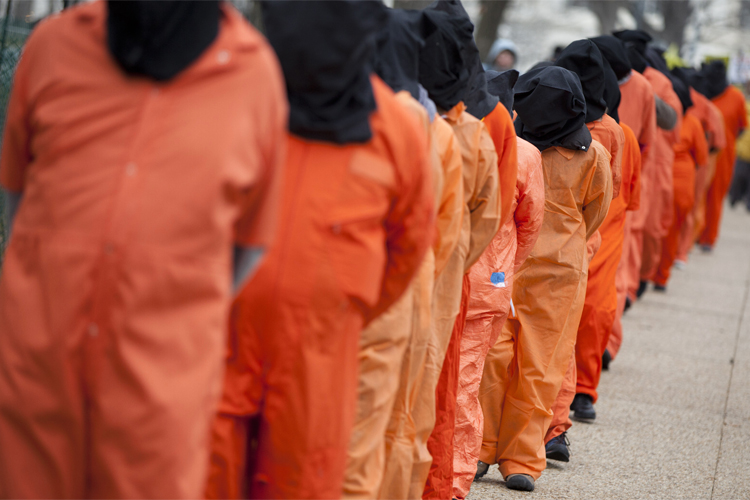
Wars are acts of man, yet all too often are fought for a “holy” cause, painted as deeds of “infinite justice” or “crusades” of good vs. evil. But it’s when we look at the victims that faith is truly tested. A religious person will have the chance to show all his horror, regret, compassion, forgiveness. In war, many parents will lose their children, a sacrifice so profound that it is more than a human being can be expected to bear; a sacrifice that is, in fact, made by God — the Christian one — and proof of godliness. (In one of the harshest and most controversial biblical tales, Abraham is ready to sacrifice his son before God, as he believes God asked him to do, but God stops him before he goes through with it. However one wants to interpret the tale — whether it’s about obedience or misunderstanding — the point is, God doesn’t actually want to impose on a parent the loss of a child.) To those who suffer such a loss, we have a chance — and an obligation — to offer utmost solidarity.
The administration’s lethargic and callous response to the call after Hurricane Katrina, just like the president’s coldheartedness toward Cindy Sheehan, suggests that the people who govern us are as willing to invoke Jesus as their guide, their inspiration, even their “favorite philosopher,” as they are firmly unwilling to behave anything like Jesus.
“What would Jesus do?” has been a favorite slogan of the Christian right. It’s a rhetorical question, meant to display lofty concerns and stake the high ground. It’s not meant to be answered; in fact it’s usually not even asked in relation to the things Jesus cared about.
It’s time to put that question to better use.
Should a nation rush into an unprovoked war whose justification is weak at best, and fraudulent at worst? What would Jesus do?
A mother mourning the death of her son in that war asks for a chance to speak to the president about her grief, and to have her questions answered. What would Jesus do?
Thousands of men, women and children are left behind in the flood with no food, drinkable water or medical aid. What would Jesus do?
Would Jesus rush to war, or neglect to interrupt his vacation to meet the mother of a dead soldier, or abandon the people of a ravaged city? Would he promote tax breaks for the rich, undercut education, support the death penalty?
The answers are painfully easy. We know what Jesus would do, because he did do it, or talked about it in no uncertain terms. Jesus was for peace, for the poor, for the afflicted, for the children, and against the death penalty — of which he was a victim. Anybody who denies this, or who argues that it’s possible to be a good Christian without adhering to these basic positions, is basically betraying Christ.
We could ask some harder questions. Would Jesus really frown upon homosexuality? Would he seek to prolong life at all cost, even when in the form of a persistent vegetative state? Here many believe the answers are in the affirmative, or at least much more uncertain. But homosexuality existed in Jesus’ times. And what Jesus had to say about it was, in one word, nothing. Unlike poverty, it just wasn’t a concern. As far as pulling the plug, being a Christian means to believe that life doesn’t end with the physical death of this body, on this earth. That’s when a far better, everlasting life begins. (The one legitimately complex issue is abortion, and one can see a case for Jesus being generally against it; still, it is not something he directly spoke about.)
The American Christian right has hijacked Jesus Christ. It has made him into a brand, a logo, a bumper sticker. It celebrates his suffering on the cross, but largely neglects what he had to say. It prefers an Old Testament God, a “Jealous God, visiting the sins of the fathers upon the children.” It elevates success to proof of God’s favor, and washes its hands of responsibility for the poor. It combines a self-righteous vision of Americans as the chosen people with shrill intimations of imminent apocalypse, to justify indifference to the rest of the world and to the planet itself. It sticks to the letter of the Bible with arbitrary selectiveness, so that it can endorse creationism and condemn homosexuality while acknowledging that (contrary to Old Testament wisdom) the earth is in fact round, and slavery is not OK.
It’s a twisted, schizophrenic form of religion that mirrors the most reactionary form of Islam. (Not by chance, both the Christian right and conservative Muslims are at odds with women’s rights, and fiercely homophobic.)
A lot can be said about the theological fallacies and over-simplifications of the Christian right. Take the way it reads the Commandments. What, for example, does “not to take the Lord’s name in vain” mean? Is it a prohibition against using the word “God” in casual conversation? Or does it forbid Christians from going to war in the name of God? And what about “love thy neighbor”? Does it refer to the guy next door, who shares our tax bracket? Or is it about all of our fellow humans, whether similar or different? In fact, is it not an exhortation to love precisely those who are different?
Most important, though, is how Christians actually relate to Christ.
Jesus was a poor man. He started a movement of the poor, for the poor. This isn’t socialist revisionism: This is what the Gospels say. Jesus defied authority, and spread a message of hope, tolerance, inclusion.
He said:
Lay not up for yourselves treasures upon earth, where moth and rust doth corrupt, and where thieves break through and steal … For where your treasure is, there will your heart be also.
He also said:
Blessed are the peacemakers: for they shall be called the children of God.
Moreover:
You have heard that it was said, “An eye for an eye and a tooth for a tooth. But I say to you, do not resist one who is evil. But if anyone strikes you on the right cheek, turn to him the other also.”
And of course, he said:
I was hungry and you gave me food, I was thirsty and you gave me drink, I was a stranger and you welcomed me, I was naked and you clothed me, I was sick and you visited me, I was in prison and you came to me. (…) Truly, I say to you, as you did it to one of the least of my brothers, you did it to me.
Does this sound like the voice inspiring this administration? Or the voice they go out of their way to ignore?
Last month, President Bush said that Hurricane Katrina exposed the problem of persistent poverty in this country. But why did the problem need to be exposed in order to warrant his concern? Was the president not aware of it before? And what about poverty in the rest of the world — a problem that the Bush administration stubbornly refuses to make a priority, which in fact its policies greatly exacerbate?
To hold a president (or a justice) up to such a high standard as the teachings of Jesus would be unfair, if it weren’t the president himself who claimed to act in Jesus’ name. It’s time for Bush, the Republican Party and the Christian right to be confronted with their failings as Christians. If there is a worthy measure of anybody’s religious commitment, it has to be how it’s expressed in action. It’s not how you talk the talk that makes you a true Christian. It’s the deeds you do — and those you don’t.
Liberals have let the right claim Jesus for themselves. But the legacy of Christ is far too precious to be left in the hands of the hypocrites who use it to justify war, bigotry and injustice. It is time to reclaim Jesus — not to start another religious party, but to free him from the one that’s hogging him as their poster child. It’s time not just to ask “what would Jesus do?” but to actually listen to the answer.
It’s about poverty. It’s about peace. No true Christian can have anything more important in mind.
Guilty!
From O.J. to Robert Blake to Kobe Bryant to Michael, the modern celebrity show trial makes us voyeurs at a morality play that showcases not guilt vs. innocence but wrong vs. wrong.
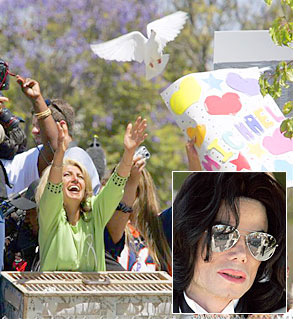
It’s over. Michael steps out into the sun, the doves are released, the already overcrowded Santa Barbara jail won’t have to make room for a very special guest.
One more time, a celebrity beats the rap. It should give Martha Stewart something to think about that she’s the only megastar who couldn’t. And yet, one more time the show ended with the sense that the truth remains somewhere “out there,” shadowy and elusive. One more time, it’s hard to discern any moral of the story.
Continue Reading CloseThe Mafia and the disappearing father
From Michael Corleone to Tony Soprano, mob dads have been increasingly embattled -- and our national obsession with their fall reflects our culture's crisis of fatherhood.
I am a Mafia junkie. I’ve watched it all, read it all, and while I wait for the final act of “The Sopranos,” I’m not above keeping an eye on “Growing Up Gotti.” It’s hardly a compelling show. Yet at some point in this new season, I began to suspect that this perfectly banal, oddly flat, wit-free slice of “reality TV” might be a zeitgeist-defining artifact.
The Mafia genre has been a pop-culture staple for the past several decades. Its relevance can hardly be overestimated. Ask people about their favorite movies, and you will get all kinds of answers — from “Top Gun” to “8 1/2,” from Adam Sandler to Lars Van Trier. One of the very few titles that will recur across age, race, gender, income or education lines is “The Godfather.” The reasons for the genre’s success are readily identified. The Mafia movie offers all the exhilaration and wish-fulfillment of the classic gangster genre, without necessarily dampening it with the violent death of the protagonist (more or less obligatory before the dissolution of the Hays code in the ’60s). It also presents a powerful mythology of immigration, and a provocative commentary on “the business of America.”
Continue Reading CloseWhose is bigger?
Bush and the GOP are trying to paint Kerry as a Euro-wimp and girlie man. But the Dems have a chance to show America that it's Bush who's the real 97-lb. weakling.
This year’s presidential election is, once again, a contest between personalities as much as ideologies. The key battleground is over masculinity. Who has more? And who gets to define it?
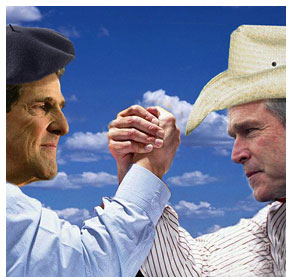
The one aspect of John Kerry’s performance at the Democratic Convention that everybody would agree on is that he wanted to come off like a man. The war-buddy reunion, the documentary mini-epic, the talk of lessons learned patrolling the Mekong Delta on a gunboat — all were part of an ongoing effort to boost Kerry’s macho credentials. Whether shooting pheasants or clay pigeons, playing hockey in the winter, or riding a race bike in the summer, Kerry has taken every possible opportunity to paint himself as warrior, hunter, athlete, and overall man’s man. This eagerness is a response to the Republican Party’s relentless attempt to undermine Kerry’s masculinity and score points for Bush on a highly symbolic, highly valuable plane.
Continue Reading CloseEurope kicks!
Italian white trash spitting! Hot British lads wearing G-strings! Aging French stumbling to a Foreign Legion-like doom! It must be the European soccer championship.
On Sunday, around the time America turns on the barbecue grills to celebrate its independence, Europe will turn on the TV to celebrate the new champions of the sport America knows as “soccer.” For everybody else, of course, it’s still and always will be football, the world’s primary entertainment and a business that hasn’t stopped growing since its marriage with television half a century ago.
Euro 2004 has been an interesting tournament, though hardly as electrifying as the previous edition, which connoisseurs consider one of the best football (OK, soccer) competitions ever. What’s been interesting about it is, above everything else, the collective fall of the superpowers. All teams that boast World Cup titles (Italy, Germany, England, France) were eliminated either in the first round or in the quarterfinals. The four semifinalists were home team Portugal, Holland, Greece and the Czech Republic. While at least three of these teams (the exception being Greece) have been knocking on heaven’s door for decades, nobody would have predicted all four of them in the semis — or that Greece and Portugal, two of Europe’s poor Southern relations, would meet in Sunday’s final. Factor in that Porto won the European title for clubs (over the much more rich, famous and decorated likes of Real Madrid, AC Milan, Manchester United, Juventus, Bayern Munich and Arsenal — the ruling elite of Euro soccer), and it’s apparent that this was the year of the underdog.
Continue Reading CloseAmerican torture, American porn
Abu Ghraib and "The Passion of the Christ" are connected in a dark basement of the American psyche.
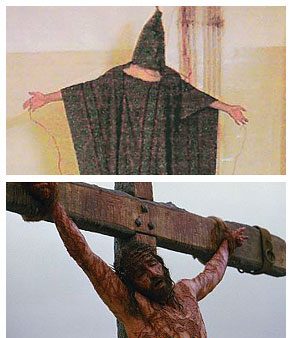
Twice in the last few months torture and its graphic representation has been at the center of public discourse. The first time had to do with “The Passion of the Christ,” a film that features more violence than any big Hollywood movie before it. The second time — now — has to do with the events at Abu Ghraib prison. The two spectacles reveal disturbing truths about American politics, sexuality and spirituality.
It’s easily observed that torture has a highly developed aesthetic dimension. Medieval instruments of torture are gathered in dedicated museums and traveling exhibits all over the world. Those very instruments, of course, were often used in public. Torture, despite its need for secrecy, also needs its own representation. It’s usually meant not only to inflict pain but to instill terror. It’s sometimes meant to please the torturer. Therefore, the ritualistic, fetishistic, “spectacular” aspects of torture are an integral part of the practice. As a spectacle, torture is akin to porn — S/M being the obvious shared territory. It elicits voyeurism and a morbid fascination.
Continue Reading Close