Alison Espach

When Amazon took my gold medal away

A novelist was thrilled when her debut made Amazon's mid-year best-of list. Then the new Jeffrey Eugenides arrived

(Credit: valdis torms via Shutterstock/Salon)

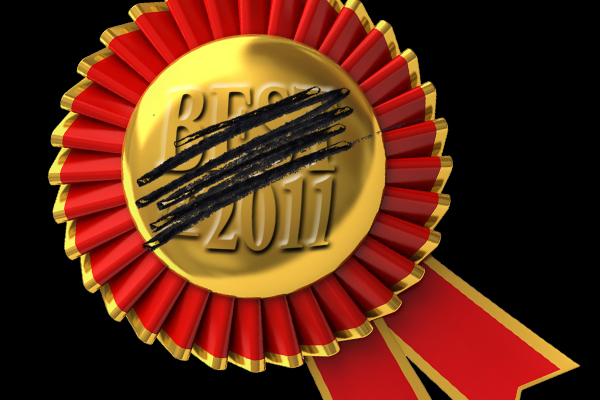
Congrats! You’re the best. For now. That’s the essence of an email I got back in June, when my novel “The Adults” was listed as an Amazon Best Book of 2011 … So Far. You haven’t heard of this list? Two weeks ago, I would have directed you to my Amazon page, where you’d see the gold badge on my book. It was inscribed Best Book of 2011, and then in small print, “So Far.”

It was enough of an honor for me. The shiny addition to my Web page would boost sales, regardless of what was written inside it. A gold badge plastered to a rock would help it sell, even if what was written on the badge was, “This Rock Sucks.” It draws attention to the rock, makes you at least consider its worth.

As a debut novelist, that is all I had hoped for. So I properly celebrated, meaning, I posted the news on Facebook, drank some champagne with friends, who were very enthusiastic, shouting, “That’s the coolest thing ever” and “Wow, I shop on Amazon!”

Then I called my parents. Talking to parents is always easier when drinking champagne, and drinking champagne is more fun when it’s because of your achievement. Even if that achievement is offered with a possible expiration date — December, the month that the final best books lists start to emerge. As the phone rang, I tried to savor the honor, ignored its ephemeral nature, and Harold Camping’s prediction that the world would end on Oct. 21, before the year-end lists. That didn’t seem like the worst thing in the world.

So far?” my mother said through the phone. “What do they mean, so far?”

Yes, I explained. Amazon likes “The Adults,” but can’t commit to declaring it the best, because the year is not yet over, and surely something much better will come out, especially closer to the holidays when the big names are published.

“That’s kind of stupid,” my mother said.

My mother didn’t think it made sense to honor something and hedge your bets at the same time. And the more she pointed out the absurdity of the “So Far” on the bottom of the badge, the more it became the smudge on my contact. I put my finger over the two words, imagined what it’d look like if it were gone by December. My mother was right. A gold badge is not quite a gold badge if it’s halfhearted. Even if it’s shiny-looking, the doubt is there — especially when it’s written right within its border.

“It’s still an honor,” I said. “Just to be noticed.”

“You don’t have to be diplomatic. Not with me, sweetheart,” my mother said.

- – - – - – - – - -

Months passed. The world, for better or worse, did not end. December arrived. The best books lists came out, and I did not make Amazon’s final cut. My halfhearted gold badge was removed from my page. My friends came over again, and this time we drank Jameson.

“Imagine,” a friend said, “a teacher giving you a gold star on your elementary school essay. Congrats! You’re the best! And then you look closer, and you see ‘So Far’ inscribed in the middle of it. So mean.”

Another friend said, “At the very least, you are still kind of Buzz Aldrin.”

“At least you were invited to the party,” another offered. “I didn’t get sort of celebrated for anything this year.”

That was how I felt; at least I was invited to the party. That was how I always felt, in high school, if an invitation found its way to my locker. Me? Out of all these hundreds of people in our school? You want me to come and stand by your bag of potato chips and Twizzlers and tell stories about my slightly feral cat?

I always arrived too early to those parties, which might explain why I am always late now. When you are the first to show up, you stand around with the other early birds. Usually the only thing I had in common with the early birds is that we were early, and we are desperately waiting for everyone else to show up.

In the meantime, I started talking to a boy from my math class. He liked my earrings. I said, “Thanks.” We had math together. We started making fun of our math teacher. Turned out we had more in common. We both disliked our math teacher and agreed that her skirt made her look like a Fisher Price toy. Soon, we were laughing. I liked him. Who would have thought, this early into a party, already finding an interesting conversation? But he was still looking over his shoulder, waiting for the others, and so was I, even though I was pretty sure were both enjoying the conversation. Because all around us people were arriving and new conversations were forming. The room was loud with new laughter. Better laughter. Louder and fresher laughter. It had to be, because isn’t that the point of a civilization, that we advance with time, and the party gets better as the night goes on?

The cool kids were not even here yet; they showed up the latest, of course. I looked at my watch. Turned out, I wasn’t wearing a watch. But I could feel time passing, the room changing as it filled, and I suddenly wanted to go back to the time when I arrived, when it was just me and the nice boy from my math class, enjoying our small but surprising conversation. Looking over his shoulder was tiring, but I couldn’t help myself. I needed to see who was coming through the door, and figure out how they might change everything. I prayed the cool kids would get lost, that the world would end. No more cool kids, no more better books, no more lists.

- – - – - – - – - -

And the cool kids came, except this time in the form of Russell Banks, Haruki Murakami, Jeffrey Eugenides and others who made Amazon’s recently released Best Books of 2011 list. This would be upsetting, except who is outraged when outdone by these three giants of fiction? Who gets upset when they are cut alongside Teju Cole’s “Open City” or Arthur Phillips’ “The Tragedy of Arthur”?  It was an honor to be noticed. I was grateful for those months on Amazon with a gold badge, the sales it garnered. Just like I was grateful for those minutes with the boy from my math class who surprised me with his humor, even if he did walk away shortly after to go talk to the girl with the loud laugh from my bio class.

I wouldn’t want their job anyway. It’s impossible for me to declare that something is absolutely the best, confidently, and with no conditions attached. I’m the most indecisive person I know. Well, probably. Diners terrify me with their book-length menus, married couples impress me with their lifelong contracts. I envy the people who, when online banking, chose the security questions: Who is your favorite painter? What is your favorite book? What is your favorite color? To think that this is even possible, one part of the rainbow being better than another? That someone logs onto their checking account in one year, two years, three years, and still confidently answers: Oh, Pollock. Because I can’t even make a list for various blogs that ask me to select the top 10 books of 2011. I can’t even choose one book when asked about this year’s best, and I don’t think I want to. I don’t want to pretend blue is so obviously the best anymore. My only honest response is to say, “The one I’m reading.” So far.

This Sunday

Since Lisa's father died, Peter tried to keep her busy. Why not visit the park, then return a gift to Tiffany's?

“This Sunday, let’s check out Occupy Wall Street,” Peter says, and it sounds just like last week when he turned to his wife and said, “This Sunday, let’s check out the Museum of Modern Art.”  Going to MoMA was something Peter and Lisa had wanted to do since they moved to New York City two years ago — that and eat a hot dog from Gray’s Papaya, get Korean barbecue at midnight, take a boat around the Statue of Liberty and go to a Golden Girls drag show (which was not nearly as funny as they wanted it to be).

“After we check out the revolution, let’s stop by Tiffany’s so I can return that knife set your mother gave me,” Lisa says. She is joking because that’s what this protest is to them. But it is also not really a joke, because Tiffany’s happens to be located very close to the protest. Lisa is very serious about wanting to return the knife set. She does not need sterling-silver knives to butter her toast.

“OK,” Peter says, because this is exactly the kind of thing they do on Sundays. They check something out that they have been meaning to check out while simultaneously doing an errand. That way, the errand doesn’t feel so much like an errand, and any fun they have along the way doesn’t feel entirely wasteful. “But wait, you’re going to bring the set? You want to hold it the whole time we’re there?”

“How long are we planning to be there, Peter?” Lisa asks. “Should we bring our sleeping bags?”

He knows she is joking because they don’t even have sleeping bags; they are not the kind of people who sleep inside bags. Bags are for the things they have; bags are for gifts to be returned; bags are for dead people.  They put Lisa’s father in one seven Sundays ago. Ever since then, Peter has been very careful to keep Lisa occupied. He keeps using that word. “You’ve got to keep yourself occupied, Lisa.”

Lisa remembers from her liberal arts education that occupation is the language of colonialism. It is also the language of airplane bathrooms.  It is Korean barbecue, then the Statue of Liberty, then MoMA and now Wall Street. What, Lisa wonders, will it be next Sunday?

“We’ll stay a little while, at least,” he says. “Long enough to get a good sense of it.”

And so Lisa gets the knife set and they put on their lightest coats. They head out and pass vendors selling American flags and large photographs and Peter leans down and says, “This one would be perfect for my father’s birthday.”  That is next Sunday. Peter’s father’s birthday. He holds up the photograph featuring a man and his golf clubs and in big white letters it says YOUR WORST DAY GOLFING IS BETTER THAN YOUR BEST DAY WORKING. As Peter buys it, Lisa thinks that this is true; she thinks of how the day her father died was the worst day in her life, but probably still so much better than many other people’s days. She thinks of people far away; people who do not have knife sets, people who do not have a set of anything.  This is what she says to Peter as they enter Zuccotti Park.

“What?” he says. There are people chanting loudly. Occupy Wall Street is very loud. A leader speaks, and the people around the leader echo the words. In all of Lisa’s life, she has never seen communication work like this. For Lisa, it has always been the opposite; words start out so big and end up so small. But here, the words start as tiny as a rock dropped in the ocean, and ripple outwards until they reach the street.

- – - – - – - – - -

In the park, Peter and Lisa stand side by side, looking at three women dressed in white dancing with dollar bills taped over their mouths. It is performance art.  The knife set is heavy in Lisa’s hands.  Peter and Lisa stand there watching for what’s got to be at least 10 minutes, and Peter looks around the park, and he almost nudges her to say, “Let’s check out a different part.” He feels an urgency to see everything here, a pressure to do it all, like when they were in London last year for only a day, and had to do Big Ben, Buckingham Palace, the Tower of London and the Tate.

But he doesn’t say anything, because he isn’t sure what the appropriate amount of time is to spend at each part of the park. He had the same problem at MoMA. He doesn’t know how long it takes to absorb whatever it is they are supposed to absorb from the women in white, just like he didn’t know how long he was supposed to stand quietly in front of White on White at the MoMA.  Just like he stood in front of Lisa’s father’s casket, and thought, How long as the son-in-law am I supposed to stand here? How long until I understand that he is dead? How long until everybody else understands that I understand this man is dead? How long does it take for meaning to transfer from one body to another? Well, he didn’t know. He just didn’t know.  He looked at the people dressed in black and stared.  He said, “All of this black is starting to depress me,” and Lisa said, “I have learned today that there are 100 shades of black,” and he guesses she was trying to tell him that she was seeing something he wasn’t; she was trying to hint that her version of the world was a much more complicated one than his, and she made sure to do this on a day when he couldn’t argue with her.

So they stand there, silent, staring at the women in white, and Peter wonders how many shades of white his wife is seeing.  He nudges her, and says, “Let’s go check out the anarchist section,” and she agrees.  As they move through the people, Lisa says, “There’s an anarchist section? Do anarchists even believe in sections?” He sort of smiles, but then says, “They believe in clusters.” He isn’t joking at all. “They really believe in clusters — here, look,” and hands Lisa a pamphlet, Anarchist Basics.  Lisa tries to read but is stopped by a man with a long white beard.  The man grabs Lisa’s arm, and says closely and quietly to her face, “When you wake up tomorrow, I’ll still be here.” Peter pulls his wife toward him because this is what he does when a strange man threatens something too close to her face.

But Lisa finds something reassuring about this man’s promise; that is the growing difference between Peter and Lisa. Lisa sees it as a promise, and Peter sees it as a threat. And not only that, but Lisa believes him; the man’s beard is so long and white, she believes he has been living in Zuccotti Park forever.  The promise reminds her of her father, and how he used to say something very similar to her, when she was younger and afraid they’d all die in the middle of the night for some inexplicable reason.  She stands there, with her knife set, and Peter with his golf photograph, and she does not move away. She imagines next Sunday, when the man is still here in his sleeping bag, and they are at Peter’s father’s house in Connecticut. Peter’s father will unwrap the golf photograph, and he will say, “This will look great in my office.” Peter will say, “We got it two blocks down from the revolution.” Lisa can already hear the glass clink against their teeth as they try to drink and laugh at the same time.

Continue Reading Close