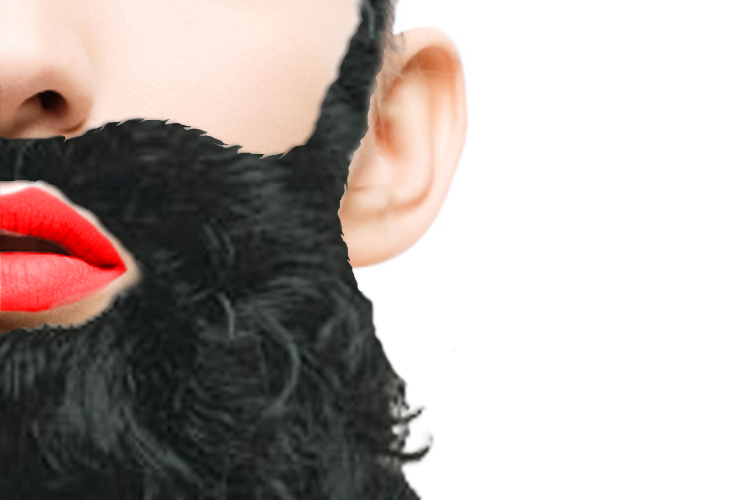
I’m making my way down the path that leads to the clinic’s front door. I’m walking through a rock garden, past beds of flowers, little miniature waterfalls whose tinkling makes me want to pee. I feel like I’m walking down a hallway that keeps getting longer and longer. I’ve seen horror films like this: Just when you think you’ve reached the end, you find the end is out of reach.
Right before I decide it’s a sign to go home, I see it: the front door. Damn. Two fewer steps in the fog and I could’ve given up, left, called from the office, sorry, couldn’t find it, will call back to reschedule.
Or I could’ve just never rescheduled. I could’ve avoided the voice on the phone, that sweet down-to-earth tone that belongs to –
“Hi,” the woman says. “I’m Jessica.”
She’s not what I’d expected: a pudgy Latina with braces, heavy eyebrows, a little roll of fat bulging beneath her shirt, which says Oil of Olay, spelled out in little faux rhinestones. The front lobby is comfortable. That sucks. I’d wanted it to feel sterile to the point of hostility. Leather couches and subtly lit mirrors, a smoke machine maybe. Instead it looks like the kind of place where you’d want to housesit. Warm, soft tones, an olive-colored rug on the floor, a glass-topped coffee table with copies of Rolling Stone and Harper’s. A large, cushy-looking couch striped in olive and beige, tons of pillows, facing off against a flat-screen television set.
“Is this where you do the face stapling?” I ask Jessica.
I am a woman with a beard. I have an adrenal disorder — congenital adrenal hyperplasia, it’s a mouthful — that results in excess hair as well as obesity, infertility and male-pattern balding. It’s a gift of inheritance, and it was first called out to me when I was 10 years old.
I was sitting on the linoleum floor of the Black Mountain Middle School assembly room. A voice behind me said: “A werewolf!”
A second voice: “Where? Lemme see.”
A werewolf? That was way more interesting than the German rock band that was about to perform for us. The show was meant as a history lesson in this time before the Berlin Wall tumbled, an idea that appealed more to school administrators than to us. I wanted to see the werewolf too.
“There,” First Voice said.
Laughter gathered, bloomed and spread. I started to join in — and then I felt that flush. Dummy, it said, don’t you know?
I wore a Wonder Woman T-shirt. It had pulled up and out of my jeans, exposing my lower back. That was where they were looking. That was why they laughed.
The hair had come. It began with a place I’d never looked, a spot now revealed. How had I never noticed? How could I not know?
I am now 25 and have never been medically treated. Instead, I’ve tried shaving. I’ve tried waxing. I’ve considered electrolysis. Now I’m getting laser hair removal.
Jessica leads me into a private room. Now this is what I’d expected: white-on-white, not even a Thomas Kinkade knockoff to lighten things up. Excellent.
“Have a seat,” she says, and I perch on the exam table. The air in here smells like nothing, nothing at all. It’s as if they deep-clean the oxygen between appointments.
“I didn’t like Oakland,” Jessica says, a little while later. She’s kneeling before me, peering closely at my cheeks and chin. “Too ghetto. So I moved to Hayward.”
“The training ground for gangs,” I say.
“Yeah.” She puts her hand to the side of my face and turns me slightly to the left. I flinch. I’m not used to anyone touching me there. “But the parking’s easy.”
She pulls out a drawer, a clipboard, a piece of paper and a red pen. She uncaps the pen and I notice the short, unpainted nails capping stubby fingers. There’s something endearing about her hands, something natural and undiminished. She marks a diagram, drawing with red ink on the blank, expressionless example. She’s a lefty.
“Full face,” she says, tapping the paper with the pen’s tip. It’s still uncapped. She’s giving the paper diagram freckles, acne. “Upper lip, chin, cheeks. The whole pickle.”
I bite my lip hard enough to draw blood – not from nerves, but to reassure myself that I’m here, I’m alive, I’m doing this.
Jessica puts down the clipboard and fixes me with a metallic smile. They make invisible braces, why didn’t she go that route? Then I flush, angry at myself. You’re judging her?
“Six sessions,” she says. “At least.”
Six sessions at $300 a session. If I go for the package, it’s $1,500 total, one free treatment. A laser hair removal Value Meal.
“Jessica,” I say, “I’ve been to two doctors. Neither of them could fix me. If I pay you $1,500, can you make me look like a girl?”
She says: “Let me tell you how it works.”
The technician uses a hand-held laser instrument. It sends a light beam through the skin. The beam seeks melanin, a pigment found in hair and particularly in dark, coarse hair like mine. It hits and destroys the hair follicle. Cooling gel protects the skin. Topical cream and aspirin minimize pain.
The laser light works best for people with dark hair and fair skin. Dark hair and fair skin. That’s me!
That’s Jessica too. She tells me how her hairy arms made her feel like something in an African jungle. “No more,” she says, rolling up her sleeves. Now there’s just smooth, freckled skin.
Her eyes are warm. Trust me, they say. “I’m very happy,” she says. “So are my clients.” Clients, not patients. Word choice means everything. Client means choice. It means you’re the boss.
“We’re on,” I say.
Jessica hands me a Popsicle stick with cooling gel. I swipe it across every problem area and in the end only my eyes remain uncovered. My pupils are dilated with worry, my left eyelid twitching.
“Hop up,” she says, patting the exam table. I do this with a motion that is nothing like hopping. It is more like the walk to the guillotine.
“Lie back,” she says, and I lower my head until it is level with my feet.
“Make it quick,” I say.
But it is not quick. It takes an hour and that is made bearable only by a break halfway through. My hands dig into the crinkly white paper beneath me. I feel one of my fingernails pierce the surface and it’s almost like permission to scream. I moan instead.
“How you doing?” Jessica asks.
It feels like someone scraped my face with the blunt, rusty side of an ax, then sprayed it with lemon juice.
“Fine,” I say.
I’d trawled the Internet to find out just how much this was going to hurt. Like a rubber band snapping said one message board. Another warned of a little stinging, a little swelling. One laser clinic’s website advised that patients might feel a slight prickling or burning sensation.
Let me post on those message boards. I’ll give a rebuttal to that clinic. It feels like someone’s going fishing in my face.
The laser is like a roving fishhook. Each time it bites into my skin I hear a beepbeepbeep. That’s the beam seeking the follicle. Once found, it goes zap. That’s the hair frying. Not only can I feel it, I can also smell it.
“Just about there,” Jessica says. “You OK?”
Outside this clinic lovers are having late-morning breakfasts. Bikers and joggers huff past. Tennis partners square off. Drivers pump gas at the Chevron. Mothers squat in front of strollers and shake fingers.
I would kill to be any one of them.
“Hurry,” I say.
“Four more,” she says. “I’ll count them down.”
I bite my lip, curl my toes, remind myself why I’m doing this. No more razors in the morning, pulling my skin this way and that to get the closest cut. No more second shave of the day, the hair so thick and persistent it grows back even as it’s shorn.
No more stubble, no more shadow.
No more hopeful posing in front of the mirror: From this angle I can’t see it at all!
No more walking in a room and wondering: Are they looking at me?
Done.
“Jesus,” I say.
I pull off the goggles. Light, beautiful blessed light. I struggle to sit up. My tailbone is tentative, unsure if it’s able to hold me. My head is runny, my brain muddled. My face is a balloon expanded with too much air.
“Hand me a mirror,” I say to Jessica. All my politesse, my good-girl training has vaporized in the moment. I need to see what’s been done to me.
“You don’t look that bad.”
“So hand me the damn thing.”
“Just be prepared. That’s all I’m saying.”
She hands it over.
There I am, my eyes red and wet above my inflamed skin. The singed hairs are everywhere, some already falling out. I brush at them with triumph.
I look great.
Allison Landa is a Berkeley, Calif.-based writer who has held residencies at the MacDowell Colony, Kimmel Harding Nelson Center for the Arts and the Julia and David White Artists’ Colony. She received her MFA in creative writing from St. Mary’s College of California, and this essay is excerpted from “Bearded Lady,” a memoir in the works. Visit her at www.allisonlanda.com.
In Santa Barbara, the fog lingers around the ragged coastline long past
daybreak, hugging the land as if to insulate it from the world outside.
As a student at the University of California there, I always thought the
mist lay especially thick over our seaside campus, creating a vacuum, an
unbreakable seal shutting out what we viewed with a jaundiced, wary eye
as the real world.
We drank in that rarefied air as eagerly as we sucked down our weekend
beers at Giovanni’s Pizza, gladly forfeiting an existence outside psych
class, quarterly registration fees and our student mecca, the town of
Isla Vista. Swathed in our own self-absorbed, self-induced stupor, we
happily lost any concept of what lay beyond the ivied boundaries. Such a
glorious forgetfulness.
It took a would-be poet in his 50s who spent more time wooing my
roommate than composing verse to jolt me into seeing a life outside the
academic arena. By his own estimate, the joyfully unemployed Jesse
spent 60 hours a week on campus — he’d met Katerina while monopolizing
an ancient Macintosh next to her at the student computer lab — and the
balance of his time warming our third-hand La-Z-Boy.
Jesse had his routine down cold long before Kat or I ever came to Santa
Barbara. He’d be up in the wee hours of 11 a.m. or so to catch the No.
11 bus from his shabby boarding house over to campus, where he spent
all day and part of the night slipping into the student fitness center,
napping on one of many rolling emerald lawns, grabbing an illicit bite
to eat at a dorm cafeteria. Jesse had never once set foot in a
lecture hall. He had no reason to do so — he wasn’t a student. He just played one in his own mind.
The fling with Katerina didn’t last long. It couldn’t, what with my
doing my best to sabotage it. After a few weeks of his dirty feet on our
coffee table, his discarded socks on our kitchen floor, his charming
habit of urinating with the bathroom door half-open, even Mother Teresa
would have snapped. And I’ve never been accused of possessing her
virtues.
Blessedly temporary though his furlough at our place was, it set
me to seriously question my own future ambitions. Would I someday awake
as another Jesse, borrowing student registration cards to surf the
Internet and get whopping discounts at local stores, writing rambling
editorials for the campus newspaper and penning odes that were
stunningly beautiful — if only in my own eyes?
Suddenly, I realized that to do otherwise meant wresting
myself from the cushiness of academia and plunging full-force into the
fabled shark-infested waters of the Other World. Now, two years after
making that leap, I concede that it’s a rough transition. My antipathy
for Jesse has faded with the working world’s challenges; I’ve come to
see that fear as well as fervor led him to seek campus refuge.
Really, it’s hard to blame him … at least in hindsight.
For someone like Jesse — low on the marketable skills, high on the
illusions — the ivory tower is a haven. A sad, out-of-place footnote on
Main Street USA or in corporate culture, he’s found his comfortable,
ragged niche in the tolerant foothills of the university environment.
He’s hardly the only one. Colleges across the spectrum, from right-wing to bleeding-heart liberal, draw hangers-on who flock
for some reason. Some are eccentric but basically sane students who never quite managed to graduate. Others are stark-raving lunatics wise enough to know that the campus is a far kinder asylum than any state ward. They’re the groupies — and without them, college life would lack a vibrant and essential dimension.
The University of California at Berkeley, in particular, gains a large
part of its eclectic reputation from the oddballs who stalk through the
free-speech area of Sproul Plaza. Sproul welcomes them, if a small
plaque embedded in its leaf-strewn walkway is to be trusted. It reads:
“This soil and the air space extending above it shall not be a part of
any nation and shall not be subject to any entity’s discretion.” In
other words, an intellectual free-for-all.
Eddie Richards came to Sproul Plaza in order to spread the Word of God. Most schools play host to at least one token religious zealot, but Eddie sings the Lord’s praises as sweetly as a seasoned choir girl in a lilting
Jamaican-accented chant. “God is good … God make the sun shine …
Life is good … God is good …” Socratic it’s not, but it’s the stuff
that feeds Eddie’s soul.
In a worn duffel bag he carries an ancient rock magazine. Inside, Eddie
is pictured with two of Berkeley’s other motley pseudo-performers.
There’s Homeless Drummer, who bangs the skins at lunch time for amusement
and spare change, and will gladly tutor you for $6 an hour. And there’s Hate
Man, who wears a dress paired with hiking boots and will sometimes join
in on Eddie’s riff. “He’s the reverse,” Eddie says of Hate Man. “You say, ‘I
love you,’ he get mad. You say, ‘I hate you,’ he happy.” The three are
shown crossing Telegraph Avenue barefoot, smiling. A crowd throngs in the background, smiling, holding up half-smoked joints in approval.
The warm sentiment carries over to today’s students. Most cheer Eddie on
as he shares God’s word: Punkers nod gaudy-colored mohawks,
skateboarders flash a thumbs-up as they skid by, a future pretender
to the Bill Gates throne spares a grin as he hustles by on his way to
some computer class. It’s all so congenial, until you notice the
distance they keep. A ring of empty space surrounds Eddie … a halo.
The prophet is far from lonely, though. In fact, he was invited to 16
graduations just in the last year. And he prides himself on being a
recognized campus force, getting acknowledged in the student yearbook,
people knowing his face and voice if not his name. “People pass by, they
know me, they say, ‘Hey, Eddie, how you doing?’” Should an emergency
arise — the bus breaks down and he can’t get to campus, he’s having
trouble collecting that month’s check and needs to go to the Social
Security office — he’s missed. “They say, ‘Hey, Eddie, where you been?
I didn’t see you yesterday. Where were you?’”
Aw, hell. I did my share of ditching class and avoiding campus while I
was in school, and never once did strangers inquire about my absence.
Eddie — who’s not a “legitimate” part of UC-Berkeley — probably
touches more people with his words than any run-of-the-mill student.
Even if they do stay several feet away. Even if they do question his
sanity.
An hour south at Stanford University, Joe Euclid draws a different sort
of fan club: the pigeons. They surround him at his outdoor table along
Tressider Student Union as if he were the second coming of Mary Poppins.
And with good reason; Joe’s an invaluable source of nutrition, dropping
pastry crumbs and coffee splashes from his shaggy gray beard.
Accustomed to his presence, the greedy birds perch on Joe’s cluttered
work space, pecking at the ancient typewriter, nosing inside a crumpled
paper cup, staring warily at precarious newspaper stacks.
If Eddie’s an entertaining campus sideshow, Joe’s the one
students avoid at all costs, spreading the rumor that Ted Kaczynski —
who he eerily resembles — has come to town. He’s the cautionary tale, the object
lesson: If you don’t study for that test, that’s how you’re
going to wind up.
Passersby tend to give Joe a wide berth as he bangs away feverishly on
the falling-apart keys, occasionally shooting him a sympathetic if
nervous smile before quickly moving on. But don’t feel sorry for Joe —
he lives at the edge of Stanford’s campus in his broken-down mobile home,
but he’s got big dreams. He’s out to prove the existence of mental telepathy. And once he does, professors will flock among the pigeons at his feet,
hoping for a crumb of his knowledge.
The research project’s been ongoing since 1982, when the Angel of God
came to Joe and showed him the way. Ever since, he’s dragged his
makeshift office to the patio outside Tressider, poking into
falling-apart books and typing madly with two fingers, poking and
typing, typing and poking. Since 1982. And now a light’s appeared at the
end of the tunnel. “I should produce a writing which is fit for
publication by the end of this fall,” he says, not without a hint of
pride. “I just keep doing these rewrites and rewrites. And it all starts
with … this.” He holds a tattered Webster’s Dictionary as tightly as
I’d seen Eddie grip his New Testament.
Like Jesse, Joe serves as a reality check for the Calvin Klein-wearing,
Daddy’s-Mercedes-driving set. Yes, Virginia, these people really do
exist. In the suburbs, they’re swept off the sidewalks along with
yesterday’s front page. In wealthy cities like Giuliani’s New York, they’re
routed from their park homes by politicians obsessed with the ballot
box. But within the university’s golden gates, they find their own home,
an outlet for their muttered thoughts, a faint hope for dreams that
will in all likelihood never see fulfillment.
The polarized dichotomy between the haves and have-nots gives rise to a
strange and reciprocal freak show: The campus hangers-on watch the
students just as much as they are the subject of stares. And sometimes,
as with Joe, they behold the students with just as much repugnant
fascination. After all, it is the homeless, the crazy, the indigent, the
just-plain-lazy, who are the closest anyone can ever come to true
freedom. They have no classes to attend, no scholarships or grades to
maintain. It’s Jesse’s choice to hop the bus and sprawl on the lawn
every day, Hate Man’s decision to bring antipathy to the student world.
Eddie preaches, Joe hunts and pecks, Homeless Drummer slams down the
sticks — all of their own volition. They retain ultimate control.
Ernest Alexander bridges the strange gap between the two classes. He
knows what it’s like on both sides of the fence. And now his view from
the middle, and from his desk in the underbelly of the UC-Santa Barbara
main library, is confusing, a bit disturbing. Ernest first entered my
alma mater as an undergraduate in fall 1986, driving his sporty new Jeep
Cherokee up from the tony Los Angeles suburb of Thousand Oaks to enroll as a
freshman microbiology major.
By the time I met him, eight years and three changes of major later, he
was on the verge of turning his back on academia. The work was drudgery,
the professors just didn’t understand him … and he had just flunked
all his finals. So he dropped out — temporarily, he told himself and
his parents — but couldn’t quite bring himself to leave the campus
community. So first he milled around campus, brooding, sulking like the
poet-philosopher he longed to be, befriending other drifters and forming
a sullen coalition. It was nice, but didn’t pay the rent. The
hastily procured job at the university library did.
That was nearly four years ago. Today, Ernest sits at his desk,
decorated with wayward Post-It notes and the gaudy Mardi Gras beads I
brought him in 1995, and does more staring than work. He gazes out the
window, seeing everything, everyone. Laughing tank-topped students on
their way to nearby Buchanan Hall. Pipe-smoking professors with their
graduate-student paramours. Ranters like Eddie. Psychotics like Joe.
Drifters like Jesse, like himself a few years back.
Ernest exudes soft-spoken but bitter regret. “I
guess a part of me feels like I should have finished it,” he says,
discussing the sought-after diploma during an afternoon break, fishing a
smoke out of a backpack that once saw better days and university
textbooks. “In a sense, I failed, but I can always go back. I mean, I’m
here. I can always go back.”
That hope, in part, ties him to Santa Barbara, prevents him from moving
out of student-choked Isla Vista, but that’s not the whole story. It takes him two additional Parliaments to admit it. “Yeah, it’s cushy,” he says with a
self-deprecating laugh. “I mean, the campus setting is a nice one.” Much
better, he says, than what he terms “the business lot” — corporate
America, a world he’d rather die than encounter.
Ernest lost touch with his undergraduate friends a while back. “I’m
coming from a different place now” he says, referring to the working world we all dreaded so much while locked in our studies. But working at the university is
different, the lights of the ivory tower are visible if distant. It’s
definitely a comfortable lot, he admits, as he bends his head to survey the ground, his faded black-and-white checked bandanna slipping to reveal a premature bald spot. It’s oddly endearing. “I guess I, um, I think I sort of play like it’s a horrible thing.”
It’s not. He still drinks with his buddies, naps on the library’s
fourth-floor couches, swaps deep thoughts with his co-workers — many of whom are themselves frustrated academics. And maybe he will re-enroll one day.
But even he knows that’s unlikely — “It would just be too damned hard
at this point” — and so he remains mired in the middle, remembering the
classroom, knowing he’ll never truly be student or drifter. He’s a warning against complacency, a flashing red light
showing what happens when you just don’t give a damn anymore. Even the
library’s part-time student assistants know it; they call him “Mr.
Intellectual Social Security.”
But Eddie might warn the kids not to judge, lest they be judged. These
characters, all of them, even Jesse, are on campus for a reason, though
they might not even know it. They are there to further the
university’s mission in a different way, to teach lessons students will
never hear in the classroom. In a place so free from trivia and troubles of the real world, these characters force us to share the academic bomb shelter with those who need it the most. And while we attempt to wrap ourselves in our intellectual fog, they teach us to remember, even as we try to forget.
Continue Reading
Close