Amol Sarva

White star, black galaxy

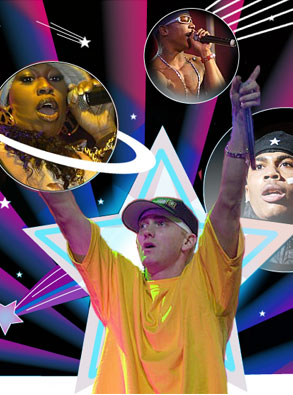
Eminem is the man of the hour, but rap is still an African-American business.

  • more
    • All Share Services

White star, black galaxy

Astrologers took note last week as a rare alignment graced their star charts. The auspicious sign: one Eminem, two No. 1 slots. This year’s prince of hip-hop scored a pleasing symmetry, with the film “8 Mile” and its soundtrack album reigning atop the box-office charts and the Billboard charts in the same week.

In the marvel of a humanized Eminem, once just another angry thug, is yet another symmetry. The white rapper’s transformation is hip-hop’s, and in his race is the message that black music has gone mainstream. Eminems character in “8 Mile” climbs out of his Detroit ghetto on the merit of his stylish flow alone, an achievement all the sweeter for a young white kid in a black mans world. And so is born the record industrys white knight, he who will carry the budding hip-hop genre farther and deeper into the heart of a mostly white target market. Yet as his roman à clef meditates on hip-hop’s color barrier, Eminem’s observers miss the fact that this exception proves the rule and that his genre is anything but budding. Hip-hop is all grown up. And now, as much as ever, it is by and about black America.

Invented in the Bronx ghettos of the 1970s, the cultural form of hip-hop has found its target market in suburbs across America. From 1995 to 2001, the hip-hop market share boomed, increasing by 75 percent. (CD sales have sagged badly this year, but that’s true across all musical genres.) This achievement was possible only because more than three-quarters of hip-hop record buyers were already white. Booming beyond music, hip-hop’s biggest names are increasingly involved throughout the culture industries: fashion, TV, film and print. Twenty years after the Sugar Hill Gang’s “Rapper’s Delight” hit the pop charts, hip-hop has managed something rock ‘n’ roll never could: It’s popular, profitable and black.

Hip-hop has defied a central cliché of commercialization, unlike rock, jazz, and the blues before it. For all of the latter, Norman Mailer’s observation that postwar American “cool” has repeatedly returned to black America for inspiration is true. But as hip-hop transformed from outsider to establishment, it has remained a creation by and about black Americans — even if the product is for whites. Hip-hop’s leaders, stars and aristocrats are predominantly African-American, from Russell Simmons to the Wu-Tang Clan to Lauryn Hill to Ja Rule, DMX and Nelly (who topped the charts just prior to Eminem’s arrival). And on the world stage, hip-hop’s subject matter, from NWA’s 1987 “Fuck tha Police” to Jay-Z’s 1999 “Hard Knock Life (Ghetto Anthem),” continues to treat the experiences of American blacks.

Eminem’s prominence in 2002 merely confirms that the occasional white rapper is by now a familiar novelty. In the early 1990s, Boston’s Irish-American group House of Pain had rap’s biggest hit, and it was the Beastie Boys who were rap’s first superstars. But a check of the Billboard hip-hop chart last August found that 19 of the top 20 albums were from black performers (Eminem was at No. 4).

The surprise, in fact, is that there are so few Vanilla Ice-style knockoffs to mention. Rap records made up 11.4 percent of the $13.7 billion in U.S. record sales last year, and the confederate category of R&B accounted for another 10.6 percent. Rock, by comparison, has declined from over 40 percent in the late ’80s to just 25 percent today. While “teen pop” and the travails of Britney Spears have made headlines lately, the treacle merely footnotes the rise of hip-hop. Mass-market breakout has long since happened.

The face of hip-hop is and always has been black. But so too are hip-hop’s seats of power. Behind the stars is a universe of black producers and impresarios. This is where Eminem came from; he was discovered and packaged by black producer and entrepreneur Dr. Dre in 1999. Successful artists frequently start their own labels to sponsor whole coteries of affiliated acts or “families.” And while the L.A.-based major labels have surely made fortunes distributing most titles, Master P’s No Limit Records and Sean “Puffy-Puff Daddy-P. Diddy” Combs’ Bad Boy Entertainment are clearly powerful, as are other black-run labels.

The list of hip-hop businesses has kept on growing, notably with the explosion into fashion of fabulously successful brands like Phat Farm, Karl Kani, And 1, Rocawear, FUBU and Combs’ own Sean John line. Hip-hop is a world of black musicians, producers, film stars, moguls, critics and designers — and white fans.

The story has often gone very differently in the history of American music. Commercialization has usually separated black America from its artistic progeny, as with the appropriation of jazz by the bourgeois elites, the usurpation of blues first by a white record industry and then by the international explosion of rock ‘n’ roll.

Rock, above all other forms of pop music, has a history of singular racial uniformity, from Elvis Presley and Beatlemania to Morrissey and the Strokes. Rock as an institution is a narrative about the experiences of white, middle-class male adolescents. Just ask Jann Wenner or Nick Hornby. Try to think of a black rocker today. The odds are you can do no better than French-Jewish pop perennial Lenny Kravitz or the early-’90s band Living Colour. It’s true that Jimi Hendrix revolutionized rock guitar in the ’60s, and long before him Chuck Berry was among the music’s key progenitors. But while Mick Jagger will gladly admit that all the first great rock records were black, in subsequent decades rock has rarely told the stories from black America.

On this year’s 25th anniversary of Elvis’ death, music critics noted his catalytic role in the success of the musical form of which he would be King. As sweet country boy, he was perfectly positioned to foot the line of propriety and liberate teenage lust. And as sex symbol to millions of dizzy fans, he was an erotic object that a black man could never have been in pre-civil-rights America. It’s this overwrought parallel that Eminem has claimed, crowning himself “the worst thing since Elvis Presley/ to do black music  to get myself wealthy” on his most recent album.

A repeated theme from rap’s early days was that the fad would fade. Rap was nothing different or special. “King of Rock” was the triumphant title that Run-DMC put on the follow-up to their first hit album, as they claimed a place in the pantheon next to Led Zep and the Stones. The critic Samuel David, writing in the New Republic in 1991, detailed the role of white music insiders, like Def Jam’s Rick Rubin, behind the early hit groups, while pointing out the rappers often came from middle-class backgrounds. His point: Rap is “the black music that isn’t either.” The market would assimilate hip-hop, and thank goodness.

The 10 years since have not been kind to such predictions. Since the ’80s, groups like Public Enemy have crusaded on a Malcolm X-style platform of black identity. Rap was about life in the ghetto, about people from the ghetto, and it was tied up with the concerns of the ghetto; Chuck D famously called it “black America’s CNN.” While today’s materialistic stars have left overt politics behind in favor of flashing their hopelessly nouveau riche tastes on lifestyle showcases like MTV’s “Cribs,” they have not diminished their commitment to expressing the aspirations, realities and dramas of life in black communities. Hip-hop is still about the ghetto. If Rick Rubin was the slick producer behind Dr. Dre’s NWA in 1987, in 2002 Dr. Dre is the puppetmaster behind Eminem.

Of course, what rap’s opponents were really saying is that money changes everything. And commercialization has indeed reconfigured the genre. The early sound was all prosody, no melody; a rapper’s vocals meshed over a spare beat or record sample. These basic elements have evolved to incorporate a more R&B-influenced, consumable tenor, while the emergence of female stars like TLC, Jennifer Lopez and Missy Elliot has diversified its appeal. Combs, in his Puff Daddy phase, crystallized this mainstream sound in a series of hip-hop remakes of pop classics such as the Police hit “Every Breath You Take.” Following textbook marketing principles, duets intermingling “rough” male rappers with R&B starlets have become increasingly common. And kid-friendly acts like Lil’ Bow Wow deliver the low-in-sugar variety thats both kid-tested and mother-approved.

While capitalist impulses have driven the migration to a softer sound, it has also sharpened a hard edge: hip-hop’s obsession with themes of crude street contest and self-aggrandizement. The earliest stars were often gang members and graffiti artists, often in trouble with the law. Today’s stars still adopt this identity as a source of credibility. This posture’s significance peaked in the mid-’90s with violent, misogynistic “gangstas” like Snoop Doggy Dogg and Tupac Shakur. While the “West Coast” wave invented a new melodic, mass-market sound, its very success drew a political backlash against its disturbing messages. At the nadir in 1995, hip-hop sales collapsed.

The post-gangsta incarnation transcended this challenge, typified in the style of Notorious B.I.G. The ghetto credentials persist (like Tupac, he was murdered in an “unsolved” drive-by shooting), but the lyrical themes of violence and sexual power have been replaced by a sublimation of hip-hop’s street origins into a materialized “cash money” aesthetic. “Gucci down to the socks,” he sings on his first hit album, detailing his wealth and glitzy excess. Hip-hop went from “straight outta Compton” to “ghetto fabulous,” from “grunge” minimalism to plutocracy.

Gone are the inflammatory politics of Public Enemy’s black nationalism. Instead, a soothingly bourgeois materialism pervades the music. But there still remains an unexplained demographic mystery: At first glance, a white-dominated mass market would seem to require an increasingly white product. In an era when Britney was instantly covered in marketing-machine imitators, hip-hop has defended a remarkable cultural and racial uniformity.

Where are today’s answers to the Beatles and Rolling Stones, ready to bring us rap’s British Invasion? Or a downtown art-scene rapper, like a 21st century version of Andy Warhol’s flunky, Lou Reed? Is there a place for nihilistic suburban kids from good homes to go grunge, or for bespectacled English majors to make indie rap? A&R men have surely mused about the possibilities, and in fairness something of a multiracial, international hip-hop underground is beginning to take shape. But these white-guy flavors are nowhere on the charts. Ask elite DJs what they play at home, and you may glimpse an opening. For the rest of us? Hip-hop is as black as ever.

The explanation lies in the nature of hip-hop itself and in its deeply instilled obsession with origins and authenticity. The essence of hip-hop is a framework of values and identity that constantly demand artists to “keep it real.” Themes of violence and misogyny may offend genteel ears, but to hip-hop they have the virtue of being genuine. If rappers are charged with crimes and gang associations, they become more popular; they exhibit their authentic connections to the street. Connections to place and community are constantly avowed in shout-outs to Queens or Philly or associates in the crowd.

Materialistic values, far from being perceived as a vice of commercialization, express the basic aspirations of the ghetto and racialized poverty. Hip-hop never chastises its own for “selling out” for money, and artistic integrity is scarcely invoked. It is unimaginable that a rap star would invite commercial self-destruction for ideological reasons in the manner of Pearl Jam’s 1994 campaign against Ticketmaster or Smashing Pumpkins’ retirement due to artistic disaffection with “the Britneys.” Keeping it real never competes with “getting paid.” They are one and the same. Rappers explicitly praise each other for their business acumen.

While post-1960s youth culture has ascetically demanded a rejection of profit in favor of political or artistic ideals, hip-hop has built its values around a concrete cultural identity. To keep it real is to remember your origins in the ghetto, however removed your actual life now is from the street. And if there is a single indicator that most efficiently measures one’s connection to the conditions of the folkloric ghetto, it is race.

Hip-hop is dominated by black Americans, just as black America is dominated by hip-hop. As Q-Tip, member of 1990s alt-rap idols A Tribe Called Quest, put it when he was talking about his upcoming rock album experiment, “Black people in this country are told that they are just a few things. The minute you start to wander and go outside of that you’re not black.” Hip-hop is the identity of post-civil-rights black politics; and this time it is more Malcolm X than Martin Luther King Jr.

Though Michael Jordan once famously dodged political obligations by declaring, “Republicans buy sneakers too,” no such bland assimilationism would issue from hip-hop leaders expected to express solidarity with their communities. Black athletes may appear in suits, but hip-hop is raucous, vernacular and self-consciously intimate with ordinary black life. Its leaders pay attention to politics, sometimes appearing with figures like Jesse Jackson or Al Sharpton, and they support social organizations. Russell Simmons has attracted many stars to his Hip-Hop Summit Action Network, promoting political awareness among hip-hop fans, responsibility among its stars, and issue advocacy through protests and campaign donations. Assiduously inclusive of Latinos and others in the “hip-hop community,” rap is nonetheless intimately connected with black identity in a way that Hollywood and even the National Basketball Association can never be.

Despite the undeniable star power of Eminem, this music’s racial identity remains so strong that some critics in the black community have openly worried that hip-hop is little more than a vehicle for marketing the most negative and violent black stereotypes to exhilarated white teenagers. This debate will surely continue, but it is usually black rappers who hold the microphone — and black executives who stand behind them. (In cases like Combs and Master P, MC and exec are one and the same.) Sex and violence sell rap records as surely as they sell movie tickets, but the news worth noting is that the success of hip-hop has opened a national forum on the life and identity of its largely African-American constituency.

One result is that hip-hop is starting to organize black political identity into a coherent picture for the first time since the civil rights era. Another is a purely unintentional marketing marvel: Race guarantees that black America will continue to ride this economic engine. But the cultural significance is even greater. Black culture is towing in its wake the aesthetic and social sensibilities of a generation of Americans. New York artist Tom Sanford’s reverential paintings of hip-hop stars as religious icons suggest a radicalization of Mailer’s old formula. Tupac’s violent 1996 death in Las Vegas was both an ordinary gangbang and a martyr’s self-sacrifice. Neither merely appropriated by white culture nor simply performed with minstrel-show detachment, hip-hop is black culture telling its own story.

Something has changed in America. It is white suburbia that looks on from a barren culture at murdered gangsters ascending to our culture’s firmament. Tupac and his fellows were once the inadmissible black men. Now they work raw and utterly unsanitized, busily making a culture as genuine, as messy and as painful as the one punctuated by the overdoses and rock-throwing protesters of our fondest Woodstock-era memories. The black music that was neither black nor music has turned out to be both — an early indication that this generation’s Bob Dylans and John Lennons will turn out to be a pantheon of African-Americans.

Evolution, Enron-style

Not all fast-mutating organisms flourish. Some go extinct.

  • more
    • All Share Services

Evolution, Enron-style

There is a ’90s way of doing business that new economy companies “get,” and old economy companies create committees to study. It has much to do with flat hierarchies, innovation, casual clothes and foosball tables. It’s the theme that ran through every issue of the Industry Standard, every Silicon Valley mission statement and every recent book by “pop” strategy gurus like metaphor-spinner Geoffrey A. Moore or Wired editor Kevin Kelly. And it is exactly this cluster of ideas that is at the heart of “Survival Is Not Enough: Zooming, Evolution, and the Future of Your Company,” a new book by Seth Godin, Fast Company editor and self-proclaimed “agent of change.”

The twist of Godin’s approach is his choice of master narrative: an evolutionary approach to business. On one level, this is just another vapid gimmick connecting a sexy metaphor to the same old recycled management fads: Unleash your company’s “mDNA” to make it “zoom”! A clearance-counter library of variations exists on this theme, from “business judo” to “chessmaster strategy.” But on another level, Godin’s topic gestures at a genuinely interesting idea.

The underlying observation of “Survival” is that Darwinian evolution by natural selection is a theory of change for all complex systems — not only in organic systems but in any system with finite resources and reproducing individuals. What biology has learned by studying the struggle for survival can inform us as we think about the struggle of products for market share, firms for talent, countries for a tax base or start-ups for venture capital. Natural selection is more than a mere metaphor for the dynamics of business. It is actually at work in economic systems, and there are likely to be common tendencies between ecosystems and markets for strategists to exploit. Darwinism has a long history of application outside biology — from Herbert Spencer’s Social Darwinism to Richard Dawkins’ attempt to identify the “genetic” nature of cultural change. The use of evolutionary ideas to understand business is inevitable.

But Godin does nothing to take us past the gimmicky metaphor approach to evolution. The appeal of the evolutionary approach should be that it provides a genuinely scientific framework for understanding market dynamics. Godin’s goofball “zoometry” (meant to be the study of business evolution) is no such thing. He ends up offering a bunch of familiar prescriptions: Embrace change, reward performance, take risks, compete ruthlessly. It’s nothing any freshly minted MBA wouldn’t say. What he misses is much more important: Nature is trickier than that. It’s often bureaucratic and resistant to change. It sometimes kills the fittest instead of rewarding them. It usually avoids risky moves and often appears to be pushing noncompetitive, cooperative behavior. Nature is a subtle thing.

If Godin’s science is dubious, his timing is worse. This is the wrong moment for yet another how-to guide to doing business on “Internet time.” The new economy is firmly in recession. The greatest dot-coms are limping. Major sectors from manufacturing to transportation are reeling. And yet Godin is still telling us to take lessons from Amazon, or learn from the tactics of spammers. In boom time, everybody’s a genius. But in a down-market, the usual drivel won’t do.

Consider, for example, the case of Enron. Godin doesn’t discuss Enron directly in “Survival,” but his prescriptions for evolutionary business success read like a list of everything Enron did right through the 1990s: Shed physical assets, build intellectual capital, bring competition to the workplace, encourage innovation, push bold strategies, pioneer new markets and so on. On the new economy scorecard, Enron was a management marvel. In retrospect, the recklessly aggressive strategy and obsessively competitive structure were precisely the things that Enron did wrong. Problems were piling up well in advance of the accounting scandals — profits were down, growth was sluggish, big bets were coming up losers and observers were starting to get suspicious.

Does Godin’s reading of evolution recommend a better way? Quite the opposite. Godin goes on and on about change — the kind of change Enron specialized in. For Godin, change is constant, pervasive and a force of obsolescence. Most companies, especially big ones, are bad at handling it and have developed mechanisms that specifically resist it. Yet, nature shows that you must embrace change. Survival depends on adaptation to the slightly warmer climate, or the predator’s better vision, or the sudden disappearance of a key food item. Species change over generations because natural selection prefers particular variations over others — the lighter coat or the better camouflage — and these advantages are passed on by the successful to their numerous offspring. Companies that don’t follow this drive risk extinction.

Enron was a paragon of Godin-esque values, particularly in respect to “change.” CEO Ken Lay responded aggressively to a changing regulatory environment in gas delivery by merging into and then taking over a larger rival. Lay and his McKinsey consultant, Jeff Skilling, radically redirected the company into commodities trading. They invented a market for energy supplies and came to dominate it. Then they increased the sophistication of the derivatives contracts they traded, created new markets for commodities from bandwidth to weather and brought it all online in a hurry — relentlessly innovating ahead of the competition. They globalized, undertaking projects from Europe to Brazil to India. And they diversified, moving into water and pollution emissions.

Enron knew how to change because it was set up to encourage innovative thinking. Godin rails against the usual culprits of corporate torpor: committees, skeptics and bureaucracy. Well, Enron had none of that. Initiatives were created through a decentralized approach where anyone could contribute to the marketplace of ideas. An executive from the London office, Louise Kitchen, won big for secretly developing EnronOnline from the bottom up — contra management’s stated strategy — and launching it into blockbuster success. When one executive originally came to Skilling with the idea for a bandwidth exchange that was facing opposition from his superiors, Skilling told him simply to ignore the opposition and proceed covertly.

Enron kept a dizzying pace, shifting its business from pipelines to gas trading to financial derivatives to fiber-optic bandwidth in just 10 years.

But suspicions about all that evolution began to rise — especially about Enron’s $1.5 billion bet on bandwidth trading — when Blockbuster pulled out of a key partnership in March 2001. In July, the division’s revenues were revealed to be a pitiful $16 million and the entire bandwidth operation was shuttered. Azurix, Enron’s water business, had already been stumbling and EnronOnline appeared merely to be cannibalizing its own offline cousin. The Dabhol power project in India, over budget and past schedule, was limping. And California’s energy crisis had brought intense scrutiny on the practices of Enron’s core trading business. Investors were worried that its fundamental strategy was struggling, and later they found out that it had been.

Godin’s change-mongering not only makes for a reckless management style, it also gets the biology wrong. Unlike Enron’s transformations, the hallmark of evolutionary change is that it is slow. It takes generations for minor mutations to accumulate into a big change in the species. But Mother Nature seems to prefer it that way. Big changes often yield deadly instability, while refinements permit steady, meticulous improvement on a working design. And by forcing each change to prove itself, selection makes sure to test alternative paths to the big adaptations. Since individuals mutate one at a time, there’s also lower risk of losing the whole species. In the grips of an “innovate or die” mantra, Enron regularly placed huge bets on major projects — India, bandwidth, water. But nature usually waits to see a mutation start to stick in one place before spreading it too far around, not because nature is cautious but because this is what works.

Godin himself applauds Amazon for its incremental approach of constantly running small trials of new ideas on its Web site, and eliminating the ones that don’t work. But he misses the crucial difference between a new home page at Amazon, and the type of change embraced by a company like Enron. The former variety moves away from the core business in steps, with small bets on many different approaches, yielding large-scale results after much iteration.

Of course, a competitive organization is the sum of its people. So Godin recommends applying natural selection indoors as well: rewarding performers for their contributions, punishing laggards, encouraging innovation and constantly providing performance feedback. Some mix of these familiar themes is in everything written on the topic, but Godin tweaks the “survival of the fittest” elements. He thinks companies should regularly fire people for performance (make them struggle for survival), and demand more innovation from even the least-skilled workers (even janitors should be “knowledge workers”).

Again, Enron fits Godin’s bill. Enron worked hard to cultivate the right people and the right culture. It rewarded performance with big cash and stock bonuses, providing luxuries like on-site concierge service and massages. One executive called it “the best meritocracy in business.” It stocked the ranks with hundreds of Ivy League and Stanford MBAs in entry-level positions, and then set them to compete against each other. The Performance Review Committee lived to “rank and yank” — constantly running performance reviews, ranking everyone against their peers and firing the bottom 15 percent. The result was a mercenary culture where traders locked their desks to keep their colleagues from stealing their work and where orders were ignored if they didn’t match selfish interests. Even as Enron worked to save itself last September, top traders were heading straight out the door to competitors. Enron’s injection of free market absolutism created a Wild West culture of backstabbers.

Even nature is not so cruel. Examples of altruism and cooperative behavior abound. Chimps and wild dogs share their food. Many kinds of animals give predator alarm calls, even when this draws extra attention to the individual making the warning. Even vampire bats share blood with less lucky hunters. The traders at Enron didn’t seem inclined to such behavior, nor were there mechanisms to encourage it. Nature’s function is far subtler that “dog-eat-dog,” an observation that requires digging deeper into biology than Godin manages.

The danger of Godin’s sloganeering, simplistic approach to applying Darwinism in business is the complexity of the systems themselves. “Survival” is little more than a compendium of the usual management clichés recast in a Darwinian vocabulary. Converts to this form of Darwinism beware. Well-meaning but naive interventions can lead to disastrous effects as unforeseen impacts ripple through the system. As Enron implemented one extremist approach after another, it grew to be a bizarre, unnatural place. Ultimately, as much-touted new projects failed to deliver and growth began to stagnate, a final lesson of Darwin’s became evident: Nature doesn’t work by fixing its mistakes; it works by eliminating them.

Continue Reading Close

Survival of the losers

Even Charles Darwin couldn't have predicted who would emerge from the Web's evolutionary shakeout.

  • more
    • All Share Services

The revolution is over. Or so it might appear to anyone reviewing the wreckage wreaked in the past month in the digital music industry. As chronicled in Salon, the purchases of MP3.com by Vivendi Universal and Myplay.com by Bertelsmann were only the latest in a series of sad stories about Scour, Launch Media, Liquid Audio, Emusic, CDnow, Listen.com, Aimster, Gnutella and even Napster. The revolution has choked on litigation, drifted toward bankruptcy and sold out to the establishment at rock-bottom prices.

It wasn’t so long ago that things looked very different. Stewart Alsop, general partner at venture capital firm New Enterprise Associates and Silicon Valley pundit, went so far as to say, “The music business as we know it is hosed.” Fortune and BusinessWeek put Napster’s teenage founder on their covers. The record industry was accused, again and again, of failing to “get it.” Of the new technology’s impact, said Hal Varian, professor at Berkeley’s Haas School of Business, “the business model for music distribution is unlikely to survive.”

It was supposed to be the same story all across the Fortune 500. The Internet would let tiny upstarts oust mammoth multinationals, in the music industry as surely as in television or retail. MP3.com, Yahoo and Amazon would replace Virgin Records, NBC and Wal-Mart. According to Michael Robertson, CEO of MP3.com, the old economy didn’t stand a chance — the majors were in for an “Internet enema.”

What made him so sure?

Easy. Evolution was on the Internet’s side. Times were changing, technology was in overdrive and Net start-ups were fast, savvy, agile and aggressive in all the ways that General Motors, NBC, AT&T and their consultants were not. They were blessed by Charles Darwin. While dinosaurs lumbered to adjust to the new climes, these warmblooded techno-mammals were out to inherit the earth.

Evolution offered a metaphor that a day trader could love. Simple, intuitive, rich with serious science, a vaguely Darwinian theory became the reigning myth behind dozens of bizarre business models. The market demanded a theory of radical change that explained the upheavals with rational argument. Darwinism was it; due diligence could wait for later. Or so it seemed. A closer look at Darwinist theory should have inspired more caution. Nature doesn’t always pave the way for the survival of the fittest.

Before the doom and gloom of the post-NASDAQ fall, Net visionaries in the late 1990s found an irresistible appeal in the story from the late 1800s about a certain mutant variety of British moth. This species, called the peppered moth, liked to perch in sun-speckled forests. A good choice, since their white wings camouflaged them against the dappled sunlight, protecting them from predator birds. A few dark-winged mutants turned up in every generation, and an unlucky lot they were: Their dark coloring made these fellows especially susceptible to predators.

As the Industrial Revolution got underway and coal-burning smokestacks went up with the English textile mills, the world started changing. By the end of the century, smog was everywhere. The bark on the trees was increasingly covered in soot. Birds had a field day with the peppered moth. The normal light-colored moths began to stand out sharply against tree bark.

But for the mutants, life suddenly improved. Now hidden better, they survived longer and reproduced more, leaving offspring that were more likely to survive and reproduce. In a famous calculation, evolutionary biologist George Hamilton showed that just a 1 percent advantage in fitness could take a mutant variety from tiny minority to dominant majority in a few hundred generations. Moth generations are brief, and by the 1950s “industrial melanism” had turned moth populations throughout southern and eastern England entirely dark. The peppered moth became the most famous case of empirically confirmed Darwinian evolution in all of biology.

Connections between the luck of the peppered moth and the new phenomenon of fast-moving companies from Silicon Valley struck the new-economy pundits as well worth mentioning. The Bionomics Institute, which had been pushing the slogan “economy as ecosystem” for years, suddenly started getting attention in the mid-1990s. Big-shot technology venture capitalists and CEOs turned up on the institute’s board of directors and at its conferences. The institute’s founder, Michael Rothschild, issued predictions on how only Darwinism could help us understand the dramatic changes forced by technological innovation. “The last time the earth witnessed a comparably compressed surge of evolutionary invention was 543 million years ago — at the start of biology’s Cambrian Explosion. Indeed,” he continued, “insights into nature’s first evolutionary tsunami may help explain the economy’s latest.”

This was just what the doctor ordered. The digerati, their investment bankers and tech investors needed a theory that grounded the stock market’s astronomical valuations in eminently sane, serious laws of nature. The Dow 30′s incumbency meant nothing, and this was the reason. The Web was “like a deep-sea volcano bursting to the surface,” creating whole new landscapes. Only those who could adapt to the new environment would prosper, just as evolutionary history shows. Change or join the dinosaurs. Evan Schwartz, with his 1999 book “Digital Darwinism,” put evolutionary vocabulary into the mix. Darwinism had attained buzzword status.

Since the 1996 Bionomics conference, NASDAQ has been to 5,000 and all the way back. Now we realize, as we close the books on several years of hysteria, that there were errors of ideology in reporting the facts of this exuberantly Darwinian story.

True enough, the Cambrian was “the big bang of animal evolution,” probably driven by a fortuitous advance in the way genes combined. The developments of the Cambrian are responsible for radical changes like the first appearance of multicellular organisms. So Rothschild’s enthusiasm was understandable: If IBM and Microsoft were the primordial bacteria, just imagine what was yet to come.

But then the bottom fell out. Global temperatures increased a few degrees and the Cambrian’s spell was broken. Extinctions commenced in droves. So vast was the carnage that even now, 500 million years later, we have never again achieved comparable levels of biodiversity. Of history’s great extinctions, this was the whopper. Recall the saying about “what goes up.”

And so it has been with us these past 18 months. Take any sample of once-blessed names. CMGI, Kozmo, Idealab, Boo, Infoseek, Netscape, DoubleClick, Free-PC, Ariba, Amazon, you name it: If not dead outright, then they are shadows of their former selves. Even AT&T, Oracle and Cisco are hobbling.

But the sinking fortunes of the dot-com herds have not led to a similar fate for Darwinist approaches to markets. Amazon’s Jeff Bezos himself has spent much time invoking the Cambrian Explosion, telling BusinessWeek that “what people don’t think about is that [the Cambrian] was also the period of greatest extinctions ever.” Although “this is a great time to be experimenting,” he also warned, “it’s silly to think they’re all going to be successful.” That much has proved true. His underlying suggestion was, though, that while many will fail, the survivors will benefit enormously.

But is that how ecosystems really work? We all know that Mother Nature lacks foresight, so a rainy season can cause antelope herds to reproduce too eagerly. When next year’s rainfall is back to normal, the relative water shortage kills them in scores — but this paring back is not reliably therapeutic, as in the optimistic reading of “survival of the fittest.” These swells and dips are destabilizing. The young or pregnant die first, casting ripples for the future fate of the population. Similarly, the equity market’s present aridity is particularly harmful for early-stage companies, even very promising ones, while gigantic bunglers like Lucent have the resources and assets to survive. The mammals are starving while the dinosaurs lumber on.

And some good ideas may not come around again for a while. Take Vindigo, a Palm Pilot-based restaurant and night life guide that has been all the rage since it launched early last year. Expecting more venture capital, the company built out its platform extensively. If funding is temporarily unavailable while the revenue model matures, say your goodbyes. That’s what happened to Kozmo, a business that actually made economic sense in Manhattan, but got rushed to suicidal expansion by expectations of plentiful financing, growing demand and a long boom. Even Darwinism cannot guarantee that bad things won’t happen to good ideas — the conditions have to be just right. Bezos may find that bad luck can outrun even earth’s biggest bookstore.

Though Darwinist pundits come and go, the grand theory of struggle and survival remains. As irrational exuberance has faded completely, faith in evolutionary destiny may be slacking a bit. One lasting result, however, has been the upswing of interest in science’s most successful theory of change in complex, interacting systems: Darwinism. The next step is to leave the hype and sound bites for a deep, systematic analysis. There is much we can learn about new-economy companies from what biologists know about the humble peppered moth. Now that the world is back to normal, we have time to ask.

Continue Reading Close