Andy Dehnart

Home decorating and other lies

On the wildly addictive "Trading Spaces," two neighbors remodel bedrooms while producers and designers reinvent something else -- reality.

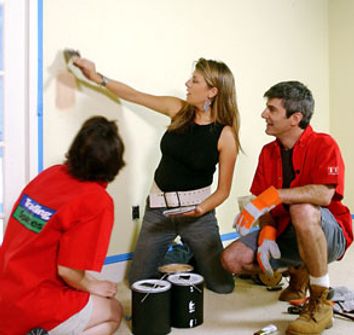
Press pause. You see three people on their knees in the corner of an empty bedroom. Two of the people are wearing matching shirts, and they’re watching the third. He’s wedging a screwdriver under the lid of a paint can. A few trays and a roller sit on the dropcloth that covers the carpet. The stuccoed wall behind them is white and clean. There is nothing else to see.

Pull back; everything’s still paused. You weren’t really looking directly at the three people. You were staring at a small TV monitor, peering over the shoulder of a woman dressed in all black. In front of her the same three people are still on their knees, but there’s a well-built man with a camera on his shoulder standing so close they’ll hit their heads on the camera lens if they move. Look to the right: Near the window are two men wearing shorts; one has headphones connected to a bag of small antennae. Back up, turn around, go past the guy with the notebook near the door. Follow the cables that lead from a digital video camera mounted high up in the room to a small monitor in the hallway at the top of the stairs. More people are gathered here. Behind them you see other bedrooms full of the furniture from the bedroom you just left.

Keep going, down the carpeted stairs, covered with something that feels like the lining of diapers. Move into the kitchen, where couches are stacked. Push past the makeshift curtains to the sewing tables in the family room. Go out the garage door, past the associate producer walking between the houses, past the tented table in the driveway that holds breakfast tortillas, past the caterer. Look to the left, at the driveway next door, where a larger canopy covers a work area where two people are sawing and hammering. Cross the street, past the minivan whose driver is staring at the two houses. Stop near the crowd watching the scene you just left from lawn chairs and the curb. It is 10:31 a.m. and you are in a suburban neighborhood 30 miles northeast of Houston. This is the set of the 39th episode of the second season of TLC’s “Trading Spaces.”

If you’ve never heard of the show, you’ve managed to escape its cultural saturation. Now in its third season and continuing to build momentum, “Trading Spaces” is based on the BBC’s “Changing Rooms.” Its premise is this: Two sets of neighbors switch houses for two days, and, led by a designer with a $1,000 budget, redecorate a single room in their neighbor’s house. Both teams share a carpenter. At the end of Day 2 the host reveals the rooms to the homeowners, who usually say, “Oh my God.” Sometimes, however, they cry.

Hillary Clinton is a fan of “Trading Spaces.” So far this season well over 3 million viewers have watched the show’s new episodes on Saturday nights, often beating “SpongeBob SquarePants” and even “WWE Raw.” The show has been criticized by the producer of the show’s atrophying and distant cousin, “This Old House,” and has inspired a flurry of copycats. From rock stars redecorating rooms for their fans using “the artist’s own style and signature” (VH1′s “Rock the House”) to shows where one resident surprises his or her housemate with a redecorated room (TLC’s “While You Were Out”), domestic-themed nonfiction television programs have multiplied and picked up speed in the wake of “Trading Spaces.” Maybe years of being unable to successfully turn their homes into Restoration Hardware showrooms by themselves prompts people to watch and then participate, or maybe what people will do to get on TV has just expanded to allowing a crew of strangers to invade and remodel their homes.

Watch the episode that involves this bedroom — “Houston: Appalachian Trail,” which frequently repeats — and you will never see the crew, the cables, the stacked furniture, the crowds of people that only increase in size. You’ll never see the sewing coordinator who has done all the sewing. You will not hear him tell a homeowner working in front of the camera that she won’t hurt anything because the machine isn’t threaded. You also will not know that some of the scenes that take place on Day 1 actually were shot near the end of Day 2. And you will never know how many retakes it took to get the scene right.

You will never see any of this and you are never told about it, yet “Trading Spaces” is not fake. With hand-held cameras, a bright TV news look, and next-door neighbors as its stars, it feels completely real and raw, as if a camera crew just showed up at the door, started filming and then broadcast the results. But as with most reality TV shows, people tend to act surprised and even horrified when they learn what was involved in the production. Here, those revelations come from journalists, homeowners who’ve been on the show and then written online about their experiences, or from the designers and crew members themselves, and there seems to be a sense of outrage over the lies we’ve been told, however inconsequential.

Why exactly these revelations make us feel so violated has to do both with how well the cast and crew of the show do their jobs, and how much we’ve grown to value and accept the false idea that what we see is what we get. But at the very core is a conflict that was evident, on one level or another, nearly every moment of the three days I spent on the “Trading Spaces” set last spring.

“Do you like that color?” Doug Wilson asks me as we stand near a kaleidoscopic wall of paint swatches at a Lowe’s Home Improvement Warehouse northeast of Houston. The designer presents a colored card and holds it up next to the fabric samples he has in his other hand. As far as I can tell, it matches well, but what do I know? I nod. “That’ll do; an icy blue,” Doug says, handing the sample to the guy at the paint desk. Tomorrow he’ll reveal this color to Mendi and Boyd Lunsford as the three of them kneel in the corner of Erik and Kim Estrada’s bedroom.

As Doug — and everybody on “Trading Spaces” uses first names exclusively — searches for mirrors he asks me, “Have you seen the show?” I almost choke. “Oh yeah. I’m pretty much a die-hard fan,” I say, instantly blowing my cover as an objective journalist type. Ever since I was introduced to “Trading Spaces,” I’ve watched it compulsively.

“Every show has to have a villain,” Doug has said, and it’s a role he plays well. Once he transformed a bedroom into a replica of a Pullman car, complete with a curved ceiling and a fake window; another time, he converted a rec room adorned with racks of antlers into a sleek home theater with stadium seating. At the height of his villainy a homeowner burst into tears when she saw that he’d covered her ugly fireplace with a wood facade.

Considering his earlier escapades, Doug’s plans for this room are surprising, and he knows it. “I’m going to shock people,” he says. The rather ordinary room will have a padded headboard, a rug and pillows, mostly blue with white accents. He says it will be called “A pretty room, by Doug,” and then adds: “In italics.” As he repeats this title throughout the shoot, sometimes in front of the camera, he’ll act it out, tilting himself to the right, italics-like, as he says it.

For some of the room’s furnishings, we wander around Ikea, the Swedish home furnishings superstore that supplies inexpensive yet trendy pieces for “Trading Spaces” rooms. “I’m sorry this wasn’t more exciting for you,” he says to me as we head toward the checkout.

Suddenly a stout woman with a thick Texas accent screeches, “Time out!” I back away as she stops and yells, “Slow down!” Her arms are a blur. Then she freezes, looking at Doug inquisitively for a second. Quieter, she says “‘Trading Spaces’?”

Doug smiles and reaches out his right hand. “Hi, I’m Doug.” The woman’s voice seemingly climbs three octaves. “Oh, I watch you all the time.” Gesturing to her seemingly mortified friend, she says, “I’m trying to get her to go on it with me. My husband will be shocked when I tell him!”

“Well, too bad he isn’t here,” Doug says, a perfect smile on his face.

- – - – - – - – - – - -

This is not the Doug we see on the show. It’s not that he undergoes a Jekyll-and-Hyde transformation when the camera starts to record. But there’s an obvious disconnect between the bitchy drama queen Doug whom a fan of the show called “an asshole … [and a] cocky son of a bitch,” and the Doug who will say, “Hi, it’s nice to meet you, too,” to a small redheaded girl who walks up to him while he’s signing autographs.

Watch any episode and you can see that Doug, who started acting in theater productions when he was 15, relishes playing up his “evil” side, generally doing so with a sort of sly grin. During an infamous episode last season, he sat in a lounge chair, sipping a drink while he directed the homeowners to work. As much as I suspected that to be somewhat of a for-the-camera act, some part of me still expects to see that Doug in Texas. Instead, he’s been nothing but friendly and even fun. And on Day 1 — the first day of official taping but the second of three days that the crew spends at a location — I find Doug painting in the bedroom alongside a production assistant. The cameras and the homeowners are nowhere to be found.

“I’m impressed by how much you’re doing,” I say.

“We don’t lounge around.” Doug watches his paintbrush as he talks; it slides up and down the trim, turning it a brighter white. “But it made for fun TV.”

Since I’m being as confrontational as I get, I ask Doug whether he tries to create “fun TV” by designing rooms that are the exact opposite of what the homeowner wants. It often appears this way on the show. The homeowners will say during their pre-interview, for example, “Anything but country,” and Frank Bielec, the designer assigned to their room, fills it with arts and crafts and paints curlicues on every damn surface.

Doug doesn’t flinch. “If you give them exactly what they want, then what’s the risk? And no, I don’t try to do things exactly opposite by any means. Most often, my homeowners have liked my rooms.” Of the lack of monumental changes in this particular room, he says, “I wasn’t going to just change it for the sake of change.”

He steps back. “The crisp white does look very good. It’s very Martha.”

Producer Aimee Kramer calls to him from downstairs. “I’m finishing this door trim side, and then I’ll be down. Let me know when you’re set up, Aimee.” He leans toward me and says, in a much lower voice, “It’ll be 20 minutes. You just gotta keep working until they pull you away.”

- – - – - – - – - – - -

Aimee is the person responsible for pulling Doug away. As one of two producers on the shoot, she works closely with Doug to plan the room, and then directs him and his team during each scene, from outlining what will happen to shooting retakes if something seems off to her. Her crew consists of a camera operator, a sound tech, a grip, a production assistant and the two homeowners. There’s an identical team in the opposite house. For each shoot one of the two producers assumes the responsibility of overseeing the entire shoot and joint scenes like the opening Key Swap.

Most of the time, it’s not obvious that Aimee and Doug are locked in a quiet battle of priorities. Between shots, Aimee is relaxed, casually chatting with me on the living room couches about what happened on MTV’s “Real World/Road Rules Challenge” last week. She jokes with Doug and with Paige Davis, the host of the show, who effervescently moves between the two houses, often getting involved in the scenes. But when the camera rolls tape, Aimee is all business, focused on getting all of the footage the editors will need to construct the episode. She always watches a monitor, seeing what we, the audience, will eventually see. That’s her priority.

Doug’s priority, however, is to create a room. There’s constant pressure on the entire crew to finish, and the second-day deadline looms over the shoot. Although there’s not an actual hour by which the rooms must be finished on Day 2 (some of the shoots have gone late into the night), the rooms must eventually be finished. That pressure appeared to me to affect Doug the most. It would be a challenge to work that fast on your own, never mind having a couple of untrained homeowners helping out and a camera crew getting in your way. On Day 2 this tension finally broke.

“You want me to get this done?” Doug asked Aimee, with the camera hovering over him as he wired a lamp. “Move the camera, move the lights.” For the first time, Doug was visibly pissed off. “You’re yelling at me; you’re getting edgy already.” Up until this moment, Doug and his producer had interacted like teasing brothers and sisters. Now they seemed like a couple who’d been together for so long they forgot why they liked each other.

“I’m not edgy,” Aimee replied. The room was silent. Then Aimee asked Doug a question.

“Hold on, I don’t want to think right now,” Doug snapped.

“O-K. Let me know, then,” Aimee said, and left the room.

Although it sometimes seems as if the designers on “Trading Spaces” treat their rooms like throwaway canvases, what I saw from Doug was a lot of attention to the details of his project. During on-set downtime, if Doug wasn’t outside signing autographs, he was usually in the room working. Aimee’s crew worked extremely hard, too.

An episode of “Trading Spaces” is created exactly like a movie: The episode is broken down into individual scenes, planned, set up and then shot and often reshot until they’re right. The lighting has to be right, the sound has to be right, and most of all the cast members need to know what they’re doing. Sometimes it takes a half-hour or more to set up a scene. Then after the shot is done everything has to be taken down and moved to the next location.

The seemingly obvious problem with this is that “Trading Spaces” isn’t a movie, it’s a reality-based TV show, one that comes off feeling like a documentary, featuring real people, real houses and really hideous paint jobs (and sometimes even moss or hay) on the walls. That the show looks so real may explain why people feel cheated when, for example, they find out that the show is not always shot chronologically.

In Houston, for example, in front of the camera, Doug asks carpenter Amy Wynn Pastor to make him a bench. The bench in question, however, is sitting a few feet away, almost finished. They are, technically, lying — but not being untruthful. Doug did indeed show his plans to Amy Wynn earlier, and she did build the bench. They just held off doing it for the camera.

Amy Wynn, Paige and the designers — and even the homeowners — all handle these on-camera lies really well. After lunch, Mendi heads outside to help Amy Wynn work on a shelving unit for the bedroom. They’ll act as if Mendi has helped Amy Wynn with this entire project. As the crew heads to the backyard for another scene, I hang back and ask Amy Wynn how she feels about the fact that, on camera, she just let a homeowner take credit for her work.

“I’ve gotten a lot more comfortable with it,” she says, continuing to work. She’s wearing jeans and a tight sleeveless shirt with a deep neckline that exposes a lot of her amber skin. “It’s fine with me; it’s all part of the game.” She compares it to the way she ostensibly takes credit for the work of Eddie Barnard, the other carpenter who’s never mentioned on camera but appears in the credits as Prop Master. He handles some of the more intensive work, helping to ease a workload that would be near impossible for one person. When Amy Wynn first started with the show, she says, taking credit for Barnard’s work was a source of guilt. “Every single day at the end of the shoot, I’d say, ‘I’m sorry.’”

- – - – - – - – - – - -

“The magic always happens after lunch on Day 2,” Laurie Hickson-Smith, the shoot’s other designer, says when she comes in from next door to look at Doug’s work. For most of the two days of filming, the room was just blue. In a few hours, though, it has what looks like a brand-new bed and furniture, funky lamps hanging upside down from the ceiling, a designer entertainment center with crown molding and new artwork. Now it’s time for the final two scenes: the Designer Chat and the Reveal, where the completed rooms will finally be shown to their owners. On the living room couch, where we’re all waiting while Paige gets ready to interview Doug about the room, Mendi asks if anyone has a Pepcid.

“I’m nervous again,” she says.

I ask why. “I guess I’m just nervous because they can’t do a redo.” A few minutes later she’ll continue to worry out loud: “If I say something stupid, it sticks.”

A room in her home has been completely redesigned — it may have hay glued to its walls or broken glass used as a design element — yet she’s worried about her on-camera performance. Her focus seems to be a bit off, but she’s actually being really smart: Mendi knows what is permanent (the tape of her reaction, which will play again and again in reruns) and what can be undone (her room). She also knows what the producers know: This is the one shot that cannot be redone; reactions can’t be faked.

For this reason, the crew is very protective about what is happening on the opposite set; they must prevent the homeowners from getting even a hint of what is going on next door. They’ll be kept inside while someone checks to see if the other crew is shooting outside, or if Amy Wynn is working on something for their room. Crew members and visitors must check their shoes for revealing paint stains. The entire show rests on those final moments when the homeowners open their eyes and see their brand-new rooms for the very first time, and no one wants to spoil that.

Upstairs, two lights are set up near the foot of the bed, where the two camera operators are standing; Mike the sound guy is behind them. When they open their eyes, Erik and Kim will see more people and equipment than furniture. Doug says what I’m thinking: “Are they going to be able to see that there’s a bed in here?”

The producer from the other house, Laura Swalm, directs me to the bathroom, where the monitors for the two cameras are set up, cables snaking from them over the bed to the cameras. Amy Wynn comes in and jumps up on the high ledge of the large soaking bathtub, and Doug soon joins us. Three days of work has come down to this, two people looking at their new room. This is their bedroom, and they’ve let strangers invade it and maybe destroy it.

In the bathroom, we have our eyes glued on the monitor. I doubt anyone is breathing as Paige brings Eric and Kim — eyes closed — into the room. My heart is beating furiously; there’s a lot of tension as we wait for the one moment over the three days that will be a complete surprise. Paige tells them to open their eyes.

Eric’s first words are, “Blue — I like it. I like the blue, I really do.”

It takes a minute for Kim to say anything, because she’s choking up. Is she going to cry? Scream? Alas, no: “Oh, it’s beautiful!” she says, her eyes wet. Doug smiles at the monitor. Amy Wynn looks thrilled, too, and so does Laura and the rest of the crew.

“Cut,” says Laura as their comments start to trail off. But the cameras continue to roll. Laura has requested the “fake cut,” a trick producers use only for the Reveal. Pretending the cameras are off is designed to get the homeowners to speak up and talk more openly.

Three days ago I would have been appalled by this technique, but now it makes sense. Over the past two days Aimee never told Mendi or Boyd what to say or how to react, but she really had to work hard to get them to express themselves when the cameras were on. More than once, after Joe pulled the camera off his shoulder, Boyd or Mendi would say what he or she really felt about, say, the shade of blue Doug selected. They’re acutely aware of the camera’s presence and the film’s permanence. Even when they had to repeat a scene, they’d stick with their original reaction, maybe phrasing it in a slightly different way, being honest in a reserved and supercareful way.

Laura asks questions, trying to get Eric and Kim to elaborate on their feelings. They do, and finally Laura says, “Cut. Real cut.” The crew stops filming and starts to move the equipment next door. Immediately Doug walks into the room and Kim hugs him. “Thank you so much. It is so beautiful.”

After the Reveal next door — Boyd and Mendi both love the room Laurie designed for them (“That is awesome!” “Oh my God!”) — Paige closes the show and the cameras finally stop rolling tape. There are hugs and pictures and thank you’s. It feels like the last day of summer camp as the crew packs up; everyone’s anxious to leave, but it’s depressing that everyone is going home.

- – - – - – - – - – - -

Janet Malcolm’s famous book “The Journalist and the Murderer” begins with a proclamation: Journalists prey “on people’s vanity, ignorance, or loneliness, gaining their trust and betraying them without remorse.” It ends on a less definitive note, though, after having waded through the murky relationship between a journalist and a subject, finding that both those who seek to document people’s lives and those who are documented are complicit in the outcome.

Malcolm’s flaw, however, is that she leaves out the audience — the reader, the viewer — and the audience might really be the most important part of this now ubiquitous and rather dysfunctional triangle. In a way, both the subject and the documenter seek the audience’s attention and approval — the murderer wants to be proved innocent; the journalist wants to write a good story — or else they wouldn’t exist as subjects or documenters.

The audience? Well, we’re fickle, curious creatures, demanding, in the case of “Trading Spaces,” captivating reality. Yet we often act indignant the moment we discover exactly how the show has been produced. During the first season of “Survivor” a photograph of a camera operator and other crew members hovering over the cast illustrated this perfectly; we knew that people were there filming, but the camera’s intoxicatingly singular point of view makes it easy to forget just where that footage came from, never mind how it was edited. The show looks so good to us, so real, that we’re taken aback when we discover that it’s not quite a transcript of real life.

Maybe we’ve grown so disgustingly arrogant that we actually assume our lives are flawless and fascinating enough to just be recorded raw and then broadcast to millions of viewers. But that’s never been the case. From the most innocuous documentaries (the most insipidly dry nature show) to the most argumentative nonfiction shows (anything by Michael Moore) to trusted sources of information (your local news), documentaries and other forms of nonfiction TV are all about shooting and editing footage that pushes viewers in a certain direction. Raw footage is not television — it’s a home movie. On “Trading Spaces,” the crew will spend maybe 30 hours working on the rooms. From that, only eight or nine 30-minute Beta tapes will be recorded in each house, providing roughly eight to 10 hours of footage that will be edited down to 44 minutes. What happens to make that compression successful doesn’t make the results fake, it just makes it TV.

Walking through the aisles of Lowe’s with Doug, I asked him about the one thing that has become the show’s trademark: the designer’s removal of ceiling fans, sometimes to accommodate new fixtures, other times for aesthetic reasons. During this episode a total of three ceiling fans lost their lives between the two houses, despite the homeowners’ pleas that this is Texas, for crying out loud.

“What is it with you guys and ceiling fans?” I asked.

“I know they’re practical, but they don’t look good,” Doug said.

What’s practical doesn’t look good. There probably isn’t a better explanation for why the show is constructed the way it is. Watch an episode of “Trading Spaces” and you will be deceived, but you will not have been betrayed.

Whither reality TV?

So far, "The West Wing" is the only drama directly responding to the attacks. Will TV ever be the same?

“Ripped from the headlines.”

That’s the phrase NBC uses to promote its drama “Law & Order.” On the short commercials plugging this week’s show, the announcer sensationally enunciates the line, as if to suggest that because the fictional show takes its inspiration from real life, the program will be even more dramatic.

That might have been convincing before Sept. 11, when terrorist attacks destroyed the World Trade Center towers live on television. There, of course, we saw headlines come to life in the most unimaginable ways during typically perky morning news shows. The footage wasn’t “just like a movie” or really like anything we’d ever seen on TV before, except perhaps for footage of events like the Challenger explosion. This was real-life drama with incredible real-life consequences playing out on our screens a few seconds at a time. The headlines were writing themselves with a cathode ray tube.

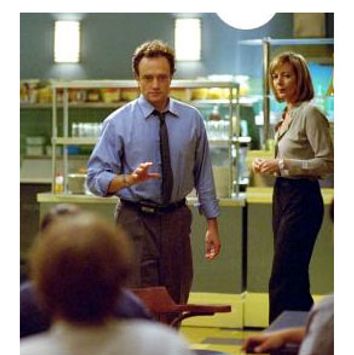
This Wednesday night, the only drama on TV that has truly been ripped from the headlines — or at least the headlines we’ve seen in the last three weeks — is a “very special episode” of “The West Wing.” Unlike the “Law & Order” spot, “The West Wing” is being promoted by a solemn commercial featuring stars Martin Sheen and Bradley Whitford. “In the wake of the events of Sept. 11, we decided to postpone our premiere,” says Whitford. Sheen continues, “We wanted to set our continuing story lines aside for a night and try something different. We hope you’ll join us on Wednesday, Oct. 3, for this new episode.” Titled “Isaac and Ishmael,” the episode finds the staff of “The West Wing” “dealing with some of the questions and issues currently facing the world in the wake of the recent terrorist attacks on the United States,” according to NBC. Series creator Aaron Sorkin wrote the hourlong show, which was rushed into production last week — so fast that there were no screening tapes available for critics.

While “The West Wing” will be the first fictional show to deal with the terrorist attacks, it’s not the first show to acknowledge them — or to react. Other shows quickly made changes. CBS’s CIA drama “The Agency” dropped its pilot, which began with a hostage gagged with an American flag being blown up in Cairo. “24,” a new Fox show that was shot in real time and will unfold an hour at a time throughout the season, edited out of its first episode a bomb exploding on a commercial airplane. Scenes of airport troubles were deleted from the season premiere of “Friends,” and “Law & Order: Special Victims Unit” reportedly removed shots of the twin towers from the show.

The first entertainment shows to come back on the air after the attacks were the late-night talk shows, but they weren’t the same as they’d been. First David Letterman returned, teary-eyed alongside an also-shaken Dan Rather; a somber Jay Leno came back the next evening. Later, an equally choked-up Jon Stewart delivered an unexpectedly poignant and moving monologue at the beginning of the normally biting and satiric “The Daily Show.”

Although soap operas have returned to their daytime slots and laugh tracks are again resounding during prime-time comedies, television has a different tone. And while some of the changes made in the name of sensitivity seem like overreactions, the decisions generally make sense in the context of the unimaginable events of Sept. 11. Watching a jet blow up just to make a suspenseful drama a bit more entertaining has a different meaning now. But what happens a month, six months or a year from now? Will TV and pop culture ever be the same?

In the past decade we’ve witnessed the rise of nonfiction and nonfiction entertainment. We dive into memoirs and personal essays, and even eagerly read biographies of almost-forgotten presidents. On television, first came talk shows, brash representations of fringe America that we couldn’t turn away from. Then game shows made a resurgence in prime time, finding audiences rallying around an individual contestant and playing along in their living rooms. Somewhere in the midst of all this, documentaries sprang back to life. “The E! True Hollywood Story” introduced us to the gritty back stories of our real-life cult icons, and later we tuned in to follow Crocodile Hunter Steve Irwin, as he inexplicably picked up and pissed off deadly creatures for our education. Finally, in the past year and a half — although the format has been around for 10 years — reality TV moved to the front of our pop culture psyche.

But now, we’ve collectively experienced something that was more real than anything we could have imagined seeing in person or on TV. Most of us only experienced it through our television sets and computer screens, but we watched what happened to the twin towers live — the aftermath of the first plane’s impact, the almost unbelievable footage of the second plane flying directly into the other tower and then the unspeakable shots of the towers crumbling and people fleeing mammoth billowing clouds of smoke and debris.

Television’s impact and immediacy suddenly seemed more obvious than ever. We’re far more used to seeing the aftereffects of disasters and catastrophes– the destruction left by an earthquake, even the empty shell of a building left after a bombing. While traumatic, those kinds of images seem easier to deal with, perhaps because we didn’t actually experience the event live.

Television, as a medium, has a tremendous ability to communicate a process, to tell stories from their beginnings to their ends and to keep us tuned in throughout. Our most captivating cultural moments have been those that we watched from start to finish; would we have sat through the O.J. trial had we not seen the bloody crime scene and the dramatic chase live on TV? Maybe that’s why, after Columbine, oversimplified shows about high school life didn’t get pulled off the air (although the season finale of “Buffy the Vampire Slayer” was, even though the episode was anything but simple), and post-Oklahoma City, explosions were still commonplace on TV. Although horrific, most of what the public saw from those was secondhand. Three weeks ago, though, we watched as people jumped to their deaths from atop burning skyscrapers — and that was just the beginning.

After that collective experience via television, there’s an understandable rush to change things, to change habits, to quickly airbrush existing shows and redefine the future. Adweek reports that a recent survey conducted after the attacks found just under half of those surveyed agreeing that “the attack on the World Trade Center has made me more sensitive to certain themes and story lines in the TV programs I am willing to watch.” Additionally, the survey found “57 percent of respondents indicating they are now less interested in watching” reality TV shows.

The reaction is reasonable. In the shadow of something so life- and perception-altering, entertainment seems irrelevant. But, at different speeds for different people, that shadow will slowly go away. For some, escape is necessary right now; the survey also found 57 percent of respondents wanting to watch more comedies right now.

Now, in the weeks following the disaster, it seems obvious that silly sitcoms seem even more irrelevant than before. And as far as heroes go, the winners of “Survivor” aren’t even on the same planet as the firefighters who raced into the twin towers before they collapsed. (Sadly, there’s some crossover: The winner of Fox’s “Murder in Small Town X,” Angel Juarbe, was one of the firefighters who responded to the scene, and he is still missing.) And whatever actions the real president takes will be remembered far longer than whatever happens to Martin Sheen’s character this season on “The West Wing.”

But all of that has always been true. Wouldn’t gagging someone with an American flag and blowing that person up have been distasteful before Sept. 11? Didn’t “Friends” always deal with ridiculous story lines? That sudden realization by television executives has them rushing to change their lineups now, and some are forecasting the end of reality TV because of a few low-rated shows or the results of a survey. Some of the changes are small, but others could be overreactions that shift the direction TV has been moving in.

For some viewers, it may be too early to laugh with “Friends” or scheme with players on “The Mole 2.” But escapist, entertaining shows aren’t going anywhere. Maybe they’ll remain the same; maybe their creators will be struck by a newfound sense of responsibility and change the shows’ directions. Because we’ve never been through a national crisis with our current burgeoning entertainment world, we have no idea what this will do to today’s television culture.

Television’s power is that it can be both ridiculously trite and overwhelmingly real at the same time. It can show us how a snake reacts when a feisty Australian holds it by the tail, or it can teach us about our relationship to the world and the human condition through footage of a crumbling building. And they don’t cancel each other out.

Continue Reading Close

“The Real World” refuses to grow up

The show that spawned reality television comes back for its 10th season, forgetting the lessons it taught everyone else.

“The Real World,” MTV’s circle jerk of narcissism, voyeurism and exhibitionism, turns 10 years old on Tuesday. Watch tonight’s show and you’ll see seven young cast members exploring the expansive New York loft they’ll call home for the next three months. There’s a potentially racist and homophobic suburbanite from Ohio, a virginal blond, a feisty black woman from San Francisco and a male cancer survivor who’s already interested in an attractive plain-Jane Jersey girl.

It all seems so familiar now — even more so with all the other reality shows on TV — but it’s important to remember that “The Real World” actually invented an entire genre of television. By putting real people in an artificial context (a beautiful, free apartment stocked with cute, well-groomed roommates), producers Mary-Ellis Bunim and Jonathan Murray figured out a way to combine documentary and drama into a sort of soap opera that we’d never seen before.

“The Real World” was so far ahead of its trend that the rest of television took nine years to catch up. And “Making the Band,” the first of the new network reality shows, was also made by Bunim and Murray. But watch any reality show now — even crap like last year’s “Big Brother” or the imports from overseas — and “The Real World’s” influence will be so obvious you’ll probably miss it.

The “Real World” gave us cast members talking directly into the camera in one-person confessionals. It seamlessly blended hip music into location shots with its stars. The producers typecast for conflicts, and they introduced a system of editing hundreds of hours of footage into half-hour or hour-long narrative arcs. And several producers and directors who now appear in the credits for new reality TV shows such as “Fear Factor” and “The Mole” also learned their stuff at “The Real World.”

The 10th season returns the show to its Big Apple roots. But if the first episode is any indication, geography will be the only thing this season has in common with “The Real World’s” first. The show may look the same and feel the same, but underneath that scrawled logo and hip loft, something is missing.

When exactly “The Real World” jumped the shark is debatable, but clearly the show isn’t the consistently dramatic and entertaining half-hour that it used to be. The advent of gimmicks — like forcing the cast to work a job together (which began in Miami with the infamous business that never got off the ground) or casting close friends (as happened during the Seattle season) — seemed to indicate that the show was moving away from a proven formula.

What really broke, though, was the cast.

MTV’s history of press releases about the show illustrates the transformation. From the first “Real World,” April 23, 1992: “As sparks fly, MTV captures every moment — in the loft, around the New York City scene, and wherever their lives may take them.”

The key word is “lives.” Fast-forward to Seattle 1998. That season’s press release describes the show as chronicling “the cast’s daily lives as the diverse group contemplates its future while hanging out with today’s hottest bands.”

Contemplating the future has never made for scintillating television. And even though the Seattle season saw plenty of drama — tough-guy David had a drawn-out affair with the show’s casting director — something has unquestionably been missing ever since that year.

What was missing were the cast’s lives. Gone are the days when the producers plucked random people off the streets and invited them to live in a loft and have their life taped. In the first couple of years we met a hip-hop MC, a comic book artist and an AIDS activist. And the show often followed the characters as they pursued their careers and their goals.

Later, complex identities turned into stock character traits. We got the frat boy, the sheltered religious girl, the down-to-earth black guy, the attractive gay person or various combinations of each. Worse, we met cast members who grew up with the series, and the show has never been the same.

Now, the cast is entirely self-selecting. Potentials send in videotapes or attend open casting calls to apply. And anyone who applies is hyperaware of the process. They know that regardless of the producers’ insistence to the contrary, they’ll be cast in one of seven loosely but definitely defined roles and be edited to fit the image they were cast for. They know the producers will screw with linear events in order to make a more compelling arc. (Sometimes, however unintentionally, they will fight back; the constantly changing color of Justin’s hair in the Hawaii season gave us an unparalleled perspective into how much time is altered in the editing room.) The cast members also know that they’ll become famous, if just for a moment. And so the seven strangers come on “The Real World” to let the tape construct their lives — not to have their lives taped.

You can see it in the casting: Despite the surface diversity, the stars are almost exclusively college kids with limited range. No one older than 23 has been on the show since Boston in 1997, and the majority of the cast members’ ages seem to hover around 21 or 22.

This season isn’t much different. The first episode is flat and features nonstop repetition of two basically empty story lines. Right away, cast members are talking about how this “experience is going to change” them, commenting about whom they’d like to have a relationship with in the house. They know what they’re supposed to do.

Worse, since the new New York cast is so aware of the tension they’ve been cast to produce, they let that loose immediately. Mike, the conservative, makes an idiotic and insulting comment that offends Coral, the black woman from San Francisco, and she overreacts and then impatiently waits for a days-later apology. Roughly the same thing happened the first season between Kevin and Julie.

Coral and Mike may not be acting — there are after all real feelings involved — but seriously, how could they not be at least subconsciously altering their behavior? Everyone, even the show’s fans, knows what happens on “The Real World.” For cast members especially, past seasons are more or less memories as real as their own.

Despite the slide, “The Real World” has brought us terrific drama, and it still has the potential to do so. There are moments those of us who are addicted will never forget. I got hooked during the sixth episode of the second season, which found the roommates screwing around one night, laughing and playing. And then stand-up comedian David pulled the sheets off a half-naked Tami and all hell broke loose. The word “rape” was thrown out, hysterics ensued and David was booted from the house.

Every season has had explosive moments like that: Kevin and Julie’s shouting-match debate about racism on the sidewalk in front of the New York loft; Seattle’s Stephen smacking departing cast member Irene in the face — just moments after he threw her teddy bear into the bay because she told him that she thought he was gay. And so on.

“The Real World” has been so cutting-edge that it came down the cultural evolution path years before the rest of the world. We didn’t need “Dawson’s Creek” to show us a limp same-sex kiss; we had Pedro and Sean’s relationship and eventual wedding in San Francisco. We didn’t need “Survivor” to see crew members interfering with the show; a counselor brought in by the show made Seattle’s Stephen attend anger-management classes.

At its best, the show is dramatic and funny and emotional all at once. At the end of the Boston season, as the cast said teary goodbyes in the airport, I felt myself getting choked up. I wondered why the hell I was getting all emotional over a TV show about self-centered 20-somethings.

I’ve decided that it’s for the same reason that people hated “Survivor” Jerri’s guts. For the same reason viewers looked at toga-clad Chicken George on last year’s “Big Brother” and hit themselves in the head with their remote. For the same reason that we watched the couples on “Temptation Island” try to destroy their relationships on national TV.

“The Real World” and its offspring still give us a mix of people that we can both identify with and love to hate. We know these people and yet we do not. We live vicariously through them and turn to them every week for companionship. That is, of course, what all good television does.

The best new reality TV shows take “Real World” creators Bunim and Murray’s formula and expand upon it, like “Survivor’s” addition of tribes and elimination. But nothing is better or more compelling than watching people interact with each other, make sense of a new place or actually learn something about themselves. Reality TV would be better off as a genre if the new shows would follow that lead.

And it wouldn’t hurt if “The Real World” did, too.

Continue Reading Close

Don’t call it a comeback

How TV networks turned around their lily-white lineups -- and why that still isn't enough.

Back in 1999, Kweisi Mfume, president of the NAACP, blasted prime-time television’s “virtual whitewash in programming” of black characters and actors. He was reacting to the 1999 prime-time lineup, which had not one black or minority performer in a leading role in any of 26 new programs.

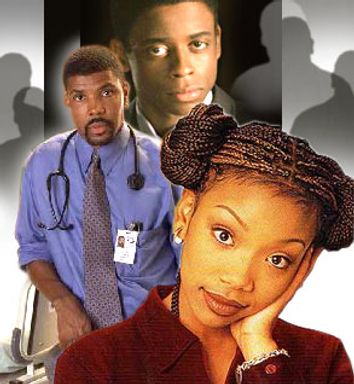
The networks reacted — and fast. Shows without black actors added them. “The West Wing,” for example, on NBC, quickly cast Dulé Hill as the president’s personal aide. Other shows responded too. Indeed, the moves led to an overrepresentation of African-Americans in prime-time network television for that year.

“The nation’s largest minority group is over-represented in prime-time television programming,” said the African-American Television Report, a June 2000 Screen Actors Guild-commissioned study of the 1999-2000 fall television season. “African-Americans make up about 12 percent of the U.S. population, but nearly 16 percent of the characters seen on the networks during prime time.”

Problem solved?

Not a chance. That effort, token or not, didn’t even begin to address the issue of the way blacks are represented on network television. Although African-Americans have been a presence on television since its birth, their presence hasn’t always been a positive or representative one.

Why? The answer varies depending upon whom you ask and what statistics you look at. Mostly, though, the question leads to the conclusion that TV is still considered a business that takes place in a vacuum rather than a cultural force with significant social side effects.

To look at the problem from a purely statistical point of view, the Screen Actors Guild commissioned the African-American Television Report to examine the landscape well before the uproar occurred. But by the time the study of the 1999-2000 season had been completed, most networks had already reacted to the criticism.

While several shows added black series regulars, which led to the overrepresentation, those characters were “often … marginal to the programs’ central narratives,” according to Darnell Hunt, who wrote the SAG report. And more significantly, the report found, “over 44 percent of all African-American characters seen in prime time” were on the WB and UPN — “the two upstart networks with the smallest viewership and the shakiest futures,” Hunt says.

With just under 13 percent of its characters African-American, CBS was “the only major network that seemed to present important black characters in rough proportion to the share of blacks in the overall population,” he says.

- – - – - – - – - – - -

Hunt’s study coincides with several examinations of African-Americans on TV. Another is Donald Bogle’s “Primetime Blues,” an exhaustive study of the history of African-Americans on prime time. His smartly written, nearly 500-page narrative chronicles the significant contributions of African-Americans — and the slow evolution of their presence on television.

Bogle says that 1963′s “East Side, West Side,” which featured Cicely Tyson as “a brown-skinned African American woman, who was not a ditsy maid … [and] was functioning successfully in a professional life,” made progress over the earliest, most directly racist programs. Later, there were exaggerated black comedies like “Good Times,” “The Jeffersons” and “Sanford & Son.” He argues that not until “The Cosby Show,” long after the civil rights movement, was there a series that “truly reflected a certain African-American sensibility.”

Television is affected by the social-political atmosphere, but often trails sociopolitical change, Bogle says. The African-American community criticized TV shows that aired in the 1960s — shows that would have been cutting-edge, progressive programs a decade earlier — because they failed to address the current societal and political climate. “Television is a really a very conservative sort of medium,” says Bogle. “It’s coming into people’s homes.”

There’s evidence, too, that other groups aren’t being treated fairly by Hollywood. SAG’s report “Still Missing: Latinos in and out of Hollywood” primarily examined the overall Latino employment in the entertainment industries, rather than their appearance on television; still, it found that Latino or Hispanic actors “face an uphill battle to find employment in the entertainment industry.”

“It takes television quite a while before [programming] really begins to catch up” to the political landscape. Shows like “‘NYPD Blue’ or maybe ‘Homicide’ or maybe ‘ER’ are closer to the spirit and the social-political outlook of the era in which they appear,” Bogle says. Still, they’re not perfect; although Bogle and others praise “ER” for presenting some representative characters, they still lack “cultural definition and cultural references.”

The SAG study found that the current TV grid concentrates African-American shows on particular evenings and, more significantly, smaller networks. UPN, which along with the WB is the youngest network on the air, overwhelmingly led the six-network pack in all categories relating to African-Americans: the number of black characters, the number of black series regulars as a percent of all black characters, black series regulars as a percent of all series regulars and average screen time for black characters.

The African-American audience is clearly important to UPN, so much so that UPN president of entertainment Tom Nunan doesn’t mind it being called “the black network.”

Nunan says the network’s “main goal is to reflect the way America looks and is, in terms of a diverse collection of performers, not just in terms of their ethnicity, but in terms of their sex and age as well.”

“As an alternative network,” he says, “we always have to be thinking a little bit differently and programming a little bit differently so that the viewer has that relationship with us: ‘Oh, this doesn’t look or feel like the big networks.’”

One of those big networks used to share UPN’s reputation. Fox debuted in 1986, and several of its early shows had African-American themes. But in the 1999-2000 season, the SAG report found Fox in last place in all of the categories that UPN led; only 3.2 percent of all the network’s regular characters were African-American.

Steve Johnson, TV critic for the Chicago Tribune, says that, historically, “a new network starts up, and they need to put some numbers on the board right away. And the way they do that is by appealing to black audiences in the larger cities, and essentially they milk that for a few years, and when they’re ready to move on, like Fox, they drop those shows.”

Fox executives were not available for comment. But UPN’s Nunan, who worked for Fox during the period that it was known for shows like “In Living Color” and “Martin” — not “The X-Files” or “Ally McBeal” — says of Johnson’s thesis, “I think it does ring with a certain degree of truth in terms of history.”

Fox “had enormous success with those shows,” he says, and Fox “did rely on this audience when they were starting up and now they’ve abandoned it, by perception. Whether or not that’s actually something they set out to do, who knows. But that’s what happened.”

So does UPN plan to drop its current slate of African-American programs when its audience reaches a certain point? “This audience is extremely valuable to us,” Nunan says. “In embodying the reputation of being alternative to the viewer, part of that is with different ethnic groups that don’t feel as though there’s anything that connects with them on the other networks, including seeing faces that look like them. And it’s going to continue to be a big priority for us going ahead.”

Still, he admits that his network, like all others, has “to find a way to make money and try to build upon our revenue year by year.” Right now, he says, UPN’s audience is “absolutely … valuable” and the network is delivering the right audience to the right companies.

Still, he says, “there’s some talk [about] whether or not this audience is valuable to Madison Avenue, because ultimately all of these networks are just advertising tools or mediums.”

- – - – - – - – - – - -

But advertisers aren’t solely responsible for the way African-Americans are portrayed on network TV. Hunt, who is the chairman of the department of sociology and director of African-American studies at the University of Southern California, says that the problem is systemic and partially the fault of “industry inertia.”

“Creative people of color are underemployed at every stage in the production process, leading to a prime time that underrepresents people of color and their stories, while often portraying the ones who are shown in implausible and unsuccessful ways,” Hunt says.

So when African-Americans do appear on television, how do they appear? Although Hunt’s SAG study only analyzed characters’ professions, and not any other aspects of their personalities, Hunt says that he’s concerned that just over half of all black characters appeared in sitcoms, compared with 30.2 percent of white characters. “This, of course, raises the specter of the age-old black buffoon stereotype, and the corresponding fear that black characters are most acceptable to the larger audience when they are bumbling, comedic and not meant to be taken very seriously,” he says.

The content of the shows can be subtly negative, too, and can even come during commercial breaks. A study just released by the University of Chicago’s Children’s Hospital found that “black prime-time television contains 60 percent more food and beverage commercials, more images of candy and soda, and more obese characters than general prime-time television.” The researchers say that “may influence the eating behaviors of African-Americans,” who are more overweight as a group (60 percent) than the population as a whole (54 percent).

Even the networks with strong minority representation may have less-than-ideal content in their shows. For example, although UPN’s programming may be progressive in the sheer quantity of African-American shows and performers who appear on its lineup, most of the network’s shows are sitcoms, like “Moesha” and “The Hughleys.”

UPN’s Nunan defends programs like “The Parkers.” They’re not “debasing in any fashion,” he says, but rather feature “aspirational” situations and “positive role models … not just for the African-American viewer, but for any viewer.”

Nunan says that the length and genre of the show aren’t what matter. “That they’re half-hour comedies and there’s a laugh track,I don’t think at all harks back to the days of ‘Amos ‘n’ Andy’ or Stepin Fetchit.” He points to the “leading roles with ethnic Americans in all of our programming, half-hour, one-hour and reality” as evidence of the network’s far-reaching diversity.

Reggie Rock Bythewood, a film and television writer, doesn’t mind black sitcoms. “There are a lot of silly white shows,” he points out. The problem “is that we don’t have really a balance … shows that would balance out some of the sillier shows.”

Bythewood wrote and directed the HBO movie “Dancing in September,” which deals with the subject of African-Americans on TV, focusing on how “African-American writers and executives deal with their working in an industry that permits this to go on.” The film follows “a television writer moving up the ranks of the black sitcom world amid network boycotts from [a] civil rights organization” who is passionate about producing programs that are reflective of black people’s lives. She’s fired from a show for “speaking out against [its] racist characterizations,” and so she pitches a new show that becomes a success.

Bythewood wrote for shows like NBC’s “A Different World” and Fox’s “New York Undercover.” He began thinking about “Dancing in September” when “New York Undercover” eliminated a Puerto Rican actor and character to bring in more white characters.

Broadening a show’s audience — whether it’s an African-American-oriented program or a program predominantly white in focus — is sometimes a goal. Author Bogle says, “It’s great if it connects to a larger audience as well, but we’ve been so starved for images, or images that we feel are not degrading, and that are progressive, that it is important how [the show] connects [with] that black audience.”

Different shows do appeal to different audiences, and while black households and white households still predominantly like different television shows, there are signs that the gap may be closing. In 1996, for example, “Monday Night Football” was the only program that appeared on the Top 20 favorite shows of both black and white households. Now, however, eight of the Top 20 favorite shows in black homes are on the Top 20 lists of white homes as well, USA Today reported in April. And in February, the Washington Post reported a similar figure, calling it “the greatest common viewing experience in at least a decade.”

- – - – - – - – - – - -

The SAG-commissioned African-American Television Report concludes with four recommendations for the television industry. First, it says, “African-American characters should be positioned more frequently as heroes/heroines in their respective shows.”

Second, “shows with an ‘opportunity’ to add African-American series regulars should do so.”

Third, African-American characters in predominantly white shows “should be developed more extensively.”

And finally, “Writing staffs should be diversified so that stories told position minority performers for more meaningful roles.”

It’s that last suggestion report author Hunt considers the most crucial in the ongoing battle, because it will have a key effect on the rest. Still, “it will take ongoing, vigilant community pressure, I believe, to slowly peck away at the structural imbalances that define the industry today,” Hunt says. “Only when this structure has been transformed will the issue of diversity become a nonissue. I am not too optimistic that this will occur anytime soon.”

Johnson says that’s primarily because networks “tend to take chances with what they know” — falling back on familiar writers and producers, who often are white. And when they do take chances, airing a show like a black drama, he says, the networks “tend to … play it way too safe, and as a result it’s a little dry, it’s a little preachy, it’s a little boring.”

In order for blacks to achieve a more representative balance on television, advertisers have to recognize the value of the audience; writers have to connect with important and significant ideas. And networks and their executives have to give African-American shows the “time to find an audience, and … time for an audience to relate to the rhythm of a show and the premise of a show,” just as they do for slow-starting but ultimately successful white shows like “Cheers” and “Family Ties,” Bogle says.

Will more African-American actors help? Bogle thinks both quantity and quality are important. “I would like to see more, and I would like to see what’s there to be accurate,” he says. UPN’s Nunan says that the network just “want[s] to do what feels natural. Frankly, what is natural for us is that our casts are diverse, and that’s the way the U.S. is, and that to me is what’s so bizarre about what our competition does, because it’s so lily-white across the board.”

And that’s a problem, says Hunt. “As our most central cultural forum, we rely upon television to give us a sense of who we are, who we are not and who we hope to be,” he says. “Wildly overrepresenting a dominant group on television at the expense of others influences this meaning-making process in ways that work against the ideals of an open and diverse society.”

Hunt has a point. Culturally and socially, television plays a huge role in American lives. While television shows — from “The Cosby Show” to “ER,” “Moesha” to “Survivor” — aren’t just products for sale on a shelf at Wal-Mart, they do have an often significant impact on consumers. But networks don’t treat them that way. No one wants to deny networks a right to make creative decisions or prohibit them from making money. But like companies that create toxic waste or develop products that have harmful side effects, networks and producers need to remain conscious of — and be held accountable for — the effects of their actions.

In a way, networks even have an obligation by nature of their very existence to accurately represent society and all of its members. “The networks keep pleading ratings and money … but they keep conveniently forgetting that they exist by virtue of using the public airwaves,” the Chicago Tribune’s Johnson says. “And somewhere they ought to have a duty to do a better a job at representing the public and giving African-American kids images they can look at and see and feel proud of — and just feel like they exist.”

Continue Reading Close

What about laughs?

ABC's new sitcom seems stale already, but it has something other comedies don't -- the witty, intelligent Joan Cusack.

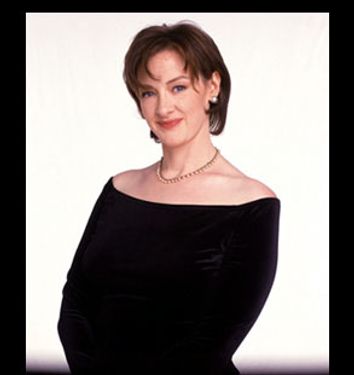
Let’s get the obvious, easy criticism of Joan Cusack’s new ABC sitcom out of the way first. In the premiere episode, Joan and her two best friends end up in a coffee shop talking about their problems and cracking limp jokes. By then, it’s already obvious that “What About Joan” looks and feels way too much like every other lame sitcom. It doesn’t have the energy or the chemistry of a “Will & Grace” breakout, and it’s definitely nowhere near as spastic or original as “Malcolm in the Middle.”

But the show does have one killer hand that it hasn’t fully played yet: Cusack herself. Although she may be best known for relatively small parts in movies starring her brother, John Cusack, Joan always manages to pull a strong performance out of whatever situation she’s in — whether it’s serving as an assistant to a hit man in “Grosse Point Blank” or trying to kill off Uncle Fester as a psychotic gold digger in “Addams Family Values.” The same is true of her performance in “What About Joan.”

Starring in her first television series (excluding her appearance for a year on “Saturday Night Live”), Joan plays a semineurotic high school teacher who is surrounded by close friends and alternately plagued and blessed by her new boyfriend, Jake (Kyle Chandler). Developed by television producer James Brooks (“The Mary Tyler Moore Show,” “The Simpsons”) and Gwen Mascai (a National Public Radio essayist), the show’s premise is simple, if thin, and it ultimately relies nearly entirely on Cusack’s strengths.

And that doesn’t always work. In the first episode Tuesday night, Cusack struggles against banal setups — her boyfriend wants to get married, she freaks out — and tries to cope with what looks like a genetically engineered, all-too-typical supporting cast. Among the show’s six regulars, Wallace Langham plays almost the same tiresome character he played in “Veronica’s Closet,” and Chandler is just as green-eyed and straight A as he was in “Early Edition,” only a mediocre match for Cusack’s unhinged schoolteacher. When the show shifts the focus away from Cusack for a subplot or even just for a scene, it falls, fast.

It’s not clear yet exactly what the show wants to be when it grows up. ABC says “the series focuses on the private lives of an intimate group of high school teachers, exploring the complexity and endurance of close friendships among women, as well as the challenging relationship between Joan and Jake … as they blunder toward intimacy.” The problem is that no one watches a sitcom to explore “the complexity … of close friendships.” That’s what “Oprah” is for. Sitcoms are for cheap, fulfilling laughs, and they’re at their best when they play to our intelligence but don’t require much brain activity.

And that’s the problem.

For some reason, we’re demanding too much, too soon from sitcoms, and that’s causing them to self-destruct into endless recasting and reworking, eventual three-episode runs and, finally, cancellation, resulting in a round of embarrassment for everyone involved.

Most significant, even if a show has potential — and “What About Joan” certainly does — it’s usually not given time to develop. In today’s ratings-obsessed, instant-gratification world, network executives, blind to everything but the numbers, often pull a show before there’s even the smallest chance for growth. Watch the first season of “Seinfeld” and imagine it being judged from the first half-dozen episodes alone. The cast took several episodes to develop chemistry, and the writers needed just as long to come up with the show’s smart, interwoven stories.

When they’re not giving life to a show and then cutting off oxygen in just a few weeks, this season networks have tried to draw viewers based solely upon marquee celebrities. While it’s somewhat understandable why they’re attempting to revive the nearly dead genre of the sitcom using strong talent off the big screen, the networks are still demanding too much from shows that have too little to offer. Bette Midler, John Goodman and Geena Davis all had sitcoms that pretty much crashed and burned. Only Davis is holding on, barely; right now she’s being held for the debut of Cusack’s new show. As with “What About Joan,” those series failed to exploit their stars fully, preferring instead to drop them into a situation, praying desperately that the star’s charisma and talent would carry the crappy writing and supporting cast on their shoulders for a six-year run. Much of Midler’s “Bette” and some of Goodman’s “Normal, Ohio” were funny, but the humor was isolated, star-centric and out of place — a hyena-style laugh in the middle of a bus full of placid yuppies. The stars didn’t have anything worthwhile to work with.

“What About Joan” was developed without Cusack in mind, yet there’s nothing there besides the star. Still, Cusack really has something, and her physical presence single-handedly rescues the show from immediate dismissal. Just by squinting up her face and jittering incessantly, she’s funny; and when she lets loose — snuffing out a series of candles with a wooden spoon, for example — it’s absolutely riotous. But in between doses of Cusack, we have to slog through pretty bad acting in horrifically unfunny and unrealistic situations.

That doesn’t mean we need Very Special Episodes or even realistic, logical situations for Cusack’s able physical comedy and eager personality to break through. “The Golden Girls,” for example, was full of plot holes the size of Miami, yet nine years after the last episode aired, the sitcom holds up, enjoying marathon repeats every weekday on the Lifetime cable channel. You can watch the same episode over and over again, and the jokes, although entirely forgettable, are just as funny. And that’s because the show was carried by the strength of the writing plus the strength of the actors and their chemistry — not by plot. Nearly every episode of “The Golden Girls” sacrifices logic in its story line to make way for Rose to tell another one of her nonsensical St. Olaf stories, to permit Sophia to relentlessly mock her daughter, Dorothy, or to allow Blanche to act like a slut.

Just as no one watches MTV’s “Undressed” to examine the psychosomatic intricacies of teenagers and young adults — they watch to see those people stripping to their underwear in every sort of sexual situation imaginable — no one watches sitcoms to be drawn into a compelling, believable story. We watch to laugh, to spend some time with characters as funny as we wish we could be in our comparatively dreary existences.

Sitcoms are all about capturing the perfect balance among the actors, the writing and a situation that both can play off. The situation in “What About Joan” isn’t inherently funny or ripe with possibility; it’s just a tired amalgam of a woman with a job and some friends and a boyfriend. The show doesn’t use Joan’s high school workplace for much more than another set on which to angle for a few laughs. Likewise, although the show is set and entirely filmed in Chicago (it’s the first to do so), the city is hardly ever used except for a gratuitous El reference here and a painting of the Wrigley Building there.

That gratuitousness hurts “What About Joan” and tramples on Cusack’s ability to truly break through. But again, it’s ridiculous to expect so much so fast. While some shows fit tightly into their groove right away, others take time. Let’s hope ABC gives “Joan” that time.

Continue Reading Close

The ratings game

I was a post-teen Arbitron diarist -- and all I got was a lousy 4 bucks.

SHE was dead.

Late one Saturday night in the spring of 1999 I was editing the latest issue of my college paper. As usual, the radio was set on Orlando’s WSHE 100.3 FM. I was fanatical in my devotion to the station, primarily because I’d never before found one that so perfectly matched my taste. Plus, it had cool DJs and often sponsored great concerts and events. Sure, they overplayed songs and had too many ads, but what station doesn’t?

Around 11:30 that night, REM’s “It’s the End of the World as We Know It” came on. I didn’t catch the hint. Next up was a song I’d never heard before on that station. Then another. Then the death knell: a station ID, identifying it as “the new Cool 100.”

I fiddled with the dial. Maybe the signal was gone and we were picking up another station. Or maybe they were promoting a new station temporarily on SHE’s band. Something. But hours later, there was no change. I called the station. The person who answered the phone confirmed my fear: They’d switched formats. Gone were the Barenaked Ladies and Sarah McLachlan; in were groups I couldn’t even name if I tried. No notice. Nothing. Everything I’d grown to love, DJs and all, was gone. SHE was dead.

SHE may have been just a radio station, that didn’t mean WSHE’s demise was any less of a surprise or any less wrenching for me. The station’s Web site soon offered an explanation: “We are sorry that you are disappointed with the format change on WSHE. The low ratings on SHE forced us to make a change to a format that has a larger listener base.” The Orlando Business Journal gave the details: SHE was 14th in the market, pulling in $3.5 million a year. Another station had recently changed formats. Its previous, now-abandoned oldies format had kept it in the Top 10, and it had twice SHE’s revenue. So SHE’s parent company, Clear Channel Communications, which owns 900 radio stations in the country, leapt at the opportunity to switch to oldies and grab some of those now-floating listeners — and the ad dollars they brought in.

Of the 22 markets that Radio-Info.com tracks, the site lists at least 10 changes in format since September. Elsewhere, Radio & Records Online reported on Nov. 20 that three different stations had changed formats the previous Thursday and Friday alone. Radio stations come and go now; this is a nationwide reality. And the changes are all over the board: jazz to modern rock, news to all ’80s, oldies to alternative. But one thing’s for sure — their reasons all sound familiar. Radio-Info provides detailed descriptions about the format changes they list (and they definitely miss some, including WSHE’s), and low ratings and holes in the market are frequently cited as rationale for the switch.

SHE itself was only 2 years old when it went under, and it had replaced Orlando institution WDIZ. Still, I was distraught and wrote about how pissed off I was. Later, grief took the form of reaching for that familiar preset button and finding nothing familiar. Finally, I reached the stage of acceptance and rationalization: Hey, at least I would hear more pop music.

But even now, a year and a half later, I’m still annoyed. My radio station was killed because its ratings were low. Yet everyone I knew listened to WSHE. It seemed like its events were packed and the advertisers fat. To me, that meant that whoever compiled those ratings had asked the wrong people. It seemed like the station format was killed because a handful of random people liked to listen to oldies and other formats instead of alternative/adult contemporary music. And that really irritated me.

About six months ago, just over a year after the death of SHE, I received a random telephone call. It was Arbitron, the company responsible for “measuring radio audiences in local markets across the United States,” according to its Web site. I’d been randomly selected to record my listening habits for a week, which would help to form the spring ratings. Was I interested in participating? Hell, yeah. It was payback time.

The process was explained, and then the person on the phone expressed concern that I, a 22-year-old male, wouldn’t return the diary. “We can count on you to put it in the mailbox?” the representative asked repeatedly. “Yes, yes,” I said, exasperated.

Apparently, “men in [my] age group” aren’t well known around Arbitron for returning diaries. Mine, I assured them, would be in the mail. I was told I’d be paid a small amount for my participation, but I wasn’t supposed to go out and buy a car — just a cup of coffee and a newspaper.

Within a few days, I received a letter. “Thanks again for agreeing to take part …,” it said. The letter rehashed what the rep had told me and reiterated why my participation was so important. A brochure explained the process and showed a group of people in 1980s clothing sitting by radios and dutifully filling out their diaries. The most fascinating part of the mailer, however, was a $1 bill stuffed into the envelope. A slightly wrinkled, I-just-pulled-this-out-of-my-wallet bill. My compensation? They had to be kidding.

A few days after that, I received my diary and another letter. Also enclosed, according to that letter, was another “token of our appreciation” — three more dollars. A little crisper, but still three loose $1 bills. I was beginning to feel awfully cheap.

I looked at the diary, a small paper book. It was preprinted for seven days; a little chart showed me how to fill out the daily grids. Every time I heard a radio, I was to record the start and stop time, the station (“call letters, dial setting, or station name”) and the place where I was listening to the station. Interestingly, “listening” was defined as “any time you can hear a radio — whether you choose the station or not.”

On the first day, I woke up around 7 a.m. and promptly forgot to turn on the radio. Once I remembered that I was supposed to be recording my listening habits for the ratings, however, I immediately turned it on, debating over what morning show to listen to. I went with the one I listened to most often. I recorded the time. Later, I took my diary to work, where I dutifully recorded my listening there. This was easy.

But I was having a hard time figuring out how I was going to extract revenge. Fabricating my listening habits never even occurred to me; instead, I realized this was my chance to support the kind of stations I liked by listening all day, every day. I decided to extend that to stations outside my area. I live in Chicago now, but after I moved here, I continued listening to an Orlando station almost every day at work via the Internet. Gradually, I stopped. But now, diary in hand, I was going to listen again — I wanted to help boost its ratings so it wouldn’t die an agonizing death like SHE. Would listening to a station via the Internet count? I wrote it down anyway, giving a lot of information in the tiny box: “104.1 WTKS Orlando via Internet.”

During the rest of the week, I tried to be good. Someone gave me a ride home one day, and being a good diary keeper, I asked what station we were listening to, and recorded it. But my plan to listen all of the time never materialized. My listening was definitely the heaviest on days one and seven — the days I was most conscious of my participation. Sunday, Monday and Tuesday, my listening was rather gratuitous — “Oh, I should listen to the radio now.” I’d flip it on, record the hour or two. All in all, it was roughly 30 hours of radio time over seven days.

Before I mailed the postage-paid diary back to Arbitron, I had to supply some demographic information: my age, sex, location, employment status, education, number of children in the household and income. I also had to tell them what station I listened to the most six months ago. When I first received the survey, the big blank area on the demo page that said “Your opinion counts” called out for a screed against Arbitron for leading to the death of my beloved SHE 100.3 FM in Orlando. But I left it blank. I was tired of the damn diary. I photocopied it and dropped it in the mail.

And then I began to think about the whole process. Specifically, rumors of Nielsen families came to mind. Much like Arbitron, Nielsen surveys families on their TV viewing habits. I’d heard that, compared to those families whose viewing is recorded by an electronic device, those who self-report their viewing habits generally exaggerate about what they watch. (They don’t admit to spending a lot of time on fluff, instead sending in journals that claim they’ve watched only the news and insane amounts of PBS.) Was my self-reporting really accurate? How exactly can Arbitron survey a few random people with such seemingly inaccurate methodology and use that to issue what amounts to death warrants for low-rated radio stations?

Arbitron, as far as I knew, relies solely on people like me to report accurately the stations we listen to. And as a result, stations — and more significantly, their parent companies — make decisions that affect all listeners. I e-mailed Thom Mocarsky, vice president of communications at Arbitron, to find out exactly what Arbitron does and why they do it that way. As it turns out, it all comes down to math.

Like all of the Arbitron diarists, I was selected at random. Actually, my unlisted telephone number was selected at random. And that random sample is, Mocarsky said, “representative of the local market that sample is drawn from.” But is it? How do you just pick random people and know they’re like the whole population?

For one, reports are adjusted to make sure demographics participate equally. “When we tabulate the data, we ‘weight’ any returned sample segment that is slightly under or over representative so that it acts as if it were perfectly proportional.” He offered an example: “If we need 340 diaries for men 18-24 and we only got 322, we make those 322 diaries have the mathematical weight of 340 diaries when we compute the ratings.” Mocarsky said that those percentages — X percentage of women, Y percentage of people 18 to 24 — is reported with each survey.

But more significantly than that, I thought, how can you just pick a few people and claim they represent everyone? I sent an e-mail message to Dr. John Rasp, a statistics professor at my undergrad alma mater, to see if he could help explain. First, I asked him about the methodology of picking a “representative” group. Finding “a small group that gives a cross-section of the … whole,” he said, “… can never be done perfectly — but can be done close enough for practical purposes.” And Rasp, an associate professor of decision and information sciences at Stetson University, says Arbitron’s method of random selection of telephone owners is “a fairly close approximation” to the population.

Also significant is who participates. Mocarsky says that, of those selected to participate, “38.7 percent of those people sent back a diary that was complete enough for us to tabulate in the ratings report” — which is “a very good response rate for our type of survey methodology — a seven-day, self-administered diary.”

Fair enough. But even though it seems logical, it still rubs me the wrong way. What if the wrong group was selected? Don’t you get a different group of radio listeners every time? Rasp drew an analogy: If I were in charge of taste-testing a 700-gallon vat of a beverage, I wouldn’t have to drink the whole thing, or even 70 gallons, to know it was OK. Rasp says, “A mouthful or two will do. Same principle applies to statistical sampling. Assuming the ‘vat’ of people you’re sampling from is well mixed (and that’s the purpose of the randomness), you just need a ‘mouthful’ or two — a few hundred, maybe a couple of thousand, people.”

I turned the metaphor around on him and said that people aren’t like a homogeneous liquid; they’re more like a barrel of mixed nuts. He agreed, but again pointed to the numbers. As long as they’re selecting enough people, it’s OK. “[I]t’s the size of the scoop that matters, not whether the barrel has five or 50 tons of nuts.” Mocarsky told me that of Chicago’s 7,147,300 people over the age of 12, they had 6,095 diaries — one for every 1,173 people. Which, I confess, doesn’t seem too bad at all; I’m OK with representing 1,173 people. Plus, variation in two different samples is accounted for and quantified by, Rasp says, margins of error, which Arbitron says are different for each survey but are offered with each report.

For Rasp, the “key concerns” lie not with the margin of error, but with “honest reporting of data.” And he’s not buying my accuracy, or anyone else’s, in recording our own listening habits. “Folk[s] do not recall their listening habits accurately. Not everyone is willing to keep diaries of their listening. And those who do are not necessarily like those who don’t.” The results, Rasp says, “are only as good as the input.”

Mocarsky defends their methodology and experience. “We invest a lot of money ‘researching the research,’ constantly improving our methods, and working hard to get a telemarketing-weary American public to take part in our surveys. We constantly work with our customers to address their interests and concerns.”

And they disclaim the heck out of themselves. “[L]est you think we’re pulling the wool over anyone’s eyes we cite 16 specific categories of limitations — including this one ‘Diaries, or portions thereof, may be completed improperly if the diary instructions are not followed by the diary keepers,’” Mocarsky says. “Within the stated limitations of our methodology, we do a good job of tracking local market radio audiences in the United States.”

Plus, they’re audited and “accredited by the Media Ratings Council, an independent, industry-supported organization that is charged with seeing that the audience estimates used by the broadcast and advertising industry are ‘valid, reliable and credible.’”

But what about the cash, essentially a bribe to get me to fill the diary out? Predictably, Mocarsky says Arbitron includes money to help encourage participants to return their surveys. Even the cash gifts are calculated moves: Because certain demographic groups — like my own, 18- to 24-year-old men — “do not respond as readily” as others, Mocarsky says, Arbitron gives us more cash. “We regularly calculate the cost of the cash incentives we enclose against the benefits of the increased response rates,” he says. And Rasp says that such rewards are a “fairly common practice” that “does serve to increase the response rate moderately”; he doesn’t think it affects the response negatively.

So all this is making sense. But what about my beloved SHE 100.3 FM? Why did Arbitron sign its death warrant when so many people I knew were listening?

Apparently, people my age were listening, but no one else was. “In the fall of ’98 — the station had a total audience of 148,800 people — or 13.5 percent of everyone 12 [and up] in the market,” Mocarsky said. Among 18- to 34-year-olds, SHE was No. 6, and No. 4 for women 18 to 34. But for adults 25 to 54, it wasn’t even in the top 10. And the 18- to 24-year-olds I insist were listening? They’re only 11.5 percent of the population, Mocarsky says, and this past spring, 11.9 percent of the surveys came from that group. “[Y]our peers have had appropriate representation in our surveys.” Clear Channel obviously looked at those numbers, and then those of the station that changed formats, and decided to make a switch. A sound business decision, albeit one that affected me directly.

So, OK, maybe no one was listening. But not this time. How did my patronage of the Orlando station via its streaming audio on the Web affect its ratings? “The issue of how Internet listening is reported by Arbitron is a subject of much debate among our customers,” Mocarsky admits. “If you lived in Chicago, and you entered enough information for us to identify that Orlando station and to know that you listened over the Internet, the station would get credit in the database we use to tabulate the Chicago Local Market Report.” In other words, my ratings didn’t do anything to help the station in Orlando — even though I was listening to their local and national ads. But if enough people in Chicago had listened to that station via the Internet, it would have appeared right alongside traditional stations in Chicago.

That hasn’t happened yet, though: “[T]o date, no station has gotten enough Internet-based entries to meet the minimum reporting standards for any of our services,” Mocarsky says. But my listening did count for something; those hours were included in the “total radio listening” report for Chicago.

Well, I tried, making the best use I could of my chance to affect radio history. And there’s always next time. The first letter I received from Arbitron told me I probably won’t be asked to participate again until 2042 — when I’ll no doubt be listening to oldies like Eminem and ‘NSync. Then it’ll be time for true revenge.

Continue Reading Close

Page 1 of 4 in Andy Dehnart

www.salon.com/writer/andy_dehnart/index.html