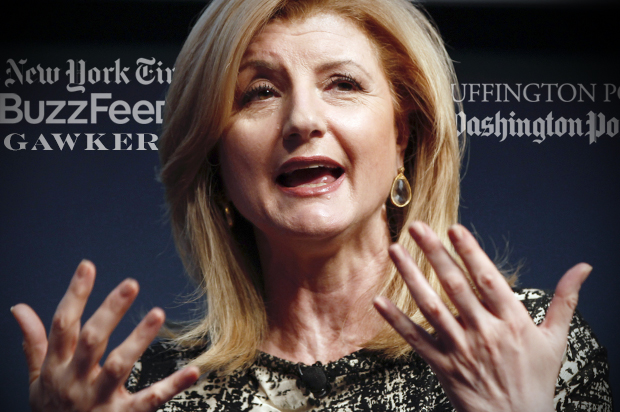
Arianna Huffington

Whitewashing the pope

The media's obsessive coverage of the pope's death does not include a discussion of the tragic failures of his reign.

  • more
    • All Share Services

Paint the last month black. It’s been an orgy of mourning, a cornucopia of death. We’ve had Terri Schiavo, Pope John Paul II, Prince Rainier, and Charles and Camilla’s wedding — which felt as grim as any funeral. All brought to us in no-longer-living color. If nothing else, the media have outed themselves as the ultimate necrophiliacs. I expect CNN and Forest Lawn to announce a sponsorship agreement any day now.

The pope’s interminable interment was the magenta-colored cherry on the death sundae. The TV coverage was so over-the-top and utterly uncritical, it was as if John Paul had been, well, the Second Coming of Jesus Christ. Or, at least, Jim Caviezel.

Now, I’m certainly not suggesting that the last week should have been spent trashing the late pontiff. His many achievements — taking on communism, embracing the Third World, speaking out for the poor, and standing up against war — surely deserved recognition and praise. But you’d think the wall-to-wall coverage would have included some serious discussion of the two tragic failures of his reign: his woeful mishandling of the church’s child-molestation scandal, and how his archaic position on condoms contributed to the deaths of millions of people, especially in Africa.

The molestation outrage is a black mark that can’t be whitewashed.

Over 11,000 children were sexually abused and close to $1 billion in settlement money has been paid out, but the pope did not go much beyond decrying “the sins of some of our brothers.” He never met with any victims, he never offered practical solutions to dealing with the problem, he never addressed the decades-long coverup of the abuse. He even rejected a “zero tolerance” policy calling for the immediate removal of molester priests, concerned that it was too harsh.

Too harsh?! This is a man who wouldn’t allow priests to become bishops unless they were unequivocally opposed to masturbation, premarital sex and condoms. So in his perverse pecking order, you had to be dead-set against “self-love,” but when it came to buggering little kids, there was some wiggle room.

And let’s not forget that the pope appointed Cardinal Bernard Law, who was one of the architects of the sex scandal coverup and who even faced potential criminal prosecution for his role in the concealment. But instead of making an example out of Law, the pope gave him a cushy sinecure in the Vatican. Adding insult to the grievous injury suffered by the abuse victims, Law was one of the nine cardinals specially chosen to preside over the pope’s funeral Masses. It is a disgrace — and an indication of how detached the Vatican became under this pope.

The other stain on the pope’s legacy is his tireless opposition to the use of condoms — even in places like Africa, where AIDS killed 2.3 million people last year alone, and where the disease has driven life expectancy below 40 years in many countries.

But even in the face of that kind of suffering, he fought tooth and nail against condoms. Anytime a church official even suggested that people infected with HIV should use condoms, they were either removed from office or censured by the Vatican. We were told again and again last week about how committed John Paul was to promoting a culture of life. I guess the 20 million people who have died from AIDS are the exception that proves the rule.

On the other hand, the pope’s passing might have saved the political skin of one of his “culture of life” cohorts, House Majority Leader Tom DeLay. If you have a series of looming ethics scandals about to come crashing down on your head, having the media focused 24/7 on something else is a very lucky break indeed. But, in the end, it’s going to take a huge celebrity dying every three days for the next few months to keep the Hammer from going down.

The presence of DeLay at the pope’s funeral in Rome, along with the attendance of George W. Bush, Laura Bush, Condoleezza Rice, Bill Clinton, Nancy Pelosi, and the elder Bush, was a stark reminder of our perverted priorities. The pope dies and it’s Must Holy See TV; 1,547 American soldiers die in Iraq and President Bush and Laura have yet to attend a single funeral. Not a single one. Maybe the president only goes to the funerals of people whose death he wasn’t involved in.

Boyz on the Hill

The Bush budget-cut gang is gunning for Medicaid and permanent tax cuts, while doing nothing to secure the nation's increasingly dangerous city streets.

  • more
    • All Share Services

Over the next week or so, House and Senate negotiators will try to hammer out the differences in their competing budgets. Among the major bones of contention: disagreements over how deeply to cut Medicaid; whether to make President Bush’s expiring first-term tax cuts permanent; and whether to go along with the president’s proposal to slash funding for a wide range of programs related to homeland security.

No, President Bush is not gutting the Department of Homeland Security. The problem is Bush’s definition of homeland security. Apparently, it doesn’t include things like the safety of our streets. Especially the streets of our inner cities, which have become war zones.

After plummeting during the 1990s, gang violence is making a bloody comeback all across America, with gang-related homicides up 50 percent since 1999. According to Justice Department estimates, there are about 21,500 gangs nationwide with over 730,000 members. And these gangs are no longer confined to Los Angeles and New York. Cities like Denver, Portland, Ore., Salt Lake City, and Tulsa, Okla., have all seen dramatic surges in gang-related criminal activity.

And how has our tough-on-security president responded? By proposing to cut close to a billion dollars from programs designed to help anti-gang efforts. His 2006 budget would cut more than $412 million from education, after-school and family-support programs that help keep at-risk kids away from gangs. It would eliminate Juvenile Accountability Block Grants ($54 million worth) designed to help prosecutors deal with gang issues. It would also reduce funding for the Community Oriented Policing Services (COPS) program by 95 percent, which could result in as many as 88,000 fewer police officers patrolling America’s mean streets. And these proposed cuts come on top of a 44 percent reduction in delinquency-fighting and anti-gang funding since 2002.

“The federal budget is more than mere numbers, it is an accounting of our country’s priorities,” says Seattle Chief of Police Gil Kerlikowske, chairman of Fight Crime: Invest in Kids, a bipartisan anti-crime organization of over 2,000 police chiefs, sheriffs, prosecutors and crime victims. “The president’s budget just doesn’t add up for children and instead makes the wrong choices on crime prevention.”

But wait, could this possibly be the same president who during his State of the Union address so preeningly patted himself on the back for his commitment to dealing with gang violence?

Of course. It’s the kind of political sleight of hand his presidency is built on. First, Bush earned P.R. points for earmarking $50 million a year for the next three years to a new, still-to-be-defined anti-gang initiative, then turned around and submitted a budget that cuts nearly 20 times that much from programs already proven effective in keeping young people out of gangs. Not exactly a fair tradeoff for America’s at-risk kids.

Oh, and here’s the kicker: The new initiative is to be overseen by first lady Laura Bush. I don’t know about you but the idea of Laura the Librarian bringing the Crips, the Bloods and MS-13 to their knees doesn’t exactly make me feel any safer.

The first lady’s new role as gang czar seems like another Mission to Mars in the making — a highly touted project long on potential photo ops and woefully short on specifics. Here’s what we do know about Mrs. Bush’s feel-good initiative: The program won’t be administered through the law enforcement professionals at the Justice Department. Instead, the limited dollars will be funneled through the president’s compassion fund and doled out to his favored faith-based groups. Who knows, maybe they’ll serve up the gang prevention entree with a side order of moral values. I can hear the ad campaign now: “Just Say No to Drive-Bys and Turf Wars. And Premarital Sex, While You’re at It.”

President Bush and his Republican buddies are quick to talk tough on issues of law and order and just as quick to cut the kinds of proven programs that help alleviate the social disorder that so often leads to criminal activity. There seems to be plenty of money for new cops to patrol the streets of Baghdad, but very little for those protecting America’s inner cities. Indeed, the $150 million Bush has pledged to spend on his national anti-violence proposal over the next three years is about what we’re spending in Iraq — every single day.

What is it going to take before the president gets serious about protecting America’s inner cities? Maybe community leaders can hire Ahmed Chalabi to tell the CIA that the Crips and the Bloods are looking to get their hands on some WMD. What’s a little faulty intel among homies? Hey, Porter Goss, I smell a Medal of Freedom.

Continue Reading Close

Starving for leadership

Democrats missed a golden opportunity to reclaim the "moral values" debate in the Terri Schiavo case.

  • more
    • All Share Services

This column is not about Terri Schiavo and the wrenching spectacle that has surrounded her tragic fate. May she rest in peace.

It is about congressional Democrats and how they once again pathetically misread what moral values mean in a political context. May they miraculously wake from their persistent vegetative state — or it won’t be long before they are receiving their political last rites.

Ever since November, Republicans (aided and abetted by a poorly worded exit poll) have not only succeeded in defining the last election as having been about moral values, they’ve succeeded in defining moral values. In the GOP’s extraordinarily abridged moral dictionary, fighting against gay marriage is morally valuable; fighting against 12 million children living in poverty is not.

Democrats, meanwhile, have been going through the most embarrassing public identity crisis since Anne Heche couldn’t decide if, when it came to the bedroom, she preferred surf or turf. They’ve been mastering the feeble arts of second-guessing themselves and ducking for cover.

While real political leadership is determining the direction the country needs to go and convincing the public to follow you down that road, Democrats keep choosing the path of least resistance. Party leaders have been sticking their fingers in the air, feeling which way the political wind is blowing, and then chasing after these zephyrs of public sentiment. Which is bad enough. But making matters much, much worse, they are consistently misreading the wind — an affliction that has led to their being blown away in three straight elections.

The Schiavo case is a perfect example. Before the cards had even been dealt, Senate Democrats decided that the Republicans already held all the aces. So instead of calling Dr. Frist’s bluff, they folded, sat out the hand, and headed into the kitchen to see what kind of sandwiches Felix was whipping up. Not a single Democratic senator formally objected to the pro forma voice vote that sent the Schiavo bill to the House, where, with a few notable exceptions — especially Rep. Barney Frank and rising star Rep. Debbie Wasserman Schultz of Florida — Democrats were nearly as compliant.

In an interesting twist, it turns out that Bill Clinton had a behind-the-scenes role in the party’s decision to adopt a hands-off policy on the Schiavo debate. According to CBS News, the former triangulator-in-chief helped sway Schiavo bill backer Tom Harkin, “egging him on” to roll over and play dead — an odious echo of his efforts to get John Kerry to come out in favor of all 11 state constitutional amendments banning gay marriage. This kind of strategic calculation may have been all right in the mid-’90s, but not today, when the party is in desperate need of bold, decisive leadership.

So the Democrats punted, Frist, DeLay and Bush got their photo ops, and the reptilian Randall Terry was born again as a media figure. Then the polls started pouring in — with each and every one showing that the vast majority of the American people thought the Republicans had wildly overreached, seeking a political advantage as opposed to acting out of concern for Terri Schiavo.

But the Democrats, having gone MIA, were unable to ride the tidal wave of public sentiment. Yet again. For years now, they have failed to grasp that when it comes to their core issues — including providing affordable healthcare, protecting the environment, safeguarding Social Security, gun control and basic abortion rights — they are on the same side of the fence as the majority of Americans.

Look, I understand why the Democratic powers that be didn’t want to be seen as fighting to end Terri Schiavo’s life. They’ve got enough problems without giving Karl Rove and his GOP image masters an executioner’s song to sing in 2006. And, if the decision were up to me, I would not have voted to pull the feeding tube. As a mother, I deeply empathize with the plight of Terri’s parents — and don’t see why, given their willingness to take over their daughter’s care, they shouldn’t be given that chance. But it wasn’t my decision to make — just as it wasn’t Congress’s.

And being steamrolled by the Republicans or dancing on Terri Schiavo’s grave were not the only two options open to Democrats. If they hadn’t been running around hiding from their own shadows, they would have easily found a larger moral frame in which to put the fight over Schiavo’s fate.

If the Republicans insist on making the “culture of life” a federal issue, the Democrats should, by all means, let them. But they need to make sure that the national debate doesn’t center on tragic anomalies like the Schiavo case but on the thousands of people whose lives are cut short because they lack access to decent healthcare or on the prolonged suffering of the millions of children living in poverty.

Instead of allowing themselves to be cowed by the fear of looking like they’re coming down on the immoral side of the moral values debate, Democrats should snap out of it and demand that the president interrupt his next vacation and that Bill Frist hold another midnight session of Congress to address the moral disgrace of 45 million people with no health insurance and 36 million people living in poverty — and, in doing so, reclaim the moral high ground.

Continue Reading Close

Paying the price for Bush’s retro energy policy

President Bush's energy policies are a throwback to the age of the dinosaurs.

  • more
    • All Share Services

The new sales pitch for President Bush is that he’s a forward-thinking visionary, right? His policies in the Middle East were, it turns out, not about the bloody debacle in Iraq today but about democracy spreading throughout the region in a glorious future. And his plan to fix Social Security is not at all about privatizing the jewel of the New Deal but simply about ensuring a safe and secure system well past 2052.

But when it comes to dealing with the many energy-related crises we’re facing, can the Bushies really go on pretending that their policies are any more forward-looking than a rerun of “That ’70s Show”?

Exhibit A is the president’s bizarre and long-standing obsession with drilling for oil in the Arctic National Wildlife Refuge, which just got Senate approval last week. I mean, how retro can you get? Instead of pushing to increase fuel-efficiency standards that could save millions of barrels of oil each day and calling for a national commitment to invest in renewable sources of energy, he’s after one more fix of dinosaur byproducts from one of the world’s last pristine places.

Which might be understandable if making an Exxon Mobil theme park out of the refuge would reduce our dependence on foreign oil. But it won’t. At best, there’s only enough oil there to satisfy U.S. demand for about six months. And it won’t be available for at least a decade — which is the only forward-looking aspect to Bush’s ANWR dream.

The consequences of Bush’s head-in-the-tundra policies are already all around us — starting with the record prices Americans are paying to gas up their cars. The national average just raced past $2.10 a gallon — up 21 percent from last year. The United States remains the world’s largest oil consumer, but with growing countries like China and India demanding more and more oil, and the world’s refineries already close to maxed out, things are only going to get worse. How long will it be before filling stations are asking, “Cash, Credit or Home Equity Loan?”

In response to this mounting economic calamity, President Bush summoned all his authority as the leader of the free world and, uh, well, sent an official complaint to OPEC ministers meeting in Iran. I’m sure it was very strongly worded. In any case, most experts agree that even OPEC can’t pump enough additional oil to make a long-term difference.

Meanwhile, the president’s old oil company pals are raking in record profits. Exxon Mobil, for instance, more than doubled its cash flow last year, ending 2004 with $23.1 billion in its bulging coffers. In fact, every time the price of a barrel of oil goes up a dollar, Exxon’s accountants chalk up another $550 million in after-tax profits. Indeed, the Wall Street Journal reported last week that oil companies are having a hard time figuring out what to do with all that cash.

The president’s outdated energy policies are also pushing us to the brink of an economic and ecological catastrophe brought about by global warming. Temperatures are climbing, sea levels are rising, Antarctica is thawing — and these are just the tip of the rapidly melting iceberg. The winter ice cap at the North Pole has shrunk 20 percent in the past two decades, and all that disappearing ice is going to reappear in the form of rising seas threatening coastal areas from New York to New Orleans.

Our MBA president’s energy plan is designed to coddle corporations, of course. But the most surprising aspect of the scheme is how bad it has been for business (non-oil business, that is). Oh, those unintended consequences.

Just look at the head-on collision at General Motors, which, along with the rest of the industry, has enjoyed one fuel-economy loophole after another. The company bet the farm on hulking gas guzzlers and engines whose basic designs date to the 1950s. Now, with gas prices heading through the sunroof, demand for SUVs has tumbled — and with it, GM’s fortunes. Despite rebates as high as $6,000, sales of models including the Hummer H2 have dropped by double digits. As a result, GM has taken a $4 billion cash-flow hit and laid off thousands of workers — yet losses are still expected to reach $850 million in the first quarter of 2005 alone.

At the same time, Toyota and Honda, companies that have shown a commitment to higher fuel efficiency and fuel-saving hybrid technology, are running away with Detroit’s market share. In true Neanderthal fashion, GM has responded to its troubles by redoubling its focus — and its multibillion-dollar advertising budget — on hawking the upcoming models of its SUVs. They just don’t get it — and for that they are paying a heavy price.

And our leaders in Washington — their pockets stuffed with oil, gas and auto-industry donations — have been willing accomplices in this financial fiasco. By keeping mileage standards for SUVs lower than for cars, allowing unconscionable fuel-efficiency loopholes that exempt monster trucks like the Hummer H2, and giving a special tax break allowing write-offs up to $100,000 on luxury SUVs, they helped create an artificial market for gas guzzlers — and helped lead GM to the corporate ICU.

Bush and company call themselves free marketers, but by indulging Detroit they’ve discouraged innovation and made it much easier for companies like GM to slowly destroy themselves — and their workers. It’s assisted suicide, Beltway-style.

Tom DeLay and Bill Frist should immediately call another midnight session of Congress to look into this. And someone needs to wake up President Bush before his habit of looking in the rearview mirror when it comes to energy policy leads us even further off the road to energy independence — and straight over a cliff.

Continue Reading Close

The Washington establishment fails Logic 101

Politicians and pundits who attribute changes in the Middle East to the American invasion are living in a fairy tale.

  • more
    • All Share Services

I just got back from a trip to the Happiest Place on Earth. Didn’t ride the teacups, though. Because I wasn’t in Disneyland but in Washington, D.C., where everyone is walking on air, swept away by the Beltway’s latest consensus: President Bush was right on Iraq, and as a result, Tomorrowland in the Middle East will feature an E-ticket ride on the Matterhorn of freedom and democracy.

The political and cultural establishment has gone positively Goofy over this notion. In the corridors of power, Republicans are high-fiving and Democrats are nodding in agreement and patting themselves on the back for how graciously they’ve been able to accept the fact that they were wrong. The groupthink in the nation’s capital would be the envy of Dear Leader Kim Jong Il.

Even heroes of mine like Jon Stewart and my buddy Bill Maher have hopped on the Bush bandwagon. “I’ve been supportive of President Bush,” Maher told Wolf Blitzer this week, “now that I think Iraq is turning around … He had a bigger and better idea than the rest of us.”

How did this cozy unanimity come to pass? Is it something in the water, a byproduct of Bush’s gutting the EPA? But then I thought back to my time at Cambridge, taking a course in elementary logic, studying the fallacy of the undistributed middle. For those of you in need of a refresher on the concept, here’s an example from the first chapter of my Logic 101 textbook: “All oaks are trees. All elms are trees. Therefore, all oaks are elms.” See how easily you can go from point A to point Z, jumping over all the important steps in between?

So: We invaded Iraq. Change is afoot in the Middle East. Therefore, the Middle East is changing because we invaded Iraq. QED. GWB.

See how simple it is? And how illogical? The Bush White House has been masterful at this infantile reasoning: America is free and democratic. Terrorists attacked America. Therefore, terrorists hate freedom and democracy. And that’s all anyone needs to know.

What makes this particularly seductive is the historical longing of Americans for political consensus. It’s no accident that the European idea of a loyal opposition never took hold here in the New World. Instead, Democrats are all too eager to suspend disbelief and go along with the fairy tale the president is telling about freedom and democracy on the march, and the happily-ever-after future of the Middle East.

But flip the page on this “once upon a time” fantasy, and what’s revealed is a very ugly war story — a bloody narrative we hear shockingly little about on our daily news. Maybe the four people Brian Nichols killed in Atlanta are more important than the tens of thousands killed in Iraq. Or maybe Bush’s fairy tales have inoculated us to the daily horrors of life over there. The dream is so wonderful that, in its name, we accept all sorts of nightmares.

In truth, I doubt the people of Iraq are going to bed with visions of Thomas Jefferson dancing in their heads. Not when their days are filled with random bombings and checkpoint shootings and kidnappings that have become commonplace. And six weeks after so many of them risked their lives to go to the ballot box, there is still no new Iraqi government in place.

What about the highly touted changes going on elsewhere in the Middle East?

The “Cedar Revolution” in Lebanon turned out to be only part of the story, as 500,000 pro-Syrian demonstrators took to the streets of Beirut last week to denounce U.S. involvement in their country. What’s more, the competing protests were ignited by the assassination of the anti-Syrian former Prime Minister Rafik Hariri, which wasn’t — as far as we know at least — the handiwork of George and Condi and Wolfie.

The local elections in Saudi Arabia were a start — but women weren’t allowed to vote and only half of the seats were up for grabs, with the rest appointed by the royal family. In the meantime, a new report from the State Department found that “the record of human rights abuses and violations in Saudi Arabia … still far exceeds the advances.”

In Egypt, President Mubarak’s promise to open future elections to competing parties hasn’t been accompanied by the lifting of the current repressive emergency laws that, among other things, ban all public demonstrations and allow citizens deemed a threat to national security to be held indefinitely without formal charges. Nor did it stop the recent arrest of Ayman Nur, a leading opposition figure in Egypt. So remind me: What exactly are we celebrating?

Much as I hate to rain on the president’s democracy parade, the fact remains: Holding an election is not the same thing as establishing a democracy. Just ask the people of Russia. Or Algeria. Or Haiti. Or Africa. Indeed there have been more than 50 elections in Africa over the past decade and a half — but the continent couldn’t be realistically described as a hotbed of political freedom.

The truth is the vast majority of Arabs remain skeptical of U.S. motives. So as long as the idea of democracy is equated with America — and promoted by America — it will be much harder for real democracy to take root in the Middle East. Especially when it is democracy accompanied by 150,000 U.S. troops.

And can we really blame the Arab world for its skepticism about the United States’ sudden commitment to freedom and democracy? After all, it wasn’t that long ago that Dick Cheney was opposing the release of Nelson Mandela in South Africa, Donald Rumsfeld was cutting deals with Saddam Hussein, and the CIA was overthrowing Mohammed Mossadegh, the democratically elected leader of Iran, and installing the shah. And President Bush continues to make nice with Mr. Putin, Gen. Musharraf and the House of Saud.

And let’s not forget that the great underpinning of the president’s devotion to spreading democracy throughout the world is his oft-stated belief that more freedom will lead to less terrorism — a belief for which he has offered little evidence. Mohammed Atta was exposed to all the freedom and openness America has to offer. So was Timothy McVeigh. That didn’t stop them from leading the two deadliest terrorist attacks on U.S. soil. Each was driven by a fanatical ideology, not by a hatred of freedom and democracy.

The most dangerous aspect of the president’s newfound dedication to freedom is that it completely ignores the fact that his aggressive push to liberate the people of Iraq has made us much less safe here at home. And this, more than anything else, is the highest priority of any government. Yet our ports, railways and borders remain porous. Our first responders remain underfunded. Our troops are stretched way too thin. And the war in Iraq has been both a breeding ground and a training ground for the next generation of Islamic terrorists.

But the White House continues to razzle-dazzle the Beltway with its command of the undistributed middle: The president invaded Iraq. There have been no terrorist attacks in America since 9/11. Therefore, the invasion of Iraq has made us safer. And lit the torch of freedom throughout the Arab world.

In any freshman course in logic, this reasoning would collapse, shot full of holes. In Washington, it’s become the conventional wisdom.

Continue Reading Close

The Senate’s moral bankruptcy

The pending bankruptcy bill reads like a wish list for the credit card industry -- and couldn't be nastier to the average American consumer.

  • more
    • All Share Services

U.S. senators are about to pass a bankruptcy bill so hostile to ordinary American families that it could only have come about in a place as corrupt, cynical and unmoored from reality as Washington, D.C.

In a normal world, those elected to represent the interests of the people would have fought for bankruptcy legislation that would, well, represent the interests of the people. But not in Beltway Bizarroland. Instead of cracking down on predatory lending practices, closing loopholes that favor the wealthy, and strengthening the safety net for working people, single mothers and elderly Americans struggling to recover from a financial setback, the Senate put together a nasty little bill that reads like a credit industry wish list. Rubbing salt in the wound, Sen. Charles Grassley, the bill’s chief sponsor, labeled it the Bankruptcy Abuse Prevention and Consumer Protection Act of 2005 — even though it does nothing to prevent bankruptcy abuse or protect consumers.

So what does the bill do? It makes it harder for average people to file for bankruptcy protection; it makes it easier for landlords to evict a bankrupt tenant; it endangers child-support payments by giving a wider array of creditors a shot at post-bankruptcy income; it allows millionaires to shield an unlimited amount of equity in homes and asset-protection trusts; it makes it more difficult for small businesses to reorganize while opening new loopholes for the Enrons of the world; it allows creditors to provide misleading information; and it does nothing to rein in lending abuses that frequently turn manageable debt into unmanageable crises. Even in failure, ordinary Americans do not get a level playing field.

Credit card companies have been feverishly lobbying for this legislation for nearly a decade — and it looks like the $34 million the finance and credit industries have contributed to political campaigns since 1996 is finally about to pay off. On Tuesday, the cloture vote on the bill was 69 to 31. The House passed similar legislation last year, and GOP leaders are hoping to bypass the conference committee deadlocks that have derailed similar measures in the past and to get the bill on President Bush’s desk in short order. The president, well aware that credit card giant MBNA is one of the Republican Party’s largest donors, has promised to sign the bill as soon as someone hands him a pen.

Make no mistake, the inequitable nature of the bill — bending over backward to help the credit card industry while sticking it to American working people who fall on hard times — is no accident. Time and again over the last week, the Senate shot down amendments that would have made the bill a bit less mean-spirited. They denied proposals that would have made it easier for military veterans, the sick and the elderly to qualify for bankruptcy protection. They even rejected an amendment that would have put a 30 percent ceiling on the interest rates credit card companies can charge. Thirty percent — that’s more than Paulie Walnuts charges. But 74 U.S. senators — including John Kerry, Harry Reid, Barack Obama and Dick Durbin — clearly thought that wasn’t high enough. Quick, somebody send those guys a Bible bookmarked to Deuteronomy 23:19: “Thou shalt not lend upon usury to thy brother.”

For years, credit card companies have been claiming that tougher laws are needed to rein in high-flying customers using bankruptcy to game the system. But the truth is that the vast majority of people who file for bankruptcy are middle-class folks who can’t pay their bills because they’ve lost their jobs or been hit with high medical bills or gone through a divorce.

Indeed, a recent study by Harvard University found that half of last year’s 1.6 million bankruptcies were the result of crushing medical bills. Put another way: Every 30 seconds, someone in this country files for bankruptcy in the wake of a serious illness. How’s that for a shocking stat? Here’s another: Three-quarters of the so-called medically bankrupt had health insurance. It just wasn’t enough to cover the dramatic rise in healthcare costs.

But instead of adapting to this harsh new reality, where hard-working, college-educated, middle-class folks can be financially destroyed by a sudden illness, the Senate is about to approve a one-size-fits-all law that treats a family man who has sunk into debt because of a heart attack the same as a con artist who maxes out his MasterCard, then refuses to pay up.

Worst of all, the bill does absolutely nothing to protect consumers from the aggressive tactics credit card companies have devised in recent years — tactics that have proven hugely profitable. Along with sending out over 5 billion solicitations a year, they are constantly developing new ways to stick it to the people they’ve already lured into the tent. For instance, companies now routinely jack up a cardholder’s interest rate when their payment is late — and, presto, a “fixed” 7 percent APR is suddenly transformed into a cash-gobbling 30 percent loan.

There has also been an explosion in the fees that credit card companies charge: late fees, balance transfer fees, cash-advance fees, over-the-limit fees. Such fees bring in billions and are partly responsible for the fact that, even as personal bankruptcies in America have steadily increased, so have the profits of credit card companies — which reached a whopping $30 billion last year.

So tell me again: Just who is gaming the system?

It’s one thing for credit card companies to exact their pound of flesh even as their profits soar. But shouldn’t we hold our elected officials to a higher standard? The bankruptcy bill is morally bankrupt. And so is any senator who votes for it.

Continue Reading Close

Page 2 of 44 in Arianna Huffington