It’s become a familiar story: poor working stiff is unhappy with life in cubicle. Poor working stiff has an epiphany. Poor working stiff can’t take it anymore, quits his job, finally opens that adorable chicken-and-pie shop and takes the world by storm. It’s got all the elements to seize our imaginations — a quixotic dream, a rebellion against The Man, and a happy ending: a tangible, delicious product that is as different from an Excel spreadsheet as could be.
How did Mr. Stiff do it? For most of the 20th century, corporate drones wanting to jump ship have had a pretty reliable road map to culinary glory: You started at the bottom, maybe as a dishwasher somewhere, and worked your way up to line cook, to sous chef, to positions at steadily fancier and more expensive restaurants. Or, you enrolled in cooking school. Either route helped you build up the broad, deep culinary repertoire you need.
But the rules are changing.
Culinary credentials, or even experience, are no longer a prerequisite for success in the culinary world. More and more of these dissatisfied professionals are skipping the usual steps and reaping quick rewards. In just a couple of years since he quit his job in financial services, Luke Holden has opened three branches of his popular lobster roll shack, Luke’s Lobster. Ex-lawyers driving cupcake trucks have popped up in New York, Philadelphia and Washington, D.C. (There’s also a Butch Bakery owned by a proudly self-identified “former asset backed securities attorney for a major Wall Street law firm,” that specializes in “bringing a totally unprecedented culinary product to market” — the “manly” cupcake.) The Peached Tortilla in Austin, Texas, is run by yet another disillusioned lawyer. The list goes on and on.
Aside from their white-collar roots, these operations have something else in common — a very simple, savvy business model: develop a relatively low-maintenance product, sell it for a reasonable price, and devote the rest of your energy to aggressive, compelling marketing.
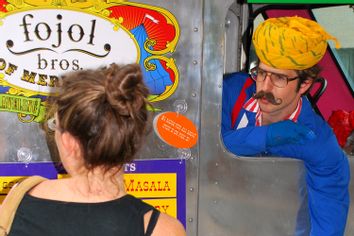
The Fojol Brothers, a food truck in D.C., for example, push their marketing straight into the surreal. The brothers include Justin Vitarello, who previously worked in e-commerce, and Peter Korbel, a former financial analyst, but in their truck, they play colorful, turbaned performers of a “traveling culinary carnival” from the mythical land of Merlindia. In an interview, Vitarello briefly abandoned the shtick to explain, “Our concept involves smells and colors and music and taste.” The Fojol Brothers are selling their costumes, their fantasy, their brand. Their menu — relatively simple, Indian-inspired dishes — might be good, but who cares? They wear fake mustaches and turbans, they play Radiohead during lunch hours. The food is a byproduct of the story.
And, as always, the TV execs have their noses to the wind. A new competition reality show, “America’s Next Great Restaurant,” centers around this business model. Essentially, whoever has the most marketable “fast casual” concept will win an investment from the judges to launch his or her chain. In the Top Ten, we’ve got upscale grilled cheese, meatballs, taco varieties and something called “the sports wrap.” Almost all of the contestants are transitioning from other white-collar fields: financial services, marketing companies and law firms, etc.
The existence of such a contest would have been unheard of just a few decades ago, when being a chef held no cachet and was considered a working-class profession. But Gary Alan Fine, sociology professor at Northwestern University and author of “Kitchens: The Culture of Restaurant Work,” explains that the modern food industry has been trending this way for a long time. Since the mid-1980s, we’ve been gradually privileging marketing concept over menu until the conditions became just right for these entrepreneurs to flourish.
First, there was the rise of the celebrity chef. “Fine dining became more accessible, more democratic,” Fine said. “By the 1980s, it was certainly much more common for people to go out and eat at restaurants that had culinary pretensions, just as they explored art and music and theater. Food became cultural capital. As part of this you began to develop the idea of these celebrity chefs.”
Starting with Wolfgang Puck (“he really made himself into a brand,” according to Fine), chefs began to be aware of and cultivate their own images along with their cuisine. Chefs like Bobby Flay and Emeril Lagasse developed restaurant empires under the umbrella of their celebrity. And just like that, a new model was born — not just for becoming a celebrity, but for simply making a living as a chef. In order to be competitive in the industry, self-marketing became just as important as quality of food and ambience. Aspiring chefs started hiring P.R. firms and making the Food Network rounds. They created personas that diners could recognize and respond to.
As a result, the restaurant world has shifted from primarily independent restaurants to more and more branded — and financially stable — collections and chains. These collections take on the characteristics of any other large corporation. And this new order changes the role of the chef. “So it’s not a chef-owner situation anymore,” Fine explained. “The chef is an employee, a manager, for a corporation.” And the actual cooking part can become secondary.
Enter the disillusioned lawyer. “If you’re a lawyer or businessperson you are likely to have the social capital and financial capital to switch professions,” Fine pointed out.
In this landscape, financial capital and marketing experience are survival skills; the ability to julienne a carrot perfectly, not so much. You don’t need culinary credentials to start a cupcake truck, and a cupcake truck, with the right paint scheme and Twittercisms, can now be enormously, quickly profitable — much more so than starting as a line cook fresh out of culinary school.
Effective marketing is just one of the business sensibilities held over from these entrepreneurs’ past corporate lives. According to the Wall Street Journal, 32 New York food trucks recently started a trade group and hired a lobbyist to try to change laws that govern mobile food vending. Street food vendors have most often been immigrants on the fringes of the system, and issues with licensing and parking spots have historically been dealt with outside of the system, through turf wars and under-the-radar negotiations. Now, these same issues have been transplanted off the streets into the conference room. The head of the trade group, Rickshaw Dumpling Truck co-owner David Weber, should be comfortable there; he holds an MBA from NYU’s Stern Business School and has several years of business consulting experience.
Given the growing domination of the corporate model at the top of the restaurant industry, it might seem like the guys in food trucks at the bottom are the plucky rebels of the food industry. After all, they’re not going through the traditional routes. They’re young, they’re living the dream, and they’re out there on the streets every day. But consciously or unconsciously, they’re bringing with them knowledge of the same rules that rule success at the top. These business-savvy career changers have been trained to understand the importance of branding. And the conditions of today’s food world — more food fans than ever, always hungry for the next new thing — make it easier than ever to succeed on brand alone. These guys recognize that we want the packaging just as much as, if not more than, the food itself. And so they’re going to give it to us, bells and whistles carefully tailored and strategically attached. There’s room for innovation in that, but it seems that food has very little to do with it.
The Food and Drug Administration will hear a panel today to examine a possible link between artificial food coloring and hyperactivity in children. Though no one actually expects the FDA to ban the dyes, the panel provides a great opportunity for reporters to dig up hand-wringing parents … and strike fear into the hearts of many more.
According to the New York Times, the petitioner, the Center for Science in the Public Interest, is seeking either an outright ban or, at the very least, a prominent warning label. European companies have had to put warning labels on artificially colored products for years, and many have switched to natural dyes, such as from beets. Should the U.S. follow suit?
The dye debate has been raging since the 1970s, with very little conclusive evidence to settle for either side once and for all. The FDA previously stated that there was no reason to fear the dyes, but since the use of artificial coloring has skyrocketed in recent years, scientists have been examining this claim, with little success. The most convincing evidence comes from a 2007 study headed by University of Southampton professor Jim Stevenson. In the study, children were fed a daily fruit juice containing different concentrations of dyes and the preservative sodium benzoate, and noted a small effect on behavior. It isn’t clear whether the dyes, the preservative or the combination caused the effect.
Basically, scientists don’t know what the cause of hyperactivity is, but children are still going cuckoo. FDA scientists released a report speculating that while many children are probably not adversely affected, those already with conditions like attention-deficit hyperactivity disorder (ADHD) may have their behavior problems exacerbated. In all probability, the two-day panel will conclude that it needs more research to reach any conclusions.
It’s tempting, of course, to try to finger a culprit for a disorder that affects a large number of children, even if the science doesn’t support it. Faced with uncomfortable ambiguity, the Times found a concerned mother to weigh in on the debate:
Renee Shutters, a mother of two from Jamestown, N.Y., said in a telephone interview on Tuesday that two years ago, her son Trenton, then 5, was having serious behavioral problems at school until she eliminated artificial food colorings from his diet. “I know for sure I found the root cause of this one because you can turn it on and off like a switch,” Ms. Shutters said.
NPR’s “Morning Edition,” meanwhile, found its own worried mother of a hyperactive child to refute the claim. After her daughter used blankets to slide down the stairs, Christine Woodman adopted a familiar mantra:
“What is natural is good; what isn’t natural was bad,” she remembers.
On the advice of friends, Christine decided to start by cutting out foods with artificial coloring, but Dawnielle didn’t really go for it. She missed her favorite oatmeal with little red-colored dinosaurs in it. Christine tried a substitute. “You know, I made the oatmeal with blueberries and soymilk and thought you would be happy with it,” she says to Dawnielle.
For Dawnielle, however, the problem was only solved once she was diagnosed by a doctor and given Ritalin.
So, despite the media’s best efforts, even the anecdotal evidence is inconclusive.
However, this doesn’t mean that we should ignore the dye debate entirely. As the director of the Center for Science in the Public Interest, Michael Jacobson, pointed out, regardless of the health risks of the dyes themselves, they exist primarily to lure children to junk foods saturated with sugar — a substance known to stimulate hyperactivity in pretty much everyone:
“Dyes are often used to make junk food more attractive to young children, or to simulate the presence of a healthful fruit or other natural ingredient,” Jacobson said. “Dyes would not be missed in the food supply except by the dye manufacturers.”
Even so, the dyes alone are not the main attraction. Sure, kids might enjoy the rainbow hue of Lucky Charms cereal, but we all know they’re really in it for the marshmallows, no matter what color they are. Ultimately, artificial dyes are the media’s hot new distraction from the real target. Eliminate dyes, and you’re still left with highly processed, sugary foods that pretty clearly increase your child’s hyperactive behavior. They’ll just be a little less colorful.
Continue Reading
Close
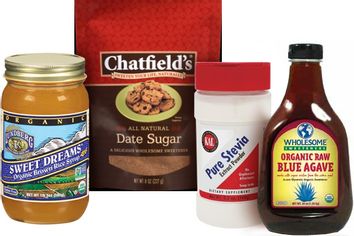
Now that the artificial sweetener aspartame (Nutrasweet) has attracted suspicion, you might be thinking twice about that daily Diet Coke or Splenda (sucralose) in your coffee. Not that this is surprising; even without the stroke and cancer warnings, the word “artificial” alone conjures up images of shadowy figures in lab coats concocting solutions destined for your stomach. Much more reassuring are images of freshly plowed farms tucked in the mountains, like the one on the jar of Lundberg Family Farms’ organic brown rice syrup.
Brown rice syrup is just one of many “natural” sweeteners that have taken off in the wake of the backlash against artificial sweeteners like aspartame and sucralose, which, of course, were invented to defeat the dietary axis of evil — refined white sugar and high fructose corn syrup. Once confined to Berkeley communes, these not-refined-sugar, not-man-made substances pose a huge marketing opportunity, since most people who avoid sugar don’t want to get cancer but also aren’t ready to commit to a joyless, dessert-free existence. Natural sweeteners are the perfect answer to this conundrum. Right?
The biggest problem is that the term “natural” is a slippery one. Unlike with organic foods, there are no official standards in the U.S. to determine a natural versus unnatural food. Essentially, it’s a word that promises a lot — those wholesome fields — but can mean nothing.
The potency of that promise depends on the leap people make from “natural” to “healthy.” But because the popularity of alternative sweeteners is relatively new, there’s no definite consensus on their long-term risks and benefits. Plus, there’s no telling what unholy quantities Americans will consume of a sweetener with no yet-known health consequences whatsoever.
Then there’s the issue that sugar, in all its caloric and cholesterol-boosting splendor, is just so damn delicious. For one thing, sugar is more than just a sweetener; in baking, it’s a structuring agent that resists lumping and introduces air into batter as it creams, creating a fluffy and even texture. It also caramelizes when heated, developing a flavor much more complex than mere sweetness. How can you beat that? For people with diabetes or sugar allergies, natural non-sugar sweeteners can be a godsend. But those seeking a consequence-free sugar fix, beware: not all sweeteners are created equal. We took a standard sugar cookie recipe — flour, eggs, vanilla extract, butter — and subbed in a different sweetener for each batch to find out what works, what doesn’t, and what actually tastes good.
Agave syrup
The facts: Beloved by raw food enthusiasts, agave syrup has become one of the easiest alternative sweeteners to find in grocery stores. It’s derived from the Mexican succulent plant agave, of which there are several varieties. It has to be processed to become sweet, and depending on that process, it can be comparable in composition to the dreaded high fructose corn syrup. True, agave has a low glycemic index — meaning it releases glucose into the blood stream at a slower rate than refined sugar — so it can help keep blood sugar levels stable. Eating agave as a “healthy” alternative to sugar, however, is pointless; the two have the same number of calories, no nutritional value whatsoever, and, even though it doesn’t spike blood sugar, the primary sugar in agave, fructose, has been linked to cancer and cholesterol problems when consumed in large quantities.
The experience: Agave syrup is very similar to honey or maple syrup in terms of consistency, though it has a distinctly deeper, cleaner sweetness than either, without as assertive a flavor. Subbing agave for sugar is relatively simple; because it’s sweeter than sugar, a cup of sugar should be replaced by ¾ cup of agave syrup. Don’t expect an identical product, though — our crack team of Salon taste-testers noted that cookies made with agave syrup became “densely chewy” and “raisin-like” in taste, with a “nice complexity.”
Brown rice syrup
The facts: Brown rice syrup is what happens when cooked brown rice meets barley malt enzymes. The sweetness comes from starchy complex carbohydrates, which take a couple of hours to digest. As a result, the glucose is released gradually into the bloodstream, providing a steady supply of energy rather than the rush — and crash — of cane sugar. Plus, the syrup maintains some of the nutrients in brown rice, like protein, so it’s not a total nutritional bust like most sweeteners are.
The experience: Although nutritionally, brown rice syrup is the best you could hope for, it certainly doesn’t taste like table sugar. Maltose (the kind of sugar in brown rice syrup) is not as sweet as sucrose, so you’ll need about 1¼ cups of syrup to replace a cup of sugar. By itself, brown rice syrup is similar to butterscotch in taste and consistency. Baking it into cookies, though, resulted in an “unpleasantly gummy” texture, and made one tester feel “like I just woke up from a nightmare where I was stuck in a San Francisco commune in 1971, only to find out that it wasn’t a dream.” The mild butterscotch taste has potential, though, and could work well as a complementary flavor in bread or a savory dish.
Stevia
The facts: Stevia’s not technically a sugar; it’s extracted from a sweet herb of the same name. Therefore it has no calories and doesn’t raise blood sugar. Though the FDA labeled it a “dangerous food additive” in 1991 after an “anonymous industry complaint” (read: shadowy figures in lab coats), stevia is now back on the market as a “dietary supplement.” In the rest of the world, particularly Japan, widespread use of stevia has been going on for decades.
The experience: The biggest drawback of this seemingly perfect sweetener is that it has an “odd chemical aftertaste” that is not weakened in the baking process; one tester described the aftertaste of the cookie as “psychological torture.” It’s a pleasant, pure sweetness at first that just keeps on going … and going … and going, long after you are ready for the taste to end. If you can get used to that, you only need a teaspoon of the powder to replace a cup of sugar. Keep in mind, though, that sugar is more than just a flavoring; take away its structural properties from a recipe and you’re left with one crumbly cookie. To adjust, we added in more butter, resulting in a shortbread-like consistency.
Date sugar
The facts: Date sugar is so low-tech it’s kind of funny — it’s just dehydrated dates that have been ground into a powder. That means it’s completely unprocessed and retains all the nutrients in dates. It’s high in fiber and protein, and has lots of vitamins and minerals like iron and potassium. Plus, it qualifies as a raw food. It still contains sucrose, fructose and glucose, so it’s not a good alternative for diabetics or people looking to control their blood sugar.
The experience: Date sugar seems to be the Salon staff’s favorite sweetener of the bunch. It has a very subtle sweetness that evoked almonds for one tester. Another described it as “nutty, not super sweet.” The cookie’s texture turned out to be “very crumbly” and “chalky” but not unpleasant. Date sugar’s not soluble, so don’t try to put it in tea or coffee. It is, however, simultaneously delicious and nutritious, which is no small feat.
Continue Reading
Close
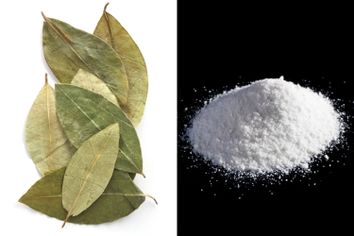
Walk into a supermarket in Bolivia and witness the unfolding of what might have been the world’s next big food fad. The aisles are lined with boxes of cereals, cookies, candies, granola bars, soft drinks and even flour tinged the earthy green color of the exalted coca leaf. One dubiously neon-lime liquor, Agwa de Bolivia, advertises “a coca leaf way of life.” A new soft drink, Coca Brynco, was launched with government support on Jan. 18. Touting extraordinary health benefits, including both energy-boosting and appetite-suppressing properties, these sweet, nutty-tasting coca products are burning hot in South America. Coca is even making inroads in fine dining; South America’s most famous chef, Peruvian Gaston Acurio, uses the leaf to season meat and shellfish, and to make Andean-style cocktails. But, unfortunately, without a plane ticket, you probably won’t be enjoying one of his coca sours any time soon. Outside of the Andes, coca isn’t really known for its culinary and medicinal uses. It’s mostly known as the raw source of cocaine.
This association is the reason why Bolivia’s campaign to end the U.N. narcotics ban of the coca leaf will fail today. The ban, which began in 1961, lumps the leaf — and all products made with it — in with the powder, and called for the elimination of all forms of coca consumption. The United States, as the largest consumer of cocaine and home of the “War on Drugs,” leads the opposition (Britain and Sweden have also filed objections), and its argument against the leaf basically boils down to “mo’ coca, mo’ cocaine.”
But coca has been used as a food and medicine in Andean culture far longer than crack has ravaged American cities, far longer than lines on a counter were a party favor. Since before Incan times, Andean tribes have chewed or brewed the leaf into teas, extracting a mild stimulant entirely unlike the über-concentrated crazy-making stuff in cocaine. (The effect is comparable to a weak cup of coffee.) Coca is packed with nutrients and aids in oxygen absorption, which makes it particularly important to the Andean people who live at high altitude, and its use and consumption has become a powerful marker of cultural pride among indigenous people. It is why Bolivian President Evo Morales, the first indigenous Bolivian elected to that office, has made it his pet project to repair the little green leaf’s reputation, starting with amending the U.N. ban.
Still, the U.S. just isn’t having it — after all, we’ve spent the past several decades and a lot of taxpayer dollars bulldozing, burning and spraying coca crops with herbicide from planes. However, with Morales’ encouragement, a local array of coca food products has exploded to provide a legal market for coca farmers. Coca has always been a dominant crop in the Andes, and many farmers had no other options but to sell their products to cocaine manufacturers.
Of course, coca leaves have attracted curiosity outside the Andes before. A 19th century French chemist created a precursor to Four Loko, called Vin Mariani, out of Bordeaux wine and coca leaves. It was so popular that an American company developed its own non-alcoholic coca drink, which you may have heard of: Coca-Cola. Incidentally, Coca-Cola is the only coca product in the world that may be exported overseas (the cocaine component is removed first). For the most part, though, the Western reaction to coca use has been negative, ever since the Europeans first penetrated the Andes and railed against the “pagan” practice. In fact, the 1961 ban is largely based on an unsubstantiated 1949 report claiming that coca made the natives lazy and drove up poverty levels.
This history lends a sense of urgency to the development and marketing of this new slew of coca products. On Friday, indigenous activists organized a mass protest of the U.S. opposition, with thousands of Bolivians gathering to chew coca outside the U.S. embassy in La Paz and throughout the country. For them, legalization is but a long overdue recognition of the value of indigenous culture.
And then there’s the economic development of the Andes. Of course, in America, where little-known “exotic superfoods” like açai and goji can suddenly become enormously popular, “valuing indigenous culture” is often just fancy talk for a marketing opportunity. Retailers have successfully sold us on products like agave nectar with lovely narratives of pristine streams, muggy rain forests, mysterious ancient origins and so on. We seem to respond to these stories, believing in the exotic, “natural” authority of the natives. Maybe we can chalk up this reaction to Western guilt, or maybe we are genuinely excited to be exposed to another culinary culture. Either way, coca’s history is certainly long and rich enough to capture the imagination.
Why shouldn’t coca farmers be able to capitalize on the romantic ideas of post-colonial, fair-trading Westerners like everyone else seems to be doing? It’s not hard to imagine a Whole Foods display of the goods already on the market in Bolivia. Forget those pop-up ads touting the shocking truth about açai or the rare African weight-loss fruit: “Meet the energizing wonder-leaf, the ancient secret of the Andes, full of all-important B vitamins! Don’t guzzle Coke, grab a Coca!”
Continue Reading
Close